Some libraries in Korea are worth visiting even when reading is not your main plan. They can become quiet travel stops, architectural discoveries, public resting places, and small windows into local life.
When people plan a trip to Korea, they usually search for restaurants, cafés, hotels, markets, temples, palaces, or scenic walking routes.
I do that too.
But I also search for libraries.
Not every library is worth changing a travel route for. Korea has many small local libraries, and some are mainly useful for nearby residents. Still, once in a while, a library becomes more than a place to borrow books. It becomes a quiet public space, a piece of architecture, a walking destination, or a small discovery that makes a trip feel more personal.
This is not a ranking of the most beautiful libraries in Korea. It is a personal selection of libraries that feel connected to architecture, seasons, local memory, nature, or slow travel.
Some of these libraries I have visited. Some I have visited more than once. Some are still saved on my personal list because I want to visit them one day.
The reason I keep looking for libraries is simple. A library does not ask me to buy coffee, order a meal, or spend money just to sit down. It is open to many people. It allows a traveller to rest, look around, read a few pages, listen to the atmosphere, or simply pause between plans.
Sometimes that is exactly what a trip needs.
Why Libraries in Korea Can Be Quiet Travel Stops
I have heard people say, “Who goes to libraries these days?”
I understand the question. Many people no longer go to a library simply to borrow books. We can read on phones, order books online, listen to audiobooks, or find information instantly.
Still, when I travel in Korea or abroad, I often check whether there is a library near my accommodation.
It is not always the main reason I choose a hotel. But when two places feel similar, a nearby library sometimes becomes one more filter. If I have time in the morning or evening, I may walk there. If the weather is not good, I may sit inside for a while. If my schedule has an awkward gap, I may bring my own book and read a few pages.
Sometimes I do not read at all.
I simply look at what kind of books the library keeps, how the building is used, and how local people spend time there.
There are times when I book a place near a library and still fail to visit it. Travel plans do not always go as expected. But I like knowing that such a place exists nearby.
A restaurant or café usually requires a reason to enter. You order something, sit for a while, and leave. A library feels different. It can be a public shelter, a walking destination, and a quiet cultural space at the same time.
For travellers, that can be surprisingly valuable.
Cheongun Literature Library: A Hanok Library Hidden in Seoul
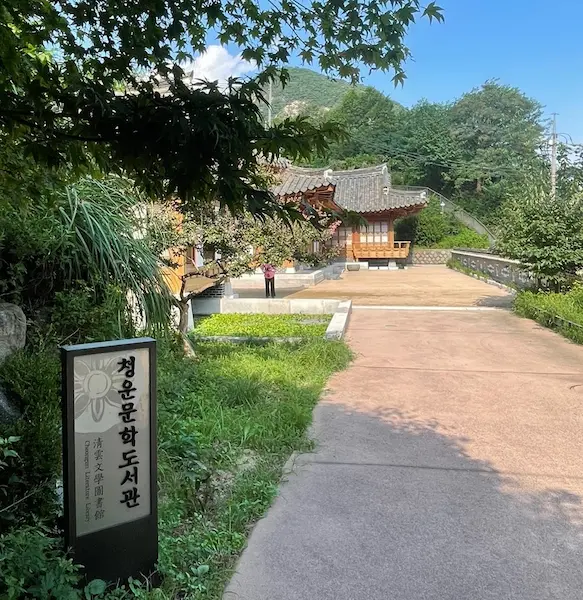
Cheongun Literature Library is one of the libraries in Seoul that I return to almost every season.
When I first learned about it, I remember feeling surprised that such a place existed in the middle of Seoul. I started the car almost immediately. Parking was not easy, so I parked farther away and walked up with the slightly exaggerated feeling that I was going on a small hike.
On the way, I kept wondering, “Is this really the right place?”
Then the library appeared.
It was hard to believe I was still in Seoul. The space felt quiet, old-fashioned in the best way, and surrounded by nature. It was not the size of the library that impressed me. It was the feeling of arriving somewhere unexpected.
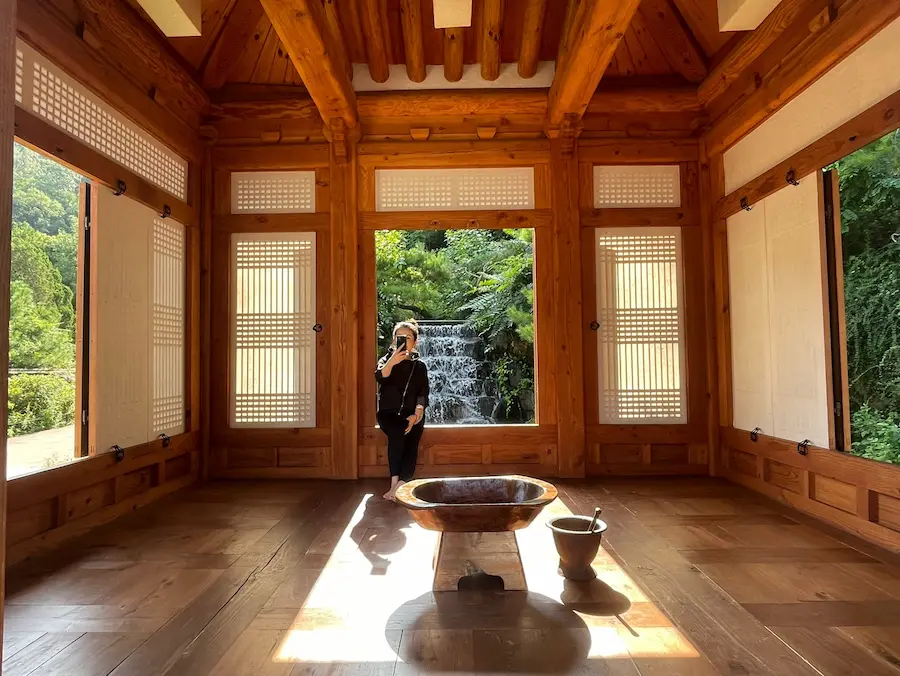
Cheongun Literature Library is a hanok-style public library in Jongno, Seoul. Its location near Inwangsan Mountain gives it a calmer atmosphere than many urban libraries. The wooden structure, tiled roof, small pond, stone paths, and surrounding greenery make the library feel closer to a place for reflection than a typical reading room.
I do not always go there to read. Sometimes visiting the place itself is enough.
When I have plans with a friend nearby, or when a friend says they need a short drive or a quiet walk, I often suggest this library. It is one of the few places in Seoul where a simple visit can feel like a small trip.
Spring, summer, autumn, and winter each change the atmosphere. That is why I try to visit at least once each season.
For a traveller, Cheongun Literature Library may not be the easiest place to reach on foot compared with major tourist sites. But for someone who wants to see a quieter side of Seoul, it is worth remembering.
National Library of Korea, Sejong: Architecture Beside the Lake
The National Library of Korea, Sejong was an accidental discovery for me.
I had a golf appointment nearby with an early morning tee time, so I went down the day before and stayed overnight. While passing through the area, I saw the building and was surprised to learn that it was a library.
The architecture immediately stands out. The building looks as if it is shaped by the movement of a book or a page. It does not look like a quiet background building. It announces itself.
The National Library of Korea, Sejong is located near Sejong Lake Park and is often noticed for its distinctive book-inspired architectural form. Because of that location, it can naturally become part of a morning or evening walk.
If someone is staying nearby for work, golf, a family visit, or a short trip, this is the kind of place that can be added without turning the schedule upside down.
I would not tell every traveller to make a special long trip only for this library. But if you are already near Sejong, it is worth walking around, looking at the architecture, and connecting it with the lake park.
Sometimes a library is not just a reading space. It is a landmark that tells you something about the city around it.
Sejong is a planned administrative city, and this library fits that atmosphere. It feels modern, open, and symbolic in a way that smaller neighbourhood libraries do not.
Achasan Forest Library: A Seoul Library Surrounded by Nature
Achasan Forest Library is another place where I found myself thinking, “Is this really Seoul?”
It is not a library I would visit only because I needed a book. I would recommend approaching it more like a park walk. If you are staying nearby, visiting Achasan, or exploring the eastern side of Seoul, this library can become a pleasant stop along the way.
Achasan Forest Library belongs to the Gwangjin-gu public library system and works best when connected with a walk around Achasan and the nearby park.
The area around the library gives a strong seasonal feeling. The park in front of it is good for noticing small changes in weather, trees, light, and air. Depending on where you stand, you can also catch a gentle view over parts of the city.
That contrast is what makes the place memorable.
You are still inside Seoul, but the mood changes. The rhythm slows down. The buildings feel farther away. The library becomes part of a short local journey rather than a destination that needs a strict itinerary.
For travellers who only stay around central Seoul, this may not be the most efficient place to visit. But for those who want to see how Seoul can suddenly open into forest, slopes, neighbourhood paths, and quiet public spaces, Achasan Forest Library is worth saving.
It is best understood not as a famous landmark, but as a calm discovery.
Uijeongbu Art Library: A Public Library for Art Lovers
Uijeongbu Art Library is still on my personal list. I have not visited it yet.
But I keep saving it because the idea of an art-specialised public library feels attractive. Even before going, I would recommend checking the collection and seeing what kind of art books, exhibitions, and visual materials are available.
Uijeongbu Art Library is widely introduced as an art-specialised public library, which makes it different from ordinary local reading rooms.
Some libraries are meaningful because of their location. Some are meaningful because of their architecture. Uijeongbu Art Library seems to have both, with the additional identity of being focused on art.
Based on official information and saved travel notes, the building appears spacious and visually memorable. It seems to be the kind of place where architecture, books, and the surrounding environment work together.
This library may work best if your travel route already includes northern Seoul, Uijeongbu, or nearby cultural spaces.
You do not need to be an art expert to enjoy an art library. Sometimes it is enough to browse titles, look at the way books are arranged, and feel how a public library can also act like a cultural gallery.
This is one of the libraries I still want to visit in person.
Jeonju Ajung Lake Library: A Music Library by the Water
Jeonju Ajung Lake Library is another library I have saved but have not yet visited.
The reason is simple: it is a music-specialised library by a lake.
Even imagining the visit makes me feel good. What would it feel like to sit inside a library, look out toward the lake, and listen to music I like? Would the music feel different because of the water outside? Would the view make the time pass more slowly?
Jeonju Ajung Lake Library is a music-specialised library near Ajung Lake, making it suitable for travellers who want a slower stop outside the city’s most crowded tourist areas.
Jeonju is already a city many travellers visit for hanok, food, history, and walking. But sometimes the most memorable part of a trip is not the most famous place. It can be a quiet hour between plans.
That is why I think Ajung Lake Library could be a good addition to a Jeonju itinerary.
A traveller may go to Jeonju for the Hanok Village, local food, or a weekend trip. But if there is a little extra time, visiting a lake library focused on music could become a softer memory of the city.
This is not a place I would describe as a mandatory stop for every visitor. It is better understood as the kind of place that can make a trip feel more personal.
Gochang Hwang Yun-seok Library: A Library Saved for a Future Trip
Gochang Hwang Yun-seok Library is also on my saved list.
It is far from Seoul, so visiting is not easy. That may be one reason I have not gone yet. But distance can also make a place feel more meaningful when the route finally makes sense.
What attracts me is not only the idea of a library, but the story behind the space. A library connected to a local historical figure, designed as a contemporary architectural space, can become more than a functional building. It can become a reason to think about how a region remembers a person.
Gochang Hwang Yun-seok Library is connected to the memory of Hwang Yun-seok, a historical scholar from the region. The library is also known for its architecture, which is one reason it feels meaningful beyond its function as a public library.
For someone travelling near Gochang, this may be worth adding to the route. If you have already gone that far from Seoul, it may feel more meaningful to visit a place that carries local memory rather than only passing through the famous attractions.
I would not recommend making a long trip only because a building looks good in photos. But beautiful architecture can be a valid reason to travel. Sometimes seeing a building in person tells you more than a description can.
Gochang Hwang Yun-seok Library is one of those places I still want to experience directly.
How to Visit Korean Libraries Respectfully as a Traveller
If you want to add libraries to a Korea travel plan, it helps to keep expectations realistic.
First, check the official website before visiting. Opening hours, closing days, and photography rules may change, so visitors should confirm the latest information before going.
Second, do not assume every library allows the same type of photography. Some spaces may be fine for exterior photos, while reading rooms may require more care.
Third, think of the library as a quiet public space, not a photo studio. The best way to enjoy it is to walk slowly, look around, and respect people who are reading or studying.
Fourth, connect the library with nearby parks, lakes, walking paths, or local restaurants. A library visit often works best as part of a slower route.
Finally, do not feel pressured to read. Reading is wonderful, of course. But a library can also be a place to rest, think, observe local life, or spend time without needing to buy anything.
That alone makes libraries valuable for travellers.
Final Thought: A Library Can Be an Accidental Discovery
One reason I like libraries is that they allow room for accidental discovery.
Umberto Eco once wrote about the value of finding things one was not directly looking for. A library is one of the best places for that kind of experience. You may enter without a clear plan and leave with a book title, a view, a quiet memory, or simply a better mood.
In travel, not every discovery needs to be dramatic. Some discoveries are small.
A quiet reading room near a lake.
A hanok library hidden in Seoul.
A forest library beside a park.
A modern library that looks like a turning page.
An art library that makes you want to browse slowly.
A local library saved for a future trip.
These places may not suit every traveller. Some are inconvenient without a car. Some require extra time. Some are better if you are already nearby.
But that is also why they feel personal.
They are not the kind of places everyone rushes to check off a list.
A library may not be the first place people search for when planning a trip to Korea.
But perhaps it should be searched more often.
Korea has many cafés, restaurants, shopping streets, and tourist attractions. Those places are enjoyable, but they often come with noise, payment, waiting, or a sense of needing to consume something.
A library is different.
It gives travellers a quieter way to meet a city. It shows how a neighbourhood rests, how a public building is used, and how books, architecture, nature, and local memory can share one space.
You may not read a single page.
Still, a library can become one of the places you remember.