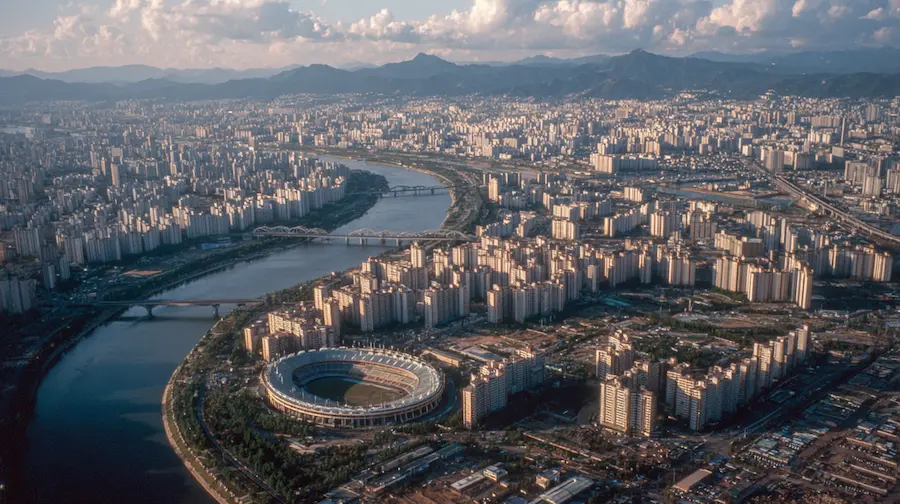
The 1988 Seoul Summer Olympics were more than a sporting event for South Korea.
Held from 17 September to 2 October 1988, the Games brought athletes, officials, journalists, broadcasters and visitors from around the world to Seoul.
For many people overseas, the Games offered one of their first sustained views of a country that had changed rapidly after the Korean War.
For Korea, the Olympics became a public test of presentation.
The country had to show a modern capital city, improved infrastructure, public confidence and a culture capable of welcoming foreign visitors.
The event did not create modern Korea by itself.
It did not create K-pop, Korean dramas, Korean beauty or today’s global interest in Korean food.
But it did help Korea practise something important:
how to be seen.
That is the deeper meaning of the 1988 Olympics.
It was not only about medals.
It was about visibility.
Before the Global Spotlight
Before the 1988 Olympics, Seoul had already changed dramatically from the damaged city left after the Korean War.
Factories, roads, bridges and apartment blocks had expanded quickly during Korea’s industrialisation.
The city was energetic and fast-growing, but it was not yet widely understood overseas as a polished global capital.
The Olympics gave Seoul a deadline.
Stadiums, roads, parks, transport links, signs, hotels and public spaces had to be prepared for international athletes, broadcasters and visitors.
This did not mean the whole city was rebuilt for the Games.
That would be too simple.
The more accurate point is that the Olympic project gave urgency to urban improvement and public presentation.
Seoul was already changing.
The Olympics forced that change to become legible to the outside world.
Jamsil and the Geography of Display
The Jamsil area became one of the most important Olympic spaces.
Many major facilities were concentrated there, including venues connected to the Games and the wider sports complex.
Olympic Park also became part of this new geography of display.
Built for the event, it later remained part of Seoul’s everyday public life.
Today, Olympic Park is used for walking, performances, exhibitions, sports and family outings.
In that sense, one part of the 1988 legacy did not disappear when the closing ceremony ended.
It moved into ordinary time.
This is one of the quieter effects of a mega-event.
A stadium may be built for a short event.
A park may remain as part of the city’s daily rhythm.
The Olympic legacy is not only found in old photographs.
It is also found in how a city continues to use the spaces created around the event.
The Han River and the Image of Modern Seoul
The Han River became one of the important visual symbols of Olympic-era Seoul.
Riverside roads, bridges, parks and sports facilities helped frame Seoul as a city of movement and modern infrastructure.
For international broadcasters, the Han River offered a clear image:
a capital that had moved from post-war hardship into urban confidence.
This image mattered.
Mega-events are not remembered only through stadiums.
They are also remembered through city views, transport systems, public spaces, signs, hotels and the general feeling of order around the event.
For many foreign viewers in 1988, Seoul was still unfamiliar.
The Olympics gave them one of their first extended looks at the city.
That first impression was carefully managed.
Korea wanted to show that it could organise a global event, welcome visitors and present a confident national image.
The Han River helped carry that image.
It was not just a river in the background.
It became part of the visual language of a modern capital.
Hodori and the Friendly Face of a Nation
The official mascot of the 1988 Seoul Olympics was Hodori, a smiling tiger designed by Kim Hyun.
The tiger was already a familiar figure in Korean folklore and visual culture.
Hodori gave it a friendly and modern form.
The mascot also wore a traditional sangmo-style hat, linking the Olympic image with Korean folk performance.
Hodori was important because it made Korea feel approachable.
For international visitors and television audiences, a mascot can do something that official speeches cannot.
It softens a national image.
It turns a major event into something memorable, friendly and easy to recognise.
Hodori did not create Korea’s later character industry by itself.
It should not be given that much credit.
But it showed how a traditional symbol could be redesigned for global audiences.
That lesson would later feel familiar in tourism branding, event mascots and cultural promotion.
The tiger became less distant.
The nation became easier to read.
Hospitality as Public Performance
The 1988 Olympics also encouraged Korea to think more carefully about how everyday culture would appear to foreign guests.
Korean food had long been part of daily life, from home cooking and markets to street stalls and restaurants.
But welcoming large numbers of international visitors required clearer explanations, better visitor services and more organised hospitality.
This did not mean Korean street food suddenly became global in 1988.
Foods such as tteokbokki, gimbap, mandu, hotteok and fish cake had already developed through local markets, school neighbourhoods and small restaurants.
What changed was the context.
The Olympics pushed Korea to present daily culture more deliberately.
Food was not only something eaten by locals.
It also became part of how visitors experienced Seoul.
For a foreign guest, trying Korean food in the city could be one of the most memorable parts of the trip.
Even simple dishes could communicate the country’s everyday taste:
warm, practical, communal and closely tied to street life.
Tteokbokki and the Everyday City
Among Korean street foods, tteokbokki is one of the easiest to recognise.
Its red sauce, chewy rice cakes and warm steam make it noticeable at markets and snack shops.
The modern spicy version is commonly associated with Seoul’s snack culture, including places such as Sindang-dong, and became widely familiar through bunsik restaurants and street stalls.
By the 1980s, tteokbokki was already an everyday food for students and office workers.
It was affordable, filling and easy to share.
For international visitors, this kind of food offered a different view of Korea from official banquets or hotel restaurants.
It showed the ordinary rhythm of city life.
This is one reason street food matters in tourism.
It allows visitors to experience a city at street level, not only through museums, palaces or major landmarks.
Tteokbokki was not created for the Olympics.
But it helps explain the kind of everyday Seoul that visitors could encounter beyond the official venues.
The Speed of Urban Eating
Korean street food also shows the speed of modern urban life.
A city that grows quickly changes the way people eat.
Food becomes portable.
Meals become shorter.
Snacks become part of commuting, studying, shopping and working late.
This is why street food should not be understood only as tradition.
Some of it is also about adaptation.
Korean urban food often reflects a practical question:
What can be eaten quickly, warmly and affordably in a busy city?
That question became more visible as Seoul became more urban, mobile and service-oriented.
The Olympics did not create that pattern.
But the global attention around 1988 made Seoul’s everyday habits easier to notice.
After 1988: Looking Outward
The year after the Olympics was also important.
In 1989, South Korea liberalised overseas travel for ordinary citizens.
This allowed more Koreans to travel abroad, study overseas, experience other food cultures and return with new ideas.
This two-way movement mattered.
Foreign visitors had seen Korea during the Olympics.
More Koreans were beginning to see the wider world.
Over time, this helped make Korean society more outward-looking.
Restaurants, cafés, bakeries, hotels and travel services gradually became more aware of global tastes.
At the same time, Koreans became more confident in presenting their own culture to outsiders.
This did not immediately create Hallyu.
The Korean Wave developed later through television dramas, music, film, games, beauty, fashion and digital platforms.
But the confidence gained around the Olympic period was part of the wider process by which Korea became more comfortable on the global stage.
What Remains in the City
Visitors today can still see parts of the 1988 legacy.
Olympic Park remains a major public space.
Jamsil is still associated with sports, concerts and large-scale events.
The Han River parks continue to shape the city’s leisure culture.
The image of Seoul as a fast, organised and modern capital owes something to the infrastructure and confidence built during that period.
Food culture has also become easier for foreign visitors to access.
English menus are more common in tourist districts.
Korean street food appears in travel videos, guidebooks, markets and food tours.
Dishes that were once mainly local snacks now circulate globally through social media, Korean dramas, YouTube and overseas Korean restaurants.
It would be too simple to say that the 1988 Olympics created K-food.
Korean food has a much older and deeper history.
But the Olympics helped Korea practise presenting itself.
That included its city, its hospitality, its symbols and its everyday tastes.
Why the 1988 Olympics Still Matter
The 1988 Seoul Olympics are important because they show how a country can use a global event to reshape its public image.
For Korea, the Games were not only about medals.
They were about visibility.
Seoul had to show that it could host the world, manage complex infrastructure and offer visitors a coherent experience.
That experience included stadiums and transport, but also parks, streets, signs, mascots, hotels, restaurants and food.
Today, Korea is widely associated with music, dramas, beauty, technology and food.
Those global images did not begin in one year.
They developed over decades.
Still, 1988 was one of the moments when Korea became more aware of how international attention could shape its image.
The Seoul Olympics gave the world a clearer view of Korea.
It also gave Korea a clearer sense of how it wanted to be seen.
Information Notice: This article provides general cultural and practical information only. Details, prices, availability and local conditions can change, so readers should check official sources and current local information when needed.
Sources / Further Reading
Olympics.com — Seoul 1988 Olympic Games records
Olympics.com — Seoul 1988 mascot Hodori
IOC — Seoul 1988 Olympic legacy
Visit Korea — Olympic Park
Seoul Metropolitan Government — Jamsil Olympic Stadium and Sports Complex
Korea Herald — 1989 overseas travel liberalisation
Visit Seoul — Sindang-dong Tteokbokki Town
Academic research on Han River development and Olympic-era urban planning
Google Search Central — Creating helpful, reliable, people-first content