Korean food is often introduced through barbecue, fried chicken, spicy stews, street snacks and late-night delivery.
Those are all part of the story.
But they are not the whole story.
Another side of Korean dining is becoming easier for foreign visitors to notice: food built around fermentation, seasonal vegetables, temple food, careful use of ingredients and lower-waste cooking habits.
This side of Korean food is quieter.
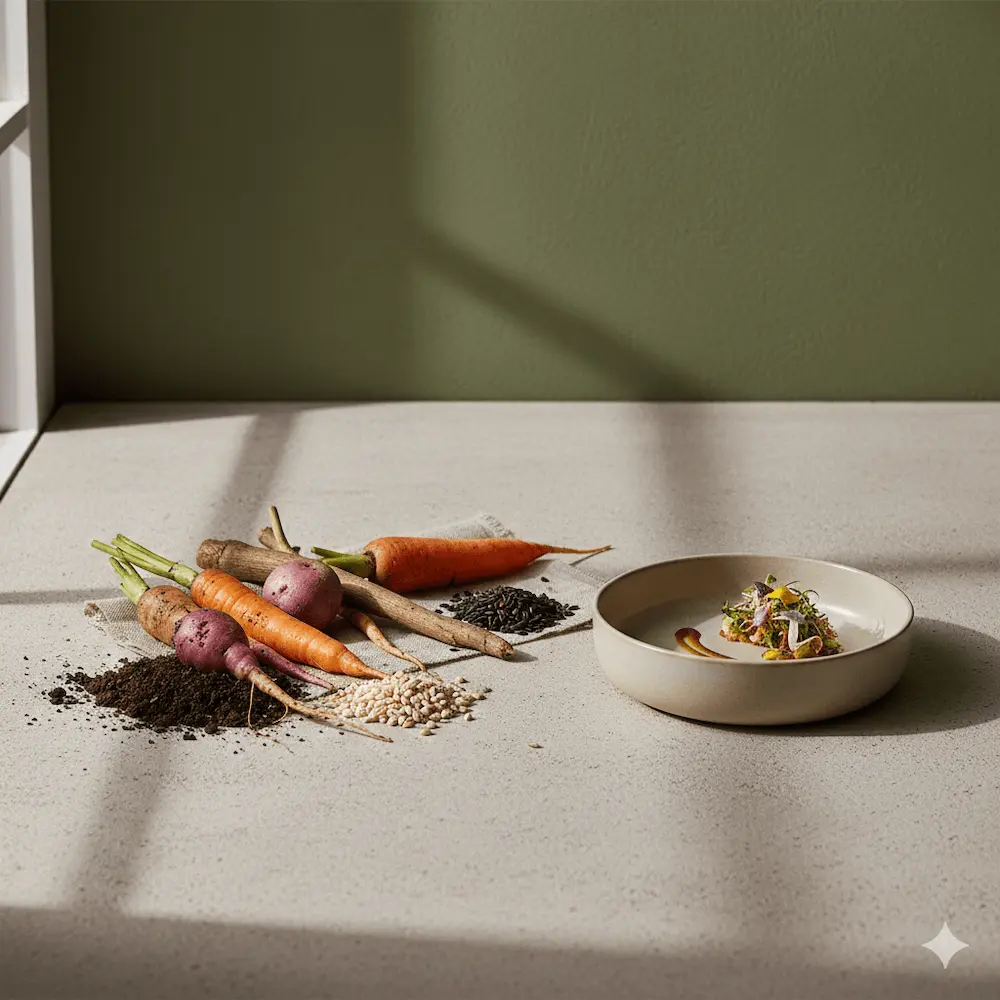
It is not always flashy. It does not depend on heavy seasoning or dramatic plating. It often begins with rice, vegetables, beans, mushrooms, greens, fermented sauces and the patience to let ingredients speak more softly.
This should not be exaggerated.
Korea is not a perfect model of sustainable dining. Restaurants still use energy, packaging, imported ingredients, delivery systems and expensive resources.
But there is a real conversation happening in Korea now. Chefs, diners, food writers and travellers are paying more attention to where ingredients come from, how food is prepared and what older Korean food traditions can still teach modern restaurants.
A Personal Doorway into Temple Food
For some people, interest in Korean temple food begins with religion.
For others, it begins more quietly.
One woman in her fifties remembers eating almost everything without much difficulty when she was younger. She was not a strict vegetarian, and she did not begin with a strong philosophy about food.
Her interest started after watching a documentary about Korean temple food.
The food looked different from the meals she was used to seeing in restaurants. It was calm, seasonal and careful. It did not seem to push flavour loudly. It seemed to ask the person eating to slow down.
After that, she began reading more, watching related programmes and visiting places where she could taste temple food when her schedule allowed.
Over time, she moved toward a more vegetable-focused diet.
She still does not force her family to eat the same way. At family gatherings or special events, she may eat what is served, while controlling the amount. Her rule is personal, not something she demands from others.
She also does not describe her diet as a perfect health solution.
But she noticed changes in her own body.
Her mornings felt less heavy. Her stomach felt more comfortable. Her skin condition seemed better to her. These were personal impressions, not medical proof, but they were enough to make her want to continue.
That kind of experience helps explain why temple food and plant-forward Korean meals are attracting interest beyond restaurants.
For some people, the appeal is not only taste.
It is the feeling of eating in a way that is quieter, lighter and more intentional.
Why Fermentation Matters
Fermentation is one of the strongest foundations of Korean cuisine.
Doenjang, ganjang, gochujang, kimchi, vinegars, pickles and aged sauces are not recent trends. They are part of everyday Korean food culture.
In 2024, Korea’s jang-making culture was inscribed on UNESCO’s Representative List of the Intangible Cultural Heritage of Humanity. Jang refers to fermented soybean-based sauces and pastes that have shaped Korean cooking for generations.
This matters because fermentation gives Korean food depth without always relying on meat, cream, butter or heavy sauces.
A small amount of aged soy sauce, soybean paste or fermented vegetable can change the character of a dish.
In modern Korean restaurants, these ingredients are often used to connect older flavours with newer cooking styles.
For foreign diners, fermentation helps explain why Korean food is more than “spicy food.”
Much of its flavour comes from time.
Temple Food as a Different Food Language
Korean temple food is another important part of this story.
Temple food is usually plant-based. It avoids meat, seafood and the five pungent vegetables known as oshinchae. These commonly include garlic, green onion, chives, Korean wild chives and leeks or similar strong ingredients.
In 2025, Korean temple food was designated as a National Intangible Cultural Heritage.
That recognition matters because temple food is not only a meal style.
It is a living cultural practice connected to Buddhist ideas of restraint, gratitude, non-violence and not wasting food.
Temple food is not simply “Korean vegan food.”
It has its own religious and cultural background. It is often gentle, seasonal and focused on the natural taste of vegetables, grains, beans, mushrooms, wild greens and fermented sauces.
For visitors who know Korea mainly through barbecue and street food, temple food offers another doorway into Korean cuisine.
It shows that Korean food can be strong and spicy, but it can also be quiet, restrained and deeply seasonal.
Seasonality and Local Ingredients
Seasonality has always mattered in Korean food.
Spring brings wild greens.
Summer brings lighter vegetables.
Autumn brings mushrooms, roots, fruits and grains.
Winter relies more on stored, dried, preserved and fermented foods.
Modern restaurants are now using this seasonal logic in more visible ways.
A dish may use mountain herbs, local vegetables, fermented sauces, seaweed, mushrooms, grains or regional seafood. Some restaurants explain the producer or region behind the ingredient. Others focus more quietly on what is available at that time of year.
This does not mean every restaurant is sustainable.
It means Korean food already has a strong seasonal base that modern chefs can build on.
For diners, seasonality can also change the way a meal feels.
A vegetable eaten at the right time of year may not need much decoration. A simple namul dish can show texture, scent and freshness. A bowl of rice with carefully prepared side dishes can feel complete without being heavy.
That quiet completeness is one reason some people continue returning to temple food and vegetable-led Korean meals.
What Michelin Recognition Shows — and What It Does Not
The Michelin Guide Seoul & Busan 2026 recognised several Korean restaurants with Green Stars, including Gigas, Fiotto, Mitou and Gosari Express.
This showed that sustainability-minded dining practices, farming relationships, low-waste cooking and plant-forward ideas had become more visible in Korea’s restaurant scene.
However, this point needs careful wording.
Michelin has also introduced Mindful Voices, a broader editorial platform for stories around gastronomy, hospitality and wine. For that reason, Green Star should not be described as a simple future growth category without checking the latest Michelin updates.
The safer way to understand the 2026 Korea guide is this:
It captured a moment when sustainability-minded dining practices were receiving more attention in Seoul and Busan.
It does not prove that the whole restaurant industry has changed.
It also does not mean every restaurant using local ingredients or vegetable-led dishes is automatically sustainable.
Each restaurant should still be judged by its actual practices.
Smart Farming and Food Technology
Korea is also investing in smart farming and agricultural technology.
Government and industry discussions around smart greenhouses, data-based farming, vertical farming, greenhouse upgrades and AI-related agricultural support may influence the future of food production.
These efforts may support more stable agricultural production and better data use in farming.
But this should not be confused with fully verified “regenerative gastronomy.”
Claims about carbon-negative restaurants, exact carbon reduction, QR-tracked nutrient density or precise environmental impact should not be used unless a restaurant, research body or government source provides clear evidence.
A more accurate point is this:
Korea is developing smart farming technologies, and some of these tools may influence how restaurants think about sourcing and ingredients in the future.
Why Lower-Waste Cooking Fits Korean Food
Lower-waste cooking connects naturally with Korean food traditions.
Korean cooking has long used stems, roots, leaves, dried ingredients, fermented pastes, broths, pickles and side dishes in ways that reduce waste and extend the life of ingredients.
This is not new.
It is part of household cooking, temple food, market food and regional food culture.
Modern restaurants may reinterpret these habits through tasting menus, vegetable-led dishes, fermentation or more careful sourcing.
The important point is not to claim that every Korean restaurant is zero-waste.
That would be false.
The more honest point is that Korean cuisine has older habits that fit well with today’s sustainability conversation.
What Foreign Visitors Can Actually Experience
Foreign visitors interested in this side of Korean dining do not need to start with an expensive restaurant.
They can begin with ordinary experiences.
Visit a traditional market and notice the range of vegetables, grains, dried goods, seaweed, fermented sauces and side dishes.
Try a temple food restaurant or cooking class if available.
Look for restaurants that explain seasonal ingredients clearly.
Visit a tea house after a meal and notice how Korean food culture also includes slower rhythms.
Try dishes based on namul, mushrooms, tofu, beans, fermented sauces or seasonal vegetables.
If you are vegetarian or vegan, check ingredients carefully.
Many Korean dishes that look vegetable-based may still use anchovy broth, seafood stock, fish sauce, egg, dairy or meat seasoning.
This is especially important for strict vegetarians, vegans and people with allergies.
A dish may look simple, but the broth or seasoning can still contain animal-based ingredients.
What to Be Careful About
Sustainable dining should not be treated as a perfect label.
A restaurant may use local ingredients but still create waste.
A plant-based dish may still rely on imported products.
A fine-dining meal may be beautiful but expensive and resource-heavy.
A restaurant may use the language of sustainability without explaining its practices clearly.
Readers should look for specific information.
Where are the ingredients from?
Does the restaurant explain seasonality?
Are plant-based options clearly marked?
Does the menu mention fermentation, farming or sourcing without exaggeration?
Can the restaurant answer allergy or dietary questions clearly?
These questions are more useful than trusting a label.
Why This Matters for Korean Travel
Korean food travel is becoming more layered.
Visitors can still enjoy barbecue, fried chicken, tteokbokki, gimbap, noodles, cafés, convenience-store snacks and markets.
Those are all part of the experience.
But temple food and sustainability-minded dining add another angle.
They help visitors understand Korea through fermentation, seasonal vegetables, regional ingredients and older habits of using food carefully.
That makes Korean food travel deeper.
It moves the question from “What should I eat?” to “What does this food say about Korea?”
For some travellers, the answer may be flavour.
For others, it may be history.
For others, it may be a meal that feels calm after several days of heavy food and busy travel.
What Not to Overstate
This topic needs careful wording.
Korean sustainable dining is not perfect.
It is not carbon-negative by default.
It is not only for luxury diners.
It is not proof that every Korean restaurant uses local ingredients.
It is not the same as vegan dining.
It is not automatically healthier.
It is not a replacement for clear allergy and dietary checks.
A vegetable-focused diet may feel better for some people, but health responses differ by person. Anyone with a medical condition, nutritional concern, pregnancy, medication use or special dietary need should consult a qualified health professional.
The safer view is this:
Korean cuisine has traditions that connect naturally with today’s interest in fermentation, seasonality, plant-forward cooking and reduced waste.
Modern restaurants and diners are finding new ways to use those traditions, but each claim still needs to be judged carefully.
Final Thoughts
Korean sustainability-minded dining should not be oversold.
Its strength is quieter than that.
Korea already has food traditions built around fermentation, seasonality, vegetables, preservation, temple food and careful use of ingredients.
Modern chefs are now finding new ways to bring those ideas into restaurants.
At the same time, ordinary diners are also rediscovering them in personal ways.
Someone may begin after watching a documentary.
Someone may start because of digestion, age or a desire to eat more lightly.
Someone may visit a temple food restaurant out of curiosity and return because the meal feels calm.
Someone may choose vegetables most days but still share ordinary meals with family.
That flexibility is important.
Temple food and plant-forward Korean dining do not need to be turned into a strict identity for everyone.
For foreign readers, that is the real story.
Korean food is not only fast, spicy or meat-heavy.
It can also be slow, fermented, seasonal, restrained and deeply connected to place.
Food and Culture Information Notice: This article is for general food, cultural and travel information only. It does not provide medical, nutritional or dietary treatment advice. Individual responses to vegetarian or plant-forward diets may vary. Restaurant menus, opening hours, Michelin listings, food programmes, sustainability claims and ingredient details may change. Visitors should check official restaurant pages, Michelin Guide updates, Korean Temple Food resources and recent notices before planning a visit.
Sources / Further Reading
- UNESCO — Knowledge, beliefs and practices related to jang-making in the Republic of Korea
- Korea.net / Korea Heritage Service — Korean temple food as National Intangible Cultural Heritage
- Michelin Guide Seoul & Busan 2026 — Green Star listings
- Michelin Guide — Mindful Voices announcement
- Korean Temple Food resources — temple cuisine, ingredients and food culture
- Ministry of Agriculture, Food and Rural Affairs — smart farming and agricultural technology policy
- Google Search Central — Creating helpful, reliable, people-first content