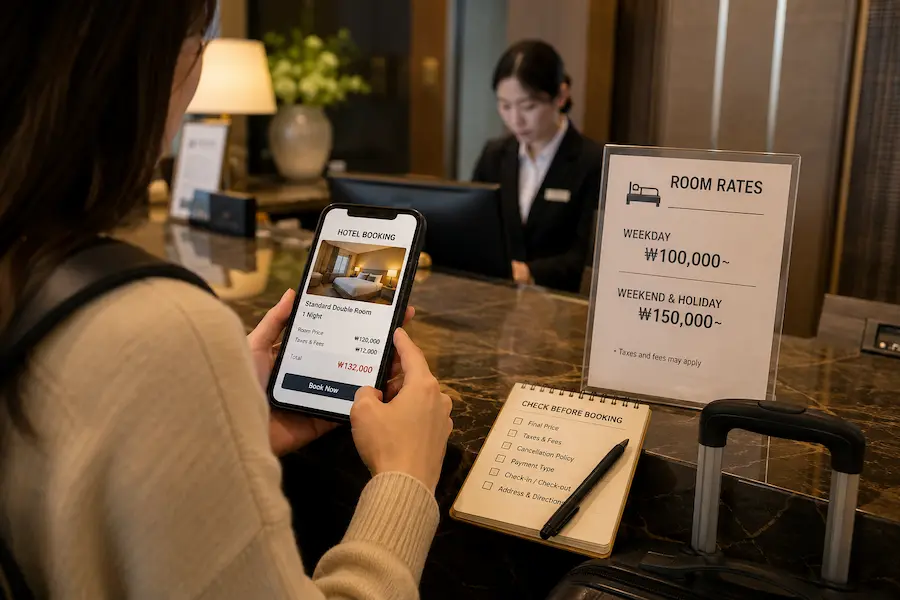
Booking accommodation is one of the most practical parts of planning a trip.
You may spend a long time choosing the right neighborhood, checking the distance from a station, comparing reviews, and looking at photos. But in the end, one detail often matters most: the price.
This becomes even more sensitive during festivals, concerts, long weekends, summer vacation periods, and year-end holidays.
In Korea, recent news coverage has reported that rules on accommodation overcharging are being tightened. The issue is not only about whether a room feels expensive. The more important question is whether the price shown to a traveler is clear, consistent, and easy to understand before payment.
For visitors, this matters because accommodation is not just a place to sleep. It is part of the trust that shapes the whole travel experience.
What Does Accommodation Overcharging Mean?
In Korean, people often use the word “bagaji-yogeum” to describe a price that feels unfairly high or unreasonable.
In travel contexts, it is often translated as overcharging or excessive pricing.
But it is important to be careful with the meaning.
A high price is not automatically overcharging. Hotels, guesthouses, and local accommodations may charge more during weekends, holidays, festivals, or busy travel seasons. That kind of price change can happen in many countries.
The real concern is different.
Accommodation overcharging becomes a problem when the price is not clearly shown, when the posted price and the requested payment are different, or when travelers feel they could not understand the cost before making a decision.
For travelers, the key issue is transparency.
Why Accommodation Prices Can Feel Sensitive in Korea
Accommodation prices are not always something travelers notice only during a major dispute. Sometimes, the difference is visible in ordinary planning.
In Korea, local travelers often compare weekday and weekend hotel prices before booking. A simple one-night stay can cost noticeably more on a weekend than on a weekday.
This can also affect small personal plans.
For example, when friends plan a hotel stay to celebrate a birthday, they may avoid a weekday because everyone has work the next morning. A weekend is more convenient, but it is often more expensive. If the birthday falls near a summer vacation period, the hotel price may rise even more than usual.
In that case, some people simply move the celebration earlier and use the saved accommodation budget for a better meal instead.
This kind of experience does not mean the price is unfair. It shows something more ordinary: accommodation prices can change quickly depending on the date, demand, and season.
That is why clear pricing matters.
Travelers can accept that prices change. What they need is to understand the price before they book or arrive.
Why Korea Is Paying Attention to Posted Prices
Posted prices are important because they help travelers know what to expect.
If a room rate is shown clearly, travelers can decide whether it fits their budget. If extra fees, weekend rates, or peak-season changes are explained in advance, the traveler can compare options.
But if the price changes unexpectedly at the point of payment, trust can break down quickly.
This can be especially difficult for international visitors who may not speak Korean fluently. Even if they are used to comparing prices online, they may feel less confident when asking questions at a front desk or checking details in Korean.
That is why price transparency is not just a consumer issue. It is also part of tourism quality.
A clear price helps travelers feel that the system is predictable.
Why This Often Becomes an Issue During Events and Peak Seasons
Accommodation pricing becomes more noticeable when demand rises.
This can happen during:
local festivals,
major concerts,
sports events,
summer vacation periods,
long weekends,
and year-end holidays.
During these times, rooms may sell out quickly and prices may rise. That part is not unusual. Many destinations around the world experience similar patterns.
The issue is whether the price is communicated clearly.
If a traveler sees one rate but is later asked to pay more without a clear reason, it can feel unfair. If the accommodation does not show its rates properly, travelers may not know whether they are being charged correctly.
This is why Korea’s rule-tightening is best understood as part of a broader effort to improve pricing transparency in local tourism.
What the Rule Change Is Trying to Do
Recent Korean news coverage has reported that enforcement rules are being strengthened for accommodation businesses that fail to post prices properly or charge more than the posted rate.
The reported change is related to administrative penalties under public hygiene rules for accommodation businesses.
In simple terms, the goal is to make pricing rules clearer and encourage businesses to follow posted rates more carefully.
This does not mean every expensive room is illegal. It also does not mean that hotel prices must stay the same all year.
Accommodation businesses can still have different prices depending on the season, date, room type, or booking condition. What matters is whether those prices are shown and applied clearly.
For travelers, the practical meaning is simple:
the price you see should be the price you can understand.
What Travelers Should Check Before Booking Accommodation in Korea
Before booking a hotel, guesthouse, pension, or local stay in Korea, it is helpful to check a few details carefully.
First, look at the final price, not only the first price shown on the search page.
Some booking pages may show a base rate first, while taxes, service charges, cleaning fees, or extra-person charges appear later.
Second, check whether the booking is prepaid or paid on arrival.
If payment is made at the property, save the booking confirmation so you can compare it with the price requested at check-in.
Third, check the date carefully.
A Friday or Saturday stay may cost more than a weekday stay. Prices may also rise during holiday periods, concerts, and local festivals.
Fourth, check the cancellation policy.
A cheaper room may have stricter cancellation conditions. A more flexible room may cost more but may be safer if your schedule could change.
Fifth, save the accommodation name, address, and booking details.
This is especially helpful if the property has a Korean name that looks different in English on maps or booking platforms. Korean addresses can also look different frim what many visiotrs expect, so it is useful to understand the address format before you travel.
What to Do If the Price Looks Different
If the price requested at check-in looks different from the price you expected, it is best to ask calmly for clarification.
You can show your booking confirmation and ask whether the difference is due to taxes, extra guests, room type, late check-in, parking, or another condition.
In many cases, the issue may be a misunderstanding or a booking condition that was not noticed.
If the explanation is unclear, keep the receipt, booking confirmation, and any message history from the accommodation or booking platform.
For travelers who do not speak Korean well, it may also help to use a translation app or contact the booking platform’s customer service.
The goal is not to assume the worst immediately. The goal is to make sure the price is clear before payment.
What This Says About Travel in Korea
Korea’s travel infrastructure is often described through convenience.
Fast trains, mobile maps, public transport cards, cafés, delivery culture, and digital payment systems all shape the travel experience.
But travel convenience is not only about speed.
It is also about trust.
A traveler needs to know where they are going, how to get there, what they are paying for, and whether the price shown is the price they are expected to pay.
Accommodation pricing is one of those small practical details that can affect the whole impression of a trip.
If the rules become clearer and enforcement becomes more consistent, it can help both travelers and responsible accommodation businesses.
Final Thoughts
Korea’s tighter rules on accommodation overcharging should not be understood as a warning that travelers should be afraid of booking accommodation in Korea.
Most travelers simply want the same thing anywhere: clear information before they pay.
A higher weekend or peak-season price is not automatically a problem. A price that is unclear, inconsistent, or different from what was shown is the real concern.
For travelers, the best habit is to check the final price, save the booking confirmation, and understand the conditions before arrival.
For Korea’s tourism industry, the larger message is about trust.
In travel, trust is often built through small details.
Sometimes it is a clear address.
Sometimes it is a reliable transport card.
And sometimes, it is knowing that the price a visitor sees is the price they are asked to pay.