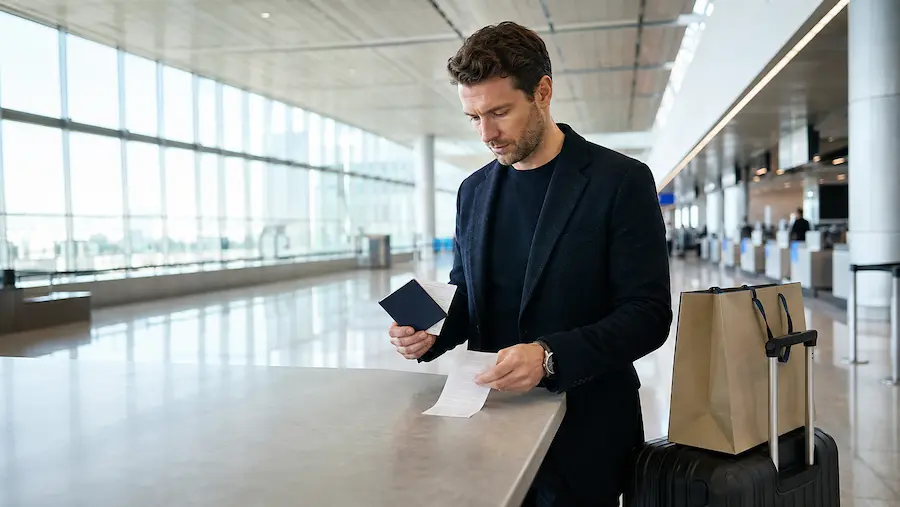
Claiming a tourist tax refund in South Korea is generally straightforward, provided that each step is completed at the correct time.
Most unsuccessful claims result from one of three avoidable mistakes: purchasing from a non-participating shop, leaving without the required refund document, or checking in luggage containing refundable goods before completing the necessary airport procedure.
Executive Briefing
- Before you pay: Confirm that the shop participates in the tourist tax refund scheme, present your passport and ask whether the tax will be deducted immediately or refunded later.
- After you pay: Check whether tax was deducted at the till. If not, make certain that you received an official tax refund voucher or electronic refund record.
- Before you fly: Keep the goods unused, retain all documents and do not surrender checked baggage containing refundable goods until the kiosk or customs procedure has been completed.
- Critical rule: If the tax was already deducted through an immediate refund at the shop, do not claim the same purchase again at the airport.
This guide covers tourist tax refunds on physical goods purchased from participating retail shops. Duty-free purchases, hotel accommodation and medical services operate under different rules.
1. Understand the Three Types of Tax-Free Shopping
Similar terms are used across Korean shops, but they do not always describe the same process.
| Purchase type | How it works | What to do at departure |
|---|---|---|
| Duty-free purchase | The applicable taxes are excluded when purchasing from a licensed duty-free shop. | Do not claim another tourist tax refund for the same purchase. Follow the duty-free shop’s collection instructions. |
| Immediate tax refund | The participating retailer verifies your eligibility and deducts the eligible tax before payment. | No second refund claim is required. Keep the receipt and goods until departure. |
| General tax refund | You pay the tax-inclusive price and receive a refund voucher or electronic refund record. | Complete the relevant city, mobile or departure-airport procedure. |
A “Tax Free” or “Tax Refund” sign does not necessarily explain which method the shop uses. Confirm the process before paying.
Phase 1: Before You Pay
Confirm That the Shop Participates
Tourist tax refunds are not available from every retailer in South Korea. Look for recognised Tax Refund or Tax Free signage and confirm eligibility with the shop before completing the purchase.
You may ask:
외국인 관광객 세금 환급이 가능한가요?
Is this purchase eligible for a tourist tax refund?
The minimum qualifying purchase is generally:
- KRW 15,000 or more in one qualifying transaction
The purchase must be made at a participating retailer. Spending KRW 15,000 at a non-participating shop does not make the purchase refundable.
Present Your Passport
The retailer must verify that you qualify as an overseas visitor. Have your passport available before payment.
Some retailers may support an approved electronic verification method, but this should not be assumed. A photograph or photocopy may not be accepted, so carrying the original passport is the safest option.
Ask Which Refund Method Applies
Before paying, ask:
세금이 지금 차감되나요, 아니면 나중에 환급받아야 하나요?
Will the tax be deducted now, or must I claim it later?
This establishes whether you are receiving an immediate refund or need a refund voucher for later processing.
Phase 2: Immediately After You Pay
Do not leave the counter until you have confirmed how the transaction was processed.
Case A: The Tax Was Deducted at Checkout
This is an immediate tax refund.
The current transaction limits are:
- Purchase amount of KRW 15,000 or more
- Single transaction of less than KRW 1,000,000
- Total immediate-refund purchases of KRW 5,000,000 or less during the visit
Review the receipt and confirm that the eligible tax has already been deducted. Do not submit the same purchase for another refund at the airport.
Keep the receipt and the purchased goods until you leave South Korea.
Case B: You Paid the Tax-Inclusive Price
This is a general tax refund. The retailer should issue an official refund voucher or create an electronic refund record connected to your passport.
Before leaving the counter, check that:
- Your passport details are correct.
- The purchase amount is accurate.
- The estimated refund is shown.
- The refund operator is identified.
- You understand whether the refund is to be processed in the city, through the operator’s mobile service or at the airport.
An ordinary till receipt or credit-card slip is not necessarily a tax refund voucher. Incheon International Airport advises that a refund may be refused if the proper document was not requested or was completed incorrectly.
If you received only an ordinary sales receipt, return to the retailer immediately and ask whether a separate refund document should have been issued. Airport staff cannot normally create one on behalf of the shop.
Keep the Goods Unopened and Unused
Refund-eligible goods must generally be taken out of South Korea within three months of purchase.
Keep them unopened and unused because customs may require evidence that the purchased items are being exported.
Potentially eligible retail goods include:
- Clothing and footwear
- Bags and accessories
- Cosmetics and perfume
- Electrical appliances
- Packaged ginseng and red ginseng products
The following are generally not covered by this retail-goods refund procedure:
- Goods opened or used in Korea
- Items already purchased tax-free from a duty-free shop
- Cooked food
- Massage and other services that cannot be inspected as exported goods
- Prohibited or export-restricted items
- Purchases made under a corporate name or through an agent
Phase 3: Before You Fly
Allow additional time at the airport and keep the following readily accessible:
- Passport
- Boarding pass
- Refund voucher or electronic refund record
- Purchased goods, unopened and unused
- Payment card, if required by the refund operator
At airports equipped with automated tax refund kiosks, the kiosk determines whether customs inspection is required. Not every purchase is physically examined.
Scenario 1: The Goods Are in Your Carry-On Baggage
At Incheon International Airport:
- Check in and obtain your boarding pass.
- Keep the refund-eligible goods and documents with you.
- Follow signs to the tax refund kiosk in the departure hall.
- Scan your passport and follow the instructions displayed.
- If the kiosk requests customs inspection, present your passport, purchased goods and purchase confirmation at the customs desk.
- After completing any required export confirmation, follow the refund operator’s instructions to receive the refund.
Do not place refund documents in checked baggage.
Scenario 2: The Goods Are in Your Checked Baggage
Do not allow the bag to enter the baggage system before completing the required refund procedure.
- Tell the airline check-in staff that the bag contains tax-refund goods.
- Have the bag weighed and tagged, but ask for it to be returned to you.
- Take the tagged bag to the tax refund kiosk.
- If the kiosk requests customs inspection, present your passport, documents and the unopened goods.
- After clearance, place the tagged bag on the designated oversized-baggage conveyor beside the customs area.
This order is important. If the bag has already been sent into the baggage system, you may be unable to present the goods when customs requests an inspection.
If You Received a Refund in the City
Receiving money at a city-centre refund desk does not necessarily complete the export-confirmation requirement.
Depending on the refund operator:
- A payment card may be required as a guarantee.
- Departure validation may still be required.
- Failure to complete the required airport procedure may cause the refund to be reversed or charged to the guarantee card.
Follow the instructions printed on your refund voucher. Different refund operators may use different applications, desks and payment methods.
Why Is the Refund Less Than 10% of the Retail Price?
South Korea’s standard VAT rate is 10%, but this does not mean that the shopper receives 10% of the displayed VAT-inclusive price.
For example:
| Calculation | Amount |
|---|---|
| Price before VAT | KRW 100,000 |
| VAT | KRW 10,000 |
| Displayed VAT-inclusive price | KRW 110,000 |
The VAT contained in a KRW 110,000 retail price is KRW 10,000, not KRW 11,000.
The amount ultimately received may also be affected by the refund operator’s processing terms, payment method or currency conversion. For that reason, do not rely on a fixed estimate such as “5% to 8%”.
Check the estimated refund printed on the official voucher before leaving the shop.
Who Is Generally Eligible?
The retail tax refund scheme is intended principally for non-resident visitors who:
- Stay in South Korea for no more than six months
- Do not earn income in South Korea
- Take the purchased goods out of the country within three months
Long-term residents, people employed in South Korea, diplomats, US military personnel stationed in Korea and people purchasing under a corporate name or through an agent may not qualify.
Overseas Koreans are subject to separate residence and length-of-stay requirements and should confirm their eligibility with the retailer or refund operator.
Common Reasons a Refund Is Refused
A refund may fail when:
- The retailer does not participate in the tourist refund scheme.
- No official refund voucher or electronic record was issued.
- The refund document contains incomplete or incorrect information.
- The goods were opened or used before export.
- The goods cannot be presented when customs requests an inspection.
- Checked baggage was surrendered before the required procedure.
- The goods were not taken out of Korea within three months.
- The purchase was already tax-free or immediately refunded.
- The traveller does not meet the eligibility requirements.
Incheon Airport Refund Facilities
According to Incheon International Airport’s current operational information:
Terminal 1
- Staffed refund desk: Near Gate 28, Level 3, in the restricted departure area
- Operating hours: 07:00–22:00
Terminal 2
- Staffed refund desk: Near Gate 253, opposite Gate 250, Level 3, in the restricted departure area
- Operating hours: 07:00–21:30
Automated kiosks are also available. Locations, supported payment methods and operating arrangements can change, so check the official airport page before departure and follow the instructions displayed in the terminal.
Executive Departure Checklist
Before you pay
- [ ] Confirm that the retailer participates.
- [ ] Present your passport.
- [ ] Ask whether the refund is immediate or claimed later.
- [ ] Confirm that the purchase meets the KRW 15,000 minimum.
Immediately after you pay
- [ ] Check whether the tax was already deducted.
- [ ] Obtain the official refund voucher if you paid the tax-inclusive price.
- [ ] Verify your passport and purchase details.
- [ ] Keep the receipt, refund document and goods.
- [ ] Do not open or use the goods.
Before you fly
- [ ] Bring your passport, boarding pass, refund records and goods.
- [ ] Allow additional time at the airport.
- [ ] Tell the airline before checking a bag containing refundable goods.
- [ ] Use the airport kiosk and attend customs if instructed.
- [ ] Complete any outstanding export-confirmation or refund step.
Final Advice
The simplest way to avoid losing a refund is to check the process at three specific moments:
- Before paying: Confirm participation and the refund method.
- Immediately after paying: Verify the tax deduction or collect the correct voucher.
- Before checking your baggage: Complete the kiosk and any required customs procedure.
Do not rely solely on a shop sign, an ordinary receipt or advice written before the current limits took effect. When instructions on the refund voucher differ from a general guide, follow the refund operator’s current directions and the airport kiosk instructions.
Scope notice: The temporary VAT refund scheme for qualifying cosmetic medical services reached the end of its statutory application period on 31 December 2025. Such services are not covered by this retail-goods guide. Hotel accommodation and licensed duty-free shopping also follow separate rules.
Information last checked: 13 August 2026