Korean etiquette is usually easier to understand than first-time visitors expect.
You do not need to memorise a long list of rules or worry about making every small gesture perfectly.
The most useful principle is simple:
start politely, watch what people around you are doing, and avoid creating unnecessary inconvenience for others.
In Korea, everyday manners often depend on context, including age, relationship, setting and formality.In Korea, everyday manners often depend on context.
Age, relationship, setting and formality can affect how people speak and behave. A family meal may feel different from a business dinner. A crowded subway requires different behaviour from a café. A traditional home or hanok stay may have customs that do not apply in a modern hotel.
For travellers, the goal is not to behave exactly like a Korean.
This Korean etiquette for travelers guide explains the public manners, dining customs and everyday habits that first-time visitors are most likely to encounter.
It is to understand the small habits that make public spaces, restaurants and everyday interactions easier.
Korean Etiquette at a Glance
| Situation | Practical approach |
|---|---|
| First meeting | Start politely and use a calm tone |
| Public transport | Keep your voice low and avoid blocking doors or walkways |
| Priority seats | Leave them available for passengers who may need them |
| Giving or receiving | Using two hands can show extra politeness |
| Homes and traditional spaces | Check whether shoes should be removed |
| Restaurants | Watch whether water, utensils or side dishes are self-service |
| Shared dishes | Use serving utensils when provided |
| Paying | Follow the restaurant’s system rather than waiting automatically for a bill |
| Older people or formal settings | A little extra formality is usually safer |
| When unsure | Observe first, then ask politely |
These are common habits rather than strict rules that apply in every situation.
Korean society is changing, and younger people may behave more casually than older generations.
Start Polite, Then Follow the Situation
When you first meet someone in Korea, beginning politely is usually the easiest approach.
You do not need advanced Korean.
A simple greeting, a small nod and a calm tone are enough in most travel situations.
Useful expressions include:
안녕하세요
Annyeonghaseyo
Hello
감사합니다
Gamsahamnida
Thank you
죄송합니다
Joesonghamnida
I’m sorry / Excuse me
Visitors sometimes worry too much about bowing correctly or using perfect Korean.
That is rarely necessary.
Being calm, patient and respectful matters more than performing a formal gesture perfectly.
Why Age and Relationship Matter
Korean communication can be influenced by age, role and relationship.
This does not mean every interaction is rigid or formal.
It means that people may speak differently to:
- an older person
- a close friend
- a colleague
- a customer
- a stranger
- a senior person at work
- a younger family member
Korean language itself reflects different levels of politeness.
As a visitor, you do not need to understand every speech level.
The safest approach is simply to begin politely.
If a Korean person becomes more casual with you, you can follow the tone gradually.
In English, this usually means avoiding overly casual or demanding language when first asking for help.
What Does Nunchi Mean?
Visitors may hear the Korean word nunchi, often translated loosely as reading the room.
It is better not to treat nunchi as a mysterious Korean skill.
In everyday life, it simply means noticing context.
For example:
- Is everyone speaking quietly?
- Are people waiting in a line?
- Are customers returning their trays?
- Is water self-service?
- Are people removing their shoes?
- Is the group waiting for an older person to begin eating?
You do not need to know every rule in advance if you can observe what is happening around you.
That habit is useful almost everywhere in Korea.
Public Transportation Manners
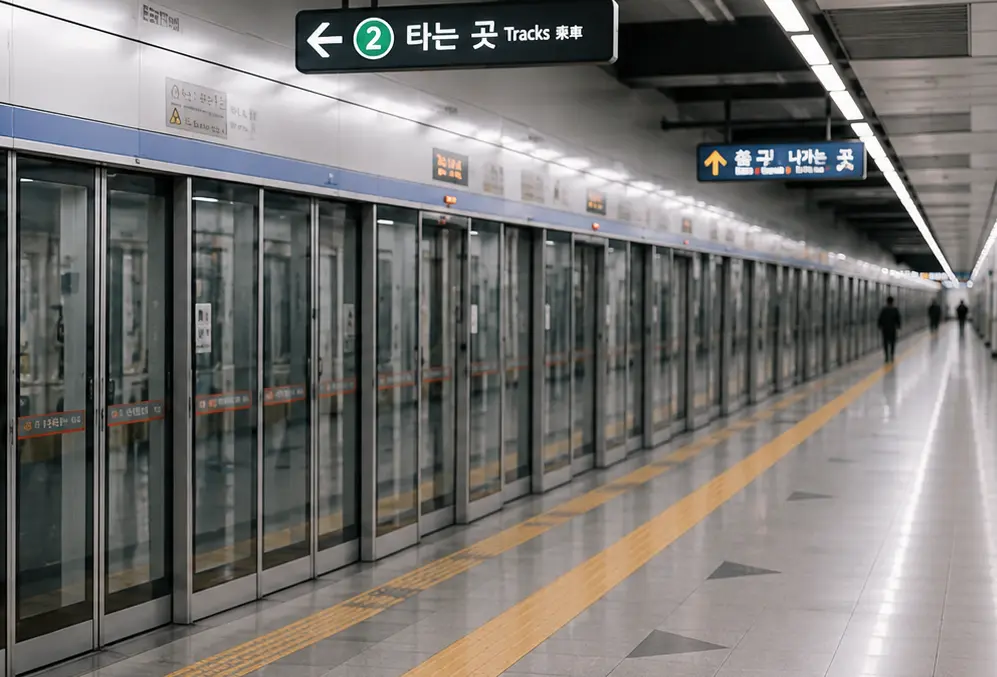
Public transport is one of the easiest places to notice Korean everyday manners.
On subways and buses, many passengers keep their voices relatively low.
Long or loud phone calls can feel out of place, especially during commuting hours.
When using public transport:
- keep bags close to your body
- avoid blocking train or bus doors
- let passengers exit before boarding
- move further inside when the vehicle is crowded
- step to the side before stopping to check your phone
- avoid standing in the middle of busy station walkways
These are small habits, but they make crowded spaces easier for everyone.
For more practical transport guidance, see our Getting Around guide.
Priority Seats
Subways and buses have priority seating for passengers who may need extra support.
This can include:
- older adults
- pregnant passengers
- people with disabilities
- passengers with injuries or mobility difficulties
When ordinary seats are available, choosing those is usually the most considerate option.
Visitors do not need to panic if they accidentally sit in the wrong place.
If someone appears to need the seat more, simply move.
Bus Etiquette and Flow
On many Seoul buses, passengers generally:
- board through the front door
- tap their transport card
- move further inside
- press the stop button before their stop
- tap again when leaving when required for fare calculation or transfers
- exit through the rear door
Follow the signs and the flow of other passengers.
The exact arrangement can differ by bus type and city, so local instructions always come first.
Giving and Receiving With Both Hands
Using both hands can show extra politeness when giving or receiving something.
You may notice this when people exchange:
- cards
- money
- receipts
- documents
- gifts
- drinks
It does not need to feel ceremonial.
In everyday situations, supporting one hand with the other can be enough.
A foreign visitor is unlikely to cause offence by forgetting, but using both hands in a formal or polite moment is an easy gesture to remember.
Shoes-Off Culture
Shoes are commonly removed in homes and some traditional spaces.
You may also need to remove shoes at:
- hanok accommodation
- some guesthouses
- certain temples
- traditional restaurants
- some private rooms
- specific cultural facilities
The entrance usually gives you a clue.
Look for:
- a shoe rack
- slippers
- a raised floor
- many shoes near the entrance
- a sign asking visitors to remove footwear
If you are unsure, pause before stepping onto the raised floor.
A simple question or gesture towards your shoes is usually enough.
Restaurant Etiquette Is Mostly About Following the System
Korean restaurants do not all work in the same way.
You may encounter:
- staff taking orders at the table
- self-service kiosks
- touchscreens at the table
- self-service water
- self-service side dishes
- call buttons
- utensils stored in table drawers
- payment at a counter near the entrance
None of these systems is difficult once you know to look for them.
For a complete explanation, see our Korean Restaurant Guide: Ordering, Paying and Table Customs.
Wait Before Starting in More Formal Meals
In family or formal settings, people may wait for the oldest or most senior person to begin eating.
Visitors do not need to turn an ordinary restaurant meal into a formal ceremony.
If you are dining casually with friends, simply follow the group.
If the setting feels more formal, waiting a moment before starting is an easy and respectful habit.
Spoons, Chopsticks and Shared Food
Korean meals commonly use both a spoon and chopsticks.
The spoon is often used for rice and soup, while chopsticks are used for side dishes and other foods.
One well-known rule is:
do not leave chopsticks standing upright in a bowl of rice.
This arrangement is associated with memorial and ancestral rites.
When sharing dishes, use serving utensils when they are provided.
Avoid placing utensils that have been in your mouth directly into a communal dish when a serving spoon or tongs are available.
For more detail, see our Korean Chopsticks and Table Manners guide.
Side Dishes and Self-Service
Many Korean meals include small side dishes called banchan.
Basic side dishes may sometimes be refillable without an extra charge, but policies vary by restaurant.
Refills may be handled by:
- asking staff
- using a call button
- visiting a self-service station
Take a reasonable amount and avoid wasting food.
If water, napkins or utensils are self-service, this is simply part of the restaurant’s system.
It is not a sign of poor service.
Tipping Is Not Usually Expected
Tipping is not normally required or expected at ordinary Korean restaurants.
Customers generally pay the amount shown.
Hotels, fine-dining restaurants or specialised venues may include a service charge or use different pricing arrangements.
A listed service charge is different from a voluntary tip.
Visitors do not need to calculate an additional percentage at an ordinary restaurant.
Drinking Etiquette
Alcohol can involve more traditional manners, particularly with older people or in formal settings.
Common habits may include:
- receiving a drink with two hands in a more formal situation
- pouring for others rather than filling only your own glass
- turning slightly away when drinking in front of a much older or senior person in a formal setting
These customs are not followed with the same formality in every group.
Among close friends or younger people, the atmosphere may be much more casual.
The safest approach is to watch the group and follow their level of formality.
Queuing and Moving Through Crowded Spaces
Korea’s busiest areas can become very crowded.
This includes:
- subway stations
- bus stops
- cafés
- department stores
- festivals
- markets
- airport queues
- popular tourist attractions
People may stand close together simply because space is limited.
When waiting, look for an obvious queue or follow the order already established.
When walking, avoid:
- stopping suddenly in the middle of a narrow passage
- blocking escalator entrances
- standing directly in front of subway doors
- gathering around the top of stairs
- checking a map in the middle of a busy walkway
If you need to stop, move to the side first.
Personal Space Can Feel Different
Personal space in crowded Korean cities may feel smaller than what some visitors are used to.
On busy subways, markets or narrow streets, people may pass close to one another.
This is not automatically aggression or rudeness.
At the same time, visitors should still respect ordinary personal boundaries.
Context matters.
A crowded train and an empty street are different situations.
Cafés and Shared Public Spaces
Korean cafés are often used for:
- meeting friends
- studying
- working
- resting
- waiting between appointments
Some people stay for a long time, especially in larger cafés.
Visitors should still use ordinary consideration.
Keep personal belongings within a reasonable area and avoid taking more seating than needed when the café is busy.
If you need to take a long call or video meeting, keep the volume appropriate for the space.
Respect Quiet or Formal Places
At temples, memorial sites, museums and other formal or reflective spaces, follow posted rules carefully.
This may include restrictions on:
- photography
- loud conversation
- food and drinks
- shoes
- entering certain areas
If a place feels quiet, it is usually best to match that atmosphere.
Do Not Overthink Every Small Mistake
One of the biggest mistakes visitors can make is becoming so worried about etiquette that ordinary travel feels stressful.
Koreans do not expect foreign visitors to know every local habit.
Small mistakes happen.
If you:
- stand in the wrong place
- forget to use two hands
- miss a self-service station
- do not know where to put your shoes
- misunderstand how payment works
simply correct the situation and move on.
A polite attitude matters more than perfect performance.
Useful Everyday Korean Phrases
A few phrases can make everyday interactions easier.
| Korean | Meaning |
|---|---|
| 안녕하세요 | Hello |
| 감사합니다 | Thank you |
| 죄송합니다 | I’m sorry / Excuse me |
| 실례합니다 | Excuse me |
| 괜찮아요 | It’s okay |
| 여기 앉아도 돼요? | Can I sit here? |
| 신발 벗어요? | Do I take off my shoes? |
| 여기서 기다려요? | Do I wait here? |
For more everyday expressions, see our Simple Korean Phrases for Travel in Korea guide.
A Simple Etiquette Checklist
Before worrying about detailed rules, remember these basics:
- Start politely.
- Keep your voice moderate on public transport.
- Respect priority seating.
- Let people exit before boarding.
- Move aside before checking your phone.
- Watch for shoes-off areas.
- Use two hands in more polite or formal exchanges.
- Follow restaurant self-service instructions.
- Use serving utensils when provided.
- Do not assume tipping is required.
- Watch how the people around you behave when you are unsure.
These habits are enough for most everyday travel situations.
Final Thoughts
Korean etiquette is less about memorising rules and more about paying attention to context.
Age, relationship and formality can affect behaviour, but visitors do not need to understand every detail of Korean social hierarchy.
Start politely.
Observe the situation.
Follow the system being used.
Avoid making shared spaces harder for other people.
That approach works on public transport, in restaurants, inside homes, at cafés and in most everyday travel situations.
You may make a small mistake.
That is normal.
Respect, patience and awareness matter much more than performing every Korean custom perfectly.
For more practical guidance on everyday life in Korea, explore our Culture & Etiquette guide.
Information note: Korean etiquette varies by generation, relationship, region and setting. This guide describes common everyday patterns rather than rules that apply to every person or situation.
Last fact-checked: September 2026