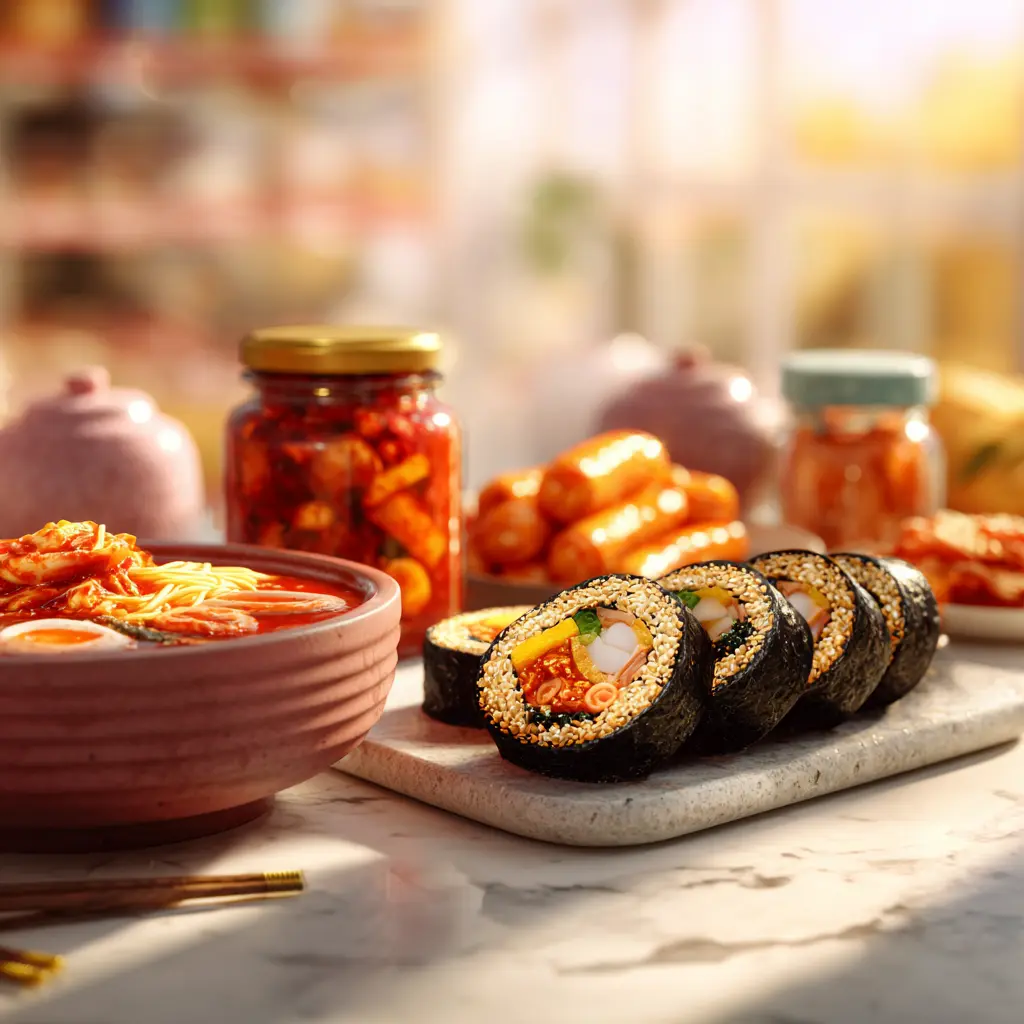
For many years, Korean food in the United States was easier to find in Korean restaurants, Asian grocery stores or the occasional social media video.
That is changing.
Today, Korean food is much easier to find in mainstream supermarkets, warehouse clubs, online grocery platforms and large retail channels. Frozen kimbap, Korean dumplings, ramyeon, gochujang, kimchi, seaweed snacks, Korean fried chicken products, sauces and tteokbokki cups are now more visible than they were a decade ago.
This does not mean Korean food has replaced other food cultures in America.
The U.S. food market is large, diverse and highly competitive.
But Korean food has clearly moved beyond a small niche. It has become more familiar in American grocery shopping and home cooking.
That shift matters because food culture becomes stronger when it moves from curiosity to habit.
Korean Food Exports Are Growing
The growth is visible in export data.
South Korea’s food and agriculture-related exports reached a record level in 2025. The broader K-Food Plus category reached about 13.62 billion U.S. dollars, while agri-food exports passed the 10 billion dollar mark for the first time.
The United States became Korea’s largest export market for Korean agri-food products. In 2025, Korean agri-food exports to the U.S. reached about 1.8 billion U.S. dollars, up 13.2 percent from the previous year.
China and Japan also remained major markets, but the U.S. result is important because it shows how strongly Korean food has entered a large non-Asian consumer market.
This growth is not based on one product alone.
Ramyeon, sauces, snacks, kimchi, seaweed, frozen meals and convenience foods all play a role.
The safer way to read the numbers is this:
Korean food is growing in the U.S. market, but it is not taking over the market.
That difference matters.
Ramyeon Is One of the Strongest Categories
Ramyeon is one of the clearest examples of K-food’s global growth.
In 2025, Korean ramyeon exports passed 1.5 billion U.S. dollars for the first time. Reports showed that ramyeon exports rose by about 21.8 to 21.9 percent from the previous year.
This matters because ramyeon is easy for new consumers to try.
It is affordable, widely available, simple to cook and easy to share on social media. It also fits current shopping habits in the United States, where many consumers look for convenient meals that still feel flavorful and different from ordinary instant noodles.
Korean ramyeon is no longer seen only as a product for Korean households or Asian grocery stores.
It is now part of a broader instant noodle market that includes mainstream American shoppers.
But ramyeon’s success should not be treated as proof that every Korean food product will succeed in the same way.
A product works when taste, price, distribution, packaging and repeat purchase all come together.
The Trader Joe’s Kimbap Moment
One important turning point was the popularity of frozen kimbap at Trader Joe’s.
Kimbap is a Korean rice roll usually made with seasoned rice, seaweed, vegetables, egg, meat, fish cake or other fillings. It is commonly eaten as a convenient meal or snack in Korea.
Trader Joe’s introduced a frozen plant-based version that could be heated at home. The product became widely discussed on TikTok and other social media platforms, and many stores sold out quickly.
The important point is not that frozen kimbap is the same as fresh kimbap from a Korean shop.
It is not.
The important point is that it gave many American shoppers an easy first step into Korean food.
After the product went viral, some consumers became more curious about Korean grocery stores, Korean ingredients and fresh versions of the dish.
In that sense, one frozen product helped introduce a wider food culture.
It lowered the barrier.
That is often how new food habits begin.
Large Retailers Change the Category
Korean food’s growth in the United States is not happening only online.
Large retailers matter because they make products easier to find.
When Korean dumplings, ramyeon, sauces, frozen meals and snacks appear in major U.S. retailers, warehouse clubs, Korean grocery chains and online grocery platforms, they become easier to include in ordinary shopping routines.
This changes how consumers see the category.
A product that once required a special trip to an Asian market can now be bought during a regular grocery run.
That visibility matters.
It helps Korean food move from curiosity to habit.
Still, retail expansion should not be overstated.
A product appearing in a major chain does not guarantee long-term success. It must sell repeatedly, stay affordable, meet local taste expectations and maintain supply.
Shelf space is an opportunity.
It is not a guarantee.
Buldak and the Role of Social Media
Samyang’s Buldak noodles show how social media can change the life of a food product.
Buldak became known internationally through spicy noodle challenges and user-made videos. The product was not only eaten. It was filmed, reacted to, shared and discussed.
By 2025, Samyang America had grown strongly, with reports showing annual sales of about 419 million U.S. dollars. Buldak products were also being sold through about 30,000 U.S. retail locations.
This shows how Korean food companies can benefit when product taste, online culture and retail distribution work together.
But it is important not to explain the growth only through online challenges.
Distribution, pricing, repeat purchases, product variety, inventory management and brand management also matter.
A viral video can create first attention.
It cannot create a stable market by itself.
K-Culture Helps, But It Is Not the Whole Story
K-pop, K-dramas, Korean films and Korean variety shows have helped make Korean food more familiar.
Viewers may see characters eating ramyeon late at night, sharing tteokbokki, grilling meat, eating fried chicken or making quick meals at home. These scenes can make viewers curious.
But cultural exposure alone does not create lasting demand.
A product still needs to fit local shopping habits.
It must be easy to buy, easy to prepare, reasonably priced and enjoyable enough for consumers to buy again.
This is why K-food’s growth in the United States should be understood as a combination of factors:
Korean cultural visibility,
social media,
retail access,
convenience,
taste,
price,
and repeat demand.
The entertainment wave opens the door.
The product has to earn its place on the shelf.
Why American Shoppers Are Responding
Several reasons explain why Korean food is gaining attention among American shoppers.
First, many Korean food products are convenient. Frozen meals, dumplings, instant noodles, sauces and snacks fit busy schedules.
Second, the flavors are distinctive. Spicy, savory, fermented, sweet and umami-rich flavors stand out from many standard packaged foods.
Third, Korean products often work well for home cooking. A jar of gochujang, a pack of dumplings or a bag of frozen kimbap can be used without advanced cooking skills.
Fourth, the products are easy to share online. Bright packaging, spicy reactions, quick recipes and Korean grocery hauls all perform well on social media.
These factors help explain why Korean food has become more visible in U.S. supermarkets.
The strongest products are not only unfamiliar enough to feel interesting.
They are also practical enough to buy again.
The Difference Between Trend and Habit
A viral product can create attention, but long-term growth depends on habit.
A shopper may buy frozen kimbap once because it is trending.
But for Korean food to stay in the pantry, freezer or weekly shopping basket, the product has to become useful.
That is why repeat purchases matter more than social media attention alone.
Ramyeon works because it is fast and affordable.
Dumplings work because they can be cooked easily.
Sauces work because they can change the flavor of a meal.
Seaweed snacks work because they are portable.
Kimchi works because it can be eaten with many dishes.
The strongest Korean food products in the U.S. market are not only interesting.
They are practical.
That is the difference between a trend and a category.
Challenges Korean Food Brands Still Face
Korean food brands still face challenges in the United States.
Taste adaptation can be difficult. Some products may be too spicy, too unfamiliar or not clearly explained for new consumers.
Supply chains also matter. Frozen products need stable cold-chain distribution. Sauces and snacks need shelf space. Retailers need reliable inventory.
If a product goes viral but disappears for months, consumers may move on.
Labeling and ingredients are also important.
American shoppers often check allergens, nutrition information, vegetarian status, gluten content, sodium and spice level. Clear packaging can make a big difference.
Competition is strong as well.
Korean food is growing, but it competes with American, Japanese, Chinese, Thai, Mexican, Italian, Indian and many other food categories.
A balanced view should recognize both the growth and the difficulty of staying in the market.
What This Means for Korean Food
Korean food’s rise in American supermarkets shows a change in how food culture travels.
In the past, many people first tried Korean food at a restaurant.
Today, some first encounter it in a freezer aisle, a TikTok video, a warehouse club package or a Korean grocery store.
This does not replace restaurant culture.
Fresh Korean food, home cooking and Korean restaurants remain important.
But packaged and frozen products create an easier starting point.
For Korean food companies, the opportunity is clear. The U.S. market is large, and consumer interest is growing.
But success will depend on product quality, clear labeling, stable supply, fair pricing and repeat demand.
For American consumers, the result is more choice.
Korean food is becoming easier to try at home, even for people who do not live near Koreatown or a Korean restaurant.
Conclusion
Korean food is no longer limited to specialty stores in the United States.
It is now easier to find in supermarkets, warehouse clubs, online grocery platforms, Korean grocery chains and large retail channels.
Export data, ramyeon growth, frozen kimbap’s popularity and the expansion of brands such as Samyang all show that Korean food has become more visible in American daily shopping.
Still, the story should be told carefully.
Korean food is growing.
It is not taking over.
It is becoming familiar.
It is not replacing other cuisines.
The most accurate conclusion is this:
Korean food has moved from niche discovery to mainstream availability in the United States.
That shift matters because it changes how people encounter Korean culture.
Sometimes the first step is not a drama, a concert or a restaurant.
Sometimes it is a packet of ramyeon, a frozen kimbap or a jar of gochujang in a regular supermarket aisle.
Information Notice: This article discusses K-food culture and grocery trends for general information only. Market figures, product availability and prices can change, so readers should check official sources for the latest information.