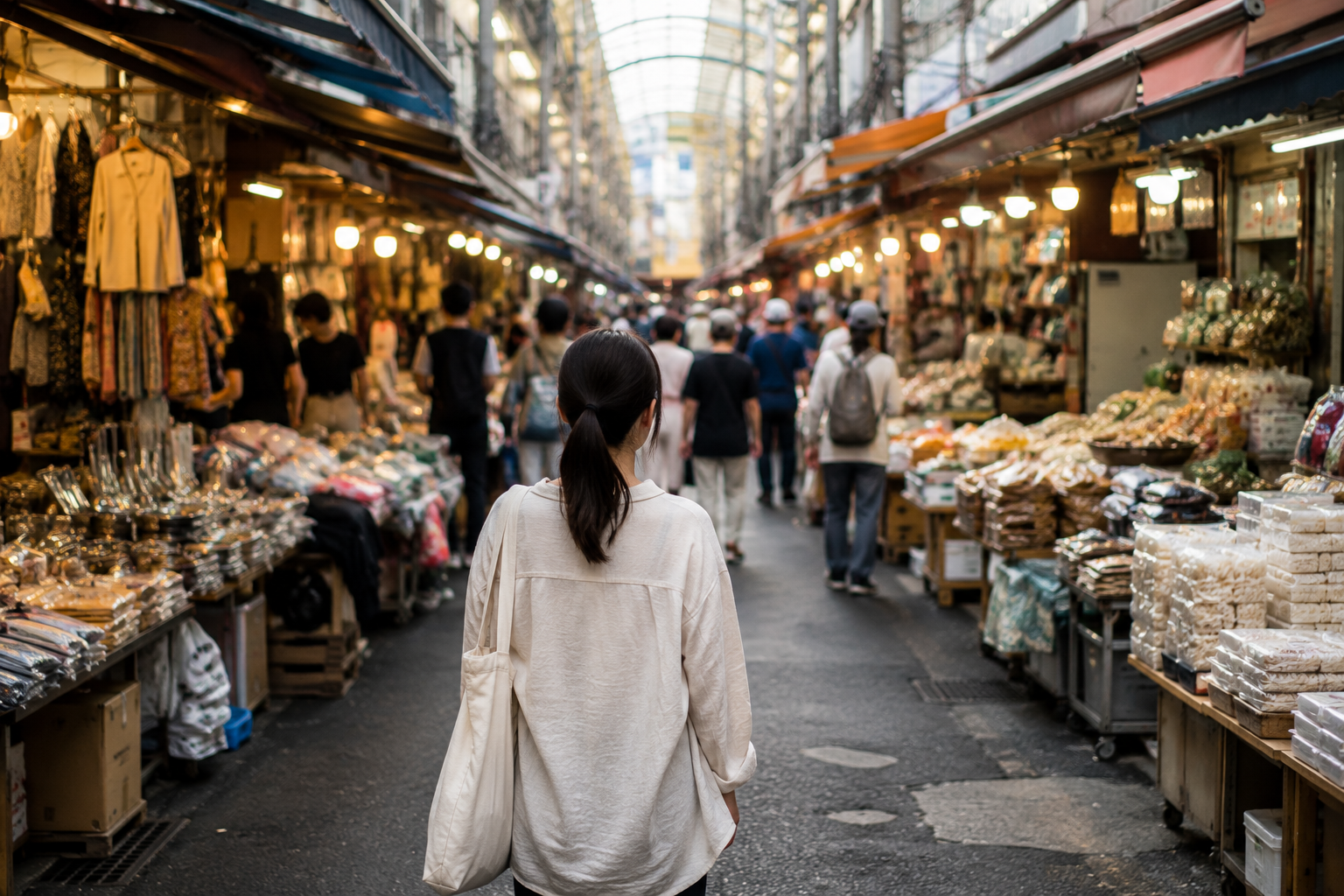
Korean market streets are not only places to buy food or souvenirs. They are practical, crowded, layered spaces where everyday life, small businesses, eating, shopping, and local movement all meet.
Korean Market Streets Are More Than Tourist Spots
For many visitors, Korean markets first appear as places to try street food, take photos, or buy small souvenirs. That is one part of the experience, but it is not the whole picture.
Many Korean market streets are still practical shopping areas. People go there to buy vegetables, side dishes, bedding, dishes, clothes, stationery, toys, household goods, fabric, shoes, or small daily items. Some visitors may walk through a market casually, but many local shoppers visit with a clear purpose.
This is one reason Korean market streets can feel different from ordinary shopping streets. They are not always designed for slow browsing. Some parts are for eating, some are for wholesale or retail shopping, some are for quick errands, and some are simply passageways used by people who already know where they are going.
For visitors, understanding this makes the market easier to enjoy.
Why Namdaemun Market Is a Useful Example
Namdaemun Market in Seoul is one of the easiest examples to think of when explaining Korean market streets. It is not only a place for tourists. It is a large, layered market area where many different categories of goods are gathered close together.
For CoreaDesk, Namdaemun Market is probably the market visited most often over the years. Those visits were not only for sightseeing. There were visits for food alleys, household goods, stationery, toys, dishes, bedding, children’s clothing, women’s clothing, and other practical items. Sometimes the purpose was to compare products. Sometimes it was to buy something specific. Sometimes it was simply to eat there after finishing an errand.
Even after many visits, Namdaemun still does not feel like a place that can be fully understood in one afternoon. There are many inner alleys, side streets, upper floors, small shops, and product sections that a casual visitor may not notice.
At other times, the market may only be something passed by on foot. From the outside, a person might look briefly at the busy edges, the signs, the food stalls, and the movement of people, then continue walking. That is also a common way to encounter a Korean market: not as a planned tour, but as part of the city’s daily street life.
Markets Are Easier to Understand With a Purpose
A Korean market can feel overwhelming if you enter it without any idea of what you want to see. There may be too many signs, shops, sounds, products, and people moving in different directions.
But the same market becomes easier to read when you have a purpose.
If you are looking for bedding, you begin to notice shops selling blankets, pillows, covers, and fabric. If you are looking for dishes, you begin to see bowls, plates, cups, and kitchenware. If you are looking for children’s clothes or stationery, you may find that entire streets or buildings seem to focus on that category.
This is different from a department store, where each floor is clearly arranged and signs are easy to follow. A market often reveals itself through repetition. After passing several similar shops, you begin to understand what that part of the market is for.
Visitors do not need to buy something to enjoy a market street. But having a small purpose, even a simple one, can make the visit more meaningful. It helps you notice how the market is organized and why local people still use it.
Food Alleys Are Only One Part of the Market
Food is often the most visible part of Korean market culture. Market food alleys can be lively, warm, and memorable. They may have small restaurants, noodle shops, dumplings, fried snacks, rice dishes, soup, pancakes, or quick meals served in compact spaces.
For many visitors, this is the most enjoyable part. It is also the part most often shown in travel videos and social media posts.
But food alleys are only one part of the market.
In a large market area, eating places may sit beside clothing shops, kitchenware shops, bedding stores, imported goods, repair shops, accessory stores, and delivery carts. A visitor who only looks for food may miss the way the market works as a daily commercial space.
This is why it is better to see food as an entrance into the market, not the whole market itself.
Why Market Streets Can Feel Crowded or Fast
Korean market streets can feel busy because many things happen at once. Shoppers stop suddenly to look at items. Shop owners speak to customers. Delivery workers move through narrow lanes. Small trucks, carts, motorcycles, and people may share limited space in older market areas.
The walking rhythm can feel different from a shopping mall. In a mall, people usually move slowly and the path is wide. In a market, space is more compressed. People may walk close to each other, pause near a stall, step aside for a cart, or move quickly because they know exactly where they are going.
For visitors, this can feel confusing at first. The best approach is to slow down, stay aware of the space around you, and avoid blocking narrow paths while checking a phone or taking photos.
Markets are not only places to look around. They are working spaces.
Cash, Cards, and Small Purchases
Many shops in Korea accept cards, and card payment is common in daily life. However, small market shops, food stalls, older vendors, or very small purchases may not always feel the same as paying in a large store.
Some vendors may accept cards easily. Some may prefer cash for small amounts. Some may use mobile payment or account transfer. The situation can vary by shop, market, and item.
Visitors do not need to overthink this, but it is useful to carry a small amount of cash when visiting a market. It can make small purchases easier, especially for snacks, low-priced items, or older stalls.
At the same time, it is better not to assume that every market shop is cash-only. Korea is highly card-friendly overall, but market streets can still include a mix of payment habits.
Why Large Luggage Can Be Uncomfortable
If you are visiting a busy Korean market, it is better not to bring a large suitcase.
Market streets can be narrow, crowded, and uneven. Some shops have goods displayed near the entrance. Food alleys may have people waiting, eating, ordering, and moving in opposite directions. In these spaces, a suitcase can quickly become inconvenient for both the visitor and the people around them.
Before visiting a large market, it is better to leave luggage at a hotel, station locker, or another storage option if possible. A lighter bag makes it easier to walk, compare items, eat, and move without blocking the path.
This is especially important if you plan to visit during lunch hours, weekends, holidays, or busy travel seasons.
Taking Photos Respectfully
Korean market streets are visually interesting. Signs, food stalls, baskets, fabrics, dishes, clothing, and old shopfronts can make the space feel very photogenic.
But visitors should be careful with photography.
A market is not only a tourist background. It is also someone’s workplace. Shop owners, customers, workers, and local residents may not want to be photographed closely. Some shops may not like photos of their products, prices, or displays, especially if the photo is taken without asking.
Taking a general street photo from a respectful distance is usually less intrusive. But close-up photos of people, shop interiors, or products should be taken carefully. When in doubt, ask first or put the camera away.
A good market visit does not require photographing everything.
How Market Streets Change by Time of Day
A Korean market street can feel very different depending on the time of day.
In the morning, some areas may feel practical and businesslike. Vendors prepare goods, delivery carts move through the alleys, and local shoppers arrive early. Around lunchtime, food areas may become crowded. In the afternoon, browsing may feel easier in some sections, while other shops may already be busy with regular customers.
Evening conditions vary. Some market food areas become more active, while certain retail shops may close earlier than visitors expect. Wholesale or specialized sections may also follow different rhythms from tourist-facing streets.
This is why checking opening hours is useful, especially if you are visiting a specific shop or product section. A market may be “open” as an area, but not every shop inside it follows the same schedule.
What Visitors Can Notice Beyond Shopping
A market street shows more than products.
It shows how a city uses space. It shows what people still prefer to buy in person. It shows which goods are grouped together, which food is eaten quickly, which shops have regular customers, and how older commercial areas continue to exist beside newer cafés, office buildings, subway stations, and tourist routes.
In a place like Namdaemun, the market is not separated from the city. It connects with nearby offices, roads, hotels, subway stations, and walking routes. A person may visit with a clear shopping purpose, stop for a meal, pass through on the way somewhere else, or simply notice the market from the edge.
That layered quality is part of what makes Korean market streets interesting. They are not always neat or easy to summarize. But they show real movement.
What to Check Before Visiting a Korean Market Street
Before visiting a Korean market, it helps to check a few simple things.
First, check where the market is and which entrance or street is closest to your purpose. Large markets may have several entrances, and different sections may sell different goods.
Second, check whether you are visiting for food, shopping, or simple walking. This changes how much time you need and what kind of bag you should carry.
Third, avoid bringing large luggage if the market is crowded or narrow.
Fourth, prepare both a card and a small amount of cash.
Fifth, be patient with the pace of the market. It may feel crowded, but much of that movement comes from the fact that the market is still being used for everyday life.
Final Thoughts
Korean market streets are often introduced through food, but food is only one layer. Markets are also places for errands, comparison shopping, small purchases, meals, deliveries, and daily movement.
For visitors, the best way to understand a market is not necessarily to see everything. It may be better to enter with a small purpose, notice how the streets are organized, and accept that one visit will only show part of the place.
Namdaemun Market is a good example. Even after many visits, it can still feel unfinished, as if there are more alleys, shops, and sections left to discover. That is not a weakness. It is part of how large Korean market streets work.
A Korean market is not just a place to look at. It is a place still being used.
Sources and Useful Links
- Visit Seoul – Namdaemun Market
https://english.visitseoul.net/shopping/namdaemun-market/ENP000085 - Seoul Metropolitan Government – Tourism and shopping information
https://english.seoul.go.kr - Korea Tourism Organization – Traditional markets and travel information
https://english.visitkorea.or.kr