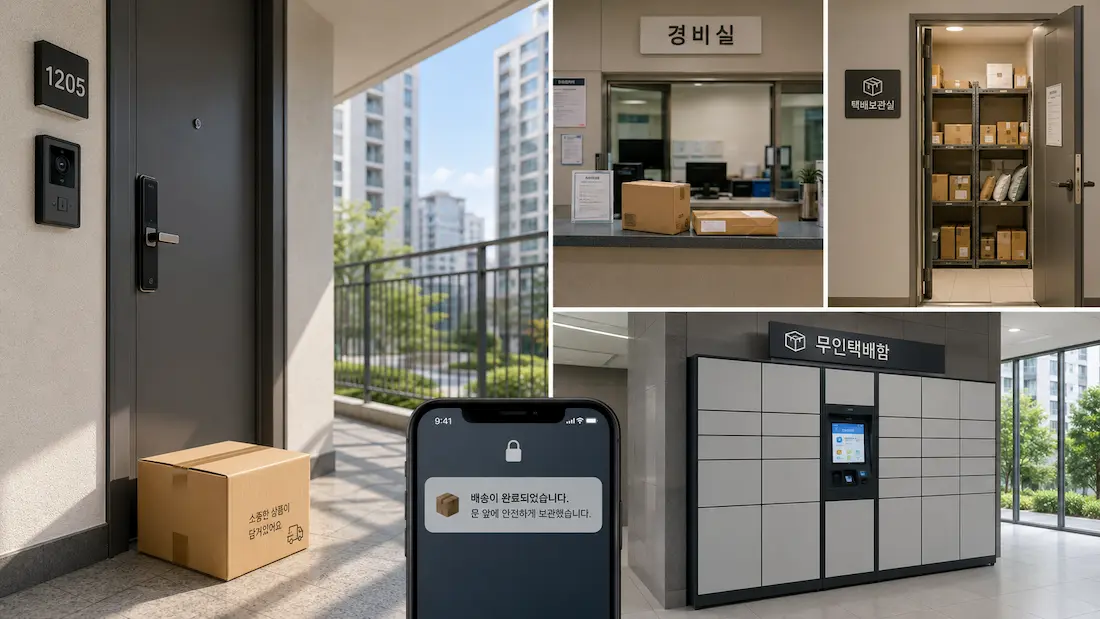
Package delivery in Korea is usually fast, quiet, and often contactless. For newcomers, the most confusing part is not only the speed of delivery, but also where the package is left. A parcel may be placed in front of the door, at the security office, in a parcel room, or inside an unmanned parcel locker depending on the building.
Why package delivery feels different
For many people living in Korea, receiving a package does not usually mean waiting at home for a delivery driver. In apartments, officetels, villas, dormitories, and office buildings, parcels are often delivered without a face-to-face meeting.
This can feel unfamiliar to visitors or new residents from countries where delivery often requires a signature, a scheduled time window, or direct handover. In Korea, a package may be left in front of the door, at the building entrance, with the security office, in a parcel room, or inside an unmanned parcel locker.
The exact method depends on the type of building, the neighborhood, the delivery company, and the instructions entered when the order is placed. This is why two people living in different buildings in the same city may have very different delivery experiences.
Doorstep delivery is common, but not universal
In many Korean apartments and officetels, doorstep delivery is one of the most common ways to receive a package. The delivery driver leaves the parcel in front of the unit door and sends a notification, often by text message, app alert, or photo.
This style of delivery became even more familiar during and after the COVID-19 period, when contactless services became part of daily life. Online shopping, food delivery, grocery delivery, and parcel delivery all became more closely connected to everyday routines.
However, it is better not to describe Korean delivery as “always” or “100 percent” contactless. There are still cases where the driver may call, leave the item with building staff, use a parcel room, or follow a rule set by the building.
A more accurate way to understand it is this: contactless delivery is very common in Korea, but the final receiving method changes depending on where a person lives or stays.
Why some packages go to the security office
In many Korean apartment complexes, the security office is more than a guard post. Depending on the building, it may also help manage visitors, parking, notices, and sometimes package storage.
If a resident is not home, or if the building has rules about where packages should be placed, a parcel may be left at the security office. In some older apartment complexes, this is still a familiar delivery pattern.
For foreigners living in Korea, this is an important detail. If the tracking message says the package was delivered but nothing is in front of the door, the next place to check may be the security office or building management area.
Still, this system is not the same everywhere. Some apartment complexes no longer allow many packages to be stored at the security office because of limited space, staff workload, or responsibility issues. Other buildings use parcel rooms or lockers instead.
This is one reason newcomers should not assume that every Korean apartment works the same way.
Parcel rooms in dormitories and large buildings
In university dormitories, company housing, large office buildings, and some shared residences, packages may be collected in a separate parcel room.
This is common in places where many people receive deliveries every day. Instead of placing parcels in front of every room, the building gathers them in one managed space. Residents usually find their package by name, room number, phone number, or delivery notice.
For students or employees living in dormitory-style housing, this system can be convenient, but it requires attention. A package may not be brought directly to the room. The resident may need to check a notice, visit the parcel room during operating hours, or collect the item before the storage period ends.
This matters especially for fresh food, cosmetics, medicine, electronics, or items that should not be left unattended for too long. Even when delivery is fast, the item can still sit in a parcel room if the resident does not check the message carefully.
Many people in Korea learn this pattern after checking the front door first, only to realize later that the package was waiting in a building storage area.
How unmanned parcel lockers work
Unmanned parcel lockers are another part of Korea’s delivery culture, but they are not used by everyone.
They can be found in places such as university dormitories, public facilities, residential complexes, subway stations, offices, and large buildings. Some lockers allow users to receive packages by entering a password, phone number, authentication code, or message sent after delivery.
The main advantage is flexibility. A person may be able to pick up a package without meeting staff or a delivery driver. This can be useful for students, workers, single-person households, and residents who are rarely home during the day.
Seoul also operates a public safe parcel locker service in many locations across the city. According to Seoul Metropolitan Government information updated in 2026, the service is available to Seoul citizens, installed in more than 220 locations, and generally operates 24 hours a day, though some locations may differ. The service is designed for people who find it difficult or uncomfortable to receive parcels directly at home.
However, parcel lockers are not the default method for every household in Korea. Many people still receive packages at the door, at the security office, or in a building parcel room. Lockers are best understood as one option within Korea’s broader contactless delivery culture.
What newcomers should check before ordering
If you are new to Korea, the most important step is to understand how your building handles deliveries.
Before ordering, check your address carefully. Apartment name, building number, unit number, dormitory name, floor, and room number should be written clearly. In Korea, a small address mistake can send a package to the wrong building, especially in large apartment complexes, campuses, officetel buildings, or company housing.
It is also useful to check whether your building uses doorstep delivery, a security office, a parcel room, or an unmanned locker. If you live in a dormitory, guesthouse, company residence, or short-term rental, there may be specific rules for receiving packages.
Delivery instructions can also matter. Many Korean shopping platforms and delivery services allow customers to leave a short request, such as “leave in front of the door,” “call before delivery,” or “leave at the security office.” The available options differ by service.
If the package is marked as delivered but cannot be found, check these places first:
- in front of your unit door
- building entrance or lobby
- security office
- parcel room
- unmanned locker message
- building management office
- delivery app or text notification
For hotels, guesthouses, and short-term stays, it is better to ask the accommodation first before ordering. Some places accept parcels for guests, while others may refuse delivery or require the guest’s name and check-in date to be written clearly.
Why this reflects Korean daily life
Package delivery in Korea is not only a logistics service. It also reflects how people live in dense cities, apartment complexes, campuses, and fast-moving daily routines.
Many people are away from home during the day but still expect packages to arrive quickly and safely. Buildings have developed different ways to handle this. Some rely on doorstep delivery, some on security offices, some on parcel rooms, and some on lockers.
This is why Korean delivery culture can feel both convenient and confusing at first. The system works smoothly once you understand the local pattern, but the pattern is not identical in every building.
For newcomers, the key is not simply knowing that delivery in Korea is fast. It is knowing where the package is likely to be placed.
Key takeaways
Package delivery in Korea is often contactless, but it is not handled the same way in every building.
Doorstep delivery is common in apartments and officetels, especially for everyday parcels.
Some buildings still use security offices for package storage.
Dormitories, company housing, and large buildings may use parcel rooms.
Unmanned parcel lockers are useful, especially in public facilities, campuses, offices, and some residential areas, but they are only one part of the system.
New residents should check their building’s delivery rules before ordering.
Final thoughts
For people staying in Korea for the first time, package delivery may seem surprisingly simple. A message appears, and the item is often waiting quietly at the door or in a designated space.
But behind that simple moment is a delivery culture shaped by dense housing, online shopping, building management systems, and the wider shift toward contactless daily services.
Understanding where your package will be left is a small but important part of settling into everyday life in Korea.