I used to think of convenience stores in Korea as places for small, urgent needs.
A quick snack late at night.
A cold drink on the way home.
Something simple to buy when the supermarket felt too far away.
For a long time, that was my image of the convenience store near home. Useful, familiar and open when other places were closed, but not a place I thought about very deeply.
That changed when my workplace moved.
The new office was in an early-stage new town area. There was no company cafeteria. There were not many proper lunch restaurants nearby. At first, lunchtime felt inconvenient. I had to find something quickly between work hours, and the easiest option was often the convenience store.
At first, I did not expect much.
But after using it for lunch several times, I began to notice something I had missed.
The convenience store was no longer just a 24-hour mini-supermarket.
It had lunch boxes, triangle gimbap, sandwiches, salads, fried snacks, desserts, coffee, pouch drinks, ready meals and seasonal products. Some items were simple. Some were average. Some were better than expected.
More than anything, it solved a very ordinary problem: what to eat when there is no time, no cafeteria and no easy restaurant nearby.
That was when my view of Korean convenience stores changed.
Why Convenience Stores Matter in Korea
Convenience stores are everywhere in Korea.
The main chains include CU, GS25, 7-Eleven and Emart24. Each brand has its own products, private-label items, collaborations, snacks, drinks, lunch boxes and seasonal promotions.
The exact number of stores can vary depending on the source and counting method, but the larger point is clear. Convenience stores are deeply woven into daily urban life in Korea.
This density matters because convenience stores are not only emergency shops.
In Korea, a convenience store can be a breakfast stop, a lunch solution, a late-night meal, a coffee stop, a snack break or a small service point during the day.
Students use them.
Office workers use them.
People living alone use them.
Travellers use them when they are tired, hungry or curious.
A restaurant shows one side of Korean food culture.
A traditional market shows another.
A convenience store shows what people eat when they are busy, working late, studying, commuting or simply trying to solve the next meal without much effort.
That ordinary perspective is valuable.
Why Foreign Visitors Notice Them
Many foreign visitors now include a convenience store visit as part of their Korea travel experience.
Convenience stores appear in Korean dramas, variety shows, YouTube videos, travel blogs and social media content. Visitors often want to try what they have seen online: instant ramen cooked in-store, triangle gimbap, lunch boxes, ice cups with pouch drinks, banana milk or limited-edition snacks.
For many travellers, convenience store food feels less intimidating than ordering from a restaurant menu written only in Korean.
You do not need a reservation.
You do not need to understand a long menu.
You can try several small items without spending much.
If you are staying in a hotel or guesthouse, it can also be a simple way to eat when you are too tired to sit in a restaurant.
That practicality is part of the appeal.
But convenience stores are not interesting only because they are fun for tourists.
They are interesting because they show how ordinary people in Korea actually solve small food problems during the day.
What to Try First
For first-time visitors, the selection can feel overwhelming.
These are some common items to start with.
Triangle gimbap is one of the most familiar convenience store foods in Korea. It is a triangular rice snack wrapped in seaweed, usually filled with tuna mayo, kimchi, bulgogi, spicy chicken or other fillings.
Dosirak, or lunch boxes, are more filling. They may include rice, meat, kimchi, egg, vegetables, sausages or side dishes.
Cup noodles are a classic choice. Many stores have hot water machines, and some larger or tourist-friendly stores have ramen cooking machines.
Pouch drinks with ice cups are another easy-to-find Korean convenience store experience. You buy a drink pouch and pour it into a plastic cup filled with ice.
Banana milk is simple, sweet and nostalgic for many Koreans. It is also one of the easiest items for foreign visitors to recognise.
Korean snacks and desserts change often. Cream breads, rice cakes, flavoured chips, chocolate snacks, seasonal desserts and collaboration products can appear for a short time and disappear quickly.
The best approach is not to expect every item to be amazing.
Buy a few small things.
Try them as part of everyday Korea.
Convenience Store Lunch Became More Serious Than I Expected
The biggest surprise for me was lunch.
Before my workplace moved, I rarely thought of convenience stores as a real lunch option. I used them when I needed something late at night or when I wanted a quick snack near home.
But when there was no cafeteria and few restaurants near the office, the convenience store became practical.
At first, I chose it because there was no better option.
Later, I chose it because it was convenient, predictable and better than I expected.
The lunch boxes were more varied than I remembered. Some had rice and meat. Some had side dishes. Some were designed for people who wanted a lighter meal. There were sandwiches, gimbap, salads, yoghurt drinks, coffee and small desserts.
It was not restaurant dining.
It was not home cooking.
But it was useful.
And in the middle of a workday, useful matters.
That experience changed my standard for convenience stores. I stopped seeing them only as places for emergency snacks. I began to see them as part of how Korean office workers manage time, cost and routine.
Recommended Convenience Store Foods by Situation
If you are looking for breakfast, try a triangle gimbap, banana milk and a small yoghurt drink. It is a quick and common combination for busy mornings.
If you need a quick lunch, a dosirak lunch box with bottled tea is a practical choice. Most stores provide microwaves for heating meals.
If you are hungry late at night, cup noodles and a snack are popular options among both locals and travellers, especially after a long day of sightseeing.
If you want to try something more local, look for seasonal snacks, rice cakes, banana milk, pouch drinks with ice cups and limited-edition collaboration products that are difficult to find outside Korea.
If you are an office worker in an area without many restaurants, a convenience store lunch can feel less like a travel experience and more like a small daily solution.
That difference matters.
For visitors, it may be fun.
For residents, it may be practical.
The Rise of Ready Meals
Convenience store food in Korea has become more serious over time.
Ready meals, lunch boxes, sandwiches, gimbap, salads, fried chicken and prepared foods are no longer treated only as last-minute options. For many people, they are part of ordinary food spending.
Major chains have continued to strengthen prepared food offerings as demand for quick and affordable meals grows.
This does not mean every convenience store meal is excellent.
Some are good.
Some are average.
Some are mainly useful because they are close, fast and available.
The honest point is this: Korean convenience stores are improving their food range because customers expect more than snacks.
When people use convenience stores for lunch, the standard naturally rises.
They expect better rice.
They expect more filling meals.
They expect more choices.
They expect products that feel acceptable during a workday, not only after midnight.
Private Brands and Collaborations
One reason Korean convenience stores feel different is the speed of product change.
Chains often release private-brand products, limited-edition snacks, celebrity collaborations, restaurant-linked meals, character packaging and seasonal drinks. Some items become popular online, sell out and return later in a different form.
This makes convenience stores feel like small trend laboratories.
For travellers, this can be fun. You may find a flavour or product that does not exist in your country. You may also notice how quickly Korean retail responds to changing trends.
Still, not every collaboration is worth trying.
Some are more about packaging than taste.
Some look better online than they taste in real life.
The best approach is to treat convenience stores as a place for small discoveries, not as a guarantee of amazing food.
How Logistics Shapes the Experience
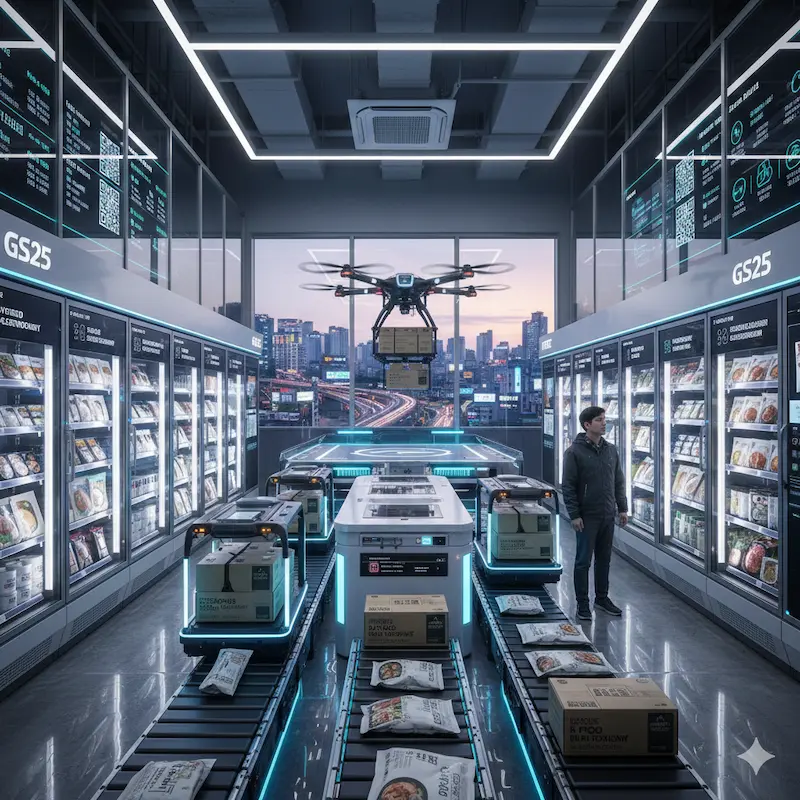
Korean convenience stores work because the supply chain is organised and frequent.
Ready meals, drinks, fresh items and seasonal products can move quickly from production centres to stores. This allows chains to update products often and keep shelves stocked in busy areas.
For visitors, the practical result is easy to see.
Stores may be small, but products are often replenished regularly.
This does not mean Korea is uniquely perfect in convenience store logistics. It simply means the system is built to support frequent use and fast product turnover.
For office workers, this matters more than it may seem.
If a store near the office has fresh lunch boxes at the right time, it can become part of the work routine.
If the shelves are empty by lunchtime, it becomes less useful.
In convenience stores, timing is part of the service.
Convenience Store Etiquette in Korea
Most convenience stores in Korea are easy to use, but a few small habits help.
If the store has a seating area, use it neatly and avoid staying too long when it is crowded.
After eating, return trays or disposable containers to the proper area if one is provided.
Many stores have microwaves, hot water machines, chopsticks, spoons, napkins and sometimes ramen cooking machines. These are usually simple to use, but procedures may differ slightly by store.
Rubbish separation also matters. Korea takes recycling seriously, and some stores separate plastic, paper, food waste and general waste.
It is also considerate not to block the counter, microwave or hot water area while deciding what to eat. Many customers are using the store on their way to work, school or home.
At lunchtime, this becomes especially clear.
People are moving quickly.
Some are choosing lunch boxes.
Some are waiting for the microwave.
Some are paying for coffee before returning to the office.
A convenience store may look casual, but it has its own small rhythm.
What Travellers Should Know Before Buying
Check the expiry date on fresh foods and lunch boxes.
Use the microwave if the item is meant to be heated.
Ask staff if you are not sure, or use a translation app.
Look for allergen information if you have dietary restrictions.
Do not assume a vegetable item is vegetarian. It may contain fish sauce, meat seasoning, tuna, egg or ham.
Be careful with spicy labels. Korean convenience store food can be hotter than expected.
Sort rubbish properly if the store has recycling bins.
Many stores have small eating areas, but not all do. Some are designed mainly for takeout.
If you are using a foreign card, payment is usually easy in major chains, but it is still useful to carry a backup payment method.
Also remember that convenience store food is convenient food.
It can be useful, enjoyable and surprisingly varied.
But it should not be treated as automatically healthier, cheaper or better than every other meal option.
Why This Matters for Korean Food Culture
Convenience store food may look ordinary, but it says a lot about modern Korea.
It reflects fast-paced urban life, long working hours, small households, late-night routines, rising lunch costs and the need for quick meal options.
This is why convenience stores are useful for foreign visitors.
They show a side of Korean food culture that is not polished for special occasions.
A famous restaurant may show technique.
A traditional market may show history.
A convenience store shows routine.
It shows how people eat when they have twenty minutes, when they are tired, when they are between meetings or when the neighbourhood does not offer many choices.
For me, the change was personal but simple.
Once I had to depend on a convenience store for lunch, I understood it differently.
It was no longer just the place near home for a late-night snack.
It became part of the way Korea solves everyday inconvenience.
What Not to Exaggerate
Korean convenience stores are interesting, but they should not be oversold.
They are not replacing restaurants.
They are not gourmet kitchens.
They are not always healthy.
They are not always cheaper than cooking at home.
They are not automatically sustainable.
They are not perfect digital food hubs.
Some items are fun.
Some are useful.
Some are forgettable.
That honesty makes the topic stronger.
Convenience stores are valuable not because every product is special, but because they fit into real life.
They are there when people need something quick, small, warm, cold, cheap, sweet, filling or familiar.
That is their strength.
Final Thoughts
Korean convenience store food is worth trying because it is part of everyday life.
It is not the most traditional Korean meal.
It is not the most refined.
It is not the most beautiful.
But it is real.
A triangle gimbap after a long subway ride, cup noodles on a rainy evening, banana milk in the morning or a lunch box near the office can tell you something about Korea that a famous restaurant cannot.
For many visitors, some of the most memorable food experiences in Korea do not happen in famous restaurants.
They happen while choosing a late-night snack, heating a lunch box after a long day of sightseeing or trying a drink that does not exist back home.
For residents, the feeling can be even more practical.
A convenience store becomes useful when there is no cafeteria, no nearby restaurant, not enough time or simply no energy to think too much about lunch.
That is why my view changed.
The convenience store was not just a place that stayed open late.
It was a place that quietly solved a small problem in the middle of an ordinary workday.
That everyday experience helps explain why Korean convenience stores stay in people’s memory long after the meal is finished.
Sources / Further Reading
Korean retail and travel reports — convenience store chains and store density
Korean media coverage — convenience stores targeting foreign tourists
Korean retail coverage — office workers and convenience store lunch boxes
Korean travel guides — common convenience store foods such as triangle gimbap, dosirak, ramen and ice-cup drinks
Convenience store brand materials — CU, GS25, 7-Eleven and Emart24 product categories
Google Search Central — Creating helpful, reliable, people-first content