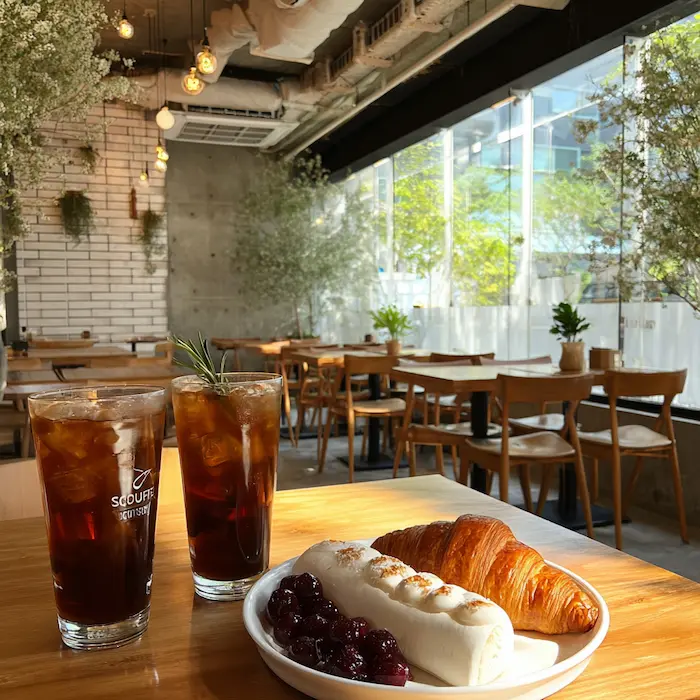
Walk into a café in Seoul on a weekday afternoon, and the first thing you notice may not be the coffee.
Someone is working on a laptop.
Someone is studying with a textbook and a tablet.
Someone is watching a video with earphones.
Someone is sitting alone by the window, not doing much at all.
To many foreign visitors, Korean café culture first appears stylish. That impression is understandable. Korea has many cafés with carefully designed interiors, seasonal drinks, large desserts and photo-friendly corners.
But the visual side is only part of the story.
For many people in Korea, cafés are not only places to drink coffee. They are temporary personal spaces outside home, school and work. They are places to study, wait, meet, rest, think, work quietly or spend time alone without feeling out of place.
That is why Korean cafés often feel like more than coffee shops.
Coffee Is the Reason to Enter. Space Is the Reason to Stay.
Korean café culture is often introduced overseas through beautiful interiors.
Minimal cafés, rooftop views, themed spaces, hanok cafés, dessert cafés and photogenic drinks are all part of the image. Those spaces do exist, and they are one reason visitors enjoy café-hopping in Seoul.
But everyday café culture is broader than that.
A person may choose a café because the table is wide enough for a laptop. Another may choose one because the music is not too loud. Someone else may care about lighting, seat comfort, charging outlets, window views or whether the café feels comfortable for sitting alone.
The drink matters, but the space often matters just as much.
Coffee is the reason to enter. Space is the reason to stay.
Why Cafés Became Useful Urban Spaces
The popularity of cafés in Korea is not only about taste or trend. It is also connected to urban life.
In large cities such as Seoul, many people live, study and work in dense neighbourhoods. Some young adults live in small apartments, studios or officetels where it can be difficult to separate rest, work, study and personal time.
A café offers a simple change of setting.
It gives people a table that is not their kitchen table.
It gives them background noise without direct conversation.
It gives them a place where being alone does not feel strange.
It gives them a short break from the routine of home, school or office.
This does not mean every café welcomes long stays. Some busy cafés need quick turnover. Some limit laptop use during crowded hours. Some have signs asking customers not to occupy large tables alone or leave belongings unattended.
That balance matters.
A café may feel personal to the customer, but it is still a shared business space.
The Rise of Solo Café Time
Another reason cafés matter in Korea is the growth of single-person lifestyles.
Single-person households have become the largest household type in South Korea. This does not mean every person living alone uses cafés often. But it does help explain why public spaces that feel comfortable for solo use have become more important.
Cafés fit that need well.
In Korea, sitting alone in a café is not unusual. A person can order coffee, sit by the window, read a book, watch a video, write notes or simply rest. Other customers usually do not pay much attention.
Many cafés also make solo use easy. Some have window-facing seats, small individual tables, charging outlets, quiet corners and seating layouts that do not require conversation.
This is one of the details foreign visitors may miss.
Korean cafés are social spaces, but they are also places where people can be alone comfortably.
If you are looking for quieter places to slow down in the capital, see our Quiet Seoul guide.
Cafés as Study Rooms and Workspaces
One of the most familiar scenes in Korea is a café filled with people studying or working.
Students prepare for exams. Freelancers answer emails. Office workers revise documents. Job seekers edit applications. Creators work on writing, design or video projects.
This habit is sometimes called “cagong,” a shortened Korean expression that combines café and studying.
The word is useful because it describes a real pattern. Many people use cafés as flexible study or work spaces. But it also points to a tension.
A café is not a private office. It is not a library. It is not a rented study room. It is a shared commercial space.
That tension became visible in 2025, when Starbucks Korea reportedly asked customers not to bring large office equipment such as desktop computers, printers, power strips or desk dividers into stores. Most café users do not behave that way. Many simply bring a laptop, notebook or tablet. Still, the case showed how far the work-and-study café habit had gone in some places.
The lesson is not that working in cafés is wrong.
The lesson is that café space has limits. Long stays, large equipment, loud calls and unattended seats can affect other customers and the business itself.
The Value of a Pause
Foreign visitors often focus on the visual side of Korean cafés: the interior, the dessert, the view, the photo spot.
Those things matter. But they do not fully explain why people return.
For many people, the emotional value of a café is just as important as the design.
Modern Korean life can move quickly. Students face exam pressure. Workers deal with commuting, deadlines and social expectations. Cities can feel crowded and tiring.
A café gives people a small pause.
Someone may not be there for deep conversation or serious work. They may simply want to sit somewhere clean, warm and calm before going home. They may want to be around people without having to talk. They may want a place where they can be quiet without feeling lonely.
That ordinary rest is easy to overlook.
But it is one reason cafés have become part of daily life.
Why Atmosphere Matters
In Korea, many customers choose cafés based on atmosphere as much as coffee.
They may think about seating comfort, table spacing, lighting, noise level, music volume, view, interior mood, charging outlets and how comfortable it feels to sit alone.
This is why two cafés selling similar drinks can feel completely different.
One café may be good for studying. Another may be better for a date. Another may be comfortable for reading alone. Another may be better for a long conversation with a friend.
Many customers do not simply ask, “Where is the best coffee?”
They may ask a different question:
“What kind of place do I need today?”
That is also why some atmosphere-focused cafés remain popular even when they are expensive. Customers are not only paying for a drink. They are paying for a temporary environment.
Cafés as Korea’s Modern Third Places
Sociologists often use the term “third place” to describe spaces outside home and work where people can spend time and feel socially comfortable.
In Korea, cafés often play that role for urban customers.
Friends meet there instead of inviting each other home. Couples go there before or after dinner. Students study there between classes. Remote workers spend part of the day there. People travelling alone may stop at cafés because they feel easy to enter.
This does not mean cafés have replaced every other public space. Parks, libraries, restaurants, shopping malls, study cafés and community spaces still matter.
But cafés have become one of the most visible and flexible third places in Korean cities.
They are easy to enter.
They are socially simple.
They do not require a big plan.
They allow people to stay alone or meet others.
That flexibility helps explain why cafés remain important in daily urban life.
For more context on everyday behaviour and social spaces in Korea, explore our Culture & Etiquette guide.
What Foreign Visitors Often Miss
Tourists often notice famous café districts such as Seongsu, Yeonnam, Ikseon-dong or Hannam. These areas are interesting, and many cafés there are designed to be visited.
But the more revealing side of Korean café culture is often found in ordinary neighbourhoods.
A small café near an apartment complex.
A franchise café near a subway station.
A quiet local café with students sitting for hours.
An office-area café full of people typing after lunch.
A person sitting alone by the window after work.
These scenes may not look as exciting as viral travel videos. But they show how cafés fit into everyday Korean life.
Korean café culture is not only about trends.
It is also about how people create small pockets of personal space inside dense, fast-moving cities.
The Limits of Café Culture
Cafés can feel welcoming, but the culture has limits.
Some cafés are crowded, expensive or noisy. Some customers stay too long after buying one drink. Some occupy large tables alone during busy hours. Some take work calls loudly. Some cafés feel more designed for photographs than comfort.
Café owners also face rent, labor costs, competition and seat turnover pressure. A beautiful interior does not mean a business is easy to run.
This side should not be ignored.
If cafés are shared urban spaces, then shared manners matter. Customers should follow store rules, avoid taking up more space than necessary, order appropriately, keep noise low and leave during crowded times if they have stayed for a long period.
A café can feel like a personal room, but it is not only personal.
It belongs to the business, the staff and other customers too.
Why This Culture Matters
Korean cafés are interesting because they show how urban life changes the meaning of ordinary spaces.
A café can be a place to drink coffee.
It can also be a study room, waiting room, quiet office, date spot, resting place or comfortable place to be alone.
That flexibility explains why cafés have become so visible in Korean daily life.
For foreign visitors, understanding this makes Korean café culture easier to read. The beautiful interiors are one part of the story. The everyday use of these spaces is just as important.
A Korean café is not always just a coffee shop.
Sometimes it is the room between home and work, between noise and silence, between being alone and being part of the city.
Official Information and Further Reading
- Ministry of Data and Statistics — 2024 Population and Housing Census
- UPI — Starbucks Korea Policy on Large Office Equipment
Information reviewed: September 2026.