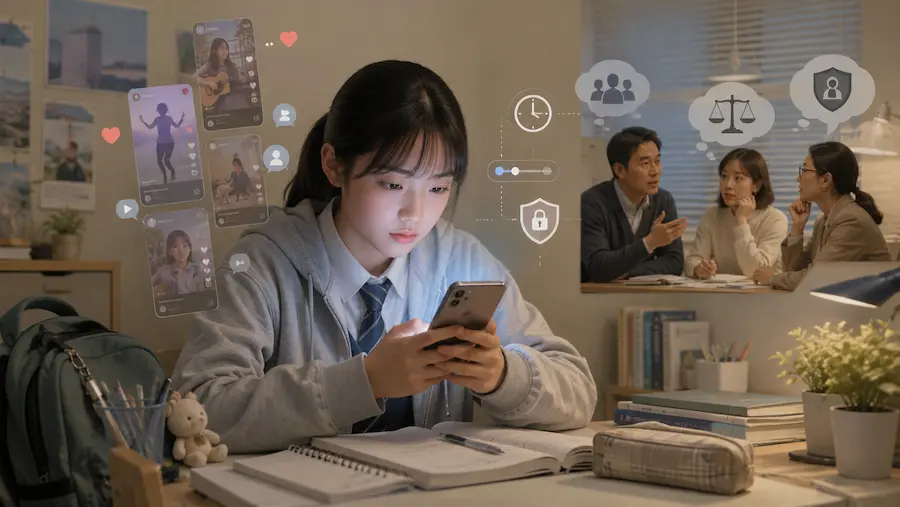
South Korea has not banned teenagers from social media.
What is happening now is more careful than that.
The Korean government is discussing stronger rules for teen social media use, including age-based limits, stronger age checks, restrictions on addictive design, and more responsibility for platforms.
This is still an ongoing policy debate and legislative push, not a completed ban.
What Is Korea Discussing?
Korean policymakers are looking at several possible rules for teen social media use.
One idea is to restrict social media sign-ups for children under 14.
Another is to place stronger limits on how social media platforms expose teenagers aged 14 to 19 to addictive design features and recommendation algorithms.
The discussion also includes age verification, parental controls, autoplay features, short-form video feeds, and platform responsibility.
In simple terms, the debate is not only about whether teenagers should use social media.
It is about how platforms are designed, how long they keep young users watching, and whether younger users are being protected enough.
Why Is This Becoming an Issue?
Teen social media use has become a larger concern because smartphones are already part of everyday life.
Teenagers use phones to message friends, watch videos, follow trends, check school-related information, and fill small breaks between school, academies, and home.
I often see how naturally younger family members move between messaging, short videos, games, and school-related phone use, almost without separating them.
That is why this issue is complicated.
For many families, the question is not only “Should teenagers use social media?”
The harder question is:
How much is too much, and who should be responsible when platforms are designed to keep users scrolling?
Why Short-Form Video Matters
Short-form video is one reason this debate has become more urgent.
Unlike older forms of online content, short videos are easy to watch one after another. Autoplay, algorithmic recommendations, and endless feeds can make it difficult to stop.
This does not mean every teenager is addicted to social media.
It means the design of the platform matters.
A teenager may open an app for a short break, but the app may be built to keep showing the next video, and the next one after that.
This is why the Korean discussion includes not only age limits, but also addictive design and recommendation algorithms.
Why the Debate Is Complicated
Protecting teenagers sounds simple, but the solution is not simple.
Social media can expose young users to harmful content, pressure, comparison, and excessive screen time.
At the same time, digital tools are already part of how young people communicate, learn, and participate in daily life.
Blocking everything may not teach teenagers how to live with digital tools. But doing nothing may leave too much responsibility on families alone.
This is why the debate includes several layers:
age-based rules,
platform design,
parental control,
digital literacy,
and the responsibility of tech companies.
Korea Is Not Alone
Korea is not the only country asking these questions.
Many countries are discussing how to protect younger users online without cutting them off completely from digital life.
Social media platforms are also changing their own teen safety systems. For example, Meta has introduced updated teen account protections and age-appropriate content settings for Instagram users under 18.
This shows that the issue is not only Korean.
It is part of a wider global question: how should societies protect young people in digital spaces that are designed for attention?
What This Says About Korean Society
Korea became highly connected very quickly.
Smartphones, messaging apps, online communities, short-form video, mobile payments, and digital platforms are deeply connected to daily life.
Now Korean society is asking a new question.
If digital life is already normal, what kind of digital environment should teenagers grow up in?
That is why the teen social media debate matters.
It is not only about apps.
It is about school life, family life, mental health, platform design, and the future of digital childhood.
Final Thoughts
Korea has not simply banned teenagers from social media.
Instead, it is debating stronger rules for how teen social media use should be managed.
The details are not final yet.
But the direction is clear: Korea is moving from asking whether teenagers use social media to asking how platforms should be designed for younger users.
That shift matters.
A very connected society is now asking how much connection is healthy, especially for young people.