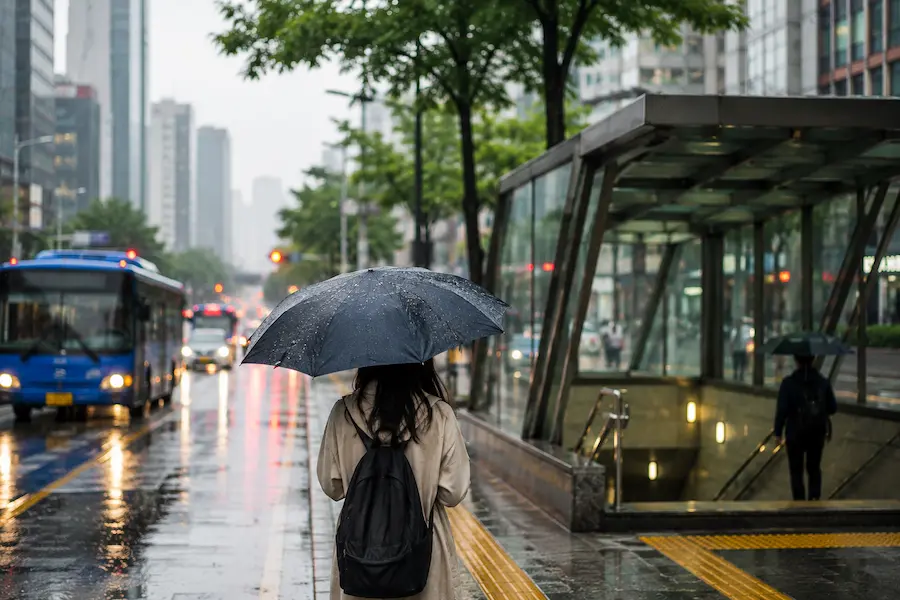
Traveling in Korea during the rainy season does not mean that every outdoor plan must be canceled.
On many rainy days, people continue commuting, shopping, meeting friends, and visiting attractions as usual. A sturdy umbrella and a little flexibility may be all that is needed.
Heavy rain is different.
When a large amount of rain is expected within a short time, checking whether you need an umbrella is no longer enough. You may also need to reconsider your route, transportation, and destination.
Streams can rise quickly, buses may be delayed by traffic, and outdoor areas can close with little notice. A place that was open in the morning may no longer be suitable by the afternoon.
The most useful habit is simple: check the weather again before leaving, even if you already looked at the forecast the night before.
When Is the Rainy Season in Korea?
Korea’s rainy season usually falls during the summer, but its exact timing and intensity are different each year.
Rain does not always continue steadily throughout the day. Some days bring light rain for many hours. On other days, the morning may remain dry before a sudden downpour arrives in the afternoon.
Heavy rain can also occur after the period commonly described as the rainy season. Travelers should therefore rely on the latest local forecast rather than assuming that a particular week will always be dry or wet.
The important question is not only:
“Will it rain today?”
It is also:
- When will the heaviest rain arrive?
- How much rain is expected within a short period?
- Has a weather advisory or warning been issued?
- Does the route pass near a stream, low-lying road, mountain trail, or steep slope?
- Is the destination still open?
Check the Forecast Again Before Leaving
I always check the weather forecast the night before a workday.
During Korea’s rainy season, however, I check it again while getting ready in the morning. Conditions can change overnight, and the expected timing or intensity of the rain may look quite different by the time I leave home.
I may miss some of the other morning news, but I rarely skip the weather. I follow the same habit in winter, when snow and icy roads can also affect my commute.
This is a useful routine for travelers as well.
A high chance of rain does not necessarily mean that the weather will be dangerous all day. At the same time, a short period of intense rain may disrupt transportation and outdoor activities more than many hours of light rain.
Before going out, check:
- The hourly weather forecast
- The expected rainfall intensity
- Heavy rain advisories or warnings
- Emergency alerts for your area
- Transportation notices
- Temporary closures at your destination
The Korea Meteorological Administration provides official Korean weather forecasts and warnings.
For safety alerts, disaster guidance, and shelter information, check SAFE KOREA.
Places to Avoid During Heavy Rain
A rainy day is not automatically dangerous. However, some places require extra caution when heavy rain is forecast or already falling.
These include:
- Streams and riverside paths
- Valleys and mountain trails
- Low-lying roads
- Flooded streets
- Underpasses
- Steep slopes
- Coastal breakwaters
- Outdoor areas that have been officially closed
Do not enter a closed area simply because the rain appears to have stopped.
Water levels can continue rising because of rain that has fallen upstream. Roads, paths, and slopes may also remain unstable after the heaviest rain has passed.
Be especially careful around urban streams
Places such as Cheonggyecheon are popular for walking, but the water level can rise quickly during heavy rain.
A stream may look calm where you are standing while rain is still falling farther upstream. Follow barriers, evacuation announcements, and instructions from staff rather than judging safety only by what you can see.
Do not use the space under a bridge as shelter when an evacuation announcement has been issued.
The same rule applies to riverside parks and smaller neighborhood streams. If access is restricted, choose another place to visit.
Subway or Bus: Which Is Better on a Rainy Day?
There is no single answer for every journey.
The subway may be the easier choice when:
- Heavy rain is expected during the trip
- The destination is close to a subway station
- Roads are already congested
- The bus requires a long wait at an outdoor stop
- You need to travel a long distance across the city
A bus may still be convenient when:
- It reaches the destination without a transfer
- The bus stop has a shelter
- Road conditions remain normal
- The destination is far from the nearest subway station
- The rain is expected to remain light
I normally commute by bus. It is the route I know best, and I enjoy seeing the streets and neighborhoods during the journey.
When heavy rain is expected, I usually switch to the subway.
The bus may still be running normally, but waiting outside and moving through slow traffic can make the journey less predictable. On those days, I prefer a route that keeps more of the trip indoors, even when it requires a transfer.
This does not mean that the subway is always unaffected by heavy rain. Entrances can become crowded, and services may occasionally be adjusted.
The best choice depends on the entire route, not only the vehicle.
A subway journey may still involve a long outdoor walk after leaving the station. A bus that stops directly in front of the destination could be more practical on a day of light rain.
For more help with stations, exits, transfers, and signs, read Seoul Subway Stations Explained.
Travelers planning to take a bus may also find What Visitors Should Know About Korean Bus Stops useful.
Check Official Transportation Information Before Leaving
A reservation does not guarantee that every service will operate exactly as scheduled during severe weather.
Check the latest information before leaving your hotel or accommodation, especially when traveling to another city, an airport, or an island.
Trains
For KTX, ITX, Mugunghwa, and other Korail services, use:
- Korail English Reservation and Train Search
- KorailTalk mobile app
Korail’s train search can show delays in the search results. Check the train again shortly before departing for the station.
Express buses
For express buses between major cities, use:
Confirm the departure terminal as well as the departure time. Large cities may have several terminals, and the correct terminal may be far from the one you first expect.
Intercity buses
For intercity bus routes, use:
Express buses and intercity buses do not always leave from the same terminal.
Check:
- The exact terminal name
- The departure platform
- The latest schedule
- Whether the route is operating normally
Domestic flights
For flights using airports managed by Korea Airports Corporation, including Gimpo, Gimhae, Jeju, Daegu, and several regional airports, use:
- Korea Airports Corporation
- The airline’s official website or app
The airport website provides real-time departure and arrival information. However, the airline should be checked as well because boarding, cancellation, and rebooking instructions come from the airline.
For flights using Incheon International Airport, check:
- Incheon International Airport
- The airline’s official website or app
Passenger ferries
Ferry schedules can change because of rain, wind, waves, tides, and vessel conditions.
Check the official website of the departure port and contact the ferry operator when the information is unclear. In some ports, the final operating decision may be made on the morning of departure.
Do not travel to the terminal based only on an old timetable, booking confirmation, or map-app result.
Read Emergency Alerts Without Panicking
Visitors in Korea may receive emergency alerts on their phones during heavy rain.
The sound can be startling, especially when the message appears only in Korean. Receiving an alert does not always mean that everyone in the city must evacuate.
First check:
- The location named in the alert
- Whether it matches your current location or planned destination
- The type of warning
- Any road closure or access restriction
- Whether the message contains an evacuation instruction
- The time the alert was issued
A warning may refer to a specific district, road, mountain, stream, or landslide-risk area rather than the entire city.
If the message tells people to evacuate, avoid an area, or follow official controls, act immediately.
When the message is unclear, ask:
- Hotel reception staff
- Subway station staff
- A tourist information center
- Museum or airport information staff
- A local companion
Useful questions include:
“Is this alert for this area?”
“Can I still go to this place?”
“Do I need to avoid this road?”
“Is the subway running normally?”
For a fuller explanation, read Emergency Alerts in Korea: What Foreigners Should Know.
Do Not Walk or Drive Through Floodwater
A shallow-looking flooded road may be more dangerous than it appears.
The water can hide:
- A damaged road surface
- An open drain
- A sudden drop
- Fast-moving water
- Electrical hazards
- Broken glass or debris
Do not follow another pedestrian or vehicle into the water simply because they appear to cross successfully.
Turn back and find another route.
For travelers, arriving late is always better than taking a risk on an unfamiliar flooded road.
Small Rainy-Day Habits You May Notice in Korea
Rainy days also reveal several small parts of everyday life in Korea.
Wet umbrellas are kept low
On a crowded bus or subway, people usually fold their umbrellas and hold them near their legs rather than allowing water to drip onto seats or other passengers.
Shake off excess water before entering a building when possible, but do not do it close to other people.
Some buildings provide umbrella stands or covers
Shops, cafés, offices, and public buildings may have umbrella stands, umbrella lockers, or covers near the entrance.
These are not available everywhere. Some places have reduced disposable plastic use, so carrying a reusable umbrella sleeve or small waterproof bag can be helpful.
Indoor spaces can feel cold
Cafés, department stores, museums, and public transportation may feel cool during summer because of air conditioning.
Wet clothes can make the temperature feel even colder. A thin cardigan or light outer layer can be useful, even on a hot day.
Spare socks can make a large difference
An umbrella does not keep shoes completely dry.
Water may collect along the pavement, splash from passing vehicles, or enter your shoes during the walk between a station and your destination.
An extra pair of socks takes little space and can make the rest of the day much more comfortable.
Convenience stores can help with sudden weather
Korean convenience stores often sell umbrellas, simple raincoats, tissues, towels, socks, bottled water, and other basic items.
Stock and prices vary, especially during a sudden downpour. It is still better to prepare before leaving when possible.
Read How Korean Convenience Stores Work as Everyday Service Hubs for more practical examples.
Change the Plan, Not Necessarily the Entire Day
A rainy day in Korea can still be enjoyable.
Instead of canceling everything, replace an exposed outdoor activity with an indoor option in the same area.
Possible alternatives include:
- Museums and galleries
- Department stores
- Underground shopping areas
- Large bookstores
- Aquariums
- Indoor markets
- Cafés
- Jjimjilbangs
- Craft or cultural experience spaces
The easiest strategy is to prepare one outdoor plan and one nearby indoor alternative.
For example, if a riverside walk is no longer suitable, you may be able to visit a museum, market, bookstore, or café without traveling across the entire city.
This reduces the temptation to continue with an unsafe plan simply because time, transportation, or money has already been invested.
When you need a place to pause while changing plans, see When You Need a Break in Korea.
A Simple Checklist Before Going Out
| What to check | Why it matters |
|---|---|
| Hourly weather forecast | The intensity of the rain may change during the day |
| Weather warnings | Heavy rain requires different decisions from light rain |
| Emergency alerts | A warning may apply to your location or destination |
| Travel route | Avoid streams, slopes, low roads, and flooded underpasses |
| Local transportation | Buses and subways may be delayed or adjusted |
| Long-distance transport | Trains, flights, buses, and ferries may change schedules |
| Destination notices | Parks, trails, and outdoor facilities may close |
| Indoor alternative | A backup plan prevents the entire day from being lost |
| Umbrella and spare socks | Small items can make a wet day more comfortable |
Frequently Asked Questions
Does it rain all day during Korea’s rainy season?
Sometimes, but not always.
Rain may continue for many hours, or it may arrive in short and intense periods. Check the hourly forecast rather than relying only on the daily weather icon.
Is the Seoul subway safe during heavy rain?
The subway remains an important way to travel during rainy weather, but no transportation system is completely unaffected by severe conditions.
Check official notices and follow station closures, exit restrictions, and staff instructions.
Can I visit the Han River or Cheonggyecheon when it rains?
Light rain and heavy rain should be treated differently.
Do not enter riverside or stream areas when access is restricted, water levels are rising, or heavy rain is forecast nearby. Never cross a barrier or remain under a bridge after an evacuation announcement.
What should I do when I receive a Korean emergency alert?
Check the named location, warning type, time, and instructions.
Compare the location with where you are and where you plan to go. Follow evacuation or access-control instructions immediately. Ask hotel or station staff when the message is unclear.
Should I cancel my Korea trip because of the rainy season?
Usually, no.
Many activities remain possible with flexible planning. However, plans involving rivers, mountains, valleys, coastlines, and low-lying areas should be changed when official warnings or restrictions are in place.
Final Thoughts
Traveling in Korea during the rainy season is usually manageable.
The key is not carrying every possible piece of rain gear. It is knowing when to check the forecast again, when to choose the subway instead of the bus, and when an outdoor plan should be replaced with an indoor one.
I check the forecast the night before, but during the rainy season, I always check it again before leaving home. That small habit often determines what I wear, which transportation I take, and whether I change my plans.
For travelers, the same habit can make a rainy day safer and much less stressful.
Carry an umbrella, but also carry a backup plan.