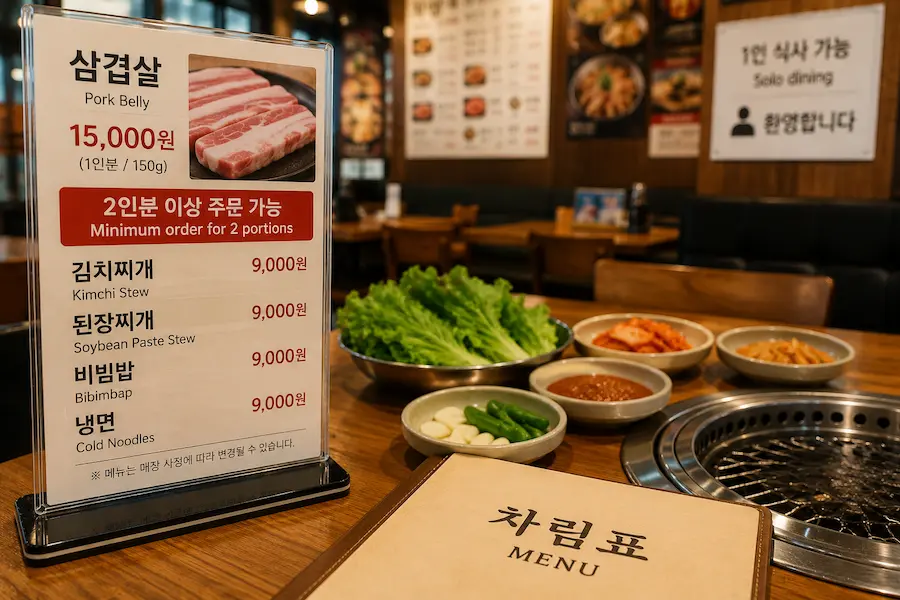
Eating alone in Korea is usually easier than many visitors expect.
Most everyday restaurants have something that one person can order. This is especially common in business districts, shopping areas and neighbourhoods where office workers regularly eat alone.
The confusion usually begins when a particular dish, rather than the restaurant itself, requires a minimum order of two portions.
Korean barbecue, hot pot, dakgalbi and other dishes cooked in a shared pan or on a tabletop grill may be marked as available from two portions.
The simplest rule is:
Check whether the minimum order applies to the entire restaurant or only to the dish you want.
Quick Guide to Minimum Orders
| Situation | What it usually means |
|---|---|
| Rice, noodles, soup or an individual set meal | Usually available for one person |
| Menu marked “2인분 이상” | At least two portions must be ordered |
| Meat priced by portion | One person may need to order two portions |
| Hot pot or shared pan dish | Often starts from two portions |
| Restaurant with individual meals | You may be able to choose a solo-friendly dish |
| Solo dining restricted at a busy time | This may be a restaurant-specific decision |
There is no single minimum-order rule for every Korean restaurant. It depends on the menu, restaurant layout, table availability and operating policy.
Can One Person Eat at a Korean Restaurant?
In most ordinary situations, yes.
Many restaurants serve meals designed for one person, including:
- bibimbap
- noodles
- soups and stews
- pork cutlet
- rice bowls
- grilled fish set meals
- individual lunch sets
Even restaurants known for barbecue, seafood or hot pot may have separate rice dishes, soups or lunch menus for individual customers.
This means a restaurant may accept solo diners even when one shared dish requires a minimum order.
“Two portions minimum” does not necessarily mean “two people minimum.”
A person dining alone may still be allowed to order two portions.
Why Do Some Dishes Start at Two Portions?
Some Korean dishes are prepared in one large pan, pot or grilling area at the table.
Common examples include:
- Korean barbecue
- dakgalbi
- jeongol
- large hot pots
- braised dishes
- shared seafood dishes
The same burner, grill, pan, table and side dishes may be needed whether the customer orders one portion or two. A restaurant may therefore set a minimum quantity for that particular dish.
The condition is usually about how the food is prepared and served, not about discouraging people from eating alone.
How to Read the Minimum-Order Notice
Look for these expressions on the menu.
2인분 이상 주문 가능
Available for orders of two portions or more
2인분부터 주문 가능
Orders start from two portions
2인 이상 주문 가능
Available for groups of two people or more
The first two expressions refer to the quantity of food.
The third refers to the number of customers.
They do not mean exactly the same thing.
A menu may show the price of one portion and place a minimum-order notice beside it.
For example:
1인분 15,000원 · 2인분 이상 주문 가능
This means one portion costs 15,000 won, but at least two portions must be ordered. The minimum order for that dish would therefore cost 30,000 won.
The small note beside the price is just as important as the price itself.
Is the Displayed Price Per Portion or Per Set?
Check the unit written next to the price.
Common expressions include:
- 1인분 — one portion
- 2인분 — two portions
- 1인 — one person
- 2인 세트 — set for two people
- 소 — small
- 중 — medium
- 대 — large
A price beside 1인분 normally refers to one portion. A price beside 2인 세트 normally refers to the entire set for two.
Do not calculate the total until you have checked both the unit and the minimum-order note.
Online menus and customer photos can help before a visit, but they may show an older price. Confirm the current price and order conditions on the restaurant’s in-store menu.
What Can You Do When Dining Alone?
When the dish you want starts from two portions, there are three practical choices.
Order two portions
A solo customer may be allowed to order two portions.
This can work when you are hungry, the portions are not very large or you particularly want to try that dish.
Before ordering, confirm that the minimum refers to portions rather than the number of customers.
Ask whether leftovers can be packed
Some restaurants will pack suitable leftovers for takeaway.
You can ask:
남은 음식 포장할 수 있어요?
Nameun eumsik pojanghal su isseoyo?
“Can I take the leftovers away?”
Whether this is possible depends on the dish and restaurant policy, so ask before ordering two portions with the intention of taking some home.
Choose another dish or restaurant
Many restaurants that serve shared dishes also have individual meals.
Look for:
- rice dishes
- noodles
- individual soups
- lunch sets
- single-person hot pots
- meals marked for one person
When there is no suitable option, it is acceptable to leave politely before ordering and find another restaurant.
My Experience with Two-Portion Menus
In my experience, it is usually possible to find a one-person meal at most restaurants.
This is particularly true in areas with many offices, where restaurants regularly serve workers dining alone or in small groups.
Barbecue, hot pot and seafood restaurants may also have individual meals, although the shared dish I want is sometimes available only from two portions.
When I am with a friend, we discuss whether to order two portions or change to another menu.
When I am alone, I usually make one of three choices.
If I am very hungry and really want the dish, I order two portions even if I may not finish everything.
If the food can be packed, I order two portions and take the remainder home.
If neither choice makes sense, I leave and find another meal.
For me, the minimum order usually changes the dish I choose. It does not mean that eating alone in Korea is generally difficult.
Can a Restaurant Decline a Solo Customer?
A restaurant may have its own seating and ordering policy.
A solo customer may occasionally be declined when:
- the restaurant serves only shared dishes
- all available tables are designed for groups
- the restaurant is extremely busy
- there is a long queue
- the requested menu has a group-order condition
The decision may also vary by time.
A restaurant may have room for one customer during a quiet afternoon but apply stricter seating rules during the busiest lunch or dinner period.
Some owners and staff may be flexible when the restaurant is not busy, but this should not be expected at every location.
One experience does not represent all Korean restaurants.
Business Districts Are Often Easier for Solo Dining
Restaurants near offices commonly serve customers who need a quick meal during lunch or after work.
These areas often have:
- individual set meals
- quick rice and noodle dishes
- counter seating
- lunch specials
- menus prepared for one person
A restaurant famous for a shared dinner menu may therefore offer individual dishes at lunchtime.
Checking the lunch menu can be useful when the main dish starts from two portions.
Useful Korean Phrases
To ask whether you can dine alone:
혼자 먹을 수 있어요?
Honja meogeul su isseoyo?
“Can I eat here alone?”
To ask whether one portion is available:
1인분 주문할 수 있어요?
Il-inbun jumunhal su isseoyo?
“Can I order one portion?”
To confirm the minimum order:
2인분부터 주문해야 해요?
I-inbunbuteo jumunhaeya haeyo?
“Do I have to order at least two portions?”
To ask whether one person can order two portions:
혼자인데 2인분 주문해도 돼요?
Honjainde i-inbun jumunhaedo dwaeyo?
“I’m alone. Can I order two portions?”
To ask about takeaway:
남으면 포장할 수 있어요?
Nameumyeon pojanghal su isseoyo?
“Can I take it away if there is food left?”
How to Check Before Ordering
Check the menu near the entrance or at the table before placing your order.
Look for:
- prices per portion
- prices per set
- minimum-order notes
- individual rice or noodle dishes
- lunch menus
- menus marked for one person
Map apps, restaurant websites and customer photos can help you narrow down your options. However, the in-store menu should be used to confirm the current price and ordering conditions.
When the wording is unclear, asking one short question is easier than guessing.
Common Misunderstandings
“Two portions” means two customers
Not always. One person may be allowed to order two portions.
Every Korean barbecue restaurant refuses solo diners
No. Some accept solo diners, provide individual menus or have seats designed for one customer.
The displayed price is the minimum total
Not necessarily. It may be the price of one portion, with a separate note requiring two portions.
Every shared dish can be packed
No. Takeaway depends on the dish and restaurant.
A restaurant that declines one solo diner always refuses solo customers
Not necessarily. The decision may depend on the menu, available tables and how busy the restaurant is.
The Simple Rule to Remember
Most Korean restaurants have something that one person can order.
A two-portion minimum usually applies to a particular shared dish rather than to solo dining itself.
Before ordering, check three things:
- Is the displayed price for one portion or a complete set?
- Does the dish require at least two portions?
- Can one person order those two portions?
Once you separate the number of diners from the number of portions, Korean restaurant menus become much easier to understand.