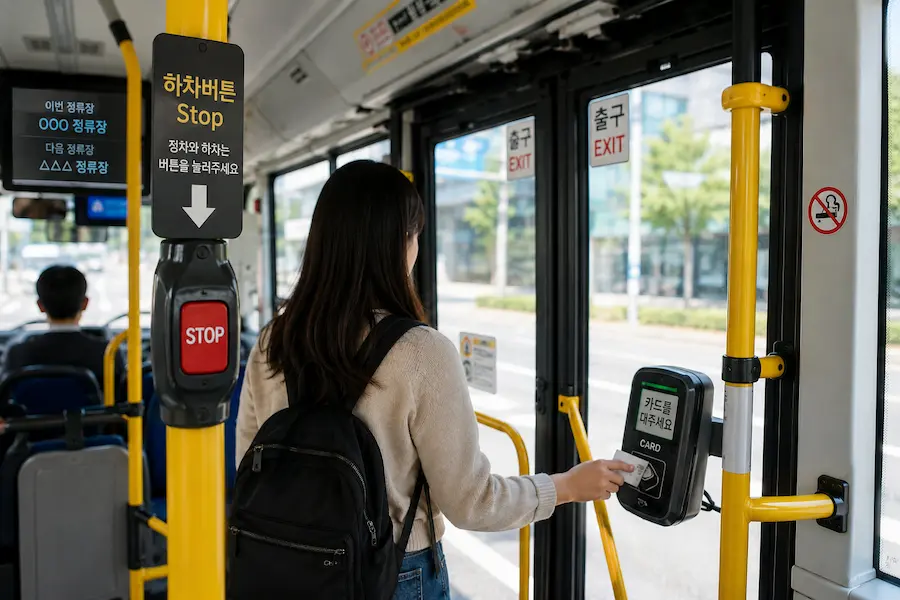
Korean city buses can take you through neighbourhoods, markets and local streets that the subway does not always reach.
The difficult part for a first-time visitor is often not getting on the bus. It is knowing exactly when to press the stop button, when to move towards the door and whether to tap the transportation card again.
The basic routine is simple:
Check the stop before your destination, press the stop button after the bus leaves that stop, move towards the rear door when it is safe, and tap your transportation card before getting off.
Quick Guide to Getting Off a Korean Bus
| Step | What to do |
|---|---|
| 1 | Follow your route on a map app |
| 2 | Remember the stop before your destination |
| 3 | Listen for the next-stop announcement |
| 4 | Press the stop button before arriving |
| 5 | Move towards the rear door when safe |
| 6 | Tap your transportation card |
| 7 | Step off after the bus has stopped |
Most city buses in Korea use the front door for boarding and the rear door for getting off. Stop buttons are placed around the bus, often beside windows, on poles and near the doors.
Check Your Destination Before the Bus Starts Moving
Before boarding, check the following information on your map app:
- the bus number
- the direction of travel
- your destination stop
- the stop immediately before it
- the approximate number of stops remaining
Knowing only your destination can be risky when several stop names sound similar. Remembering the previous stop gives you an extra signal that it is almost time to get off.
This is the routine I use whenever I take a bus to an unfamiliar place. I usually prefer buses because I can understand the route while looking at the streets and neighbourhoods outside.
When the destination is unfamiliar, however, I listen more carefully to the announcements. I remember both the stop where I need to get off and the stop before it. Once the bus leaves the previous stop and the next announcement begins, I press the stop button.
The same routine works for domestic travel and overseas buses as well.
For route planning and stop-by-stop navigation, see our Korean Map Apps Guide.
Understand the “This Stop” and “Next Stop” Announcements
Many Korean city buses announce two stops:
- the stop the bus is approaching
- the stop that comes after it
English announcements may be available, especially in larger cities, but pronunciation, background noise and passenger conversations can make the stop name difficult to hear.
Do not rely on the announcement alone.
Use three clues together:
- the announcement
- the onboard information screen
- your map app
When the stop before your destination appears, begin paying closer attention.
Do not wait until the bus is already beside your destination stop to press the button.
When Should You Press the Stop Button?
Press the stop button after the bus leaves the stop before your destination, or as soon as your destination is announced as the next stop.
The button tells the driver that a passenger wants to get off at the upcoming stop. Korea Tourism Organization guidance also advises passengers to press the bus bell before reaching their stop.
Once someone presses it, you may notice:
- a light appearing on the button
- a red or illuminated sign near the front
- a short bell sound
- a Korean message indicating that the bus will stop
You do not need to press it again if another passenger has already done so.
What If Someone Else Presses the Button First?
This is common, especially at busy stops.
Check whether the stop button is already lit. If it is, the driver has already received the signal.
You can prepare to get off without pressing another button.
This can make busy buses feel easier because several passengers may be getting off at the same place. On a quiet bus, however, it is more important to check the button yourself. If no one presses it, the driver may continue past a stop where nobody appears to be waiting or getting off.
I rarely miss my stop because another passenger has often pressed the button first. Still, when the bus is nearly empty, I pay closer attention and make sure I press it myself.
Do Not Depend Only on the Map App
A map app is helpful, but its position marker can update late or briefly lose accuracy.
Traffic, tunnels, tall buildings and GPS delay can make the bus appear slightly behind or ahead of its actual position.
Use the map to understand the route, but continue watching:
- the bus information screen
- stop signs outside
- major intersections
- nearby landmarks
- the onboard announcement
Looking outside is also one reason I prefer travelling by bus. It helps me understand the route rather than moving underground without seeing where I am.
Which Door Should You Use?
On most Korean city buses, passengers board through the front door and get off through the rear door.
The rear door usually has:
- a transportation card reader
- a step or low-floor exit
- stop buttons nearby
- warning lights or sounds when the door opens
There can be exceptions. Smaller village buses, minibuses or unusually crowded situations may use a different arrangement.
Follow the door that other passengers use and listen to the driver if instructions are given.
When Should You Move Towards the Door?
This depends on how crowded the bus is.
On a quiet bus
You can remain seated until the bus is close to the stop, then stand up carefully and move towards the rear door.
On a crowded bus
Moving earlier may be more practical.
During busy hours, I try to sit or stand near the rear door from the beginning. This reduces the need to move through a crowded aisle just before my stop.
Do not push suddenly through other passengers. A brief Korean phrase can help:
잠시만요.
Jamsimanyo.
“Excuse me for a moment.”
Or:
내릴게요.
Naerilgeyo.
“I’m getting off.”
Most passengers will make space when they understand that you need to reach the door.
Should You Stand Before the Bus Stops?
You may see local passengers standing and moving towards the door before the bus has completely stopped.
That does not mean you must do the same.
If you are carrying luggage, travelling with children, feeling unsteady or unfamiliar with the bus, hold a rail and wait until it is safe to move.
Bus movement can change suddenly because of traffic, signals or another vehicle. Even if the stop is close, keep one hand on a pole or handle while standing.
It is better to miss a few seconds than to lose your balance.
Tap Your Transportation Card Before Getting Off
When you reach the rear door, tap your transportation card on the reader.
Wait for the beep or confirmation before stepping off.
Tapping when you get off is especially important when transferring to another bus or the subway. Transfer discounts are generally calculated from the time recorded when the passenger taps out, and the rules can vary by city.
Even when you are not planning an immediate transfer, making the exit tap part of your regular routine helps prevent mistakes.
The simplest habit is:
Tap when you board. Tap again when you get off.
If you are using a valid Climate Card short-term pass in Seoul, you must also tap when getting off. Seoul ended new 30-day prepaid Climate Card recharges on 31 August 2026, but short-term Climate Card passes remain available. Always check the current Seoul transport rules before travel.
What Should You Check on the Card Reader?
After tapping, listen for the confirmation sound and glance at the screen.
Depending on the card and system, it may show:
- the remaining balance
- the fare charged
- a transfer message
- an error
- an insufficient-balance warning
Do not remove the card too quickly. Tmoney advises users to keep the card on the reader until the transaction is completed and the confirmation sound is heard.
If the reader gives an error, try again without rapidly tapping several times.
What If the Rear Door Does Not Open?
First check whether you pressed the stop button in time.
If the bus has stopped but the rear door remains closed, make eye contact with the driver or say:
기사님, 내려요.
Gisanim, naeryeoyo.
“Driver, I’m getting off.”
You can also say:
문 열어 주세요.
Mun yeoreo juseyo.
“Please open the door.”
Speak clearly but do not shout unless necessary.
What If You Miss Your Stop?
Do not panic and do not try to force the door open.
Press the stop button for the next stop and get off there.
Then check your map app to decide whether to:
- walk back
- cross the road and take a bus in the opposite direction
- transfer to another route
- use the subway
- take a taxi for the remaining distance
A missed stop is usually a small inconvenience, not a serious problem.
Avoid asking the driver to stop between official bus stops. Drivers generally need to use designated stops for passenger safety.
Be Careful When Carrying Luggage
Large suitcases make bus travel more difficult, especially during commuting hours.
Keep luggage:
- close to your body
- away from the aisle
- clear of the doors
- positioned so it cannot roll when the bus moves
Move towards the exit earlier than you would without luggage.
When possible, avoid placing a suitcase where it blocks the rear-door card reader or prevents another passenger from getting off.
A Practical Routine for an Unfamiliar Route
This is the routine I follow when travelling somewhere new:
- Check the route before boarding.
- Remember the destination stop.
- Remember the stop immediately before it.
- Follow the map without staring at it continuously.
- Listen carefully when the previous stop is announced.
- Press the button once the bus leaves that stop.
- Move closer to the rear door when it is safe.
- Tap the transportation card.
- Check my belongings before stepping off.
I use essentially the same routine in Korea, during domestic trips and when travelling abroad.
Bus systems differ, but paying attention to the previous stop, announcements and the view outside makes missing a stop far less likely.
Common Mistakes to Avoid
Waiting until the bus reaches your stop
Press the button before arrival, not when the door should already be opening.
Pressing the button repeatedly
One press is enough. If the button is already lit, another passenger has done it.
Watching only the map
GPS can be delayed. Use the announcement and outside view as well.
Forgetting to tap when getting off
This may affect transfer discounts or card usage records.
Moving through the aisle too late
On a crowded bus, prepare earlier and stand near the rear door when practical.
Standing without holding anything
Always hold a rail or handle while the bus is moving.
The Simple Rule to Remember
Getting off a Korean city bus requires four basic actions:
Watch the previous stop, press the button, move safely towards the rear door and tap your card before leaving.
After a few journeys, the process becomes familiar.
You may even find that the streets outside the window make the bus one of the most enjoyable ways to understand a Korean city.
For more practical guidance on buses, subways, taxis and intercity transport, return to our Getting Around guide.
Official Information
Information reviewed: September 2026.