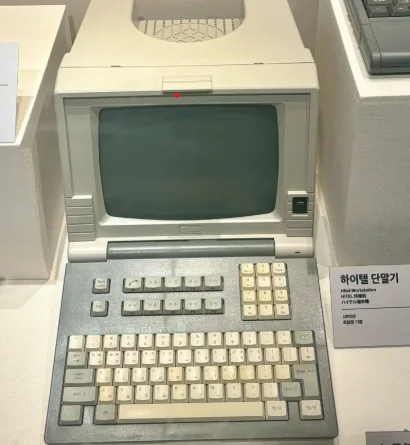
Korea was not always a country of instant messages, fast mobile payments and high-speed connections.
Before smartphones, fibre broadband and delivery apps, there was another kind of online life.
It moved through telephone lines.
It appeared on text-only screens.
It began with the sound of a dial-up modem.
For younger readers outside Korea, it may be hard to imagine a time when going online meant blocking the family phone. Yet in the late 1980s and 1990s, South Korea developed a lively online culture through PC communication services known in Korean as PC tongshin.
These services were not the same as today’s open internet.
They were mostly closed, text-based networks where users entered bulletin boards, chat rooms, file-sharing sections and hobby clubs through a modem connection.
The screens were simple.
The speed was slow.
But for many Koreans, this was one of the first times they could talk to strangers, join interest-based communities and build an identity through written words rather than only through school, workplace or family background.
To understand why Korea later became such a highly connected society, it is worth looking back at this earlier and quieter digital world.
The Beginning of Korea’s PC Communication Era
Korea’s online culture did not begin suddenly with broadband internet.
Early PC communication services appeared in the 1980s, before the public internet became part of everyday life. Services such as Hangeul Mail, KETEL, Hitel, Cheollian, Nownuri and Unitel helped introduce Korean users to online communication.
KETEL, connected with the Korea Economic Daily, began in the late 1980s and later became Hitel, one of the best-known PC communication services of the 1990s.
By the mid-1990s, Hitel, Cheollian, Nownuri and Unitel were familiar names to many Korean computer users.
At that time, most homes did not have always-on internet access.
Users connected through household telephone lines with dial-up modems. After logging in, they entered simple text-based menus where they could read messages, post comments, join clubs, download files or chat in real time.
For many Koreans, this was one of their first experiences of a shared digital space.
It was not smooth.
It was not fast.
But it felt new.
Why PC Tongshin Felt Different
Korean society has long been shaped by age, school background, workplace hierarchy and social formality.
Offline, these factors often influenced how people spoke to one another.
PC communication spaces felt different.
In chat rooms and bulletin boards, users often met through nicknames. They were judged more by writing style, humour, knowledge or shared interests than by age or job title.
This did not remove hierarchy completely.
But it created a new kind of social space that felt freer than many offline settings.
Interest clubs, known as donghohoe, became especially important.
People gathered around music, films, photography, literature, games, computers, university life and current affairs. These communities were small compared with today’s social media platforms, but they were active and personal.
Many habits now associated with Korean online culture began here:
fast group discussions,
strong community loyalty,
fan activity,
detailed recommendations,
and long written debates.
The technology was old by today’s standards.
The social feeling was not.
What Dial-Up Life Actually Felt Like
Early Korean online culture was not convenient.
Connecting to a service often began with the sound of a modem. The noise was sharp, mechanical and strangely exciting.
Once connected, users had to be careful.
If someone in the house picked up the telephone, the connection could break immediately.
For those who experienced it, the first discovery of online chatting could feel almost magical.
I still remember the strange excitement of realising that I could talk to a friend through typed words on a screen.
I was not someone who usually spent long hours on the telephone, but chatting online felt different. It was quiet, private and endlessly fascinating.
Some nights passed without noticing the time.
Conversations continued late into the night simply because it felt so new to be connected in that way.
Of course, family life often interrupted the excitement.
If my parents picked up the phone to make a call and found the line busy, I would be scolded. When the monthly phone bill rose because of long modem connections, I was scolded again. Staying awake too late to chat was another reason to get into trouble.
For many Korean teenagers and young adults at the time, these small conflicts were part of early online life.
The internet was not yet invisible or automatic.
It had a sound.
It had a cost.
It had a clear place inside the family home.
There were no video feeds, no algorithmic recommendations and no endless scrolling. Communication depended almost entirely on text.
That limitation shaped the culture.
Users wrote longer messages. They recommended songs, shared personal thoughts, exchanged jokes and sometimes formed emotional connections with people they had never met in person.
From today’s point of view, the system was slow.
But for those who experienced it, the slowness often made online communication feel more deliberate and memorable.
The Emotional Side of Korea’s Early Internet
One reason Korea’s PC communication era remains nostalgic is that it arrived during a period of rapid change.
During the 1990s, personal computers became more visible in Korean homes, schools and offices. Young people were becoming more curious about music, films, games and global culture. Korea was also moving toward an information-based society.
The 1997 Korean film The Contact captured part of this atmosphere.
The film tells the story of two people who connect emotionally through mediated communication and music rather than ordinary face-to-face meetings.
For many Koreans who remember that period, this kind of story reflected the mood of early online culture.
The early digital world was not only about technology.
It was also about loneliness, curiosity, waiting and the hope that a message from someone unknown could feel surprisingly personal.
From PC Communication to Broadband Korea
PC communication services showed that many Koreans were ready to treat online spaces as part of everyday life.
But PC tongshin alone did not create modern digital Korea.
Government policy, private companies, broadband infrastructure, computer education, online games, PC bangs, mobile technology and wider social change all mattered.
In 1995, the Korean government began the Korea Information Infrastructure project, often described as part of the country’s information superhighway policy. The goal was to expand national information networks and support the development of digital services.
After the 1997 Asian financial crisis, internet infrastructure and digital industries became even more important to Korea’s economic future.
Broadband access spread quickly through DSL and cable modem services.
By the early 2000s, Korea had become one of the world’s leading broadband countries. Fast internet changed daily life. Online games, web communities, digital news, online shopping and portal sites became part of ordinary culture.
The shift from dial-up to broadband was not just a technical upgrade.
It changed the rhythm of Korean society.
Going online no longer required a special moment.
It became part of the day.
The Rise of PC Bang Culture
Another important part of this story is the PC bang.
PC bangs are Korean internet cafés equipped with computers and fast internet access. Similar spaces began appearing in the mid-1990s and became especially popular in the late 1990s and early 2000s, helped by online games such as StarCraft and Lineage.
For young people, PC bangs were more than places to use computers.
They were social spaces.
Friends met there after school, played games together, chatted online and spent time in a shared digital environment.
This helped make online life feel physical and social.
Korea’s internet culture did not grow only inside private bedrooms. It also grew in neighbourhood PC bangs filled with rows of monitors, keyboards, snacks and groups of friends.
That culture later influenced esports, online gaming communities and Korea’s reputation as a country where digital life moves quickly.
What Remains Today
Modern Korean internet culture looks very different from the PC communication era.
Today, people use smartphones, livestreaming platforms, mobile payment apps, delivery services, online communities and AI-powered digital tools. The speed is much faster, and the platforms are more visual.
Yet some older habits remain.
Korean online communities still move quickly.
Users still form strong interest-based groups.
Product reviews, fandom discussions, restaurant recommendations and public debates can spread rapidly.
Written comments still matter, even in a video-centred world.
The tools have changed.
But the habit of building active communities online has deep roots.
Why International Readers Should Care
For international readers, Korea is often described as futuristic, convenient or highly connected.
Seoul can feel especially digital. Fast public Wi-Fi, mobile payments, delivery apps, smart transport systems and online booking services are part of ordinary life.
But Korea’s digital culture did not appear overnight.
Before high-speed broadband and smartphones, there was a generation of users who learned online communication through PC tongshin.
They joined clubs, wrote long posts, waited for replies and built friendships through text.
That early experience helped prepare Korea socially for the broadband boom that followed.
Korea’s modern digital society is therefore not only the result of infrastructure.
It is also the result of habits formed over time:
curiosity,
fast adoption,
community participation,
and a willingness to treat online spaces as part of real life.
Behind today’s fast screens and mobile platforms, there is an older memory of glowing CRT monitors, noisy modems and the small thrill of seeing a new message appear on a text-only screen.
Digital History Information Notice: This article is for general historical and cultural information only. It does not claim that Korea’s modern digital society was created by PC communication services alone. Broadband infrastructure, government policy, private companies, PC bangs, online games, mobile technology and wider social change all shaped Korea’s digital development. Historical details about early services may vary by source, so readers interested in the technical history of Korean networks should consult official archives, academic research and specialised internet history records.
Sources / Further Reading
A Brief History of the Internet in Korea — Korean PC communication and online communities
ITU — Broadband Korea: Internet Case Study
Korean Information Infrastructure research — 1995–2005 IT policy development
Korean Cultural Center / KOCIS — PC bang and Korean internet culture
KOFIC — The Contact, 1997 film information
Google Search Central — Creating helpful, reliable, people-first content