AI often feels light.
A question appears on a screen.
An answer arrives in seconds.
A video recommends the next topic.
A chatbot writes, translates or summarises something almost instantly.
For many young people, AI first appears as an app, a study tool, a search tool or a video topic. It feels digital, invisible and easy to use.
That is why the energy question can feel surprising at first.
I had also thought about AI mostly as software. I used it, watched videos about it and understood the general mood around it. But I had not thought deeply about what sits underneath: data centres, servers, cooling systems, power grids and the electricity needed to keep everything running.
The more AI expands, the more this question matters.
Where will the next layer of reliable electricity come from?
That question is one reason small modular reactors, often called SMRs, are receiving renewed attention.
South Korea is one of the countries trying to position itself in this field. The country already has long experience in nuclear power plant construction, reactor operation and overseas nuclear projects. Now it is looking at SMRs not only as a technology issue, but also as part of energy security, industrial strategy and export policy.
This subject needs careful language.
SMRs are not a simple answer to every energy problem.
They still face regulation, financing, safety review, public acceptance, fuel supply, waste management and construction challenges.
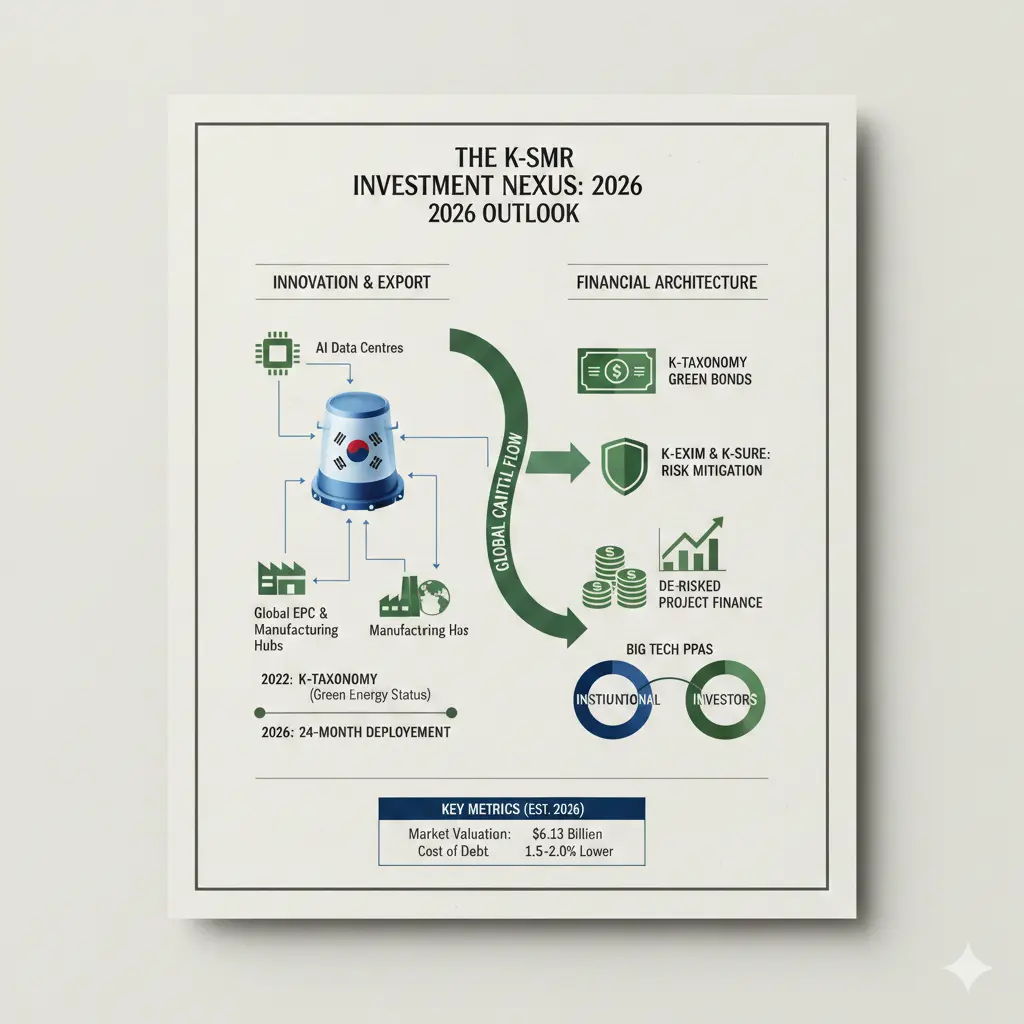
But Korea’s SMR strategy is worth watching because it brings together three important trends: AI-driven electricity demand, lower-carbon energy policy and Korea’s nuclear export ambitions.
The responsible question is not whether SMRs will solve everything.
The better question is whether Korea can turn its existing nuclear industry experience into a credible role in the next stage of power infrastructure.
What Small Modular Reactors Are
Small modular reactors are nuclear reactors designed to be smaller than conventional large nuclear plants.
The word “modular” is important.
The idea is that parts of the reactor may be manufactured in a more standardised way and assembled more efficiently than traditional large-scale nuclear projects.
Supporters argue that SMRs could reduce some construction risks because they may be easier to repeat, scale and place near industrial sites or power-intensive facilities.
However, this remains a developing field.
SMRs still require strict licensing, safety regulation, site approval, skilled workers, long-term waste management and public trust.
Many projects around the world are still in planning, demonstration or early development stages.
For that reason, SMRs should not be described as already proven mass-market infrastructure.
They are better understood as an important technology race that governments and companies are preparing for.
AI Data Centres Changed the Power Conversation
The rise of AI has made electricity supply a bigger issue for technology companies and governments.
Data centres need electricity around the clock.
AI servers require stable power.
Cloud companies, chipmakers and public authorities are beginning to ask whether existing power systems can support the next stage of digital infrastructure.
This is where the AI conversation becomes more physical.
AI is not only a model running somewhere online.
It depends on buildings filled with servers, cooling systems, chips, cables and electricity contracts.
That is an important shift for ordinary readers.
A person may use AI every day without ever seeing a data centre. But the demand exists somewhere, and that demand needs power.
The International Energy Agency expects global electricity consumption by data centres to rise sharply by 2030. Its base case projects data centre electricity consumption reaching around 945 terawatt-hours in 2030, driven by cloud computing, AI and digital services.
This demand is difficult to manage with intermittent power alone.
Solar and wind are important for decarbonisation, but data centres also need stable power around the clock.
That is why some technology companies are looking again at nuclear energy, including advanced reactors and SMRs.
This does not mean nuclear power will replace renewables.
A more realistic view is that countries and companies are exploring a mix of energy sources: renewables, grids, storage, gas, nuclear and efficiency improvements.
SMRs are one part of that wider conversation.
They are not the whole answer.
Why South Korea Is Interested
South Korea has a strong nuclear industry base.
Korean companies have experience in nuclear construction, components, engineering, operation and export projects.
Korea’s nuclear sector became internationally visible through projects such as the Barakah nuclear power plant in the United Arab Emirates.
In 2026, South Korea passed a special act to promote and support SMR development.
The law is designed to help the government establish SMR development plans and support research, demonstration and industrial preparation.
This matters because SMRs are not developed by one company alone.
They require reactor designers, engineering firms, construction companies, component suppliers, regulators, universities, financial institutions and export agencies.
Korea’s strategy is to build an ecosystem around the technology, not simply announce a new reactor design.
That ecosystem approach is familiar in Korea.
The country has often tried to connect technology, manufacturing, finance and government coordination in strategic industries.
SMRs fit that pattern.
Why This Is Not Only an Energy Story
At first, SMRs may sound like a specialist energy topic.
But the issue is wider than that.
AI infrastructure is becoming part of national competitiveness. Countries want data centres, semiconductor supply chains, cloud infrastructure, high-performance computing and stable electricity.
This means electricity is no longer only a utility issue.
It is connected to industrial policy, technology competition, climate goals and national security.
For someone who uses AI mainly as a tool, this can be difficult to see at first. The screen makes AI feel simple. The infrastructure behind it is not simple.
That gap is one reason this topic matters.
The public conversation about AI often focuses on jobs, creativity, education and productivity. Those are important. But another question is just as important: who can supply the power that AI systems require?
Korea’s SMR strategy belongs to that question.
Finance and Green Taxonomy Need Careful Reading
One reason the SMR discussion is becoming more serious is finance.
Large energy projects require long-term capital.
Investors and lenders need to understand whether a project fits climate policy, energy security needs and infrastructure investment rules.
Korea’s green taxonomy, known as K-Taxonomy, includes certain nuclear-related economic activities.
The Ministry of Environment has explained that nuclear-related activities can be included in categories such as research and development, new construction and continued operation.
This does not mean every nuclear project automatically becomes green, safe or financially attractive.
Taxonomy rules are classification tools.
They can help guide sustainable finance, but they do not remove construction risk, regulatory risk, cost risk or public debate.
For SMRs, financing will remain one of the biggest questions.
Even if the technology is promising, projects still need credible cost estimates, licensing timelines, power purchase agreements, long-term safety planning and public trust.
A classification can open a door.
It does not build the reactor.
Korea’s Export Finance Model
Korea’s nuclear export strategy is not only about engineering.
It is also about finance and state-backed support.
Institutions such as the Export-Import Bank of Korea and Korea Trade Insurance Corporation can help Korean companies compete abroad by supporting large infrastructure projects with financing tools, guarantees and insurance.
This kind of support matters because nuclear projects are expensive, politically sensitive and long-term.
For countries considering nuclear energy, the technology itself is only one part of the decision.
They also need to consider financing, construction reliability, fuel supply, regulation, operator training and long-term maintenance.
Korea’s potential advantage is that it can often present a wider package: engineering experience, industrial suppliers, public financing support and government-to-government cooperation.
That package may become important if SMR exports move from early discussion to actual deployment.
But it should not be overstated.
Export finance support does not guarantee overseas orders.
It only gives Korean companies another tool in a difficult market.
Partnerships With Technology and Energy Companies
Korean companies are also working with overseas partners.
Amazon has supported X-energy’s advanced reactor plans in the United States, and Korea Hydro & Nuclear Power and Doosan Enerbility have been linked to cooperation around X-energy’s Xe-100 reactor technology.
These partnerships reflect a broader trend.
Technology companies are becoming more interested in firm, lower-carbon electricity for data centres.
Separately, Korean companies have discussed SMR-linked energy systems for future data centres and industrial sites.
These plans should not be overstated.
Most SMR projects still face licensing, construction and commercial hurdles.
Announcements and memorandums of understanding are not the same as operating reactors.
Still, they show where the market is moving.
AI infrastructure is creating a new type of power customer, and nuclear companies want to be part of that conversation.
Southeast Asia Is Watching, But Carefully
SMRs may also become relevant to countries in Southeast Asia.
Many countries in the region are dealing with rising electricity demand, industrial growth, urbanisation and pressure to reduce emissions.
Some are studying nuclear power more seriously than before.
Korea has pursued nuclear cooperation discussions with countries such as Singapore and other regional partners.
These discussions do not mean SMRs will be built immediately.
They show that nuclear energy is becoming part of broader energy-security planning in the region.
For Korea, this could create an export opportunity if projects move beyond early-stage discussions.
For partner countries, it creates a difficult decision.
Can nuclear power fit their energy mix, regulatory capacity, public acceptance and long-term safety responsibilities?
That question cannot be answered by technology alone.
It also depends on institutions, public trust and time.
SMRs Should Not Be Overhyped
SMRs are often described as faster, cheaper and easier than traditional nuclear plants.
That may become true in some cases, but it is not yet guaranteed.
The industry still needs to prove that SMRs can be built on time, licensed safely, financed responsibly and operated reliably.
Costs may change.
Regulation may take longer than expected.
Public acceptance may vary by country.
There are also unresolved questions around waste management, fuel supply, security, emergency planning and liability.
These issues do not mean SMRs should be dismissed.
They mean the topic needs careful explanation.
A responsible article should present SMRs as a promising but still developing part of the energy transition, not as an immediate answer to AI’s power problem.
What Foreign Readers Should Understand
For foreign readers, Korea’s SMR strategy is useful because it shows how the country approaches industrial policy.
Korea often combines technology, manufacturing, export finance and government coordination.
This pattern can be seen in semiconductors, shipbuilding, batteries and nuclear power.
SMRs fit that model.
The technology is important, but the wider system may matter just as much: laws, suppliers, financing, export agencies, research institutes, regulators and overseas partnerships.
That is why Korea’s SMR strategy is not only an energy story.
It is also a business and industrial strategy story.
A Realistic Way to Read the Strategy
Korea is not simply building small reactors for the sake of technology.
It is trying to prepare for a world where electricity demand rises, AI infrastructure expands and countries look for stable lower-carbon power.
SMRs could become part of that future.
But they will need time, regulation, financing and public trust.
The most honest conclusion is this:
Korea has many of the industrial ingredients needed to compete in the SMR market, but the global SMR industry still has to prove its commercial model.
That makes the next few years important.
Not because SMRs are already guaranteed to transform energy markets, but because countries are now deciding which technologies, suppliers and financial structures may shape the next stage of lower-carbon power infrastructure.
What Not to Overstate
This topic needs careful wording.
SMRs are not yet proven mass-market energy infrastructure.
AI data centres do not automatically make SMRs commercially viable.
Nuclear power does not replace the need for renewables, grids, storage and efficiency.
K-Taxonomy classification does not remove project risk.
A partnership announcement is not the same as an operating reactor.
Export finance support does not guarantee overseas orders.
SMRs still require safety review, regulation, waste planning, financing and public acceptance.
The safer view is this:
Korea is preparing actively for the SMR market, but the technology and business model still need to prove themselves in real deployment.
Final Thoughts
South Korea’s SMR strategy is worth watching because it connects AI electricity demand, nuclear technology, industrial policy and export finance.
But it should not be described as a finished solution.
The real story is more practical.
AI is increasing pressure on electricity systems.
Korea has nuclear engineering experience and an export-oriented industrial base.
SMRs are being studied as one possible source of stable lower-carbon power for industrial users and data centres.
But that future still depends on licensing, cost, safety, public trust and real construction performance.
For foreign readers, Korea’s SMR strategy is useful because it shows how energy policy is becoming part of the AI infrastructure debate.
The question is not whether SMRs will solve everything.
The better question is whether Korea can turn its nuclear industry experience into a credible role in the next stage of lower-carbon power infrastructure.
Energy and Technology Information Notice: This article is for general energy, technology and industrial policy information only. It does not provide investment, legal, engineering, energy procurement, environmental certification or public policy advice. SMR designs, regulations, financing plans, partnerships, construction timelines, export projects, safety reviews and public policies may change. Readers should check official government announcements, company releases, regulatory documents and reputable energy sources for the latest information.
Sources / Further Reading
International Energy Agency — Energy and AI
International Atomic Energy Agency — Small Modular Reactors
South Korean government and industry reports — SMR Special Act
Innovative SMR Development Agency — i-SMR design approval updates
Ministry of Environment — K-Taxonomy and nuclear-related economic activities
X-energy — Amazon, KHNP and Doosan Enerbility cooperation announcement
Doosan Enerbility — SMR partnership announcement
Korea Export-Import Bank — export finance and infrastructure support
Korea Trade Insurance Corporation — trade insurance and export project support
Google Search Central — Creating helpful, reliable, people-first content