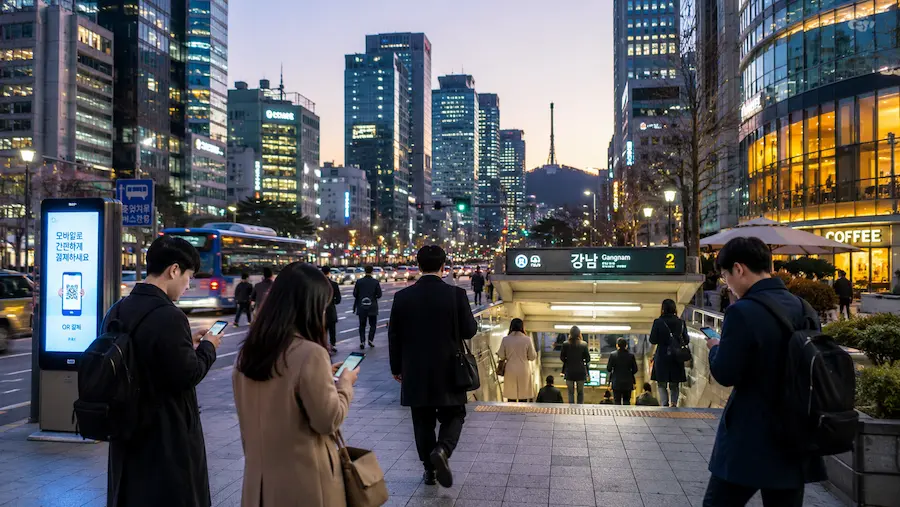
For many first-time visitors, Seoul can feel unusually connected.
A visitor may use a map app to find a subway route, order food from a phone, pay at a kiosk, stream video underground, unlock a rental bike, or receive a digital notice from a hotel or apartment building. These moments feel ordinary in Korea, but they depend on a long history of digital infrastructure.
Most people do not stop to think about the network behind them.
That is the point.
In Korea, fast connectivity is not usually treated as a luxury. It is part of everyday life.
This helps explain why South Korea is already preparing for the next stage of mobile communication: 6G.
For international readers, 6G may sound distant and technical. In Korea, the discussion is not only about faster phones. It is also connected to artificial intelligence, cloud services, industrial networks, satellite communications, smart factories, urban systems and national competitiveness.
But one point must be clear.
Korea is not living in a 6G world yet.
6G is still a future network technology. Standards, equipment, commercial services and practical use cases are still being developed. What Korea has today is not 6G daily life, but a society where connected services are already important enough to make the next network generation a serious policy issue.
Why Korea Is Preparing Early
South Korea has spent decades building strong digital infrastructure.
Fast broadband spread early. PC bangs became part of youth culture. Online games, digital communities, mobile services, delivery platforms, livestreaming, cashless payments and app-based services grew in a society already used to speed and connectivity.
That history matters.
Many people in Korea expect digital services to work quickly. Slow identity verification, unstable video calls, weak mobile coverage, delayed app responses or poor internet access can feel especially frustrating in a country where speed has become normal.
This background helps explain Korea’s K-Network 2030 strategy.
The strategy focuses on next-generation network technologies, including 6G, Open RAN, satellite communications, software-based networks and stronger network supply chains. In simple terms, Korea wants to prepare the network layer before future services fully arrive.
That does not mean 6G is already part of everyday life.
It means the country is trying to prepare early for the next network generation.
What 6G Actually Means
6G should not be described as just “faster 5G.”
Researchers, governments and telecom companies expect future networks to support larger data flows, lower latency, more connected devices, AI-assisted network management, satellite links and more flexible communication systems.
These ideas may matter for areas such as autonomous transport, smart factories, robotics, remote industrial control, AI cloud services, digital twins, urban sensors and emergency communications.
For ordinary users, many of these examples may still feel far away.
That is why 6G should be discussed carefully. It is not something already changing daily life in Korea. It is better understood as a future infrastructure project that may support more automated and data-heavy services.
The practical impact will depend on standards, cost, coverage, useful services, regulation, security and whether companies can turn the technology into something people actually need.
What Connected Seoul Already Feels Like
Seoul already gives visitors a sense of how connected urban life can be.
Subway stations, cafés and public spaces often support mobile life. Map apps, payment systems, food delivery services, apartment access systems, parcel lockers, kiosks and digital notices are common parts of daily routines.
This convenience can be impressive.
But it is not perfect.
Some services are difficult for foreigners without a Korean phone number. Certain apps require local identity verification. Some payment or booking systems work better for residents than visitors. Language barriers still exist. A system that feels smooth for a Korean resident can feel confusing for a traveller.
That contrast is important.
Korea’s digital infrastructure is strong, but it is also deeply local.
To understand it properly, foreign readers need to see both sides: speed and friction.
Korea’s 5G Base
Korea’s 6G ambition is built partly on its earlier 5G experience.
South Korea was one of the early countries to launch commercial 5G services at scale. It has also been recognised in international comparisons for strong 5G infrastructure and high mobile broadband adoption.
This gives telecom companies, device makers, network suppliers, researchers and policymakers a practical base for thinking about what comes next.
But 5G also offers a useful lesson.
It did not change every part of daily life overnight. Some promised services took longer than expected. Some business models were slower to develop. Some users felt that the difference from LTE was not always obvious in ordinary phone use.
That lesson should guide how we talk about 6G.
A new network generation may be important, but the real impact depends on practical services, pricing, coverage and actual demand.
Technology Districts Matter
Places like Pangyo help explain Korea’s network ambitions.
Pangyo Techno Valley, south of Seoul, is one of Korea’s best-known technology hubs. It is home to platform companies, gaming firms, software developers, AI startups and research-oriented businesses.
Seoul also has AI-related support spaces such as Seoul AI Hub, which supports AI talent development and AI-focused company growth.
These places matter because future networks do not create value by themselves.
A faster network is only useful when companies, public services and users can build something meaningful on top of it.
That is why Korea’s 6G story is also connected to AI, cloud computing, mobility, manufacturing and smart city planning.
The network is the base.
The services built on it will decide whether people feel the difference.
Why AI and 6G Are Discussed Together
Future networks are expected to use more AI inside the network itself.
AI may help manage traffic, predict congestion, optimise power use, detect failures and support more flexible network operations. These ideas are often discussed under terms such as AI-native networks or AI-RAN.
This does not mean those systems are already shaping ordinary life.
They are still developing ideas.
The reason they matter is that future digital systems may involve far more connected devices than today: vehicles, robots, sensors, factories, drones, city infrastructure, home appliances and industrial equipment.
If networks become more complex, managing them manually becomes harder.
For foreign readers, the useful point is simple.
6G is not only about consumer smartphones.
It is about building networks that may one day support a more automated, data-heavy and connected society.
The Human Side of Korea’s Connected Culture
Most Koreans do not spend daily life thinking about 6G.
They simply expect services to work.
Food delivery should be fast.
Payments should process quickly.
Video calls should not freeze.
A map app should show the right route.
A café should have stable internet.
A banking app should work when needed.
This expectation shapes how technology spreads.
In some countries, digital convenience can still feel optional. In Korea, it often feels like part of the basic rhythm of daily life.
That convenience is real.
But it can also create pressure.
People may feel expected to respond quickly, adapt quickly and live inside constant digital availability. Work messages, app alerts, online reservations, delivery tracking and mobile verification can make daily life smoother, but also more intense.
A balanced view of Korea’s connected culture should include both sides.
It is convenient, but it can be demanding.
What Still Needs to Be Proven
6G is not a finished story.
There are technical challenges, including spectrum, equipment standards, energy use, satellite integration, cybersecurity, infrastructure cost and global compatibility.
There are also social questions.
Who benefits first?
Will rural areas receive equal access?
How will personal data be protected?
Will small companies be able to use the technology?
Will ordinary users feel a clear benefit?
Korea may move early, but early movement does not guarantee success.
The country still needs to prove that future networks can create practical value beyond faster speed tests.
Why Foreign Readers Should Care
Foreign readers should care about Korea’s 6G preparation because it shows how a highly connected society thinks about future infrastructure.
Broadband, PC bang culture, online gaming, mobile services, delivery platforms, digital verification and 5G did not develop separately from Korean daily life. They became part of how people study, work, shop, move and communicate.
That does not mean every country will copy Korea.
But Korea’s experience can help readers understand how network infrastructure, urban density, platform services and user expectations influence one another.
It also shows why telecom policy is not only a technical issue.
In Korea, network infrastructure affects daily life, business strategy, public services and national industrial planning.
What Not to Overstate
This topic needs careful wording.
Korea does not yet have ordinary commercial 6G service.
6G standards and use cases are still developing.
A government target does not guarantee a smooth commercial rollout.
Faster networks alone do not create useful services.
AI-native networks and AI-RAN should be treated as developing ideas, not everyday realities.
6G should not be described as a magic solution for smart cities, autonomous vehicles or industrial automation.
The realistic view is that 6G is one part of Korea’s long-term digital infrastructure planning.
Final Thoughts
South Korea’s 6G story should not be exaggerated.
The country is not already living in a fully 6G future. Most people still experience technology through ordinary things: phones, cafés, subways, deliveries, payments, apartment systems and work apps.
But that is what makes the story interesting.
Korea’s push toward 6G is not only about faster networks.
It is about a society that has already built much of daily life around connectivity.
For foreign readers, Seoul is useful because it shows how future infrastructure can begin as ordinary habits before it becomes visible as a new technology.
If 6G becomes useful, it will likely be felt through practical services rather than dramatic science-fiction scenes.
It may arrive quietly, through small routines that become normal before people notice how much the city has changed.
Note: 6G standards, commercial timelines, government programmes and network technologies may change. Readers should check official government announcements, telecom company updates and international standards organisations for the latest information.