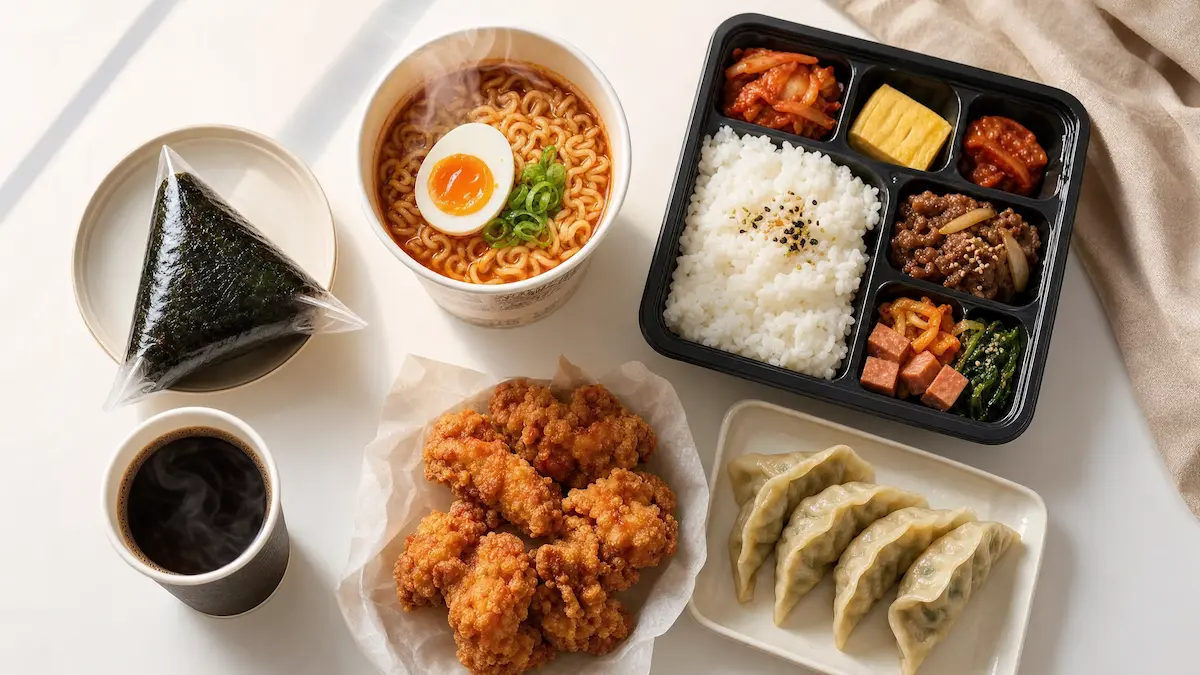
A convenience store in Korea is rarely only a place to buy water, snacks, or emergency supplies.
For many people, it is also a small dining space, a late-night food stop, a quick lunch option, and a place where new food trends appear before they reach a wider market.
For foreign visitors, it has become part of the travel experience.
A convenience store meal in Korea can include kimbap, ramyeon, dosirak lunch boxes, fried chicken, dumplings, salad, coffee, desserts, and seasonal limited-edition products.
The appeal is simple.
The food is easy to buy, usually affordable, and often more varied than visitors expect.
This change did not happen by accident.
It reflects Korea’s fast urban lifestyle, the growth of single-person households, strong competition among convenience store chains, and the global interest in Korean food culture.
A Korean convenience store is small.
But it reveals a large part of daily life.
Convenience Store Food Is Now a Tourist Experience
One clear sign of this shift is how often foreign visitors now use Korean convenience stores during their trips.
For many travelers, these stores are not just a backup option when restaurants are closed.
They are part of the Korea experience itself.
Visitors often look for triangle kimbap, cup ramyeon, lunch boxes, desserts, drinks, and limited-edition snacks they have seen online.
Social media has helped this trend spread quickly.
Videos of people trying Korean convenience store food are easy to understand even without much explanation. A cup of ramyeon, a triangle kimbap wrapper, a microwave meal, or a new dessert can be understood visually within seconds.
This is why Korean convenience stores now serve several roles at once.
They are practical stores for local residents.
They are affordable food stops for students and office workers.
They are also casual cultural spaces for foreign visitors.
Still, they should not be treated as the whole of Korean food culture.
They are an entry point.
They show what people often eat when they are busy, tired, traveling, studying late, or trying to save money.
Kimbap and the Shape of a Quick Meal
Kimbap is one of the most familiar convenience store foods in Korea.
It is portable, filling, and easy to eat without much preparation.
Triangle kimbap is especially common because it works well for commuters, students, travelers, and anyone who needs a quick meal.
The history of kimbap is sometimes discussed in relation to Japanese seaweed rice rolls, but the modern Korean version has become a distinct everyday food.
Korean kimbap usually uses sesame oil, cooked vegetables, egg, pickled radish, fish cake, tuna, beef, or other fillings.
It is not usually eaten like sushi.
It is more closely connected to daily meals, picnics, school lunches, simple snacks, and quick food on the move.
In convenience stores, kimbap works because it is inexpensive, compact, and easy to adapt.
Chains can release tuna mayo, bulgogi, spicy pork, cheese, vegetable, or premium versions without changing the basic format.
That flexibility explains why kimbap remains one of the most reliable items in the refrigerated food section.
It is not glamorous.
That is part of its meaning.
It is food made for ordinary time.
Ramyeon and the Store as a Small Dining Room
Ramyeon is another major reason visitors are drawn to Korean convenience stores.
Many stores provide hot water machines, microwave ovens, seating areas, and sometimes automatic ramyeon cookers.
This turns a simple instant noodle purchase into a small dining experience.
In busy areas such as Hongdae, Myeongdong, and university districts, ramyeon-focused convenience store spaces are popular with both Korean customers and foreign visitors.
Some stores display many ramyeon varieties and allow customers to add eggs, cheese, dumplings, sausage, or other toppings.
This matters because Korean convenience stores do more than sell packaged food.
They create a low-cost food experience that feels casual, local, and easy to share online.
For a traveler, eating ramyeon at a convenience store may feel like a small scene from everyday Korea.
For a student or office worker, it may simply be dinner after a long day.
Both meanings can exist in the same space.
Dosirak and the Need for a Complete Meal
Convenience store dosirak, or lunch boxes, are another key part of this food culture.
A typical dosirak may include rice, meat or fish, vegetables, fried items, kimchi, or small side dishes.
It is designed for people who need a full meal quickly without going to a restaurant.
For office workers, students, travelers, and people living alone, dosirak offers three clear advantages:
price,
speed,
and portion control.
It is usually cheaper than eating at a restaurant and more complete than buying only a snack.
However, dosirak also has a weakness that should not be ignored.
Several nutrition studies and consumer reports have pointed out that convenience store lunch boxes can contain high levels of sodium.
This does not mean they should never be eaten.
It does mean consumers should check nutrition labels when available and balance these meals with fresh foods, fruit, water, and lower-sodium options.
A convenience store lunch box solves one problem.
It should not become the only pattern of eating.
Fried Chicken, Dumplings, and Hot Snacks
Korean convenience stores also compete through hot snacks.
Fried chicken, dumplings, sausages, fish cakes, croquettes, and other ready-to-eat foods are often placed near the counter or in heated display cases.
These products are not meant to replace specialty restaurants.
They serve a different purpose.
They are available late at night.
They are easy to buy in small portions.
They are affordable enough for students, workers, and travelers who want something warm without sitting down for a full meal.
This is one reason Korean convenience store food feels different from convenience food in many other countries.
The store is not only selling packaged goods.
It is offering a small, flexible food stop that can work as breakfast, lunch, dinner, or a late-night snack.
In a city where people move quickly, food also becomes mobile.
Healthier Options Are Becoming More Visible
Convenience store food is still convenience food, so it should not be described as automatically healthy.
Many items are processed, salty, fried, or sauce-heavy.
That said, the category is changing.
In recent years, Korean convenience store chains have added more salads, boiled eggs, chicken breast products, low-sugar items, high-protein snacks, brown rice options, and lighter meal boxes.
These products reflect a wider consumer shift toward health management, dieting, fitness, and more careful food choices.
This trend matters because convenience stores respond quickly to demand.
If customers buy more high-protein or lower-sodium products, chains release more of them.
If a product does not sell, it disappears quickly.
In that sense, the convenience store shelf works almost like a live test of Korean food trends.
Still, readers should be careful.
A “healthier-looking” package is not the same as a balanced diet.
The best habit is to read the label, check sodium and sugar when possible, and avoid treating convenience food as the only daily meal source.
Coffee and the Everyday Routine
Coffee is another reason Korean convenience stores became part of everyday life.
A low-priced Americano from a convenience store is not the same experience as sitting in a specialty café.
It serves a different need.
For many people, convenience store coffee is fast, cheap, and close by.
It is useful during a commute, after lunch, or late at night.
In a country with a strong café culture, convenience store coffee created a more practical coffee option for people who do not want to spend several thousand won every time they need caffeine.
This also helped convenience stores move beyond the image of a snack shop.
They became places where people buy breakfast, coffee, lunch, dessert, and small household items in one stop.
The store fits into the gaps of the day.
That is its real strength.
Why New Products Appear So Quickly
One of the most interesting parts of Korean convenience store culture is the speed of product change.
Major chains such as CU, GS25, 7-Eleven Korea, and emart24 compete through private-label products, collaborations, seasonal releases, character packaging, restaurant partnerships, and viral food trends.
Industry reports and media coverage have noted that many new food items can appear across the market in a single week.
This constant change keeps customers curious.
It also gives convenience stores an advantage in social media culture, where novelty matters.
A new dessert, oversized ramyeon, celebrity collaboration, or unusual flavor can become popular online within days.
If it sells well, it may stay on shelves longer.
If not, it is replaced by another product.
This cycle is one reason Korean convenience stores feel unusually active compared with convenience stores in many other countries.
The shelf changes because the society changes quickly.
What Convenience Store Food Says About Modern Korea
Korean convenience store food is not only about taste.
It says something about modern Korean life.
It reflects a society where many people work long hours, live alone, commute often, and need quick meals at different times of the day.
It also reflects a retail culture that moves quickly and pays close attention to trends.
At the same time, it shows how Korean food culture has adapted to modern life.
Traditional ideas such as rice, side dishes, noodles, soup, and shared snacks are still present.
But they are packaged in a way that fits small apartments, short lunch breaks, late-night study sessions, and travel schedules.
For visitors, this makes convenience stores an easy entry point into everyday Korea.
They may not show the full depth of Korean cuisine.
But they show what many people actually eat when they are busy, tired, traveling, or looking for something simple.
That is why the convenience store is sociologically interesting.
It is ordinary enough to be overlooked.
It is useful enough to explain a society.
A Balanced Way to Enjoy It
Korean convenience store food is worth trying, especially for travelers who want to understand daily life in Korea.
Kimbap, ramyeon, dosirak, coffee, desserts, and seasonal snacks can all be part of a useful and enjoyable food experience.
Still, it is better to see convenience store food as one part of Korean food culture, not the whole story.
Korea also has traditional markets, small family restaurants, street food stalls, regional dishes, temple food, seafood restaurants, barbecue places, bakeries, and cafés.
The best approach is balance.
Try convenience store food for its affordability, variety, and local appeal.
Then compare it with restaurants, markets, and home-style meals.
That contrast gives a more accurate picture of how people eat today.
Korean convenience stores became popular because they solve real problems:
hunger,
time,
price,
distance,
and curiosity.
They are simple places.
But they reveal a lot about the speed, creativity, and practicality of modern Korea.
Food and Travel Information Notice: This article is for general food culture and travel information only. It does not recommend any specific convenience store brand, product, diet, restaurant, medical choice, or health plan. Convenience store foods can vary by location, season, brand, price, and nutrition content. Readers with dietary restrictions, allergies, high blood pressure, kidney disease, diabetes, or other health concerns should check labels carefully and consult a qualified health professional when needed.
Sources / Further Reading
LA Times — South Korea’s convenience store food culture and rapid product turnover
Korea Herald — Foreign tourists and Korean convenience store food transactions
Visit Korea — Convenience stores as part of travel in Korea
Korean Journal of Community Nutrition — Nutritional evaluation of convenience store lunch boxes
KoreaMed Synapse — Low-sodium convenience store food and consumer behavior
Asia Economy — Sodium concerns in Korean convenience store lunch boxes
Major convenience store brand information — CU, GS25, 7-Eleven Korea, emart24
Google Search Central — Creating helpful, reliable, people-first content