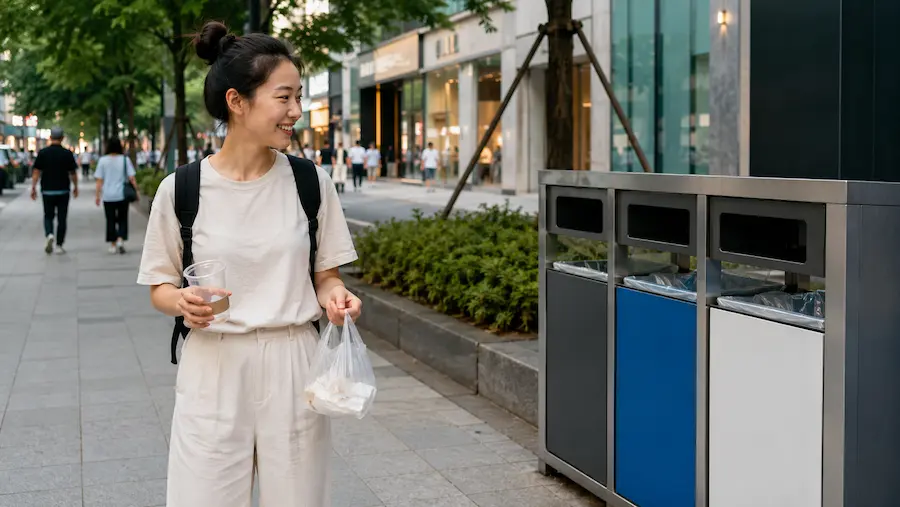
Cities often change so gradually that people living in them do not notice right away.
I realised that public trash bins had become harder to find in Seoul only on a day when I actually needed one.
I was walking with a small piece of waste in my hand and expected to see a bin somewhere along the street. I kept walking, but there was none. After carrying it for much longer than expected, I eventually entered a shop, bought something and politely asked whether the staff could throw it away for me.
That was when I remembered that street bins used to be easier to find.
Not every memory of them was pleasant. Some were poorly managed, overflowing or surrounded by unpleasant smells. There were times when I avoided getting close to one.
Still, when the bins became less visible, I did not immediately notice the change. I noticed only when I needed one.
These days, I usually keep small waste in my bag until I get home or find an appropriate bin. I also carry two or three small reused bags folded inside a pouch. They take up almost no space, but they are useful when a tissue, wrapper or empty cup lid has nowhere else to go.
For travelers, the important point is not that Korea has no public trash bins.
It is that bins may not appear exactly where or when you expect them.
Are There Really No Public Trash Bins in Korea?
Korea does have public trash bins.
The difficulty is that they are not distributed evenly. In a major station, busy tourist district, park, highway rest area or large commercial facility, you may find one without much trouble. On a residential street or in a smaller alley, you may walk for quite a while without seeing one.
The situation also varies by city, district and individual facility.
Seoul should not be treated as a perfect description of every part of Korea. Even within Seoul, one neighbourhood may have several public bins while another has very few.
The most accurate way to describe the situation is this:
Public trash bins exist in Korea, but they may be less visible and less evenly placed than some visitors expect.
Why Did Street Trash Bins Become Less Common in Seoul?
There is a specific administrative background to Seoul’s street-bin shortage.
According to the Seoul Metropolitan Government, Seoul had 7,607 street trash bins in 1995, when the volume-based waste fee system was introduced.
Under this system, households and businesses are generally expected to dispose of ordinary waste in approved volume-based waste bags rather than placing it in public street bins.
The city reported that household and business waste was sometimes being placed in street bins. As bins were removed according to local conditions, their number fell to 3,707 by 2007.
The policy did not end there.
As residents and visitors experienced difficulty finding appropriate places for street waste, Seoul began supporting the installation of bins again. By 2022, the number had risen to 6,940. In 2023, Seoul announced plans to add another 657 street bins, focusing on high-traffic areas and places generating large amounts of street waste.
Seoul continued supporting district-level street-bin installation in 2025, particularly in locations with high pedestrian traffic and clear disposal demand.
This history is more complicated than saying that Seoul simply “removed all trash cans.”
Many bins were removed after the waste-fee system began. Later, the city started adding them back where demand was high.
Where Are You More Likely to Find a Trash Bin?
There is no guarantee that every location will have one, but some places are more promising than others.
| Place | What you may find | What to remember |
|---|---|---|
| Major subway and train stations | General waste or separated recycling bins | They may be inside the station rather than beside every exit |
| Busy tourist areas | Street bins in selected high-traffic locations | Smaller side streets may still have none |
| Large bus stops | Bins may be installed near heavily used stops | Not every stop has one |
| Parks and public squares | Bins near entrances, restrooms or management facilities | Large parks can have long distances between facilities |
| Highway rest areas | General waste and recycling stations | Follow the labels for each category |
| Department stores and shopping malls | Indoor waste and recycling bins | Look near food courts, restrooms or exits |
| Cafés, restaurants and convenience stores | Bins mainly intended for customers | Ask before disposing of waste from somewhere else |
| Residential streets and small alleys | Public bins may be difficult to find | Be prepared to carry small waste with you |
When you need a restroom, station, mall or other managed facility during a day out, Korea Restrooms for Visitors explains where visitors can usually look first.
What Should You Do With a Takeout Cup?
A half-finished takeout cup is one of the most awkward types of waste to carry.
It is too large for a pocket, it may leak inside a bag, and it cannot simply be dropped into any recycling bin while liquid remains inside.
I normally try to finish my drink or food before leaving a café or restaurant. Of course, that is not always possible.
When I still have a cup, I usually carry it until I find a suitable bin or take it home. If there is any liquid left, I keep the cup upright and avoid placing it directly in my bag unless it is safely wrapped.
The practical steps are simple:
- Finish or empty the drink where disposal is allowed.
- Check the labels on the waste station.
- Separate the lid, straw and cup only when the facility asks you to do so.
- Do not pour liquid into a general recycling bin.
- When no suitable bin is available, keep the cup until you reach a station, mall, rest area or your accommodation.
The labels at the location matter more than assumptions based on colour or bin shape. Waste stations are not identical everywhere.
Can You Use a Convenience Store Trash Bin?
Sometimes, but a convenience store should not be treated as a public waste collection point.
If you buy a drink, snack or meal at a convenience store and consume it there, using the store’s customer waste area is usually the most natural option. Some branches have seating areas with clearly marked disposal stations.
Other branches are very small and may have no visible customer bin at all.
Bringing a large cup or a bag of rubbish from another business into a convenience store and leaving it without asking is different. The store has to manage and pay for the waste produced through its own operation.
When the waste came from somewhere else, ask first.
A simple English question may be enough:
Could I throw this away here?
You can also show the item and ask:
여기 버려도 돼요?
Yeogi beoryeodo dwaeyo?
Can I throw this away here?
The employee may agree, especially if you are buying something. They may also say no. That does not necessarily mean they are being unfriendly.
For more context on how these small stores fit into Korean daily life, read How Korean Convenience Stores Work as Everyday Service Hubs.
Can You Throw Travel Waste Away in a Public Restroom?
A public restroom may have a small waste bin, but that does not make it the right place for every kind of travel waste.
Restroom bins are mainly intended for waste created while using the facility, such as hand towels or small hygiene items.
A small tissue used in the restroom is different from:
- a large takeout cup;
- a container with leftover food;
- a bag of rubbish collected throughout the day;
- packaging with strong smells;
- several items brought in from outside.
There have been times when I could have placed a small piece of waste in a public-restroom bin but still felt slightly uncomfortable doing so. Unless it was connected to using the restroom, I often chose to take it home.
That is my personal habit, not a rule every visitor must follow.
The useful principle is to consider what the bin appears to be provided for. Avoid turning a small restroom bin into a place for food containers and accumulated travel rubbish.
What About Recycling Bins at Stations and Public Facilities?
Major stations, transport hubs, shopping centres and highway rest areas may provide separate bins for general waste and recyclable materials.
The categories vary. You may see labels for:
- general waste;
- plastic;
- cans;
- glass bottles;
- paper;
- cups;
- liquids;
- food waste.
Not every station has all of these categories.
Read the words and look at the pictures on the bin. Do not assume that every plastic-looking item belongs in the plastic section.
A cup with liquid or food residue may need to be emptied first. A heavily contaminated wrapper may not belong with clean recyclable packaging. When the labels are unclear, it is better not to force the item into a recycling slot simply because it appears to be the closest match.
I usually find this easier at train stations, subway stations and highway rest areas, where disposal areas are more likely to be organised by category.
When driving, I keep a small waste bag in the car and sort what I can at a highway rest area. The same bag is also useful when something spills or when I unexpectedly need to separate a wet item from the rest of my belongings.
If you are staying in an apartment, studio or short-term rental and need to sort household waste, see our Korea Trash Sorting guide.
The Small Bag I Always Carry
After the day I could not find a street bin, carrying a small bag became part of my routine.
I keep two or three lightweight bags folded very small inside a pouch. They are useful for:
- used tissues;
- snack wrappers;
- an empty cup lid;
- damp items;
- small packaging;
- something that may leak or stain the inside of my bag.
This does not mean buying a new plastic bag every time I leave home.
I reuse small bags that are already in the house. A clean bag from packaging or an earlier purchase can be folded and carried again before it is finally discarded.
The goal is not to use more plastic. It is to have a temporary way to contain unavoidable waste until an appropriate bin is available.
I Pack Small Bags When Traveling Abroad Too
This is not a habit I use only in Korea.
I also pack extra bags when traveling overseas. I place a few in different parts of my suitcase and day bag so that I am not left without one when it is needed.
Waste can begin accumulating before the trip has properly started. There may be a wrapper, tissue or small item from the flight. During sightseeing, there may be nowhere nearby to dispose of an empty package. A wet tissue or food wrapper may have to remain in the bag until returning to the hotel.
Rules and habits surrounding plastic bags also differ by country. Some shops provide them, some charge for them, and others limit them. I do not assume that I will easily receive a bag whenever I need one.
Before leaving my accommodation, I normally check that my pouch contains:
- one or two small reused bags;
- pocket tissues;
- a small pack of wet wipes when needed.
I developed this habit partly because tissues and wet wipes are not provided in the same way everywhere.
In Korea, it is often easy to find tissues at a restaurant or ask for one. During overseas trips, I have sometimes been charged for items I expected to be available or found that they were not provided at all.
I do not use them carelessly. They are there for situations that really happen while traveling: spilling a drink, dropping food, needing to clean a hand or having no sink nearby.
A small emergency kit is not exciting travel equipment, but it has saved me from inconvenience many times.
A Simple Waste Kit for a Day Out in Korea
Visitors do not need to carry a complicated cleaning kit.
A few small items are enough:
- one or two reused small bags;
- pocket tissues;
- a few wet wipes if you use them;
- a small pouch;
- a reusable water bottle when practical.
Keep wet or food-stained waste separate from clean belongings. If possible, finish food and drinks where they were purchased so you do not have to carry the containers for the rest of the day.
Travel also becomes easier when you know where larger managed facilities are located. When You Need a Break in Korea covers stations, malls, parks, museums and other places that can be useful during a long day outside.
Visitors preparing for their first day may also find First Day in Korea: Transport, Maps, Payments and Arrival Tips helpful.
What Not to Do
Not finding a bin can be frustrating, but it does not make every empty corner an acceptable place to leave waste.
Avoid:
- leaving waste beside a tree, planter or utility pole;
- placing your bag beside rubbish already left on the street;
- putting a cup with liquid into a recycling bin;
- treating a convenience store as a public disposal centre;
- putting food containers into a small restroom bin;
- ignoring the labels on separated waste bins;
- leaving rubbish on a bench, bus stop or station ledge.
When there is no suitable place, carrying a small item for a little longer is usually the simplest answer.
Frequently Asked Questions
Are there public trash bins in Korea?
Yes. Public bins exist, but their number and location vary. They may be easier to find at major stations, tourist areas, parks, rest areas and busy transport points than on residential streets or in small alleys.
Why are trash cans hard to find in Seoul?
Many street bins were removed after Seoul introduced its volume-based waste fee system in 1995. The city reported that household and business waste was sometimes being placed in public bins. Seoul has since increased bins again in locations with high foot traffic and greater demand.
Can I use a convenience store trash bin?
It depends on the store. Waste from products bought and consumed there is the most appropriate use. When the waste came from another business, ask an employee before throwing it away.
Where should I throw away a takeout coffee cup?
Empty the remaining liquid where disposal is allowed and follow the labels at an appropriate waste station. When no suitable bin is available, keep the cup until you reach a station, mall, rest area or your accommodation.
Can I put leftover food in a public trash bin?
Do not place leftover food or liquid into a recycling bin. Disposal arrangements vary by location. Follow the signs, ask staff or keep the container until you reach a place with an appropriate waste facility.
Can I use a public-restroom bin?
Use it mainly for small waste connected to using the restroom. Avoid placing large cups, food containers or a bag of accumulated travel waste into a small restroom bin.
Should I carry a plastic bag for waste?
A small reused bag can be useful for temporarily holding tissues, wrappers or damp items. There is no need to buy a new bag for every outing.
Final Thoughts
Korea does not have a simple rule that says public trash bins are everywhere or nowhere.
A busy station may have a clearly organised waste area. A nearby residential street may have nothing. One convenience store may provide a customer disposal station, while another may not have space for one.
The practical response is not difficult once you expect this difference.
Use the bin provided by the café, restaurant or shop when you consume something there. Follow separation labels at stations and public facilities. Ask before placing outside waste in a private business’s bin. When nothing suitable is available, keep the waste with you for a while.
That is why I carry a small folded bag.
It is not something I think about every day. Most of the time, it stays untouched inside my pouch.
Then one day there is a wet tissue, an empty wrapper or a cup lid in my hand, and no bin anywhere nearby.
On that day, the tiny bag feels surprisingly useful.
Last fact-checked: September 2026
Public-bin locations, recycling categories and facility policies can differ by city, district and individual property. Follow the signs and staff instructions at the place you are using.
Official references