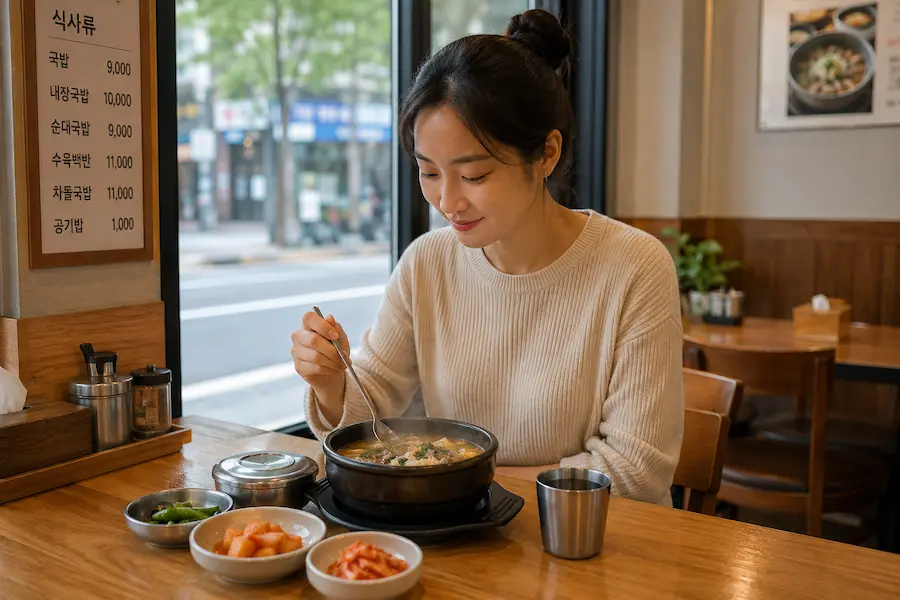
Eating alone in Korea is not unusual.
Office workers may normally have lunch with colleagues, but schedules do not always match. Someone may have a meeting, a deadline or work that cannot be left until later. On those days, eating alone is simply the most practical choice.
The same is true outside work.
I often meet friends or family for weekend meals, but when I need to shop for something specific, I usually prefer going alone. When I was younger, shopping felt like an activity that had to be shared with someone. These days, going by myself is often quicker and more comfortable.
Sometimes I finish shopping and go straight home. Sometimes I stop for a meal first.
I have never been refused service simply because I was alone at an ordinary restaurant in Seoul. There is a tonkatsu restaurant near my home that I visit regularly, either alone or with someone else. On some days, I sit down and eat there. On other days, I order the meal to go and eat comfortably at home.
That experience is common for many everyday restaurants.
The main question is usually not whether eating alone is socially acceptable. It is whether the restaurant’s menu, seating and minimum-order rules work for one person.
Is It Normal to Eat Alone in Korea?
Yes.
People eat alone for many ordinary reasons:
- work schedules do not match;
- someone is between meetings;
- friends want to eat different things;
- a person is shopping or running errands alone;
- a traveler has separated from their companions for part of the day;
- someone simply wants a quiet meal.
In Korean, eating alone is often called honbap, written as 혼밥. It combines honja, meaning alone, and bap, meaning a meal or rice.
The word is widely understood, but travelers do not need to use it when entering a restaurant. In most solo-friendly places, asking for a table for one is enough.
Eating alone is generally not considered strange. However, not every restaurant is designed around single-person orders.
Which Restaurants Are Usually Easy for Solo Diners?
Restaurants built around individual meals are usually the easiest choice.
| Restaurant type | Typical solo-dining experience | What to check |
|---|---|---|
| Kimbap and casual snack shops | Usually very easy | Order at the counter or kiosk |
| Noodle restaurants | Usually easy | Some popular places may have shared seating |
| Gukbap and soup restaurants | Usually easy | Side dishes may be self-service |
| Tonkatsu restaurants | Usually easy | Choose dine-in or takeaway |
| Rice-bowl restaurants | Usually easy | Counter seats may be available |
| Ramen restaurants | Usually easy | Ordering may be through a kiosk |
| Fast-food restaurants | Very easy | Return trays where indicated |
| Food courts | Very easy | Collect food when your number appears |
| Department-store dining areas | Usually easy | Busy lunch hours can be crowded |
| Convenience stores with seating | Easy for a quick meal | Seating is not available at every branch |
For ordering, kiosks, self-service, payments and other restaurant basics, see our Korean Restaurant Guide.
A restaurant that sells complete one-person meals is generally a safer choice than one built around shared grills, large pots or dishes intended for a group.
Kimbap and Casual Korean Restaurants
Kimbap restaurants are among the easiest places to eat alone.
They often serve:
- kimbap;
- ramyeon;
- tteokbokki;
- dumplings;
- fried rice;
- jjigae;
- simple rice dishes.
The food is usually ordered as an individual portion, and tables turn over quickly. Customers may be office workers, students, local residents or people stopping for a quick meal between errands.
Some restaurants take orders at the table. Others use a counter or kiosk.
There is usually no need to explain why you are alone.
Soup, Noodle and Rice-Bowl Restaurants
Restaurants serving soup, noodles or rice bowls are also practical for one person.
Examples include:
- seolleongtang;
- gomtang;
- dwaeji-gukbap;
- kalguksu;
- naengmyeon;
- bibimbap;
- curry rice;
- donburi-style rice bowls.
Each customer normally receives an individual bowl or tray.
At busy restaurants, a solo diner may be seated at a small table, a counter or occasionally at a shared table with another customer. Sharing a large table does not necessarily mean sharing food or conversation. It may simply be the restaurant’s way of using limited space efficiently.
Food Courts and Department Stores
Food courts are useful when you want several choices without worrying about restaurant-specific seating rules.
They are common in:
- department stores;
- shopping malls;
- large supermarkets;
- train stations;
- transport terminals.
The usual process is:
- Choose a restaurant counter.
- Order and pay.
- Receive a number, receipt or pager.
- Collect the food when it is ready.
- Sit at any available seat.
- Return the tray after eating.
Some food courts have a central payment counter, while others require payment at each restaurant. Follow the signs at the location.
This can be especially convenient when shopping alone. You do not have to decide whether a restaurant looks comfortable for one person before entering.
Convenience Stores for a Quick Solo Meal
Some Korean convenience stores have indoor or outdoor seating where customers can eat products purchased in the store.
Common choices include:
- lunch boxes;
- triangle kimbap;
- cup noodles;
- sandwiches;
- salads;
- boiled eggs;
- packaged snacks.
Not every branch has seating. Small stores may have no dining space at all.
Where seating is provided, use the waste and recycling area according to the store’s instructions. Convenience stores are useful for a quick meal, but they do not need to replace local restaurants throughout the trip.
For more information about the services available, read How Korean Convenience Stores Work as Everyday Service Hubs.
Which Restaurants May Require More Checking?
Some Korean meals are traditionally prepared and ordered for more than one person.
That does not mean a solo customer is always refused. It means the ordering conditions are more likely to vary.
Korean Barbecue Restaurants
Barbecue restaurants may require a minimum order of two portions of meat.
A single diner may still be accepted if they order two portions. Some restaurants also offer one-person sets or have seats designed for solo customers.
Other restaurants may not accept one person during busy hours or may not have a menu that works for a solo order.
I have not visited a barbecue restaurant alone, but one of my friends does not let that stop her. If she wants barbecue or sashimi, she goes.
She has ordered two portions when that was the restaurant’s minimum. She has also been turned away at a restaurant because she was alone.
One of those experiences happened near a tourist destination during a solo trip. When she returned, it became one of the stories she told us about the journey.
Her experience is a useful reminder: a solo diner is not automatically unwelcome, but acceptance can depend on the individual restaurant.
Large Shared Pots and Stir-Fried Dishes
Meals commonly prepared in a large pan or pot may require two or more portions.
Examples can include:
- dakgalbi;
- large hot pots;
- jeongol;
- some braised dishes;
- large seafood dishes;
- shared chicken or meat platters.
Some restaurants have introduced smaller portions or one-person sets. Others still follow a two-person minimum.
Look for phrases such as:
- 2인분 이상 — minimum two portions;
- 2인 이상 주문 가능 — available for orders of two people or more;
- 1인분 가능 — one portion available;
- 1인 세트 — one-person set.
Menu rules can change by restaurant, so the sign or menu at the location is more reliable than a general assumption about the dish.
Sashimi Restaurants
A sashimi restaurant may sell fish by platter size rather than by individual portion.
A solo customer might be able to order:
- a small platter;
- a one-person set;
- a lunch menu;
- a sashimi rice bowl;
- takeaway.
At another restaurant, even the smallest platter may be intended for two people.
Checking the menu before sitting down is helpful.
Does Ordering Two Portions Mean Food for Two People?
Not always.
In Korean restaurants, one portion can mean the restaurant’s measured serving unit rather than a complete meal for one person.
At a barbecue restaurant, two portions may be a manageable amount for one hungry adult, depending on the weight of each portion and any side dishes ordered.
At a large hot-pot restaurant, however, a two-person order may be much more food than one person wants.
Travelers should not assume that “two portions” always means exactly twice the amount of a normal individual meal.
Ask about the portion size when you are unsure.
How Can You Check Whether a Restaurant Accepts One Person?
The easiest approach is to check before sitting down.
You can:
- look at the menu outside;
- check whether prices are listed per person or per dish;
- look for one-person sets;
- check recent map reviews and customer photos;
- ask a staff member at the entrance;
- avoid the busiest meal period if the restaurant seems small.
Useful Korean phrases include:
| Korean | Pronunciation | Meaning |
|---|---|---|
| 한 명이에요. | Han myeong-ieyo. | One person. |
| 혼자 먹어도 돼요? | Honja meogeodo dwaeyo? | Can I eat here alone? |
| 1인분 주문돼요? | Il-inbun jumun dwaeyo? | Can I order one portion? |
| 최소 주문이 몇 인분이에요? | Choeso jumuni myeot inbun-ieyo? | What is the minimum order? |
| 포장돼요? | Pojang dwaeyo? | Is takeaway available? |
In most ordinary restaurants, saying 한 명이에요 is enough.
The longer questions are more useful at barbecue, sashimi or shared-dish restaurants.
Does the Time of Day Matter?
Sometimes.
A small restaurant may be happy to seat a solo customer during a quiet period but handle seating differently during the busiest lunch or dinner hour.
Peak periods often include:
- weekday lunch near office districts;
- early evening near popular restaurants;
- weekend meal times in shopping and tourist areas.
This does not mean a solo diner should avoid busy hours completely.
It means that a restaurant with only a few large tables may prefer to use them for groups when a queue is forming. A counter-seat restaurant or quick-meal restaurant is less likely to have this issue.
When flexibility is possible, eating slightly before or after the main rush can make the experience easier.
Can a Restaurant Refuse a Solo Customer?
It can happen, particularly where:
- the menu requires at least two portions;
- food is prepared only in a large shared size;
- the restaurant has very limited seating;
- the restaurant is operating at peak capacity;
- its internal policy does not accommodate one-person orders.
A refusal does not prove that Korean restaurants generally dislike solo diners.
It reflects the policy or operating limits of that particular business.
There is usually little value in arguing. Another restaurant nearby may have an individual version of the same dish or a menu that works much better for one person.
What About Side Dishes?
At many restaurants, a solo customer receives the same basic side dishes as other customers.
The number and size of the dishes may vary by restaurant.
Some side dishes can be refilled for free, but this does not apply to every item. Certain dishes, premium ingredients or menu additions may cost extra.
At self-service restaurants, additional water, utensils or side dishes may be available at a separate station.
Take only what you expect to eat. Food waste is unnecessary, especially when dining alone and managing several side dishes by yourself.
Water, Utensils and Self-Service
A solo diner may need to look around before waiting for a staff member.
Depending on the restaurant:
- water may be brought to the table;
- a water dispenser may be self-service;
- chopsticks and spoons may be in a drawer under the table;
- napkins may be attached to the side of the table;
- side-dish refills may be at a self-service station;
- trays may need to be returned after eating.
Restaurant systems differ even for Korean customers. It is normal to look around or ask when the process is unclear.
If ordering is done through a machine, see our What to Know Before Using a Korean Restaurant Kiosk guide.
Is Takeaway Sometimes Easier?
Yes.
Eating alone does not always mean sitting alone in a restaurant.
Sometimes I visit my regular tonkatsu restaurant and eat there. On another day, especially when I am tired or want to rest at home, I order the same meal as takeaway.
Takeaway can be useful when:
- the restaurant is crowded;
- the seating feels uncomfortable;
- the menu is easy to carry;
- you want to eat at your accommodation;
- you have already had a long day;
- the restaurant does not seat one person but allows takeaway.
The Korean word 포장, or pojang, means takeaway or packing food to go.
Ask:
포장돼요?
Pojang dwaeyo?
Is takeaway available?
Remember that not every hotel or guesthouse allows strong-smelling food in rooms. Check the accommodation rules before bringing a full meal back.
Can You Eat Separately While Traveling With Someone?
Of course.
Travel companions do not have to eat every meal together.
One person may want barbecue while another wants noodles. Someone may wake up late, attend a performance, go shopping or return to the hotel early.
Even travelers who arrived in Korea together can have moments when a solo meal is the easiest solution.
This is why solo-dining information is useful beyond solo travel.
It is not only for someone spending an entire trip alone. It is for anyone who needs one meal without coordinating with another person.
How to Choose a Comfortable Solo Meal
When you want the easiest option, look for a restaurant with:
- clearly priced individual meals;
- counter or two-person seating;
- visible self-order kiosks;
- food served in individual bowls or trays;
- photos of solo customers in recent reviews;
- one-person sets;
- takeaway options.
Good first choices include:
- kimbap shops;
- noodle restaurants;
- gukbap restaurants;
- tonkatsu restaurants;
- rice-bowl restaurants;
- food courts;
- casual cafés;
- fast-food restaurants.
Restaurants requiring shared grills, large pots or platter orders need more checking.
What Not to Assume
Avoid broad assumptions such as:
- Nobody eats alone in Korea.
- Every Korean restaurant accepts one person.
- Korean barbecue is impossible alone.
- Ordering two portions always means too much food.
- A restaurant refusing one person is discriminating against foreigners.
- Convenience stores are the only safe choice for solo diners.
The reality is less dramatic.
Most individual-meal restaurants are straightforward for solo customers. Some shared-menu restaurants require a quick check before entering.
Frequently Asked Questions
Is eating alone considered rude in Korea?
No. Eating alone is common for office workers, students, shoppers, residents and travelers. The restaurant’s ordering system matters more than social judgment.
Can I eat Korean barbecue alone?
It depends on the restaurant. Some accept solo customers who order the minimum amount, while others offer one-person sets. A restaurant may also decline a solo diner, particularly during busy hours.
Do I have to order two portions at a barbecue restaurant?
Many barbecue restaurants set a two-portion minimum, but rules vary. Check the menu or ask before sitting down.
Which Korean restaurants are easiest for one person?
Kimbap shops, noodle restaurants, soup restaurants, tonkatsu restaurants, rice-bowl restaurants, food courts and fast-food restaurants are usually easy choices.
Will I receive side dishes when eating alone?
Usually, yes. The selection and serving size depend on the restaurant. Some refills may be self-service.
Can I order takeaway instead?
Many restaurants offer takeaway, but not every dish travels well. Ask 포장돼요? to check.
Should I avoid restaurant rush hours?
You do not have to, but visiting outside the busiest lunch or dinner periods can make it easier to find a seat at small restaurants.
Final Thoughts
Eating alone in Korea is usually simple.
I do it when work schedules do not match, when I am shopping alone or when I want to stop at my regular tonkatsu restaurant without arranging a meal with someone else.
The experience does not feel unusual.
The situations that require more thought are not really about being alone. They are about how the food is sold.
A bowl of noodles, a plate of tonkatsu or a rice dish is designed for an individual customer. A barbecue grill, large pot or sashimi platter may be organised around a shared order.
Once you recognise that difference, choosing a restaurant becomes easier.
Look for individual meals when you want a straightforward experience. Check minimum orders when the menu is meant for sharing. Ask before sitting down when you are unsure. Use takeaway when that feels more comfortable.
You do not need a special reason to eat alone.
Sometimes you are traveling by yourself. Sometimes your companion is somewhere else. Sometimes you simply want a meal and do not want to wait for anyone.
That is reason enough.
For more practical Korean food and dining guidance, return to our Food & Drink guide.