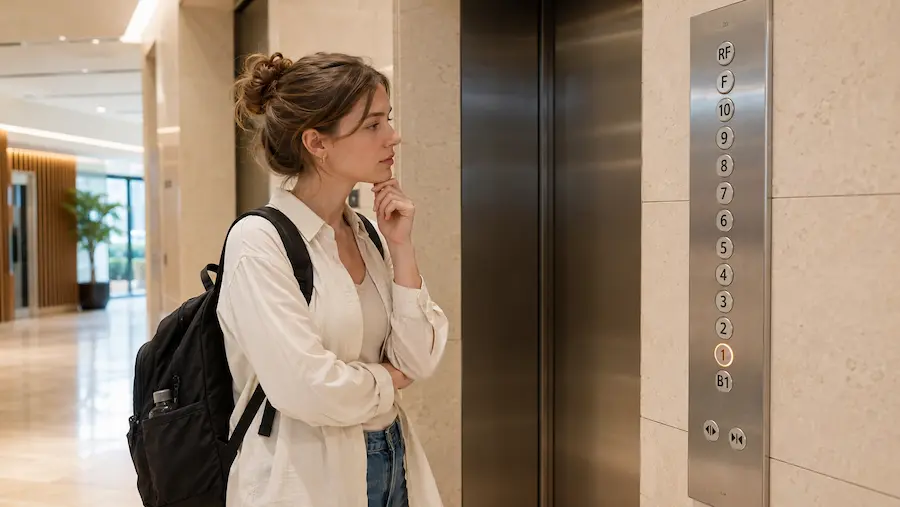
I still remember being surprised when I first travelled abroad and realised that floor numbers were not the same everywhere.
In Korea, I had always understood the level entered directly from the street as the first floor. The next level was the second floor, followed by the third floor.
Then I visited countries where the street-level entrance was called the Ground Floor and the level above it was called the First Floor. The system was simple once I understood it, but the difference was confusing at first.
Visitors to Korea may experience the same confusion in reverse.
The Korean system itself is straightforward. The main ground-level floor is generally called the first floor, and the levels above it continue as the second, third and fourth floors. Underground levels are usually marked B1, B2 and so on.
What can be confusing is the way individual buildings label particular floors.
Hotels may use L for a lobby. Shopping centres may have a mezzanine level. Rooftops may be marked RF. Some elevators replace the number 4 with F, while many other buildings display 4 normally.
This guide explains how to read those labels and what to check when the correct building still feels difficult to navigate.
Korean Floor Labels at a Glance
| Label | Common meaning |
|---|---|
| B1 | First basement level |
| B2 | Second basement level |
| 1F | First floor |
| 2F | Second floor |
| 3F | Third floor |
| F | Sometimes used instead of the number 4 |
| L | Usually Lobby |
| M | Often Mezzanine or an intermediate level |
| RF | Roof Floor or Rooftop |
| R | Roof or Rooftop |
| PH | Penthouse in some buildings |
These are common meanings, not universal rules.
The building’s own directory and elevator signs should always take priority.
The Main Ground-Level Floor Is Usually 1F
In Korea, the main floor entered from street level is generally called:
- 1층 in Korean;
- 1F on English signs;
- First Floor in English.
The floor above it is 2F, followed by 3F, 4F and so on.
This differs from the system used in countries where the street entrance is the Ground Floor and the level above it is the First Floor.
| Physical level | Common Korean label | Ground-floor system |
|---|---|---|
| Main street entrance | 1F | Ground Floor |
| One level above | 2F | First Floor |
| Two levels above | 3F | Second Floor |
A restaurant listed on 2F in Korea is therefore usually one level above the main entrance.
However, buildings on slopes or with several entrances may not feel this simple. The official floor number is the one shown on the building directory, not necessarily the level that appears to be at ground height from every entrance.
What Do B1 and B2 Mean?
The letter B stands for Basement.
- B1 means the first basement level.
- B2 means the second basement level.
- B3 means the third basement level.
In Korean, these are written as:
- 지하 1층;
- 지하 2층;
- 지하 3층.
Basement floors in Korea are not limited to parking and storage.
B1 may contain:
- department-store food halls;
- supermarkets;
- restaurants;
- cafés;
- subway connections;
- underground shopping areas;
- ticket counters;
- building entrances.
Major department stores commonly list food markets and restaurants on B1 while using 1F for cosmetics, fashion or luxury brands.
This means that B1 may be a busy public shopping level rather than a utility basement.
What Does the F After a Number Mean?
When F appears after a number, it normally means Floor.
For example:
- 1F means First Floor.
- 2F means Second Floor.
- 7F means Seventh Floor.
This is the usual meaning on building directories, shop addresses and English-language signs.
However, an elevator button showing only F between 3 and 5 may mean something different.
In that position, F usually replaces the number 4.
Why Is the Fourth Floor Sometimes Marked F?
The Sino-Korean word for the number four is pronounced sa.
A different Sino-Korean word meaning death is also pronounced sa, although the two words use different Chinese characters.
Because of this similarity, the number four has traditionally been considered unlucky by some people in Korea. Some buildings replace the number 4 on an elevator with the letter F.
You may see:
1, 2, 3, F, 5
In this sequence, F represents the fourth floor.
This practice may appear in some:
- apartment buildings;
- officetels;
- office buildings;
- hospitals;
- hotels;
- older commercial buildings.
However, it is not a legal requirement and is not followed by every building.
Many apartments, hospitals, offices, hotels and public buildings display the number 4 normally. The decision depends on the building’s developer, owner, management or signage design.
The safest rule is:
If F appears alone between 3 and 5, it probably means the fourth floor.
How Can You Tell What F Means?
Look at the labels around it.
F means Floor when:
- it appears after a number, such as 1F or 6F;
- every level on the directory uses the same format;
- it is part of a shop or facility address.
F probably means the fourth floor when:
- it appears alone between 3 and 5;
- the elevator has no button marked 4;
- the destination is listed as 4층 but the elevator shows F.
The position of the letter is more useful than the letter by itself.
Do All Korean Buildings Skip the Fourth Floor?
No.
Many Korean buildings use the number 4 without changing it.
For example, official building descriptions commonly use formats such as:
- B1/4F;
- B1/5F;
- B1/15F.
These mean that the building has one basement level and four, five or fifteen levels above ground.
You may also see restaurants, museums, clinics and public facilities openly listed on 4F.
The F replacement is a cultural practice found in some buildings, not a national numbering rule.
What Does L Mean?
L usually means Lobby.
It may appear in:
- hotels;
- office towers;
- residential complexes;
- mixed-use buildings;
- buildings with a separate reception level.
However, L does not always mean the physical first floor.
A hotel may occupy the upper section of a large building, with shops, parking or offices below it. Its reception area may therefore be several floors above street level.
For example, an official L7 Gangnam by LOTTE guide places its lobby lounge on 9F. This shows why “lobby” should not automatically be understood as street level.
When looking for hotel reception, check signs for:
- Lobby;
- Reception;
- Front Desk;
- Check-in;
- Sky Lobby.
The most reliable rule is:
L usually means Lobby, but it does not necessarily mean 1F.
What Does M Mean?
M commonly means Mezzanine or an intermediate level.
A mezzanine is a partial level positioned between two main floors.
A building may use labels such as:
- M;
- 1M;
- M1;
- B1M.
The exact meaning depends on the building.
For example, an official Shinsegae Department Store floor guide uses 1M as a separate shopping and dining level.
M should therefore be treated as a building-specific label rather than a fixed level found in every Korean building.
Check the directory to see where it sits in relation to the numbered floors.
What Do RF and R Mean?
RF commonly means:
- Roof Floor;
- Rooftop Floor.
R may mean:
- Roof;
- Rooftop.
These levels may contain:
- rooftop gardens;
- outdoor terraces;
- restaurants;
- observation areas;
- mechanical facilities;
- restricted areas.
Some department-store floor guides use RF for a public rooftop garden or sky park.
However, not every rooftop is open to visitors. It may be reserved for residents, staff or building equipment.
Before going to RF or R, check whether the directory lists a public facility.
What Does PH Mean?
PH usually means Penthouse.
It may refer to:
- a top-floor residence;
- a premium hotel room;
- an upper mechanical or service level;
- a building-specific top floor.
PH is not commonly needed by ordinary visitors unless it appears in a hotel, apartment or office address.
As with other letters, check the building directory before assuming that it is publicly accessible.
Why Can the Same Building Have Different Ground-Level Entrances?
A building on sloped land may have entrances at different heights.
One entrance may open onto 1F, while an entrance on the opposite side opens onto B1 or 2F.
Both entrances can feel like street level because the surrounding ground is not flat.
This is common in areas with:
- hills;
- raised roads;
- underground shopping centres;
- subway connections;
- elevated walkways;
- large hospital complexes;
- mixed-use developments.
The floor numbers do not change between entrances. The ground outside the building changes height.
Use the elevator or floor directory as the official reference.
Subway-Connected Buildings Can Feel More Complicated
A shopping centre, hotel or department store connected to a subway station may have several underground entrances.
For example:
- a subway concourse may connect directly to B1;
- an underground shopping area may lead into B2;
- a basement passage may connect two separate buildings;
- the main street entrance may still be marked 1F.
Entering through a basement connection does not mean that you have entered the wrong building.
Before going outside again, look for:
- the building name;
- the correct wing;
- elevator signs;
- floor directories;
- arrows marked 연결통로;
- the correct subway exit number.
연결통로 means connecting passage.
In large station complexes, counting escalators is less reliable than checking the floor shown beside the lift or on the directory.
For help with station signs and exits, read Seoul Subway Stations Explained: Tickets, Exits, Signs, and Etiquette.
Department Stores and Shopping Centres
Large Korean shopping buildings normally provide floor directories near:
- entrances;
- escalators;
- elevators;
- information desks;
- digital guide screens.
A directory may look like this:
| Floor | Possible use |
|---|---|
| RF | Rooftop garden |
| 8F | Restaurants |
| 5F | Home and lifestyle |
| 2F | Fashion |
| 1F | Cosmetics and luxury brands |
| B1 | Food hall and supermarket |
| B2 | Parking or subway connection |
The exact arrangement differs by building.
Check both the floor and the section.
A shop on 5F in the main building may not be accessible from an elevator in the annex. Large stores may also have separate buildings connected by bridges or basement passages.
Hotels
Hotels may combine several labels, including:
- numbered floors;
- L for Lobby;
- LL for Lower Lobby;
- M for Mezzanine;
- RF or R for Rooftop;
- P for Parking;
- B1 or B2 for basement levels.
The hotel entrance, reception desk and guest-room elevators may not be in the same place.
This is especially common when a hotel is inside:
- a shopping complex;
- a tall office tower;
- a transport terminal;
- a mixed-use development.
Check the booking information for the exact reception floor, particularly when the hotel advertises a Sky Lobby.
Hospitals and Large Medical Buildings
Hospitals can be more confusing because they may have:
- a main building;
- an annex;
- an outpatient centre;
- a specialised treatment building;
- underground connecting passages;
- several elevator zones.
The floor number alone may not be enough.
Also check:
- the building name;
- the department;
- the reception desk;
- the elevator zone;
- the room number.
A clinic listed on 4F in one building may not be accessible from an elevator in another wing.
Some hospitals replace 4 with F, while others use 4 normally. Follow the signs in that particular hospital.
Apartments and Officetels
Apartment and officetel elevators usually follow the normal Korean sequence:
1, 2, 3, 4, 5
Some buildings instead use:
1, 2, 3, F, 5
In the second example, F is the fourth floor. It is not an additional floor between 3 and 5.
The practice varies by apartment or officetel.
Unit numbers may also vary. A unit beginning with 4 may be used normally in one building and avoided in another.
Always follow the building’s elevator and unit directory rather than expecting every residential building to use the same convention.
When the Map Finds the Building but Not the Shop
A Korean map app may bring you to the correct building without explaining the route inside it.
Before assuming that the map is wrong, check:
- The building name.
- The floor number.
- The shop or office number.
- The correct wing or annex.
- Whether the entrance is above or below street level.
- Whether the elevator serves that floor.
- Whether the destination is inside a station or department store.
- Whether another building is connected internally.
A complete Korean address may include a building name, floor and room number.
For more help, read Korean Address Format: How Foreigners Can Read and Write Addresses in Korea.
For broader help with subway exits, maps and navigation, see our Getting Around guide.
Useful Korean Floor Words
| Korean | Pronunciation | Meaning |
|---|---|---|
| 층 | Cheung | Floor |
| 1층 | Il cheung | First floor |
| 2층 | I cheung | Second floor |
| 4층 | Sa cheung | Fourth floor |
| 지하 | Jiha | Basement or underground |
| 지하 1층 | Jiha il cheung | First basement level |
| 로비 | Robi | Lobby |
| 옥상 | Oksang | Rooftop |
| 중간층 | Junggancheung | Intermediate floor |
| 연결통로 | Yeongyeol tongno | Connecting passage |
| 본관 | Bongwan | Main building |
| 별관 | Byeolgwan | Annex |
| 동관 | Donggwan | East wing |
| 서관 | Seogwan | West wing |
Useful Questions
몇 층이에요?
Byeot cheung-ieyo?
What floor is it on?
이 식당은 몇 층이에요?
I sikdangeun myeot cheung-ieyo?
What floor is this restaurant on?
지하 1층이에요?
Jiha il cheung-ieyo?
Is it on B1?
엘리베이터가 어디예요?
Ellibeiteoga eodiyeyo?
Where is the elevator?
로비가 몇 층이에요?
Robiga myeot cheung-ieyo?
What floor is the lobby on?
이 건물과 연결돼 있어요?
I geonmulgwa yeongyeoldwae isseoyo?
Is it connected to this building?
F가 4층이에요?
F-ga sa cheung-ieyo?
Does F mean the fourth floor?
Showing the Korean sentence on your phone can be helpful when speaking is difficult.
For more everyday expressions, read Simple Korean Phrases for Travel in Korea.
Quick Checklist
When looking for a destination inside a Korean building:
- Treat the main ground-level entrance as 1F unless the directory says otherwise.
- Read B1 as the first basement level.
- Remember that 2F is one level above 1F.
- Check whether F appears after a number or alone between 3 and 5.
- Do not assume L is the same as 1F.
- Check the directory before using M, R or RF.
- Confirm the correct building wing or annex.
- Use the elevator directory rather than counting escalators.
- Check for underground connections before going outside.
- Ask “몇 층이에요?” when the destination remains unclear.
Frequently Asked Questions
Is the ground floor called the first floor in Korea?
Generally, yes. The main street-level entrance is usually called 1F or 1층. The level above it is normally 2F.
Buildings on slopes or with multiple entrances can appear different, so follow the building directory.
What does B1 mean in Korea?
B1 means the first basement level. It is written 지하 1층 in Korean.
Does F always mean the fourth floor?
No. In labels such as 1F and 2F, F means Floor.
When F appears alone between 3 and 5 on an elevator, it usually replaces the number 4.
Why do some Korean elevators use F instead of 4?
The Sino-Korean words for four and death have the same pronunciation, although they use different characters. Some building managers replace 4 with F because of this cultural association.
Do all Korean buildings skip the number 4?
No. Many Korean buildings display 4 normally. Replacing it with F is a building-specific choice, not a nationwide requirement.
Does L always mean the first floor?
No. L usually means Lobby. A lobby may be on 1F, but it can also be located on another level.
What does M mean?
M commonly means Mezzanine or an intermediate level. Its exact position depends on the building.
What does RF mean?
RF usually means Roof Floor or Rooftop. Access may be public or restricted.
Why can a building have two ground-level entrances?
The building may stand on sloped land or connect to underground transport and shopping areas. One entrance may lead to 1F while another leads to B1 or 2F.
Final Thoughts
Korean floor numbering is simple once the basic rule is clear.
The main street-level floor is generally 1F. The next floor is 2F, and underground levels are marked B1, B2 and so on.
The letters are what require a little more attention.
F may replace the number 4 in some buildings. L usually points to a lobby. M may identify a mezzanine or intermediate floor. RF generally refers to a rooftop level.
These labels are not used in exactly the same way by every apartment, hotel, hospital or shopping centre.
Check the floor number, building section and directory together rather than relying on one letter alone.
Once you understand that Korea normally begins with 1F at the main ground-level entrance, the remaining labels become useful building-specific clues rather than a completely different numbering system.
For address details such as road names, building numbers and room numbers, see our Korean Address Format guide.