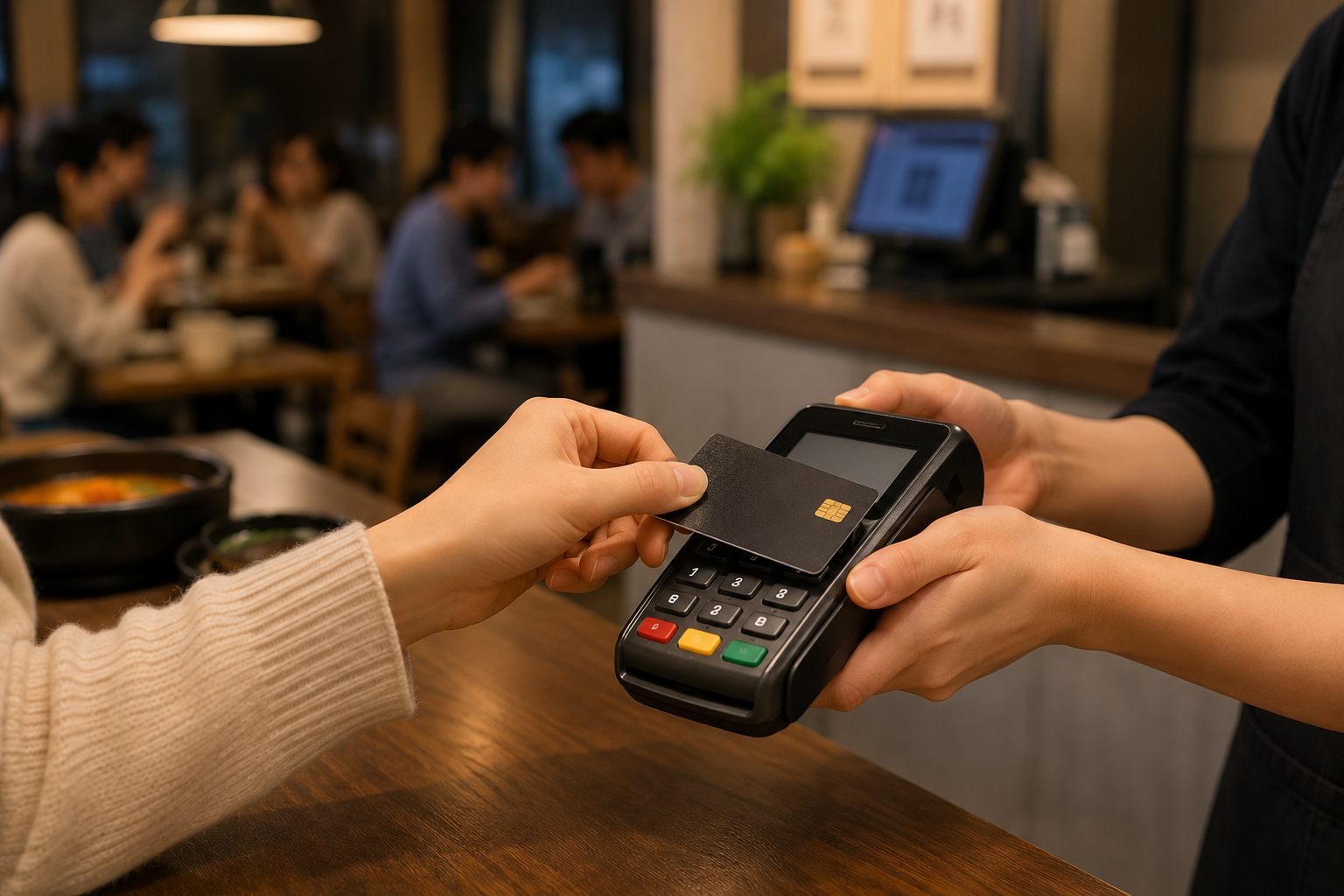
Eating at a Korean restaurant is usually straightforward once you understand how that particular restaurant works.
The confusing part for first-time visitors is that there is no single system.
You may order from a staff member, at a counter, through a kiosk or from a touchscreen at the table. Water and side dishes may be self-service. Spoons and chopsticks may be hidden inside a drawer under the table. A button may be provided to call a server. After eating, you may need to walk to the counter because no bill will ever arrive at your table.
None of these systems is difficult once you know what to look for.
The most useful rule is simple:
Look at how the restaurant is organised before assuming that service will work the same way as it does at home.
This guide explains the everyday restaurant details visitors are most likely to encounter in Korea, from ordering and self-service to side dishes, table customs, payment and tipping.
This Korean restaurant guide explains what first-time visitors should expect when ordering, using self-service systems, paying and following basic table customs.
Korean Restaurants at a Glance
| Situation | What to check |
|---|---|
| Ordering | Staff, counter, kiosk or table touchscreen |
| Calling staff | Look for a call button or ask politely |
| Water | May be brought to the table or self-service |
| Spoons and chopsticks | Check the table, drawer or self-service area |
| Side dishes | Basic banchan may be refillable, but not every item is unlimited |
| Minimum orders | Some shared dishes may start from two portions |
| Paying | Counter, kiosk, table screen or staff |
| Split payment | Often possible at a staffed counter if requested before payment |
| Tipping | Not normally required or expected |
These are common patterns rather than rules for every restaurant.
Always follow the system used by the restaurant you are actually visiting.
First: Work Out How You Order
Korean restaurants use several ordering systems.
At a traditional table-service restaurant, a staff member may take the order at the table.
At a casual restaurant, bakery, café or food court, you may order and pay at the counter before receiving the food.
Some restaurants use a kiosk near the entrance.
Others place a touchscreen or tablet on each table.
A table touchscreen may allow you to:
- browse the menu
- select dishes
- add extra items
- check the current order
- request assistance
- sometimes pay
Do not assume that every touchscreen includes payment.
Some screens are used only for ordering.
If you are using a kiosk and want a more detailed explanation of language settings, menu choices, payment and order numbers, see our What to Know Before Using a Korean Restaurant Kiosk guide.
Using a Korean Restaurant Kiosk
Restaurant kiosks are common in casual dining spaces, cafés, fast-food restaurants, dessert shops, food courts and highway rest areas.
A typical process is:
- Select the language if available.
- Choose dine-in or takeaway.
- Select your food.
- Review options and quantities.
- Pay.
- Keep the receipt or order number.
- Wait for your number or collect the food where instructed.
Useful words include:
| Korean | Meaning |
|---|---|
| 주문하기 | Place an order |
| 결제하기 | Pay |
| 매장 | Dine in |
| 포장 | Takeaway |
| 카드 결제 | Card payment |
| 현금 결제 | Cash payment |
| 영수증 | Receipt |
| 주문 완료 | Order complete |
Payment methods vary by machine.
An overseas card may work at one kiosk and fail at another. If payment does not go through, ask whether you can use a staffed counter or another payment method.
What Is the Button on the Table?
Many Korean restaurants have a small button for calling staff.
It may be:
- on the edge of the table
- attached to the wall
- beside the napkins
- incorporated into a touchscreen
You may see a bell symbol or the Korean word:
호출
This means call.
Pressing the button once is normal when the restaurant provides one.
You can use it when you need:
- an additional order
- water
- utensils
- help with the meal
- a side-dish refill
- assistance with the bill
Press it once and wait briefly.
Repeatedly pressing the button is unnecessary.
If there is no button, make eye contact with a member of staff, raise your hand slightly or ask politely.
Water May Be Self-Service
You may sit down and notice that no one brings water.
The restaurant may not have forgotten you.
Water could simply be self-service.
In Korean restaurants, 셀프, or self, means that customers should handle a particular item themselves.
It does not necessarily mean that the entire restaurant is self-service.
A self-service corner may contain:
- water dispenser
- cups
- spoons and chopsticks
- napkins
- small plates
- side dishes
- sauces or condiments
Look around before calling the staff.
Other customers often provide the quickest clue.
Where Are the Spoons and Chopsticks?
If the food arrives but you cannot see any utensils, check underneath the edge of the table.
Many Korean restaurants have a shallow drawer built into the table.
It may contain:
- metal spoons
- metal chopsticks
- napkins
- bottle openers
- small plates
The drawer can be surprisingly easy to miss if you have never seen one before.
Not every restaurant has a drawer.
Utensils may instead be:
- placed directly on the table
- brought with the food
- kept at a self-service station
- located near the counter
For more about utensils and table manners, see our Korean Chopsticks and Table Manners guide.
How Side Dishes and Refills Work
A Korean meal may arrive with several small dishes around the main food.
These side dishes are commonly called banchan.
Examples may include kimchi, seasoned vegetables, pickles and other small dishes.
Basic side dishes can often be refilled without an additional charge.
Depending on the restaurant, you may:
- ask a staff member
- use the call button
- take another portion from a self-service bar
However, do not assume that everything on the table is unlimited or free.
Rice, noodles, meat, soup and larger dishes may be separate menu items. Some side dishes may also be limited according to the restaurant’s policy or supply.
When taking refills from a self-service station:
- start with a small amount
- use the serving utensil provided
- take only what you expect to eat
Self-service does not mean taking as much as possible.
Do You Need to Return Your Tray?
Only when the restaurant clearly asks you to.
Tray-return areas are common in:
- food courts
- cafeterias
- highway rest areas
- some casual self-service restaurants
Look for signs such as:
식기 반납
Dish return
or
퇴식구
Tray or dish return area
In a normal table-service restaurant, customers usually leave the dishes on the table unless instructed otherwise.
A restaurant having self-service water does not automatically mean that you must clear the entire table.
Check Minimum-Order Notes Before Ordering Shared Dishes
Eating alone in Korea is usually easier than many visitors expect.
However, some dishes may require a minimum order.
This is particularly common with food prepared in a shared pan, pot or grill.
Examples can include:
- Korean barbecue
- dakgalbi
- jeongol
- large hot pots
- some braised dishes
- shared seafood dishes
You may see:
2인분 이상 주문 가능
Orders of at least two portions
or
2인분부터 주문 가능
Orders start from two portions
This refers to the quantity of food.
It does not automatically mean that two people must be sitting at the table.
A solo diner may sometimes be allowed to order two portions.
This is different from:
2인 이상 주문 가능
which means that orders are available only for groups of two or more people.
If solo dining is important to your trip, our Eating Alone in Korea guide explains what to expect in more detail.
Where Do You Pay?
At many everyday Korean restaurants, customers finish eating and pay at a counter near the entrance.
This is why visitors sometimes wait for a bill that never arrives.
A common pattern is:
- Finish eating.
- Get up from the table.
- Walk to the cashier.
- Tell the cashier your table number if necessary.
- Pay.
- Leave.
Look for:
계산대
This means cashier or checkout counter.
A paper order slip may be left on the table. If it is clearly intended to be carried, take it to the counter.
Other restaurants use different systems.
| Payment method | When | Where |
|---|---|---|
| Counter payment | After eating | Counter near entrance |
| Pay when ordering | Before eating | Ordering counter |
| Kiosk | During ordering | Kiosk |
| Table touchscreen | During ordering or before leaving | Screen at table |
| Table payment | After eating | Staff or portable terminal |
| Food court | When ordering | Stall, counter or kiosk |
The safest approach is to look at what other customers are doing.
How to Ask Where to Pay
If you are unsure, ask:
계산은 어디에서 해요?
Gyesaneun eodieseo haeyo?
Where do I pay?
Or:
여기서 계산해요?
Yeogiseo gyesanhaeyo?
Do I pay here?
At a table-service restaurant:
계산할게요.
Gyesanhalgeyo.
I would like to pay.
Paying by Card
Card payment is widely used in Korea.
International cards may work at many restaurants, but successful payment is not guaranteed at every terminal or kiosk.
Travel with:
- one primary payment card
- a backup card
- a small amount of Korean won
If your overseas card does not work:
- Insert the card instead of tapping.
- Ask the staff to retry.
- Try a staffed terminal instead of a kiosk.
- Use another card.
- Check your bank app.
- Ask whether cash is accepted.
For broader payment guidance, see our How Payment Works in Korea: Cards, Cash, and What Travelers Should Prepare guide.
Can You Split the Bill?
At many staffed restaurants, one total can be divided between several cards if you ask before payment begins.
For example:
두 카드로 나눠서 결제할게요.
Du kadeuro nanwoseo gyeoljehalgeyo.
We would like to split the payment between two cards.
반씩 결제해 주세요.
Banssik gyeoljehae juseyo.
Please charge half to each card.
Dividing the total is different from asking each person to pay only for the dishes they personally ordered.
Individual item payment can be more complicated when dishes were shared or the restaurant entered the entire table as one order.
The available option depends on the restaurant’s payment system.
Is Dutch Pay Normal?
The expression Dutch pay is widely understood in Korea as sharing the cost of a meal or activity.
Friends, students and colleagues may:
- divide the bill at the restaurant
- let one person pay and transfer money later
- split the total equally
- agree on different amounts
One person paying the restaurant bill does not necessarily mean that person is treating everyone.
Is Tipping Required?
No.
Tipping is not normally required or expected at ordinary Korean restaurants.
You generally pay the amount shown on the bill.
You do not need to calculate an additional percentage or leave money on the table.
The Korea Tourism Organization’s guide to Korean food and restaurant customs also states that tipping is not required or expected in Korean restaurants.
Hotels, fine-dining restaurants or specialised establishments may have their own service charges. When a service charge appears on the menu, booking terms or bill, it is part of the establishment’s pricing rather than an optional tip.
Asking for a Receipt
A paper receipt may not always be printed automatically.
Ask:
영수증 주세요.
Yeongsujeung juseyo.
Please give me a receipt.
If asked:
영수증 필요하세요?
Yeongsujeung piryo-haseyo?
Do you need a receipt?
you can answer:
네, 주세요.
Ne, juseyo.
Yes, please.
or
아니요, 괜찮아요.
Aniyo, gwaenchanayo.
No, that is fine.
Useful Restaurant Phrases
| Korean | Meaning |
|---|---|
| 계산할게요. | I would like to pay. |
| 계산은 어디에서 해요? | Where do I pay? |
| 여기서 계산해요? | Do I pay here? |
| 카드 돼요? | Do you accept cards? |
| 현금 돼요? | Do you accept cash? |
| 수저 어디에 있어요? | Where are the utensils? |
| 물은 셀프예요? | Is water self-service? |
| 리필돼요? | Can this be refilled? |
| 두 카드로 나눠서 결제할게요. | We will split the payment between two cards. |
| 영수증 주세요. | Please give me a receipt. |
For more everyday expressions, see our Simple Korean Phrases for Travel in Korea guide.
Before Leaving the Restaurant
A quick check is enough:
- Did you already pay when ordering?
- Is the cashier near the entrance?
- Is there a tray-return area?
- Have you left anything in the table drawer or under the seat?
- Do you need a receipt?
Once you understand these small systems, eating at Korean restaurants becomes much easier.
Final Thoughts
Korean restaurants do not all follow one service style.
That is the most useful thing to remember.
At one restaurant, staff may take the order and you pay at the counter after eating.
At another, you may order and pay entirely through a kiosk.
Water may be self-service.
Spoons may be inside a table drawer.
A call button may replace trying to catch a server’s attention.
Basic side dishes may be refillable.
Some shared dishes may start from two portions.
None of these practices is difficult once you know to look for them.
The best restaurant habit in Korea is simple:
Look at the table, look around the room and follow the system the restaurant is already using.
Information note: Restaurant ordering systems, payment methods, refill policies, minimum orders and service arrangements vary by establishment. Follow the menu, signs and staff instructions at the restaurant you are visiting.
Last fact-checked: September 2026