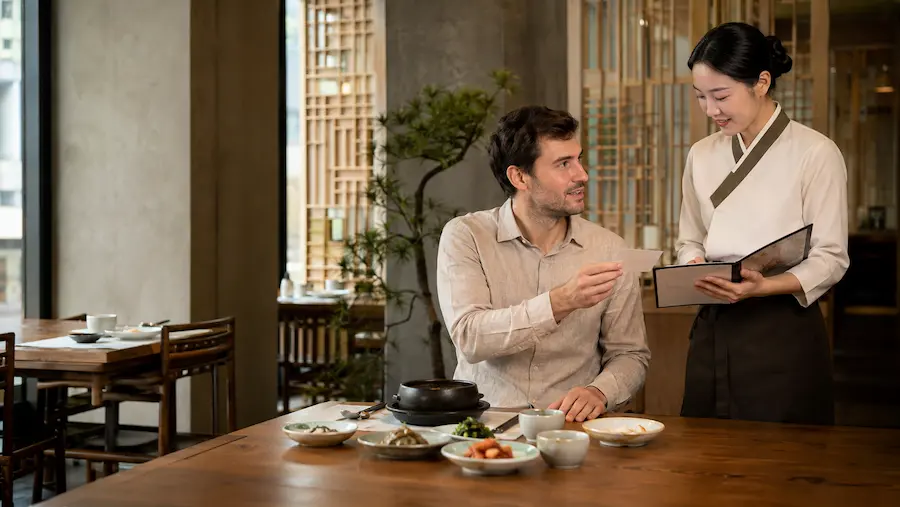
Travelling with a food allergy requires more preparation than simply choosing a restaurant with an appealing menu.
Korean cooking often uses broths, fermented pastes, marinades, sauces and shared side dishes. An allergenic ingredient may therefore be present even when it is not visible in the finished meal. Language differences can make these details harder to confirm.
This guide does not identify any Korean dish or restaurant as allergy-safe. Instead, it explains what to check, how to communicate with restaurant staff and what to do when a venue cannot provide a clear answer.
Quick guide
- Tell restaurant staff about your medical food allergy before ordering.
- Ask about broths, sauces, seasonings, garnishes, shared oil and cooking equipment—not only visible ingredients.
- Do not assume that a menu without an allergen warning confirms safety.
- Carry a carefully checked Korean allergy card and follow the emergency plan provided by your healthcare professional.
- In a medical emergency in Korea, call 119.
1. Do Not Assume Every Menu Has Complete Allergen Information
South Korea requires allergen declarations on applicable packaged foods. Under separate rules for children’s preferred foods, applicable franchise food businesses with 50 or more outlets must also display allergen information for specified products such as bread, ice cream, hamburgers and pizza.
However, this does not mean that every restaurant, café, market stall or street-food vendor must provide a complete written allergen list. A menu without allergen icons or warnings should never be treated as confirmation that a dish is suitable for you.
Staff may know the principal ingredients but not every component of a supplied stock powder, sauce or seasoning mix. Smaller kitchens may also be unable to separate equipment or preparation areas.
If staff cannot clearly confirm the ingredients or preparation method, choosing not to eat the dish is a reasonable and prudent decision.
2. Understanding Korean Packaged-Food Labels
Korean labelling rules identify a defined list of allergenic ingredients:
| Category | Ingredients covered by Korean labelling rules |
|---|---|
| Grains, pulses and nuts | Buckwheat, peanuts, soybeans, wheat, walnuts and pine nuts |
| Dairy and eggs | Milk and eggs from poultry |
| Fish and shellfish | Mackerel, crab, shrimp, squid and shellfish, including oysters, abalone and mussels |
| Meat | Pork, chicken and beef |
| Fruit and produce | Peaches and tomatoes |
| Other | Sulphites above the applicable threshold |
On Korean packaging, look for 함유 (ham-yu), meaning “contains”.
우유, 대두, 밀 함유
Contains milk, soy and wheat
You may also see a precautionary statement explaining that a product was made in a facility or manufacturing process that handles another allergen.
Korea’s regulated list is not identical to those used in the United Kingdom, European Union, United States or other jurisdictions. Check the complete ingredient list as well as the separate allergen statement. If your allergen is not covered by the Korean list—or if you cannot confidently interpret the label—do not assume that the product is suitable.
3. Tell the Restaurant Before Ordering
Do not wait until the meal has been served. Tell a member of staff before ordering and make clear that this is a medical food allergy, not a preference or a request for a less spicy dish.
You can say:
저는 [알레르기 성분]에 심각한 알레르기가 있습니다.
I have a serious allergy to [allergen].
Then ask:
이 음식에 [알레르기 성분]이 들어가나요?
Does this dish contain [allergen]?
A written card can reduce misunderstandings, particularly in a busy restaurant. If possible, ask for the card to be shown to the person preparing the food.
4. Ask About More Than Visible Ingredients
Removing a garnish does not necessarily remove an allergen already used in the broth, sauce, marinade or cooking process.
Use the following as a question checklist, not as a claim that every item contains the ingredients listed.
| Where to check | What may require confirmation |
| Broths and stocks | Fish, anchovy, shellfish, meat or prepared stock products |
| Sauces and seasonings | Soy sauce, soybean paste, chilli paste and blended seasonings |
| Kimchi and side dishes | Salted seafood, shrimp or fish sauce |
| Fried or battered food | Wheat, egg, batter and shared frying oil |
| Noodles | Ingredients in the noodles and in the accompanying broth or sauce |
| Grilled food | Shared grills, tongs, marinades and brushes |
| Desserts and drinks | Milk, egg, soy, peanuts, walnuts, pine nuts and toppings |
| Garnishes | Ingredients added after the main preparation is complete |
Recipes differ between restaurants. A familiar dish name is not enough to confirm its ingredients.
5. Ask About Shared Oil and Equipment
If cross-contact is relevant to your allergy plan, ask about the preparation process as well as the recipe.
Restaurants may use the same frying oil, grill, pan, knife, cutting board, tongs, ladle or preparation area for several dishes. A kitchen may be able to remove an ingredient but may not be able to provide separate equipment or a separate preparation space.
You can ask:
같은 기름이나 조리도구를 사용하나요?
Do you use the same oil or cooking equipment?
따로 조리할 수 있나요?
Can this be prepared separately?
A courteous answer should not be interpreted as an absolute guarantee. Base your decision on whether staff clearly understand the request and can explain what the kitchen can and cannot do.
6. Carry a Korean Food Allergy Card
Replace the bracketed wording with the exact Korean name of your allergen. If you have more than one allergy, list each ingredient separately.
음식 알레르기 안내
저는 **[알레르기 성분]**에 심각한 알레르기가 있습니다.
이 성분을 먹으면 위험한 알레르기 반응이 생길 수 있습니다.
이 음식에 [알레르기 성분] 또는 이 성분이 포함된 소스, 육수나 양념이 들어가나요?
같은 기름, 조리도구, 그릴 또는 조리 공간을 사용하나요?
확실하지 않다면 솔직하게 말씀해 주세요. 먹지 않겠습니다.
English reference:
FOOD ALLERGY NOTICE
I have a serious allergy to [allergen].
Eating this ingredient may cause a dangerous allergic reaction.
Does this dish contain [allergen], including in any sauce, broth or seasoning?
Is the same oil, cookware, grill or preparation area used?
If you are not certain, please tell me. I will not eat the dish.
Avoid broad descriptions such as “nuts”. State the exact ingredients you must avoid—for example, peanuts, walnuts or pine nuts.
Have the completed Korean wording checked by a fluent Korean speaker before travel. The card supports communication; it does not certify a venue or guarantee that cross-contact will not occur.
7. When the Restaurant Cannot Confirm
Uncertainty is useful information.
Staff may be unable to verify every ingredient in a premade sauce or stock. A small kitchen may also be unable to provide separate equipment. If an answer remains unclear, changing restaurants or choosing sealed food with labelling you can verify may be more practical than requesting a complicated alteration.
Carry suitable backup food for occasions when sufficient information is unavailable. Exercise particular caution with unlabelled food when nobody can confidently explain its ingredients and preparation.
8. Prepare Before Travelling
Before leaving for Korea:
- Review your personal travel and emergency plan with your healthcare professional.
- Bring the emergency medication prescribed for you and keep it accessible.
- Check expiry dates and required storage conditions.
- Carry a copy or photograph of your personal allergy action plan.
- Prepare a Korean allergy card naming each allergen precisely.
- Pack suitable backup snacks or meals.
- Tell your travel companions about your allergy and emergency plan.
- Save your accommodation address in Korean.
- Save Korea’s emergency number, 119.
- Confirm the rules that apply to carrying your medication with your airline and the relevant authorities.
Do not place all essential medication in checked baggage. Follow the transport and documentation requirements that apply to your medication, airline and route.
9. In a Medical Emergency
Follow the individual emergency plan provided by your healthcare professional and use your prescribed emergency medication as directed in that plan.
For an ambulance in Korea, call 119. You can say:
아나필락시스가 의심됩니다. 구급차가 필요합니다.
I think this may be anaphylaxis. I need an ambulance.
If you are in a restaurant or hotel, ask staff to call 119 and provide the exact Korean address. Do not rely on restaurant staff or a translation app as a substitute for emergency medical assistance.
For non-emergency travel and language support, contact the Korea Travel Helpline on 1330 within Korea or +82-2-1330 from an international number.
Final Takeaway
Travelling in Korea with a food allergy requires clear communication and a willingness to treat uncertainty seriously.
Check packaged-food labels, but remember that Korea’s regulated allergen list may differ from the list used in your country. In restaurants, ask about broths, sauces, seasonings, shared oil and equipment—not only what is visible on the plate.
Carry a carefully checked Korean allergy card, keep your prescribed emergency medication accessible and follow the plan provided by your healthcare professional. If a restaurant cannot confirm what is in a dish or how it is prepared, it is reasonable to choose another option.
In a medical emergency in Korea, call 119.
Important Notice
This guide provides general travel and communication information. It does not provide medical advice, diagnosis or treatment; replace an individual allergy action plan; or guarantee that any food, restaurant or preparation method is safe. Travellers should obtain personalised advice from a qualified healthcare professional before travel.
Official Sources and Verification References
- Korean Ministry of Food and Drug Safety: Food allergen labelling information
- Korean National Law Information Center: Regulated allergen labelling
- Korean Ministry of Food and Drug Safety: Allergen information at applicable food-service businesses
- CDC: Allergies and Travel
- CDC Yellow Book: Severely Allergic Travellers
- FARE: Food Allergy Chef Cards
- VISITKOREA: Emergency Situations and the 1330 Travel Helpline