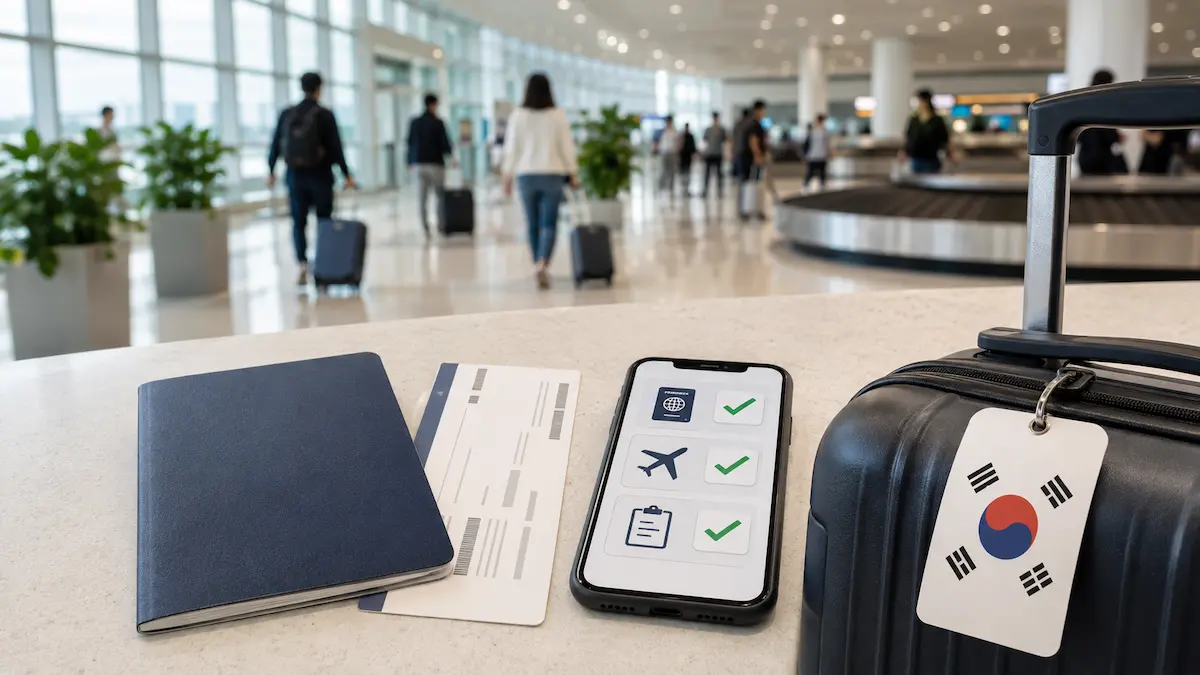
Korea entry requirements depend on your nationality, passport, purpose of travel and length of stay. Before booking a flight, check whether you need a visa, a Korea Electronic Travel Authorization (K-ETA), an e-Arrival Card or another form of entry permission.
This guide explains the checks most short-term visitors should complete before travelling to South Korea. Entry rules can change, so use the official Korean government services linked below and confirm your eligibility again shortly before departure.
Last reviewed: August 24, 2026. Korea’s visa, K-ETA and e-Arrival Card rules can change. Always confirm your requirements on the official Korean government websites before departure.
Korea Entry Requirements: Quick Answer
Most visitors need a valid passport and one of the following: a Korean visa, an approved K-ETA or eligibility to enter without either under a current exemption. Travellers who must submit an arrival card can normally complete Korea’s free e-Arrival Card online within 72 hours before arrival.
Do not assume that another traveller’s requirements apply to you. Two people taking the same flight may have different entry requirements because they hold different passports or are travelling for different purposes.
Complete These Four Checks Before You Travel
- Check whether your passport and nationality require a Korean visa.
- If you are travelling without a visa, check whether you need a K-ETA or qualify for an exemption.
- Check whether you must submit an e-Arrival Card before arrival.
- Confirm that your passport details, accommodation address, return or onward travel and supporting documents are ready.
Step 1: Check Whether You Need a Korean Visa
Visa requirements for Korea depend on your nationality, passport type, purpose of travel and intended length of stay. Use the official Korea Visa Portal’s Visa Navigator to select your country or region, purpose of entry and length of stay. The result will help you identify the visa category or entry route that may apply to your trip.
Do not rely only on an airline blog, travel forum or another traveller’s experience. If the portal indicates that you need a visa—or if your trip involves work, study, paid activity or a long stay—confirm the required documents and application procedure with the Korean embassy or consulate responsible for your place of residence before booking non-refundable travel.
Visa-Free Entry Does Not Cover Every Purpose
Visa-free entry is generally intended for eligible short-term visits such as tourism or certain limited business activities. It does not automatically permit employment, study or other activities that require a specific status of stay. The permitted period of stay may also differ according to nationality and passport type.
How to Check Your Visa Requirements
- Open the official Korea Visa Portal.
- Select your continent and country or region in Visa Navigator.
- Choose your purpose of entry and intended length of stay.
- Review the applicable visa category, required documents and application route.
- Contact the relevant Korean embassy or consulate if any part of the result is unclear.
Important: A K-ETA is not a visa. Travellers who require a Korean visa cannot use a K-ETA as a substitute.
Step 2: Check Whether You Need a K-ETA
A K-ETA is an electronic travel authorisation for eligible visa-free travellers. It is not a visa. Whether you need one depends on the passport you use and the entry rules in effect on your travel date.
Certain countries and regions are temporarily exempt from the K-ETA requirement until 31 December 2026, Korea Standard Time. This exemption does not apply to every visa-free traveller, so check your own passport and eligibility shortly before departure.
If You Need a K-ETA
Apply only through the official K-ETA website or the official K-ETA mobile application. Avoid third-party websites that charge additional service fees or claim to guarantee approval.
If a K-ETA is required for your trip, submit the application well before departure. Official guidance recommends applying at least 72 hours before boarding your flight or ship to Korea.
If You Are Temporarily Exempt
If your passport is covered by the temporary exemption, you may travel to Korea without a K-ETA for an eligible visa-free visit during the exemption period.
Travellers entering without a K-ETA may still need to submit Korea’s e-Arrival Card unless they qualify for a separate exemption. The e-Arrival Card requirement will be checked in the next step.
How to Check Your K-ETA Requirement
- Open the official K-ETA website.
- Review the current eligibility and temporary-exemption notices.
- Check the rules for the exact passport you will use for travel.
- If required, apply at least 72 hours before departure.
- Confirm that your passport number and personal information match your application exactly.
Important: A K-ETA is not a visa and cannot replace a Korean visa when a visa is required.
Step 3: Check Whether You Need an e-Arrival Card
Korea’s e-Arrival Card is the online version of the arrival declaration previously completed on paper. It is separate from both a visa and a K-ETA.
Travellers who are required to submit an arrival card can complete it free of charge on the official e-Arrival Card website within three days before arrival in Korea, based on Korea Standard Time. Once submitted, the declaration remains valid for 72 hours or until immigration inspection is completed, whichever comes first.
Who Does Not Need to Submit One
You generally do not need to submit an e-Arrival Card if you hold a valid K-ETA, are a registered foreign resident in Korea or qualify for another official exemption, such as eligible airline crew.
Exemptions depend on your immigration status, so confirm the current rules on the official website before departure.
What to Prepare
- A valid passport.
- A valid email address.
- Your arrival date and flight or vessel number.
- Your accommodation address and contact information in Korea.
- Your departure date and flight or vessel number, if available.
How to Submit Your e-Arrival Card
- Open the official e-Arrival Card website.
- Start your submission within the three-day period before arriving in Korea.
- Enter your passport, arrival and accommodation information carefully.
- Submit the form and keep the issuance number sent to your email.
- If your information changes, review and update the submission before completing immigration procedures.
Important: The official e-Arrival Card is free. Use only the Korean government website ending in go.kr, and avoid third-party websites that charge a fee.
Step 4: Prepare Your Arrival Documents
Before departure, organise the documents and information you may need at airline check-in and Korean immigration. The exact requirements depend on your passport, visa status and purpose of travel, so prepare only the items that apply to your trip.
Keep essential entry information with you during the journey rather than packing it in checked baggage.
Keep These Items Ready
- The passport you will use to enter Korea.
- Your Korean visa or K-ETA approval, if required.
- Your e-Arrival Card issuance number, if you were required to submit one.
- Your accommodation name, address and telephone number in Korea.
- Your return or onward travel details.
- Any documents supporting the purpose of your visit, if applicable.
Check that your name, passport number and travel dates are consistent across your passport, visa or K-ETA, airline booking and other travel documents.
Important: Do not place your passport or essential entry documents in checked baggage. Keep them accessible until you have completed immigration procedures.
Step 5: Complete the Arrival Procedures
After landing, follow the signs for Arrivals and Immigration unless you are transferring to another international flight. The exact route may vary by airport and terminal, but most arriving travellers complete immigration inspection, collect their checked baggage, pass through customs and then enter the arrivals hall.
Typical Arrival Order
- Follow the signs to Immigration or the appropriate international transfer route.
- Present the passport used for your visa, K-ETA or visa-free entry.
- Complete immigration inspection and any identity checks requested by the immigration officer.
- Collect your checked baggage from the assigned carousel.
- Follow the customs declaration instructions and use the appropriate customs channel.
- Enter the arrivals hall after completing immigration, baggage collection and customs procedures.
At Immigration
Keep your passport and relevant travel information ready. An immigration officer may ask about the purpose and length of your visit, your accommodation in Korea and your return or onward travel.
Answer briefly and accurately. Make sure your answers are consistent with your passport, visa or K-ETA, e-Arrival Card and travel details.
Important: Travellers transferring to another international flight should follow the transfer signs instead of joining the general arrivals route, unless airport staff direct them otherwise.
Korea Entry Checklist Before Departure
Use this final checklist after confirming the entry rules for the exact passport you will use. Not every item applies to every traveller.
Entry Permission
- I checked the Korea Visa Portal for my nationality, passport type, purpose of travel and intended length of stay.
- I confirmed whether I need a Korean visa, a K-ETA or neither.
- If I need a visa or K-ETA, I received approval before travelling.
Arrival Information
- I confirmed whether I must submit an e-Arrival Card.
- If required, I submitted it within three days before arrival and kept the issuance number.
- I saved the name, Korean address and telephone number of my accommodation.
Travel Documents
- My passport details match my visa, K-ETA, airline booking and e-Arrival Card.
- I have my return or onward travel details and any supporting documents relevant to my visit.
- I saved important documents offline and kept essential entry information in my carry-on baggage.
Final check: Entry requirements can change. Recheck the official Korea Visa Portal, K-ETA website and e-Arrival Card website shortly before departure.
Frequently Asked Questions About Korea Entry Requirements
Do I Need a Visa to Visit Korea?
Whether you need a Korean visa depends on your nationality, passport type, purpose of travel and intended length of stay. Check your requirements through the official Korea Visa Portal and confirm any unclear result with the Korean embassy or consulate responsible for your place of residence.
Is a K-ETA the Same as a Korean Visa?
No. A K-ETA is an electronic travel authorisation for eligible visa-free travellers. It does not replace a Korean visa and cannot be used when your nationality or purpose of travel requires a visa.
Do K-ETA Holders Need an e-Arrival Card?
Travellers entering Korea with a valid K-ETA generally do not need to submit an e-Arrival Card. However, a traveller holding both a K-ETA and a Korean visa may still need an e-Arrival Card when entering with the visa. Check the official e-Arrival Card eligibility guidance for your entry status.
When Can I Submit the e-Arrival Card?
You can submit the e-Arrival Card from three days before your arrival in Korea. The submission remains valid for 72 hours. If it expires before you complete immigration procedures, you will need to submit a new one.
Is the Korean e-Arrival Card Free?
Yes. Submission through the official Korean government e-Arrival Card website is free. Avoid unofficial websites that request payment or charge additional processing fees.
What Should I Do If My Travel Information Changes?
Review your submitted information before completing immigration procedures. If your arrival details, accommodation, purpose of entry or other required information changes, use the official service to update the relevant record whenever the system allows it.
Continue Planning Your Korea Trip
Once your entry requirements are confirmed, use our Start Here guide to plan your itinerary, accommodation, transport, payments and mobile data.