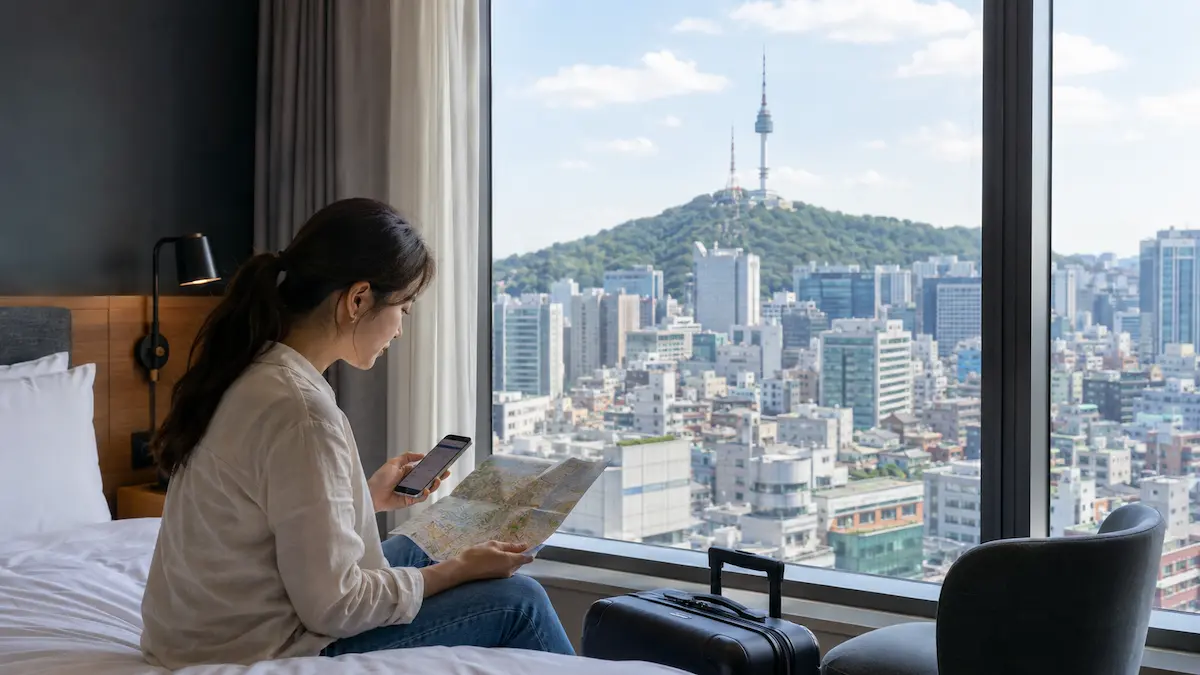
Where to stay in Seoul can shape your entire first trip to the city. Seoul is large, major sights are spread across several districts, and a hotel that looks central on a map may still require long transfers or uphill walks.
Instead of searching for one universally “best” neighbourhood, choose a base that matches your itinerary, arrival route, preferred atmosphere and budget. This guide compares the most practical areas for first-time visitors and explains who each area suits, what trade-offs to expect and what to check before booking.
Quick Answer: Where to Stay in Seoul for a First Trip
For most first-time visitors, Myeongdong is the easiest all-round base for sightseeing, shopping and straightforward subway travel. Choose Hongdae if nightlife and a younger atmosphere matter most; Jongno or Insadong for palaces, traditional streets and central sightseeing; Seoul Station for convenient intercity and airport connections; or Gangnam for business, modern shopping and destinations south of the Han River.
The best choice is not simply the most famous district. Prioritise a property within a comfortable walk of a subway station, check the route back after evening plans and compare room size, lifts, luggage storage and airport-transfer options before booking. Choose Jamsil if Lotte World, family attractions and destinations in eastern Seoul are central to your itinerary.
Seoul Neighbourhoods at a Glance
Use this comparison to narrow your choices before looking at individual hotels. Travel times depend on the exact station and time of day, so compare each property’s nearest station entrance rather than relying only on the district name.
| Area | Best for | Main advantages | Main trade-off |
|---|---|---|---|
| Myeongdong | First-time sightseeing and shopping | Central position, broad hotel choice and convenient access to several major areas | Crowded and highly commercial, especially around the main shopping streets |
| Hongdae | Nightlife, cafés and airport access | Lively atmosphere, many restaurants and a practical base in western Seoul | Longer journeys to the palace district; late-night streets can be noisy |
| Jongno and Insadong | Palaces, traditional streets and culture | Walkable access to much of the historic centre and a calmer atmosphere | Quieter at night and less convenient for some western or southern Seoul areas |
| Seoul Station | Airport and intercity connections | Practical for travellers using AREX or KTX, especially with luggage | Efficient rather than atmospheric; check the exact walking route around the station |
| Gangnam | Business, modern shopping and southern Seoul | Modern hotels, restaurants and convenient access to areas south of the Han River | Longer journeys to many palaces and historic attractions north of the river |
| Jamsil | Families, Lotte World and modern attractions | Convenient access to Lotte World, Seokchon Lake and eastern Seoul | Longer journeys to palaces and historic central Seoul |
For a short first visit, choose the area that reduces travel to the places you will visit most often. A hotel five minutes from a useful subway station is usually more practical than a cheaper property deep inside a neighbourhood.
For a broader overview of Seoul sightseeing areas, transport and trip planning, see our Seoul Travel Guide.
Myeongdong: Best All-Round Base for First-Time Visitors
Myeongdong is a practical choice for travellers who want a central base with convenient shopping, dining and public transport. It sits between several major sightseeing areas, making it easier to divide your days between the historic centre, markets, museums and neighbourhoods elsewhere in Seoul.
The area is especially convenient for a short first visit because hotels are available across a wide range of prices and many streets have restaurants, convenience stores, currency-exchange counters and shops that stay open into the evening. Myeongdong Station serves Subway Line 4, while Euljiro 1-ga Station on Line 2 may also be within walking distance depending on the exact location of your hotel.
Who Myeongdong Suits
- First-time visitors who want a straightforward central base
- Travellers planning to visit both historic and modern Seoul
- Visitors who prefer abundant shopping, restaurants and evening activity
- People who want several hotel categories within one compact area
- Travellers who value convenient access to multiple subway lines
Main Advantages
Myeongdong provides relatively convenient access to places such as Namsan, Namdaemun Market, City Hall, Deoksugung Palace and the Jongno area. Many other major attractions can be reached with a short subway journey or a manageable transfer.
The neighbourhood is also easy to use after a full sightseeing day. Food, basic shopping and everyday travel services are concentrated within a compact area, reducing the need to make another journey simply to find dinner or essential supplies.
Trade-Offs to Consider
Myeongdong is busy and strongly commercial, particularly around its main pedestrian shopping streets. Travellers looking for quiet residential surroundings, independent nightlife or a traditional neighbourhood atmosphere may prefer another part of Seoul.
Hotel location also matters within Myeongdong. A property described as being in the district may be closer to Myeongdong Station, Euljiro 1-ga Station or the steeper streets leading towards Namsan. Check the walking route, elevation and nearest station entrance before booking, especially if you will carry heavy luggage.
Hongdae: Best for Nightlife, Cafés and Airport Access
Hongdae is a strong choice for travellers who want lively streets, independent cafés, casual dining, shopping and nightlife close to their hotel. The area around Hongik University remains active well into the evening, making it particularly appealing to younger visitors and travellers who prefer an energetic atmosphere.
Its western Seoul location is also useful for airport access. Hongik University Station is served by Subway Line 2, the Airport Railroad Express and the Gyeongui–Jungang Line. However, the neighbourhood covers a wide area, so the walking distance between a hotel and the station can vary considerably.
Who Hongdae Suits
- Travellers who prioritise nightlife, cafés and casual restaurants
- Younger visitors and solo travellers who prefer lively surroundings
- Visitors arriving through Incheon or Gimpo Airport
- Travellers planning to explore western Seoul
- People who do not mind busy streets or late-night noise
Main Advantages
Hongdae offers a broad choice of restaurants, cafés, bars, shops and entertainment within walking distance. Travellers can return after a day of sightseeing and still find plenty of dining and evening options near their accommodation.
Hongik University Station provides convenient access to Subway Line 2 and airport rail services. Hongdae is also a practical base for exploring nearby areas such as Yeonnam, Sinchon, Ewha and Hapjeong.
Trade-Offs to Consider
Hongdae is farther from many palaces and traditional attractions in Jongno than Myeongdong or Insadong. Travellers whose itinerary focuses heavily on the historic centre should expect additional subway journeys.
The busiest streets can be crowded and noisy, particularly on weekend evenings. Check recent guest reviews for street noise, soundproofing and the walking route from the nearest station exit. For a calmer atmosphere, consider accommodation on the Yeonnam side of Hongik University Station while confirming that the location still suits your transport plans.
Jongno and Insadong: Best for Palaces, Traditional Streets and Culture
Jongno and Insadong are strong choices for travellers who want to stay close to Seoul’s historic centre. The area provides convenient access to major palaces, traditional streets, museums and neighbourhoods such as Bukchon, Ikseon-dong and Gwanghwamun.
This part of Seoul generally feels calmer in the evening than Myeongdong or Hongdae, while still offering restaurants, cafés and useful transport connections. The atmosphere varies considerably between major roads, office districts and smaller traditional lanes, so check the exact location rather than relying only on the neighbourhood name.
Who Jongno and Insadong Suits
- First-time visitors whose itinerary focuses on palaces and historic Seoul.
- Travellers who prefer traditional streets, museums and cultural attractions.
- Visitors who enjoy walking between nearby sights.
- Couples and mature travellers seeking a calmer evening atmosphere.
- Travellers who want a central base without staying in a major shopping district.
Main Advantages
Staying in Jongno or Insadong can reduce travel time to Gyeongbokgung, Changdeokgung, Jongmyo, Gwanghwamun, Bukchon Hanok Village and several museums. Many attractions in the historic centre can be combined on foot, although the total walking distance may still be substantial.
The area also offers convenient access to traditional restaurants, tea houses, craft shops and smaller streets with a more distinctive sense of place than Seoul’s busiest commercial districts. Several subway stations serve the wider area, so compare nearby lines and exits when choosing a hotel.
Trade-Offs to Consider
Evening activity is generally quieter than in Hongdae or Myeongdong, and some streets become calm after shops and offices close. Travellers who prioritise nightlife or late-night shopping may prefer another area.
The neighbourhood includes narrow lanes, uneven surfaces and properties located some distance from a main road or station exit. Check the walking route carefully if you have heavy luggage or limited mobility. Accommodation quality also varies, particularly among smaller guesthouses and traditional-style stays, so read recent reviews before booking.
Seoul Station: Best for Airport and Intercity Connections
Seoul Station is a practical base for travellers who prioritise transport convenience. It is especially useful if you are arriving by airport rail, taking an early intercity train or travelling with luggage during a multi-city Korea itinerary.
The area is less atmospheric than Hongdae or Insadong, but it can save considerable time on arrival and departure days. Before booking, check the walking route between the hotel and the station entrance because major roads, station buildings and changes in elevation can make a short map distance feel longer.
Who Seoul Station Suits
- Travellers arriving from or departing for Incheon Airport
- Visitors taking intercity trains to destinations such as Busan or Gyeongju
- Travellers following a multi-city Korea itinerary
- Families or visitors carrying large luggage
- Anyone with an early train or limited time on arrival day
Main Advantages
Seoul Station provides convenient connections to the airport, the subway network and major intercity rail services. Staying nearby can simplify a journey that includes several Korean cities and reduce the need to carry luggage across multiple transfers.
The location also gives relatively straightforward access to central Seoul. Areas such as Myeongdong, Namdaemun Market and several major sightseeing districts can be reached without using Seoul Station as your only sightseeing destination.
Trade-Offs to Consider
The surroundings are busy and transport-focused, and they do not offer the same neighbourhood atmosphere as Hongdae, Insadong or Myeongdong. Dining and evening options also vary considerably depending on which side of the station your hotel is located.
Do not choose a property based only on its distance from “Seoul Station” on a booking map. Check the exact station entrance, pedestrian route, road crossings, hills and whether the hotel provides luggage storage.
Gangnam: Best for Business, Modern Shopping and Southern Seoul
Gangnam is a practical base for travellers whose plans focus on southern Seoul. It offers modern hotels, large shopping centres, restaurants, cafés and convenient access to areas such as COEX, Bongeunsa, Apgujeong and Cheongdam. It can also suit business travellers attending meetings or events south of the Han River.
The main disadvantage is distance. Reaching Gyeongbokgung Palace, Bukchon, Insadong and other historic attractions north of the river may require longer subway journeys and transfers. First-time visitors whose itinerary centres on palaces and traditional neighbourhoods will usually find Myeongdong or Jongno more convenient.
Who Gangnam Suits
- Travellers visiting COEX, Bongeunsa or attractions in southern Seoul.
- Business travellers attending meetings, conferences or exhibitions.
- Visitors interested in modern shopping, dining and nightlife.
- Travellers who prefer contemporary hotels and a polished urban atmosphere.
Main Advantages
Gangnam offers a wide selection of modern hotels, restaurants, cafés and shopping centres. It is a practical base for business travellers and visitors whose plans focus on COEX, Jamsil or other destinations south of the Han River.
The area also has extensive dining and nightlife options, particularly around Gangnam Station, while several subway lines and bus routes provide useful connections across southern Seoul.
Trade-Offs to Consider
Gangnam is farther from palaces, Bukchon, Insadong and many historic attractions north of the Han River. Travellers focusing on traditional and central Seoul may spend more time on the subway than they would from Myeongdong or Jongno.
Gangnam also covers a large area, so the district name alone does not guarantee a convenient location. Check the property’s exact position, nearest useful subway entrance, walking route, road crossings and evening transport before booking. A hotel near Gangnam Station offers a different experience from one near COEX, Apgujeong or a quieter residential area.
Choose Gangnam if business, modern shopping or southern Seoul attractions are central to your itinerary. Consider Myeongdong or Jongno instead if most of your sightseeing will focus on palaces, Bukchon and Insadong.
Jamsil: Best for Families, Lotte World and Eastern Seoul
Jamsil is a practical base for families and travellers whose plans focus on Lotte World, Lotte World Tower, Seokchon Lake, Olympic Park and other attractions in eastern Seoul. The area offers large shopping centres, modern hotels, restaurants and convenient subway connections on Lines 2 and 8.
The main disadvantage is its distance from many historic attractions in central and northern Seoul. Travellers planning frequent visits to Gyeongbokgung Palace, Bukchon, Insadong, Myeongdong or Hongdae should expect longer journeys than they would from a more central neighbourhood.
Who Jamsil Suits
- Families visiting Lotte World and nearby attractions.
- Travellers whose itinerary focuses on eastern or southeastern Seoul.
- Visitors who prefer modern hotels, shopping centres and spacious surroundings.
- Travellers attending events near Jamsil Sports Complex or Olympic Park.
- Visitors who do not need to travel to the palace district every day.
Main Advantages
Jamsil provides convenient access to Lotte World, Lotte World Tower, Seokchon Lake and major shopping and dining facilities. Subway Lines 2 and 8 offer useful connections to Gangnam, eastern Seoul and several other parts of the city.
The area can feel more spacious and organised than some crowded central neighbourhoods. It also offers a broad selection of modern accommodation, restaurants and family-friendly facilities.
Trade-Offs to Consider
Jamsil is farther from the palaces, Bukchon, Insadong, Hongdae and several other attractions commonly included in a first-time Seoul itinerary. Repeated journeys to central or northern Seoul can add considerable travel time.
The area is also large, so a hotel advertised as being in Jamsil may not be equally convenient for every attraction. Event days around the sports complex and busy periods at Lotte World can increase crowds and transport demand.
What to Check Before Booking
Check the exact walking distance to Jamsil Station, Seokchon Gobun Station or another station that serves your planned destinations. Confirm which subway line and station entrance will be most useful because large intersections and extensive station complexes can make short map distances feel longer.
Compare the journey from the hotel to the attractions you expect to visit most often. Choose Jamsil when Lotte World, family attractions or eastern Seoul are central to your trip, but select a more central neighbourhood if most of your sightseeing will be around the palaces, Myeongdong and Insadong.
How to Choose the Best Area to Stay in Seoul
The best area is not necessarily the district with the most attractions or the lowest room rate. Choose a location that reduces repeated travel, suits your arrival and departure route and remains convenient after your evening plans. Compare the exact property—not only the neighbourhood name—with your itinerary before booking.
1. Start With the Places You Will Visit Most
List the attractions and neighbourhoods that appear most often in your itinerary. If most of your plans are in central and northern Seoul, Myeongdong or Jongno and Insadong will usually be more practical. Choose Hongdae for nightlife and western Seoul, Seoul Station for airport and intercity connections, Gangnam for business and destinations south of the Han River, or Jamsil for Lotte World, family attractions and eastern Seoul.
Do not choose an area only because it is popular. A neighbourhood that suits another traveller may add unnecessary transfers to your own itinerary.
2. Check the Exact Station and Exit
Neighbourhood names cover large areas, so two hotels advertised in the same district may offer very different levels of convenience. Check the nearest useful subway station, the exact entrance or exit and the actual walking route rather than relying only on the distance shown on a booking map.
Look for stairs, lifts, steep streets, major road crossings and underground passages, especially if you will carry luggage or travel with children, older family members or limited mobility.
3. Consider Your Arrival and Departure Route
Hongdae and Seoul Station can simplify airport journeys, while Seoul Station is particularly useful for travellers taking intercity trains. If your flight arrives late or departs early, check the operating hours of the airport train or bus you plan to use and whether a taxi offers a simpler alternative.
Do not choose a hotel only for one convenient arrival journey if it creates longer travel times throughout the rest of your stay. Compare the time saved on arrival and departure days with the journeys required for your main attractions.
4. Test the Evening Journey
Check how you will return to the hotel after dinner, shopping or nightlife. Review the last practical subway route, number of transfers, walking distance and surrounding atmosphere. A location that feels convenient during the day may involve a long uphill walk, quieter streets or a taxi late at night.
If you expect frequent late evenings, compare the hotel with the areas where those plans will take place and read recent reviews for street noise, bars, traffic and construction.
5. Compare the Property, Not Only the Neighbourhood
Once you have narrowed your choice to one or two areas, compare individual properties carefully. Check room size, lift access, luggage storage, reception hours, laundry facilities, soundproofing, heating or air conditioning, airport-transfer options and recent cleanliness reviews.
A slightly more expensive hotel beside a useful station entrance may provide better overall value than a cheaper property that requires additional transfers or a difficult daily walk.
6. Check Seasonal Demand and Cancellation Terms
Hotel prices and availability can change during spring blossom season, autumn foliage season, major Korean holidays, festivals and large events. Book earlier if you need a family room or want to stay near a specific station during a popular period.
When possible, choose flexible cancellation terms. This gives you room to change the property or neighbourhood if your itinerary, flight schedule or arrival route changes.
Common Mistakes When Choosing Where to Stay in Seoul
Many first-time visitors choose a hotel because the district name is familiar, the map appears central or the nightly rate is low. In Seoul, these shortcuts can lead to long walks, inconvenient transfers or a difficult journey with luggage.
- Booking without checking the exact station entrance and walking route.
- Assuming every hotel in a well-known district is close to its main attractions.
- Choosing the cheapest room without comparing room size, lift access, noise and luggage storage.
- Ignoring the late-evening route after restaurants, shopping or nightlife.
- Staying south of the Han River when most planned sights are around the palaces and historic centre.
- Booking near Seoul Station without checking which side of the station the property is on.
Before paying, test the hotel against your actual itinerary: your airport arrival, two typical sightseeing days, one evening return and your departure route. If those journeys are straightforward, the location is probably suitable.
Seoul Accommodation Booking Checklist
Before confirming a hotel, check the points below against the exact property rather than relying only on the neighbourhood name or booking-platform map.
- Confirm the exact property location and the nearest useful subway station entrance.
- Check the walking route for hills, stairs, underpasses and major road crossings.
- Compare realistic travel times to the attractions and districts you plan to visit.
- Test your airport or intercity arrival and departure routes while accounting for luggage.
- Review the room size, bed type, bathroom arrangement and space available for opening luggage.
- Confirm lift access, reception hours, late check-in rules and luggage-storage options.
- Read recent reviews for noise, cleanliness, heating or air conditioning, and access to public transport.
- Compare the total price, including taxes and fees, as well as cancellation and payment conditions.
- Save the hotel’s English and Korean names, complete address and telephone number for offline access.
A property that performs well on these practical checks is usually a better choice than a cheaper hotel that adds difficult walks, repeated transfers or uncertainty on arrival day.
Frequently Asked Questions About Where to Stay in Seoul
What Is the Best Area to Stay in Seoul for First-Time Visitors?
Myeongdong is the easiest all-round choice for many first-time visitors because it provides convenient access to central sightseeing areas, shopping, restaurants and several useful transport connections.
However, the best area depends on your itinerary. Hongdae may suit travellers who prioritise nightlife and airport access, while Jongno or Insadong is more convenient for palaces and traditional neighbourhoods.
Is Myeongdong or Hongdae Better for First-Time Visitors?
Choose Myeongdong if you want a central base for sightseeing, shopping and straightforward access to several major areas. It is especially practical for travellers planning to visit attractions on both sides of central Seoul.
Choose Hongdae if cafés, nightlife, live music and a younger atmosphere are more important. Hongdae also offers convenient airport-rail access, although journeys to the palace district generally take longer.
Is Jongno or Insadong a Good Place to Stay?
Jongno and Insadong are excellent choices for travellers interested in palaces, traditional streets, museums and Seoul’s historic centre. Many major cultural attractions are within walking distance or a short journey away.
The area is generally calmer in the evening than Hongdae or Gangnam. Check the exact walking route to the nearest subway station because convenience varies between different parts of the district.
Is Seoul Station a Good Area to Stay?
Seoul Station is a practical base for travellers using the airport railway or taking intercity trains to destinations such as Busan or Gyeongju. It can be particularly convenient for multi-city itineraries, early departures and travellers carrying large luggage.
The surrounding area has less neighbourhood atmosphere than Hongdae, Myeongdong or Insadong. Check which side of the station your hotel is on, the nearest entrance and the complete pedestrian route before booking.
Is Gangnam a Good Place to Stay for a First Visit?
Gangnam is suitable for business travellers and visitors whose plans focus on COEX, Bongeunsa, Apgujeong, Cheongdam or other destinations south of the Han River. It also offers modern hotels, shopping centres, restaurants and nightlife.
It is less convenient if most of your sightseeing involves Gyeongbokgung Palace, Bukchon, Insadong and other historic attractions north of the river. In that case, Myeongdong or Jongno will usually reduce travel time.
How Close Should My Hotel Be to a Subway Station?
For most visitors, a hotel within a five- to ten-minute walk of a useful subway station is practical. The quality of the connection matters more than the distance alone, so check whether the station serves a convenient line or interchange for your itinerary.
Also verify the exact station entrance, lifts or escalators, road crossings, slopes and late-evening walking route. A short distance on a booking map may be inconvenient when travelling with luggage.
Should I Change Hotels During One Seoul Stay?
Most first-time visitors do not need to change hotels during a short stay in Seoul. Staying in one well-connected area usually saves more time than moving luggage between neighbourhoods.
A split stay may be useful if your itinerary is strongly divided between distant parts of the city or if spending the final night near Seoul Station significantly simplifies an early departure. Otherwise, choose one practical base and use Seoul’s public transport network.
Final Recommendation
Planning a first trip to Seoul is easier when you choose accommodation according to your itinerary rather than searching for one universally “best” neighbourhood.
Myeongdong is the most practical all-round choice for many first-time visitors. Choose Hongdae for nightlife and airport access, Jongno or Insadong for historic attractions, Seoul Station for intercity travel, or Gangnam when your plans focus on business and southern Seoul.
Before booking, confirm the exact subway entrance, walking route, airport transfer, room size, lift access, luggage storage and late-evening journey. The best base is the one that reduces unnecessary travel during the days you have actually planned.
Continue Planning Your Korea Trip
Once you have chosen where to stay in Seoul, use our Start Here guide to organise your itinerary, entry requirements, transport, payments and mobile data.
For transport between neighbourhoods, subway transfers and practical travel around the city, see our Getting Around guide.
If you are deciding how many days to spend in the city, compare our Korea itineraries before booking accommodation.