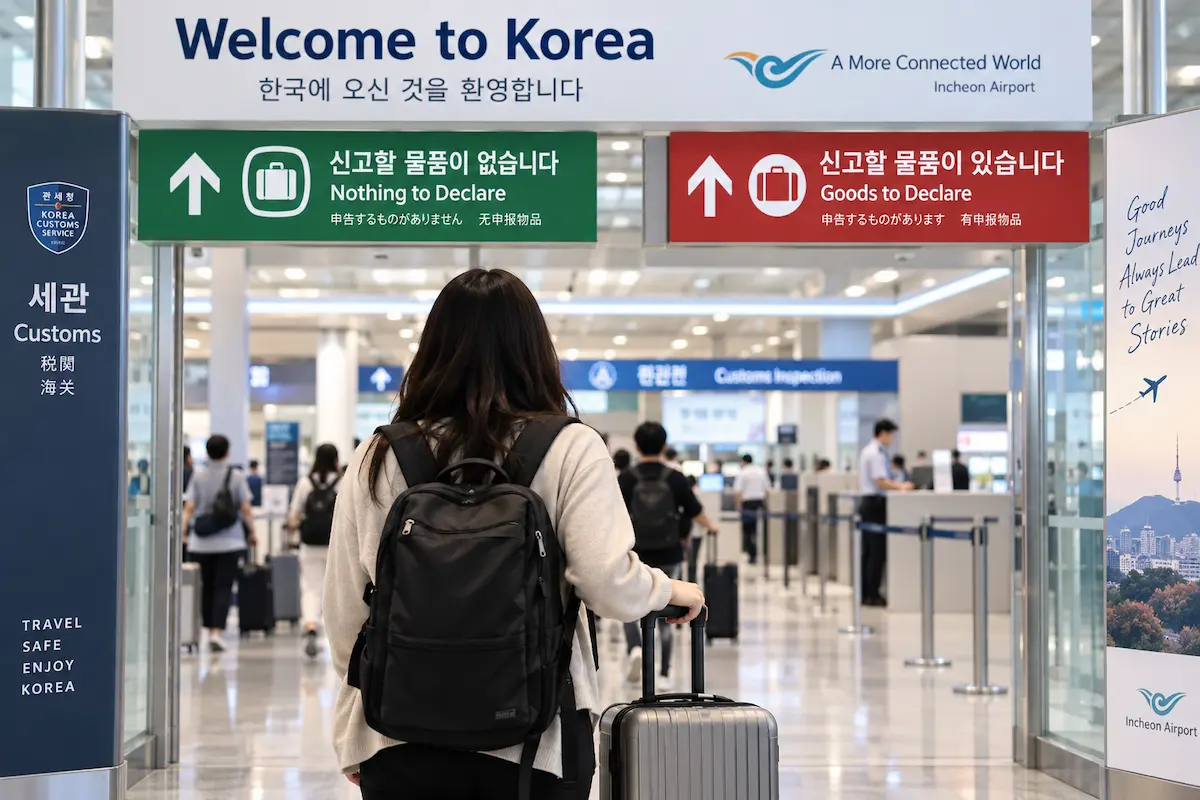
But customs rules become important if you are carrying expensive purchases, large amounts of cash, alcohol or tobacco, food, plants, animal products or certain medicines.
The simplest rule is:
If you are unsure whether something must be declared, declare it or ask a customs officer. Declaring an item does not automatically mean that it is prohibited or that you will have to pay tax.
For most first-time visitors, these are the numbers worth remembering:
| Item | Current allowance or rule |
|---|---|
| General duty-free goods | Up to US$800 |
| Alcohol | Up to 2 litres in total and US$400 or less |
| Cigarettes | Up to 200 cigarettes |
| Perfume | Up to 100 ml |
| Cash and certain payment instruments | More than US$10,000 equivalent must be declared |
| Meat, dairy, fruit and plants | Quarantine rules apply; many items must be declared |
| Controlled medicines | May require prior approval from Korea’s Ministry of Food and Drug Safety |
Last fact-checked: October 5, 2026.
Customs, quarantine and medication rules can change. Check the relevant Korean government authority shortly before travelling if you plan to carry anything unusual or restricted.
Do Tourists Have to Fill Out a Customs Declaration in Korea?
Not every traveller needs to complete a customs declaration simply because they are entering Korea.
If you have goods that must be declared, complete a customs declaration and follow the Goods to Declare route after collecting your baggage.
If you have nothing to declare, follow the Nothing to Declare signs.
Incheon Airport also provides a mobile customs declaration option for travellers who need to declare goods.
The important point is not to guess.
If an item may be restricted, exceeds an allowance or is subject to quarantine, declare it.
Korea Duty-Free Allowance: US$800
For travellers entering Korea, the basic duty-free allowance for general goods is currently US$800 per person.
This may include purchases made overseas or at duty-free shops.
The US$800 allowance is separate from certain allowances for alcohol, tobacco and perfume.
A common mistake is to think that anything bought at an airport duty-free shop is automatically exempt from Korean customs limits.
It is not.
What matters when entering Korea is whether your goods fall within Korea’s applicable duty-free allowance.
Simple example
If you bought clothing, cosmetics and accessories overseas and their taxable value remains within the applicable US$800 allowance, they would generally fall within the basic passenger allowance.
If the total exceeds the allowance, the excess may be taxable.
If you are carrying high-value purchases and are uncertain how they will be assessed, use the Goods to Declare channel and ask customs.
How Much Alcohol Can You Bring Into Korea?
The current separate duty-free allowance for alcohol is:
up to 2 litres in total, with a total value of US$400 or less.
Both conditions matter.
For example, being under 2 litres does not by itself guarantee that the alcohol falls within the duty-free allowance if its value exceeds US$400.
The allowance is separate from the general US$800 allowance.
Alcohol does not receive the passenger duty-free allowance for travellers under 19.
If you are bringing several bottles, check the total volume and value before travelling.
How Many Cigarettes Can You Bring?
The current passenger allowance includes:
up to 200 cigarettes.
Korea also has separate rules for other tobacco and electronic-cigarette products, so do not automatically convert the cigarette allowance into an assumed equivalent quantity for another product.
In particular, current Korean customs guidance separately addresses liquid nicotine and other tobacco products.
Tobacco duty-free allowances do not apply to travellers under 19.
If tobacco is relevant to your trip, check the latest Korea Customs Service passenger guidance for the exact product you are carrying.
How Much Perfume Can You Bring?
The current separate passenger allowance for perfume is:
up to 100 ml.
This is separate from the standard US$800 passenger allowance.
Be careful with older Korea travel pages.
Some older official and third-party webpages still display previous passenger limits. Current Incheon Airport customs guidance lists the perfume allowance as 100 ml.
Bringing Cash Into Korea
You can bring ordinary travel money into Korea, but larger amounts are subject to declaration rules.
If the combined value of the relevant cash or payment instruments you are carrying exceeds US$10,000 or the equivalent in another currency, you must report it to Korean customs.
This can include foreign currency, Korean won and certain types of checks.
The US$10,000 rule is a declaration threshold, not a rule saying that travellers are forbidden from carrying more than US$10,000.
If you carry more than the threshold, declare the amount correctly.
Korea Customs Service states that a foreign-currency declaration certificate cannot be issued after you have completed entry and left the immigration/customs process, so this is something to deal with at arrival rather than later.
Can You Bring Food Into Korea?
This is where travellers should be particularly careful.
The question is not simply:
“Is food allowed?”
Different foods fall under different customs and quarantine rules.
Products containing meat, dairy, eggs, plants, fruit, vegetables or agricultural ingredients may require declaration and inspection.
Do not assume that commercially packaged food is automatically exempt.
Meat and animal products
Products that may be subject to animal quarantine include:
- beef, pork, lamb and chicken
- ham
- sausages
- jerky
- canned meat
- some canned dishes containing meat
- eggs and egg products
- milk
- cheese
- butter
- other animal products
Incheon Airport states that livestock products must meet Korea’s import conditions and may require an official quarantine certificate from the exporting country.
Products from countries or regions subject to import restrictions may not be allowed.
This makes meat snacks one of the easiest things for ordinary tourists to get wrong.
If a snack, instant meal or gift contains meat, check before packing it.
Can You Bring Fruit or Vegetables Into Korea?
Fresh plant products are also subject to strict quarantine controls.
Travellers carrying items such as:
- fresh fruit
- vegetables
- live plants
- flowers
- seeds
- seedlings
- bulbs
- agricultural products
- some forestry products
- medicinal herbs
must follow Korea’s plant-quarantine rules.
Current Incheon Airport guidance states that fresh fruits and fruit-bearing vegetables are prohibited imports under the passenger plant-quarantine guidance, while plant products subject to quarantine must be declared for inspection.
Seeds, seedlings, bulbs and plants intended for cultivation may require a phytosanitary certificate issued by the exporting country.
If you have been given fruit as a snack before your flight, do not simply leave it forgotten in your hand luggage when entering Korea.
What About Packaged Snacks?
Packaged food cannot be judged safely only by whether the packaging is sealed.
A simple biscuit or sweet is very different from jerky, sausage, fresh fruit or food containing restricted animal or plant ingredients.
Processed plant foods that have been cooked or prepared may in some cases fall outside plant-quarantine inspection, but this does not create a blanket exemption for every packaged food.
When the ingredients are unclear, check before travelling or declare the item at arrival.
For a normal tourist, the easiest approach is:
Do not bring fresh fruit, meat products or questionable agricultural products unless you have checked the Korean rules first.
Bringing Medicine Into Korea
Most travellers carrying medicine immediately ask:
“Can I bring my prescription medication?”
There is no single answer for every medicine.
The most important distinction is whether the medicine contains a substance controlled under Korean law.
Korea’s Ministry of Food and Drug Safety states that travellers carrying medicines containing narcotic or psychotropic controlled substances for their own treatment must obtain approval from the ministry before entering Korea.
This requirement applies regardless of nationality.
Online applications for this approval have been available since December 27, 2024.
Do not rely only on the fact that a medicine is legal or routinely prescribed in your home country.
A medicine that is common elsewhere may be regulated differently in Korea.
Before travelling with prescription medication:
- Check the active ingredients.
- Keep the medicine in its original labelled packaging where possible.
- Carry relevant prescription or medical documentation.
- Check whether any ingredient is controlled in Korea.
- Obtain Korean approval in advance if required.
If you are unsure, check directly with Korea’s Ministry of Food and Drug Safety rather than relying on a travel forum.
What Else Must Be Declared?
Customs declaration can also be relevant if you are carrying:
- goods exceeding your passenger allowance
- commercial goods or samples
- separately shipped or unaccompanied baggage
- protected wildlife or plant products
- items regulated under other Korean laws
- restricted equipment
- goods belonging to another person
- certain high-value or unusual items
Products made from endangered animals or plants may also be controlled under CITES and other regulations.
This can include items made from certain animal skins, ivory, coral, protected plants or traditional medicines containing protected species.
Do not carry an unfamiliar animal or plant product for someone else without knowing exactly what it contains.
What Happens If You Exceed the Duty-Free Allowance?
Exceeding an allowance does not necessarily mean that you cannot enter Korea with the item.
In many cases, it means that you need to declare the goods and pay the applicable tax.
The bigger problem is failing to declare something that should have been declared.
Korea Customs Service states that passengers who fail to voluntarily declare taxable goods can face an additional tax. Current customs guidance lists an additional 40% duty for failure to declare, rising to 60% for repeated failures.
Prohibited or restricted goods can lead to more serious consequences, including confiscation and possible penalties.
When in doubt, declaration is the safer option.
Goods to Declare or Nothing to Declare?
After collecting your baggage, the practical decision is simple.
Use Goods to Declare if:
- you exceed a duty-free allowance
- you have more than US$10,000 equivalent in reportable currency or payment instruments
- you have food, plants or animal products that require declaration
- you are carrying controlled or restricted goods
- you have separately shipped baggage that must be reported
- you are uncertain whether something requires customs attention
Use Nothing to Declare if:
you have checked your belongings and do not have goods requiring declaration.
Do not use the Nothing to Declare route simply because you are unsure and hope the item is acceptable.
Ask.
Can You Declare Customs Items on Your Phone?
Yes.
Korean customs provides a mobile customs declaration service, and Incheon Airport advises that travellers with declarable goods can use the mobile service as an alternative to completing the paper form.
This can make the arrival process easier, particularly when you already know that you need to declare goods.
However, completing a declaration does not replace quarantine or government approval required for certain restricted items.
For example, declaring controlled medication at customs is not a substitute for obtaining any required MFDS approval before travelling.
Korea Customs Checklist Before You Fly
Before closing your suitcase, ask yourself:
- Are my overseas purchases within the current allowance?
- Am I carrying alcohol, cigarettes or perfume?
- Am I carrying more than US$10,000 equivalent in reportable cash or payment instruments?
- Is there meat, jerky, sausage or another animal product in my bag?
- Do I have fresh fruit, vegetables, seeds or plants?
- Does any medicine contain a controlled substance?
- Am I carrying anything for another person?
- Am I unsure whether an unusual item is restricted?
If you answered yes to any of these questions, check the relevant official rule before departure.
Frequently Asked Questions
Do I need to declare my normal clothes, phone and personal belongings?
Ordinary personal belongings reasonably needed for your trip are not what most visitors need to worry about.
Customs attention is more likely to be relevant to new purchases, excess quantities, commercial goods and restricted or regulated items.
Is the Korean duty-free allowance US$600 or US$800?
The current passenger allowance shown by Incheon Airport and the current Korea Customs Service passenger-clearance guidance is US$800.
Some older official English pages still contain the former US$600 figure, which is why older travel information can be confusing.
Use current passenger-clearance guidance before travelling.
Is Korea’s alcohol allowance one bottle?
Current passenger guidance is based on total volume and value, not simply one bottle.
The current allowance is up to 2 litres in total and US$400 or less.
Can I bring beef jerky into Korea?
Do not assume so.
Jerky is a processed meat product subject to animal-quarantine rules. Import eligibility depends on factors including its origin and quarantine requirements.
If you are not certain that it meets Korean requirements, leaving it at home is simpler.
Can I bring an apple or orange from the plane?
Fresh fruit is subject to plant-quarantine restrictions.
Do not carry fresh fruit through Korean arrival procedures without checking and declaring it as required.
Do I have to declare US$10,000 exactly?
Korea Customs Service states that amounts above US$10,000 or the equivalent must be reported.
I have prescription medicine. Is a doctor’s letter enough?
Not necessarily.
If the medicine contains a narcotic or psychotropic controlled substance under Korean law, prior approval from the Ministry of Food and Drug Safety is required. A prescription or doctor’s letter does not replace an approval that Korean law specifically requires.
Final Advice
Most visitors to Korea will pass through customs without difficulty.
The problems usually begin when travellers assume that a product is harmless because it is legal at home, sealed in commercial packaging or bought at a duty-free shop.
Three habits prevent most problems:
Check unusual items before you fly.
Declare items when required.
Ask rather than guess.
If you are still preparing the documents needed to enter Korea, read CoreaDesk’s Korea Entry Requirements and Arrival Checklist before departure.