Landing at Incheon Airport for the first time can feel more complicated than it really is.
For most international visitors entering South Korea, the basic route is:
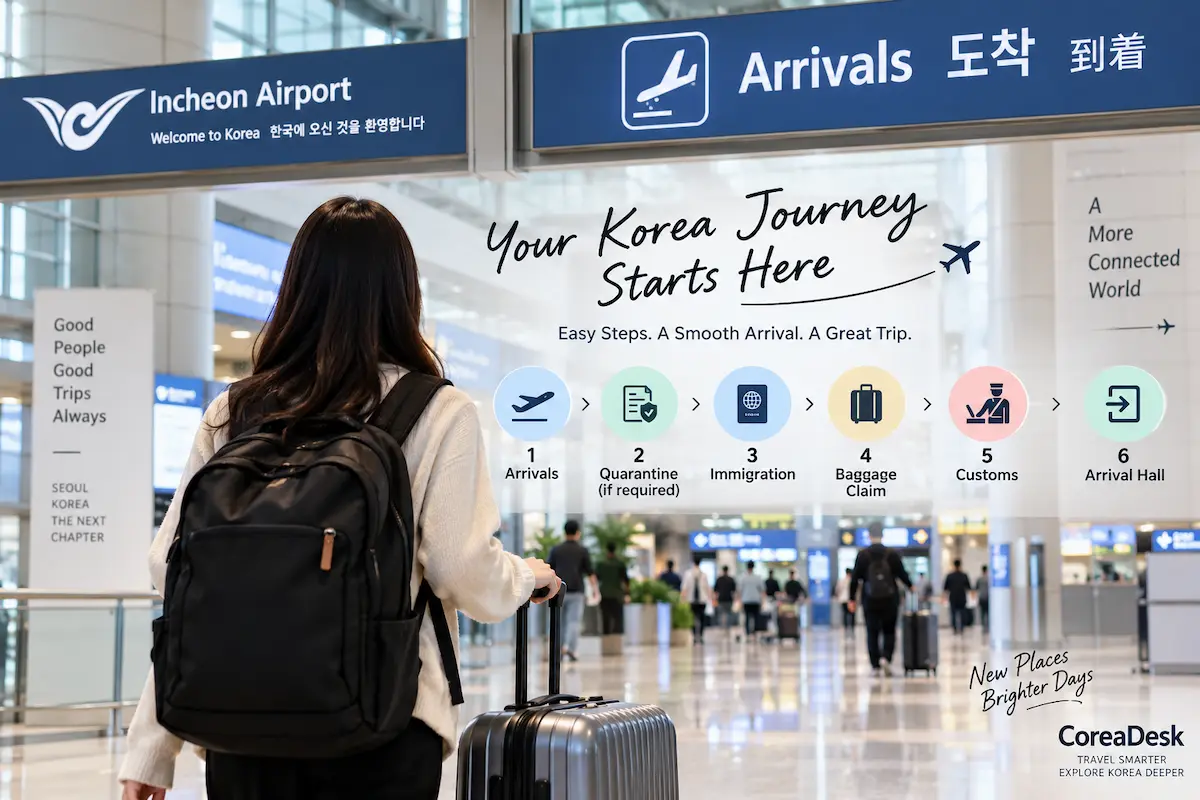
Leave the aircraft → follow Arrivals → complete quarantine procedures if required → pass immigration → collect your baggage → pass customs → enter the public Arrival Hall.
After that, focus on only three things:
Phone → Hotel Address → Transport
You do not need to solve everything the moment you leave the aircraft.
If you have not yet confirmed your visa, K-ETA or e-Arrival Card requirements, read CoreaDesk’s Korea Entry Requirements and Arrival Checklist before travelling.
Last fact-checked: October 2026.
Incheon Airport Arrival at a Glance
| Step | What You Do |
|---|---|
| 1. Leave aircraft | Follow Arrivals signs |
| 2. Quarantine | Follow health/quarantine procedures that apply to you |
| 3. Immigration | Present your passport and complete entry inspection |
| 4. Baggage claim | Find your carousel and collect checked luggage |
| 5. Customs | Declare goods if required |
| 6. Arrival Hall | Enter the public area |
| 7. Before leaving | Connect your phone and confirm transport |
| 8. Travel onward | AREX, airport bus, taxi or other transport |
For most first-time visitors, that is the entire process.
Before Landing: Keep These Items Accessible
Keep the following in your carry-on rather than checked baggage:
- passport
- visa information, if applicable
- K-ETA information, if applicable
- e-Arrival Card information, if required
- accommodation name and Korean address
- return or onward flight details
- essential medical documents
- customs or quarantine documents that apply to you
You may not need to physically show every document.
But you should be able to access the information quickly if requested.
Step 1: Leave the Aircraft and Follow Arrivals
After landing, follow signs for:
Arrivals / 입국
Do not follow Transfer unless you are connecting to another international flight and remaining in transit.
If Korea is your destination, continue toward the arrival process.
The official Incheon Airport Arrival Procedures page shows the current arrival flow.
What If Your Aircraft Arrives at the Concourse?
Some passengers arriving through Terminal 1 use the separate Concourse.
According to Incheon Airport, passengers arriving at the Concourse follow the arrival signs and take the 24-hour shuttle train to the passenger terminal before continuing the arrival process.
You do not need to plan this in advance.
Simply follow the airport signs.
Step 2: Quarantine Comes Before Immigration
All travelers arriving in Korea from abroad go through quarantine inspection.
However, that does not mean every traveler must submit Q-CODE.
Current Incheon Airport guidance states that passengers arriving from Key Quarantine Management Regions must submit either:
- Q-CODE, or
- a Health Status Questionnaire
as instructed.
The list of relevant countries and regions can change.
Check the current Incheon Airport Passenger Quarantine guide shortly before travel.
You can also check Korea’s official Q-CODE service:
Important
Do not complete forms simply because an old travel blog says that every passenger needs them.
Follow the rules that apply to your recent travel history on your actual arrival date.
Step 3: Immigration
After quarantine procedures, continue toward:
Immigration / 입국심사
This is where Korea checks your entry.
Have your passport ready.
Depending on your entry status, Korea may also rely on:
- visa information
- K-ETA
- e-Arrival Card
- residence status
- travel information
The immigration officer may ask questions such as:
- Why are you visiting Korea?
- How long are you staying?
- Where are you staying?
- When are you leaving?
Answer briefly and accurately.
Your answers should match your passport and travel information.
Do You Need an e-Arrival Card?
Not every traveler has the same requirement.
Korea’s official e-Arrival Card system should be your final reference.
The official service is:
The e-Arrival Card:
- is free
- is completed online
- can be submitted within three days before arrival in Korea
- is separate from a Korean visa and K-ETA
Travelers with a valid K-ETA and certain other exempt travelers generally do not need to submit an e-Arrival Card.
Travelers entering under other statuses may need one.
Because eligibility depends on your exact entry status, use the official site rather than assuming another traveler’s situation applies to you.
For the full explanation, see CoreaDesk’s Korea Entry Requirements and Arrival Checklist.
Do Valid K-ETA Holders Need an e-Arrival Card?
Generally, valid K-ETA holders are exempt from e-Arrival Card submission.
However, K-ETA exemption and e-Arrival Card exemption are not the same thing.
A traveler who is temporarily exempt from obtaining a K-ETA may still need to complete an e-Arrival Card.
Always check your own status on the official e-Arrival Card website shortly before departure.
What Should You Have Ready at Immigration?
Keep these available:
- passport
- accommodation address
- length of stay
- return or onward flight information
- visa or K-ETA information if applicable
- e-Arrival Card information if applicable
You normally do not need to show a detailed day-by-day itinerary.
The goal is simply to answer entry questions clearly and consistently.
Step 4: Baggage Claim Comes After Immigration
After immigration, follow signs for:
Baggage Claim / 수하물 찾는 곳
Incheon Airport directs arriving passengers to check the assigned baggage carousel and proceed to the first-floor baggage claim area.
Look at the live airport screens for:
- flight number
- departure city
- baggage carousel number
Do not rely on a carousel number you saw before landing.
Airport assignments can change.
Keep Your Baggage Tag
Do not throw away the baggage receipt from your departure airport until you have collected your suitcase.
The tag contains the baggage identification number.
You may need it if your luggage is delayed or missing.
What If Your Suitcase Does Not Arrive?
Do not simply leave the baggage area and plan to deal with it later.
If your luggage:
- does not arrive
- is damaged
- arrives open
- appears to have missing contents
contact the airline or baggage-service staff as soon as possible.
Incheon Airport provides dedicated information on Lost or Damaged Baggage.
Keep:
- baggage tag
- boarding pass
- passport
- photos of damage, if relevant
Your airline normally handles delayed or damaged checked baggage claims.
Step 5: Customs Comes After Baggage Claim
Once you have your suitcase, continue toward:
Customs / 세관
Immigration and customs are not the same thing.
Immigration asks:
Are you allowed to enter Korea?
Customs asks:
What are you bringing into Korea?
For most travelers, the order is:
Immigration → Baggage Claim → Customs → Arrival Hall
The official Incheon Airport Customs Declaration guide explains current declaration rules.
Who Needs to Declare Goods?
You may need to declare items such as:
- goods exceeding Korea’s duty-free allowance
- alcohol, tobacco or perfume above applicable limits
- food, agricultural or animal products
- restricted or controlled items
- commercial goods
- separately shipped baggage
- large amounts of cash or specified payment instruments
If you have something to declare, follow the:
Goods to Declare
route.
If you have checked your belongings and have nothing requiring declaration, follow the applicable:
Nothing to Declare
route.
When unsure, ask a customs officer.
Food in Your Bag? Do Not Guess
Take special care with:
- fresh fruit
- vegetables
- meat
- jerky
- sausage
- dairy products
- seeds
- plants
- agricultural products
- animal products
Being commercially packaged does not automatically mean an item can enter Korea without quarantine or declaration.
Animal and plant quarantine rules can apply separately from the ordinary passenger duty-free allowance.
When uncertain, declare the item and ask.
Step 6: Enter the Public Arrival Hall
After completing customs procedures, you enter the public Arrival Hall.
This is the point where you can:
- meet someone
- connect or collect mobile service
- use an ATM
- exchange currency
- find transport ticket counters
- take the AREX
- find an airport limousine bus
- take a taxi
But you do not need to stop at every service counter.
Use a simple order.
Step 7: First, Make Sure Your Phone Works
Before leaving the airport, make sure you can access:
- your hotel address
- maps
- messages
- transport information
- booking confirmations
If you prepared an eSIM or international roaming plan, activate or test it first.
If you still need mobile service, use the current Incheon Airport Information and Services directory to check telecom and roaming counters.
Airport Wi-Fi can also provide temporary internet access.
Practical rule
If your existing eSIM or roaming already works, you do not need to buy another connection simply because you are at the airport.
Step 8: Decide Whether You Need Cash
South Korea is highly card-friendly.
Most visitors do not need to exchange a large amount of money immediately after arrival.
However, a small amount of Korean won can be useful for:
- some transportation-card top-ups
- traditional markets
- small businesses
- situations where a foreign card does not work
ATMs and exchange facilities are available at Incheon Airport.
Do not make a large cash exchange simply because you think every traveler must do so.
Step 9: Confirm Your Airport-to-Hotel Route
Once your phone works and you know your actual arrival time, confirm your transport.
Your main choices are:
| Transport | Best For |
|---|---|
| AREX Express | Seoul Station and predictable rail travel |
| AREX All-Stop Train | Hongdae, Gongdeok and Airport Railroad stations |
| Airport Limousine Bus | Hotels near a bus stop, heavy luggage |
| Taxi | Groups, heavy bags, late arrivals or awkward locations |
For the full comparison, continue with CoreaDesk’s Incheon Airport to Seoul: AREX, Bus and Taxi Compared.
For live airport transport information, use the official Incheon Airport Public Transportation guide.
Should You Buy T-money Immediately?
T-money is useful for public transportation during your Korea trip.
But whether you need it immediately depends on the transport you choose from the airport.
For example:
- AREX Express uses a separate ticket.
- AREX All-Stop Train can use a transportation card.
- Airport-bus payment depends on the route and service.
- Taxi travel does not require T-money.
Choose your airport transport first.
Then prepare the payment method that route actually requires.
If You Arrive Late at Night
Do not compare the last train or bus time with your aircraft’s scheduled landing time.
Landing does not mean you are already in the Arrival Hall.
You still need time for:
walking → quarantine if applicable → immigration → baggage claim → customs
A flight scheduled to land shortly before the final train does not mean you will catch that train.
Before travelling, prepare one backup:
- late-night airport bus
- official taxi
- airport-area hotel
If your hotel has limited reception hours, notify the hotel if your arrival becomes late.
Which Terminal Did You Arrive At?
Incheon Airport has:
- Terminal 1
- Terminal 2
The terminal affects:
- AREX station access
- airport-bus stops
- taxi stands
- telecom counters
- other airport services
Do not rely on an old guide that says a particular airline always uses one terminal.
Incheon Airport specifically warns that codeshare flights and operational circumstances can change the actual terminal.
Check your real flight.
Can Someone Meet You Before Immigration?
No.
Anyone meeting you waits in the public Arrival Hall.
You must first complete:
Immigration → Baggage Claim → Customs
If someone is picking you up, send them:
- Terminal 1 or Terminal 2
- flight number
- scheduled landing time
Make it clear that the landing time is not the time you will appear in the Arrival Hall.
How Long Does the Arrival Process Take?
There is no reliable fixed number.
The time varies depending on:
- distance from aircraft to immigration
- Concourse shuttle travel
- quarantine procedures
- immigration queues
- baggage delivery
- customs
- number of arriving flights
Do not schedule a pickup or last train based on the assumption that you will be outside 15 or 20 minutes after landing.
Treat landing time as the start of your arrival process.
What Should You Do Before Leaving Incheon Airport?
Use this final check.
Phone
Can you access maps and messages?
Hotel
Do you have the Korean address?
Transport
Do you know whether you are using train, bus or taxi?
Payment
Do you have the payment method needed for that transport?
Late arrival
Does your accommodation know if you are delayed?
If all five are handled, leave the airport.
You do not need to complete every travel task at Incheon.
First-Time Arrival Mistakes to Avoid
1. Following Transfer Instead of Arrivals
If Korea is your destination, follow Arrivals.
If you are connecting internationally without entering Korea, follow Transfer.
2. Looking for Baggage Before Immigration
Checked baggage is collected after immigration.
3. Assuming Every Traveler Needs Q-CODE
The specific submission requirement depends on current quarantine guidance.
4. Assuming Every Foreigner Needs an e-Arrival Card
Check your exact entry status.
5. Throwing Away the Baggage Tag
Keep it until your luggage arrives safely.
6. Ignoring Food and Agricultural Products
Quarantine rules may apply even to packaged products.
7. Trying to Set Up Everything at the Airport
A working phone, hotel address and transport plan are enough to get started.
8. Planning Transport From Scheduled Landing Time
Allow for the entire airport arrival process.
Example: First-Time Visitor Landing at 3:00 PM
Suppose your flight lands at Incheon at 3:00 PM.
After landing
Follow Arrivals.
Complete the applicable quarantine procedure.
Immigration
Have your passport and accommodation information ready.
Complete entry inspection.
Baggage claim
Check the screen for your flight.
Collect your suitcase.
Customs
Declare anything that requires declaration.
Arrival Hall
Check that your phone works.
Open your hotel address.
Transport
Check the actual time.
Choose AREX, airport bus or taxi based on your hotel and luggage.
Then leave the airport.
That is a normal first arrival in Korea.
Example: Late-Night Arrival
Suppose your flight is scheduled to land at 10:30 PM.
Do not assume you will be outside the airport at 10:45 PM.
You still need:
- walking time
- quarantine procedures if applicable
- immigration
- baggage claim
- customs
By the time you reach the Arrival Hall, your original transport plan may no longer work.
Before departure:
- save the official transport page
- prepare a taxi backup
- save your hotel address offline
- check late check-in instructions
Then recheck transport after you reach the Arrival Hall.
Incheon Airport Arrival Checklist
Before Flying
- Passport ready
- Korea entry requirements checked
- e-Arrival Card checked if applicable
- Q-CODE requirement checked if applicable
- Hotel name saved
- Korean hotel address saved
- Airport transport planned
- Late-night backup prepared
After Landing
- Follow Arrivals
- Complete quarantine procedure if required
- Pass immigration
- Find baggage carousel
- Collect luggage
- Pass customs
- Enter Arrival Hall
Before Leaving the Airport
- Make sure your phone works
- Confirm the hotel address
- Confirm transport
- Prepare the required payment method
- Contact your hotel if delayed
Then go.
Final Advice
Your first arrival at Incheon Airport becomes much easier once you remember one sequence:
Arrivals → Quarantine if Required → Immigration → Baggage → Customs → Arrival Hall → Transport
Do not try to solve your entire Korea trip inside the airport.
First enter the country.
Then collect your suitcase.
Then clear customs.
Once you reach the Arrival Hall, focus on:
Phone → Hotel Address → Transport
For the next step, read Incheon Airport to Seoul: AREX, Bus and Taxi Compared.
For wider first-trip planning, return to CoreaDesk’s Start Here guide.
Official Information
Incheon International Airport — Arrival Procedures
https://www.airport.kr/ap_en/1439/subview.do
Incheon International Airport — Passenger Quarantine
https://www.airport.kr/ap_en/1442/subview.do
Official Korea e-Arrival Card
https://www.e-arrivalcard.go.kr/
Incheon International Airport — Customs Declaration
https://www.airport.kr/ap_en/1445/subview.do
Incheon International Airport — Lost or Damaged Baggage
https://www.airport.kr/ap_en/1450/subview.do
Incheon International Airport — Information & Services
https://www.airport.kr/ap_en/1546/subview.do
Incheon International Airport — Public Transportation
https://www.airport.kr/ap_en/1499/subview.do