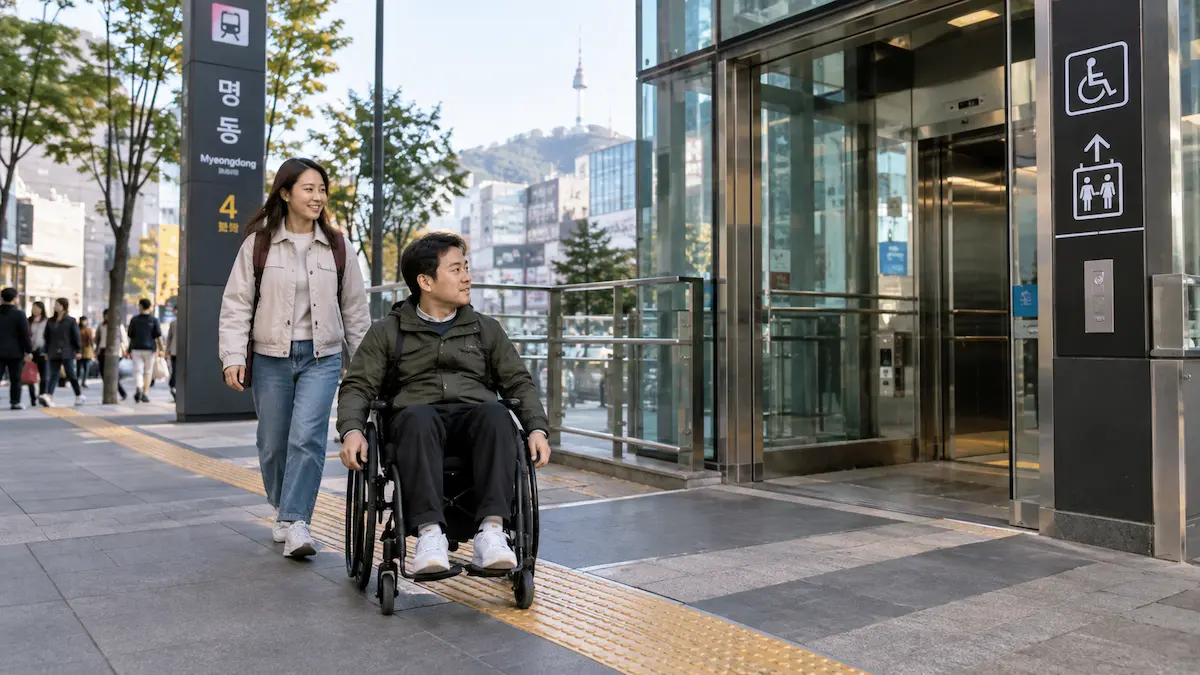
Accessible travel in Korea is possible, but it works best with advance planning.
Seoul has increasingly detailed accessibility information for public transport and tourist facilities, and the city operates the Seoul Danurim Accessible Tourism Center for travellers with reduced mobility.
However, visitors should not assume that every station, hotel, restaurant, attraction or route in Korea is fully step-free or equally accessible.
The practical approach is simple:
check the exact route before travelling, confirm accommodation and attraction access directly, and keep an alternative plan when lifts, slopes or long walking distances may be difficult.
This guide is useful not only for wheelchair users. It may also help older travellers, people using walking aids, pregnant travellers, families with pushchairs and anyone who needs to reduce stairs or long walking distances.
Accessible Travel in Korea at a Glance
| Situation | What to check |
|---|---|
| Accommodation | Step-free entrance, lift, accessible bathroom and room layout |
| Subway | Lift locations, accessible route and transfer distance |
| Tourist attraction | Entrance, slopes, lifts, accessible toilets and internal walking distance |
| Restrooms | Accessible toilet availability before long outings |
| Mobility support in Seoul | Seoul Danurim Accessible Tourism Center |
| Travel outside Seoul | Check the individual attraction and transport operator |
| General visitor assistance | 1330 Korea Travel Helpline |
| Emergency | 112 for police, 119 for fire, rescue or ambulance |
Accessibility is not only about whether a building has a lift.
The entire journey matters.
A hotel room may be accessible, but the route from the station may include a steep hill.
A station may have a lift, but the transfer between lines may still involve a long distance.
A museum may have an accessible entrance while the surrounding neighbourhood is more difficult to navigate.
Plan the whole route rather than checking only the destination.
Check Your Accommodation Before Booking
Do not rely only on the word accessible in a booking filter.
If accessibility is essential, contact the accommodation directly and confirm what you actually need.
Useful questions include:
- Is there a step-free entrance?
- Is there a lift from the entrance to the room?
- Is the lift large enough for a wheelchair or mobility aid?
- Is an accessible room available?
- Does the bathroom have sufficient space?
- Are there grab rails?
- Is there a step or raised threshold at the bathroom entrance?
- How far is the property from the nearest accessible subway exit?
- Is the route between the station and accommodation steep?
Recent photographs and reviews can help, but direct confirmation is safer when a particular feature is essential.
Also save the accommodation name and address in Korean.
This can make taxi journeys and requests for local assistance much easier.
Using the Seoul Subway
Seoul’s subway network is extensive and many stations provide accessibility facilities.
The Seoul Metropolitan Government publishes station-level information that can include:
- lifts
- escalators
- portable wheelchair ramps
- wheelchair lifts at some stations
- electric wheelchair chargers at some stations
- accessible restrooms
- voice guidance systems
- sign language video phones at some stations
This is useful because facilities are not identical at every station.
Before travelling, check the specific station rather than assuming that every exit has a lift.
A station may have several exits but only one or two accessible routes to street level.
Transfer stations can also require considerable walking even when lifts are available.
For travellers who tire easily, transfer distance can matter as much as step-free access.
Allow More Time for Transfers
Large stations can be complicated.
The shortest route on a map may not be the easiest route for someone who needs:
- lifts instead of stairs
- wider paths
- fewer transfers
- less walking
- easier access to toilets
Allow extra time and avoid extremely tight connections.
When possible, choose a slightly longer journey with fewer difficult transfers rather than the mathematically shortest route.
Official station information is more useful than guessing from a general subway map.
Accessible Restrooms
Accessible restrooms are available in many major transport and public facilities, but availability varies.
Useful places to check include:
- subway and railway stations
- airports
- museums
- large shopping centres
- department stores
- public buildings
- major tourist attractions
Do not wait until the last moment if an accessible toilet is essential.
Check before beginning a long outdoor route.
For general information about finding toilets while travelling, see our Korea Restrooms for Visitors guide.
Check Tourist Attractions Individually
Accessibility can differ significantly between attractions.
Before visiting, check:
- step-free entrance
- ramps
- lift access
- accessible toilets
- accessible parking
- wheelchair rental
- tactile or braille information
- audio or visual assistance
- slopes and uneven surfaces
- distance between buildings or exhibition areas
Historic sites require particular attention.
Korea has palaces, temples, traditional villages, mountain areas and heritage sites where old surfaces, steps, gravel or slopes may make access more difficult.
A site’s main entrance may be accessible while another part of the complex is not.
Do not assume that an attraction is either completely accessible or completely inaccessible.
The details matter.
Seoul Danurim Accessible Tourism Center
One of the most useful official resources for accessible travel in Seoul is the Seoul Danurim Accessible Tourism Center.
See the Seoul Metropolitan Government’s Accessible Tourism information for an official overview of accessibility support in the city.
Seoul describes the service as supporting travellers with reduced mobility, including people with disabilities, older people, pregnant women and families travelling with infants.
Services and information can include:
- accessibility information for tourist sites
- accessible travel planning information
- vehicle reservation services
- travel assistive device reservations
- information about accommodation and tourism facilities
The official Seoul Danurim service is particularly useful when accessibility is a central part of the trip rather than a minor preference.
Check availability and reservation requirements before travelling because services can require advance booking.
Accessibility Is Not Only About Wheelchairs
Accessible travel planning can also help people who do not use a wheelchair.
For example:
Older travellers
Long subway transfers, steep hills, stairs and extended standing can make an otherwise simple itinerary exhausting.
Choose fewer destinations and allow more rest time.
Travellers using walking aids
Check lifts, slopes, seating and walking distances before leaving.
Pregnant travellers
Reduce unnecessary transfers and plan regular places to sit and use the restroom.
Families with pushchairs
Lifts and step-free entrances can make station navigation considerably easier.
A route that works well for a wheelchair user may also be useful for a family travelling with a pushchair.
Accessibility information benefits more travellers than the term may initially suggest.
Taxis Can Be Useful, but Check the Entire Journey
A taxi can reduce walking, especially when:
- accommodation is far from a station
- the route includes a hill
- luggage is heavy
- weather is difficult
- a traveller is tired
However, a taxi does not automatically solve every accessibility problem.
Check whether the traveller can enter the vehicle comfortably and whether the destination has an accessible drop-off point.
Travellers who require a wheelchair-accessible vehicle should not assume that an ordinary taxi will meet their needs.
Seoul Danurim provides information and reservation services for mobility-support vehicles, subject to its current conditions and availability.
Travelling Outside Seoul
Accessibility information is generally easier to find for major Seoul facilities.
Outside Seoul, conditions vary considerably by city, transport operator and attraction.
This does not mean regional Korea should be avoided.
It means more checking may be necessary.
Before a regional trip:
- Check the attraction’s official website.
- Contact the attraction directly if accessibility information is unclear.
- Check the railway station or bus terminal.
- Confirm the distance between transport and the attraction.
- Check whether taxis are likely to be needed.
- Confirm accessible toilets.
- Keep an alternative indoor or easier-access destination nearby.
For attractions with limited English information, the 1330 Korea Travel Helpline can be useful for general visitor assistance.
Keep the Day Less Complicated
Accessible travel often becomes easier when the itinerary contains fewer transfers.
Instead of trying to visit five distant attractions in one day, choose one area where several activities are close together.
A practical day might combine:
- one major attraction
- a nearby lunch
- an indoor museum or shopping centre
- a café or rest point
- an early return to the accommodation if needed
This reduces the number of unknown lifts, entrances, pavements and transport changes.
A slower itinerary is not a lesser itinerary.
For many travellers, it is simply a better one.
What to Save on Your Phone
Before leaving your accommodation, save:
- Korean accommodation address
- destination name in Korean
- accessible subway exit information
- screenshots of the route
- attraction contact details
- booking confirmation
- emergency contact details
- travel insurance information
Mobile data is useful, but screenshots are valuable when reception is poor or an app becomes difficult to use.
When You Need Help
For general tourism information or visitor assistance, use the 1330 Korea Travel Helpline.
At stations, museums, airports and other large facilities, staff may also be able to help with:
- lift locations
- accessible entrances
- toilets
- platforms
- alternative routes
For an immediate emergency:
112 — Police
119 — Fire, rescue and ambulance
For a broader explanation of emergency and visitor assistance in Korea, see our Emergency Guide for Travellers in Korea.
Before Leaving: A Simple Accessibility Checklist
Ask these questions before starting the day:
- Can I enter the accommodation and destination without using stairs?
- Which subway exit has a lift?
- How long is the transfer?
- Is the route steep?
- Is an accessible restroom available?
- Is there somewhere to sit and rest?
- Do I need to reserve mobility support in advance?
- What is my alternative if the planned route is too difficult?
A few minutes of checking can prevent a much harder problem later.
Final Advice
Korea should not be described as completely barrier-free.
Accessibility varies between stations, buildings, neighbourhoods and destinations.
At the same time, travellers should not assume that accessible travel in Korea is impossible.
Seoul provides detailed accessibility information for many subway stations and tourist facilities, and Seoul Danurim offers specialised tourism support for people with reduced mobility.
The safest approach is practical:
check the exact route, verify the facilities you personally need and plan fewer unknowns into each day.
For more general travel assistance and emergency information, visit our Help & Safety guide.
Information note: This guide provides general travel information and does not guarantee that a particular route, station, accommodation or attraction will meet an individual’s accessibility requirements. Facilities, lifts, services, reservations and operating conditions can change. Confirm essential accessibility features directly with the relevant transport operator, accommodation, attraction or official tourism service before travelling.
Last fact-checked: September 2026