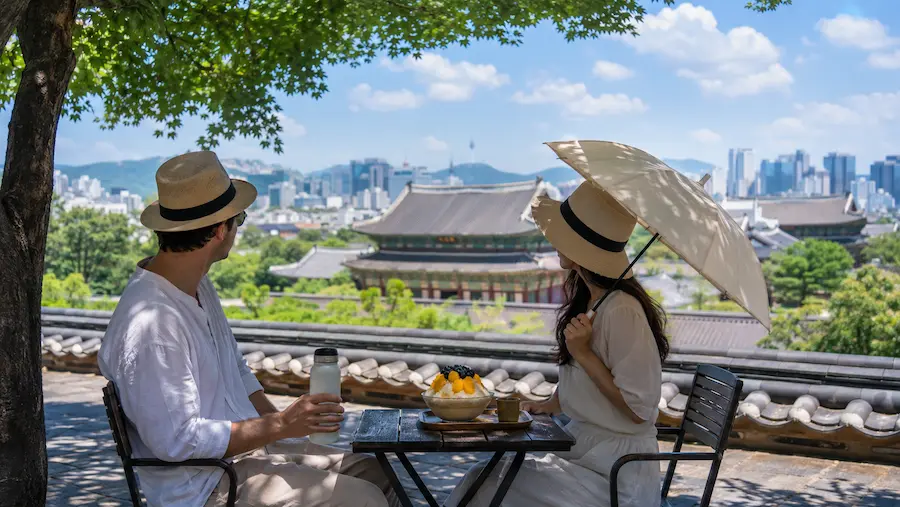
Summer travel in Korea is completely manageable, but the best itinerary is usually a flexible one.
Hot and humid weather, sudden heavy rain and strong sunlight can make a normal sightseeing route much harder than it looks on a map.
The practical approach is simple:
check the latest local weather, shorten outdoor routes, keep an indoor alternative nearby, and change the plan when conditions change.
You do not need to stop travelling. You need a summer version of your itinerary.
Korea Summer Travel at a Glance
| Situation | Practical response |
|---|---|
| Very hot day | Shorten outdoor walks and plan regular cooling breaks |
| Heat warning | Move demanding outdoor activities to another time or day |
| Ordinary rain | Carry a reliable umbrella and keep plans flexible |
| Heavy rain | Recheck transport, closures and flood risk before leaving |
| Hot afternoon | Use museums, malls, cafés, cinemas or accommodation as cooling stops |
| Long outdoor walk | Look for shade and reduce unnecessary walking |
| Someone becomes confused, collapses or loses consciousness | Call 119 immediately |
There is no single timetable that is safe for everyone.
Age, health, medication, humidity, direct sunlight, physical effort and familiarity with hot weather all affect how someone responds to summer conditions.
Check the Weather Again Before You Leave
Do not rely only on the forecast you saw the night before.
Weather can differ considerably between Seoul, Busan, Jeju, Daegu, Gyeongju, Gangneung and other destinations.
Check the actual city or district you are visiting.
Useful Korea Meteorological Administration information includes:
- Current weather warnings
- Heat impact forecasts
- Heatwave information
- Hourly temperature
- Apparent temperature
- Rain
- Lightning
- Typhoon information
Rain and heat conditions can change during the day, so check again before starting a long outdoor route.
What Korea’s Heat Alerts Mean for Travellers
Korea uses heat alerts based partly on expected maximum apparent temperature.
A heat advisory generally indicates maximum apparent temperatures of at least 33°C for two or more days.
A heat warning generally indicates at least 35°C for two or more days.
From 1 June 2026, Korea added a new highest-level Major Heat Warning. It may be issued in areas already experiencing heat-warning conditions when a maximum apparent temperature of 38°C or higher, or a maximum air temperature of 39°C or higher, is expected.
For travellers, the exact official category matters less than the action you take.
As conditions become more severe:
- shorten outdoor visits
- avoid long unshaded walks
- reduce queues in direct sunlight
- plan longer indoor breaks
- postpone non-essential outdoor activities when necessary
Official warnings describe regional conditions. They are not personal safety limits.
Heat illness can occur even below warning thresholds.
Build a Summer Itinerary That Can Change
A good summer itinerary does not need to alternate between sightseeing and hiding indoors.
Instead, choose areas where several activities can be combined without long transfers.
For example:
Seoul: one palace or neighbourhood walk + nearby museum + meal + evening activity
Busan: short beach visit + aquarium, observation space, department store or café nearby
Jeju: one coastal stop + nearby café or museum + accommodation break
Gyeongju: one major outdoor historical site + indoor museum or café + shorter evening walk
The important point is not the exact itinerary.
It is keeping outdoor walking distances short and having somewhere comfortable nearby if the weather becomes difficult.
Move Indoors During the Hardest Part of the Day
One of the easiest ways to enjoy Korea in summer is not to fight the weather.
Many local outings naturally combine:
- department stores
- shopping centres
- museums
- cinemas
- bookstores
- cafés
- restaurants
- large transport complexes
These places allow travellers to eat, rest, shop or see something interesting without repeatedly walking outside.
If you want to visit an outdoor attraction, consider going earlier and moving indoors later.
A simple pattern can be:
Morning: outdoor sightseeing
Lunch: nearby restaurant
Afternoon: museum, exhibition, shopping centre or café
Evening: optional outdoor activity after checking the weather again
Do not assume sunset automatically means comfortable weather. Humidity and retained heat can remain high into the evening.
Rainy Season Does Not Mean It Rains All Day
Korea’s rainy season generally occurs during summer, but the timing and intensity vary from year to year.
Some days have light rain for several hours.
Others may be dry in the morning and experience a sudden heavy downpour later.
Heavy rain can also occur outside the period usually described as the rainy season.
For that reason, use the latest local forecast rather than relying on a fixed rainy-season calendar.
Ordinary rain does not necessarily require cancelling your plans.
Heavy rain is different.
Streams can rise quickly, traffic can slow, outdoor attractions may close and routes that were fine earlier in the day may become unsuitable.
What to Do During Heavy Rain
Before leaving, check:
- current rainfall warnings
- hourly forecast
- transportation notices
- attraction closures
- lightning
- flooding or local safety alerts
Avoid unnecessary routes along:
- rivers
- streams
- low-lying areas
- flooded roads or underpasses
- mountain trails during severe rain
If authorities close an area or advise people to stay away, follow those instructions.
When the forecast becomes worse, change the itinerary rather than trying to complete the original plan.
A museum, shopping centre, café, cinema or longer meal can become the day’s main activity.
That is still travelling.
Reduce Direct Sun When You Have to Walk
Shade does not make extreme heat safe, but reducing direct sun exposure can make a necessary short walk easier.
Check:
- total walking distance
- hills and stairs
- outdoor queues
- exposed bus stops
- distance to the nearest air-conditioned building
One Korea-based option is Geuneulro (그늘로), an app that can compare a shortest route with a route expected to have more shade.
Its prediction considers factors such as walking time, the sun’s position and available building and street-tree data.
Shade estimates can change depending on the time of day, so they should be treated as planning assistance rather than a guarantee.
Most importantly, a shaded route does not make dangerous heat safe.
Summer Food Can Be Part of the Plan
A cooling break does not need to feel like wasted sightseeing time.
Summer is also a good season to try Korean foods such as:
- Samgyetang (삼계탕) — hot chicken soup traditionally associated with the hottest days of summer
- Naengmyeon (냉면) — cold noodles
- Kongguksu (콩국수) — noodles in cold soybean broth
- Makguksu (막국수) — cold buckwheat noodles
- Mulhoe (물회) — raw seafood and vegetables in a cold spicy broth
- Bingsu (빙수) — shaved ice dessert
- Chamoe (참외) — Korean melon
Summer food is part of the travel experience, but food, fruit and desserts do not replace regular water intake.
Beaches, Pools and Summer Evenings
Beaches, pools and water activities can still be enjoyable in hot weather.
Being near water does not remove the risks of:
- dehydration
- sun exposure
- lightning
- strong waves
- currents
- heat illness
Before swimming, check the official swimming period, permitted hours, weather, warning flags and lifeguard information.
A beach may remain physically accessible outside official swimming hours even when entering the water is not permitted.
Follow the local operator’s rules.
Summer evenings can also work well for markets, illuminated attractions, waterfront walks and performances.
Check conditions again before leaving.
What to Carry
Choose according to your itinerary:
- Water
- Parasol or wide-brimmed hat
- Lightweight clothing
- Sunscreen
- Handheld or folding fan
- Charged phone
- Portable battery
- Necessary medication
- Korean name and address of your accommodation
Drink water regularly rather than waiting until you feel extremely thirsty.
People who have been instructed by a healthcare professional to restrict fluids or salt should follow their individual medical advice.
Know When to Stop
Possible signs of heat exhaustion include:
- heavy sweating
- headache
- dizziness
- unusual weakness
- fatigue
- muscle cramps
- nausea or vomiting
- cool or clammy skin
Stop the itinerary and move somewhere cool or air-conditioned.
Allow the person to rest and cool down.
Seek medical help if the person does not improve or continues to worsen.
Confusion, collapse, seizure, loss of consciousness or suspected heatstroke requires urgent attention.
Call 119 immediately.
Do not force an unconscious, confused, vomiting or unsafe-to-swallow person to drink.
Emergency Help in Korea
| Number | Service | When to use it |
|---|---|---|
| 119 | Ambulance, fire and rescue | Medical emergency, suspected heatstroke, fire or rescue |
| 112 | Police | Crime, immediate danger or urgent police assistance |
| 1330 | Korea Travel Helpline | Travel information and non-emergency visitor assistance |
For a broader overview, see our Emergency Guide for Travellers in Korea.
If you do not speak Korean when calling 112 or 119, say:
“English, please.”
or
“Interpreter, please.”
Give your location as clearly as possible.
Final Check Before Going Out
Before starting a summer itinerary, ask:
What is today’s weather warning for my actual destination?
How much outdoor walking does this route require?
Where is my nearest indoor alternative?
Can I change the plan easily if the weather gets worse?
If the answer raises concern, change the itinerary.
Final Advice
Summer in Korea does not have to mean choosing between staying indoors all day and enduring uncomfortable weather.
The better approach is to combine outdoor sightseeing with indoor culture, meals, cooling breaks, shorter walks and evening activities.
During rainy periods, check the forecast again before leaving.
During heatwaves, reduce outdoor exposure and prioritise health over completing an itinerary.
A flexible day is not a failed travel day.
It is often the best way to enjoy Korea’s summer safely and comfortably.
Information note: This guide provides general travel and safety information. Weather warnings, transport conditions, attraction opening hours, swimming rules and local safety instructions can change. Check current official information before travelling.
Last fact-checked: September 2026