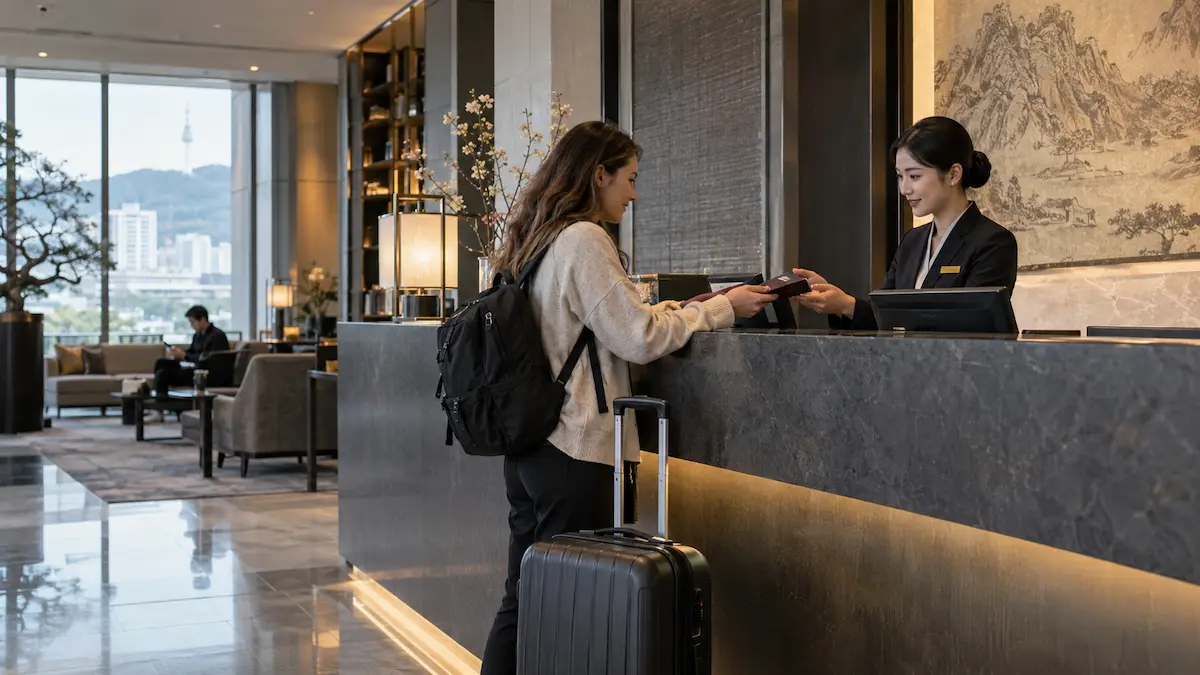
Checking into a hotel in South Korea is usually straightforward.
For most international travelers, the basic process is:
Arrive at the accommodation → show your booking and identification → confirm the room and payment details → receive your key or self check-in instructions → check the room → confirm check-out time.
The part that causes confusion is rarely the check-in itself.
It is usually one of these questions:
What if I arrive before check-in?
Do I need my passport?
Can I leave my suitcase first?
What if I arrive late at night?
Why is there no toothbrush in the room?
Can the hotel keep my luggage after check-out?
This guide explains those situations without assuming that every Korean hotel works the same way.
Last fact-checked: October 2026.
Korea Hotel Check-in at a Glance
| Situation | What to Do |
|---|---|
| Arrive at normal check-in time | Go to reception with your booking details and identification |
| Arrive early | Ask whether luggage storage or early check-in is available |
| Arrive late | Contact the accommodation before the reception desk closes |
| Self check-in property | Save the access code and instructions before arrival |
| Asked for a card or deposit | Check whether it is a payment, deposit or temporary authorization |
| No toothbrush or razor in the room | Check hotel policy; larger hotels may not provide disposable amenities free |
| Check out before a late flight | Ask whether the hotel can hold your luggage |
| Need proof for travel insurance or expenses | Request the receipt before leaving |
The most important rule is:
Check the policy of the hotel you actually booked.
There is no single check-in time, deposit rule or luggage-storage policy for every accommodation in Korea.
Before You Arrive: Save Four Things
Before traveling to your hotel, save:
- The accommodation name
- The Korean address
- Your booking confirmation
- The property’s contact information
The Korean address is particularly useful.
Taxi drivers, local map apps and airport-bus information may work more reliably with the Korean address than with an English hotel name alone.
Also check your reservation for:
- check-in time
- check-out time
- reception hours
- late check-in instructions
- breakfast information
- cancellation conditions
- payment method
- any deposit or card requirement
Do this before leaving the airport rather than discovering a problem at midnight.
Step 1: Arrive at the Correct Property
This sounds obvious, but Korea has many hotels and guesthouses with similar English names.
Before getting out of a taxi or walking away from a subway station, compare:
- hotel name
- Korean address
- building number
- booking confirmation
This matters even more for:
- guesthouses
- serviced residences
- small hotels inside mixed-use buildings
- self check-in accommodation
- properties with several branches
Do not rely only on the English name shown in a map search.
Step 2: Go to Reception—or Follow the Self Check-in Instructions
Traditional hotels normally have a reception or front desk.
Smaller guesthouses, residences and some newer accommodations may use:
- self check-in kiosks
- door codes
- messaging instructions
- unmanned reception
- key boxes
If your accommodation uses self check-in, save the instructions before you arrive.
Do not assume you will have mobile data or Wi-Fi at the building entrance.
Take a screenshot of:
- entrance instructions
- door code
- room number
- Wi-Fi details
- host contact information
If the instructions say they will be sent on the day of arrival, check your booking app and email before heading to the property.
Do You Need Your Passport to Check Into a Hotel in Korea?
Keep your passport ready.
Hotels and other accommodation providers may ask to see identification when confirming a foreign guest’s reservation.
Exactly what is required can depend on the accommodation and the circumstances.
For an international visitor, the simplest approach is:
Carry the passport you used for your Korea trip when checking in.
Also make sure that the name on your reservation can be matched easily to your identification.
If someone else made the reservation, save:
- the reservation number
- the booking name
- the confirmation email or app screen
Do not put your passport inside a suitcase that has been sent separately or stored somewhere difficult to access.
Step 3: Confirm the Reservation and Payment
At the front desk, staff may ask for:
- your name
- passport or other identification
- reservation number
- payment card
- number of guests
If the room has already been prepaid, the hotel may still ask for a card for incidentals or a security authorization.
If it has not been prepaid, you may need to pay at check-in or check-out according to the booking conditions.
If the hotel asks for your card
Do not immediately assume you are being charged twice.
Ask:
“Is this a payment or a deposit?”
A hotel may use a card for:
- the room payment
- a security deposit
- a temporary authorization
- incidental charges
Policies vary by property.
If the amount matters, ask the front desk to explain it before you approve the transaction.
Is a Hotel Deposit Normal in Korea?
Some hotels request one.
Others do not.
There is no useful rule such as:
“All Korean hotels require a deposit.”
That is not accurate.
The requirement can depend on:
- hotel brand
- room type
- booking platform
- payment status
- minibar or incidental policy
If a deposit is required, ask:
- how much it is
- whether it is charged or only authorized
- how it will be refunded
- whether cash is accepted
- when a card authorization is normally released
Card-release timing may also depend on your bank, not only the hotel.
What Time Is Hotel Check-in in Korea?
There is no single national hotel check-in time.
Around 2:00–3:00 PM is common, but your reservation is the final authority.
Official Korean tourism accommodation listings show examples with:
- 2:00 PM check-in
- 3:00 PM check-in
and different check-out times as well.
So do not build your first day around the assumption that every Korean hotel allows check-in at 3:00 PM.
Check your booking.
What If You Arrive Before Check-in?
This is very common for visitors arriving on morning flights.
You usually have three possibilities:
1. The room is ready
The hotel may allow you to check in early.
This is not guaranteed.
Some hotels provide early check-in free when a room is available; others may charge.
2. The room is not ready, but the hotel stores your luggage
For many travelers, this is the easiest solution.
Leave your suitcase, take the items you need for the day and return at normal check-in time.
3. The property cannot store luggage
This is more likely with some unmanned accommodation, private rentals or very small properties.
In that case, consider a station locker or luggage-storage service that fits your route.
CoreaDesk’s Subway Lockers in Korea guide explains when this is useful.
Do Not Assume Luggage Storage Is Included
Many hotels provide luggage storage, but it is not a universal right attached to every booking.
Before depending on it, ask the property.
This is especially important if:
- there is no staffed reception
- you arrive very early
- you leave very late
- your luggage is unusually large
- you plan to store bags overnight
- you are returning several days later
For an ordinary hotel with a front desk, short-term storage before check-in or after check-out is common enough to ask about.
But always confirm.
What If You Arrive Late at Night?
This deserves attention before you fly.
A large hotel with 24-hour reception may have no problem with a late arrival.
A small guesthouse may.
A self check-in property may require a code.
Some accommodation may close or reduce front-desk service late at night.
Before a late arrival, check:
- reception closing time
- latest check-in time
- whether advance notice is required
- self check-in instructions
- entrance-door instructions
- how to contact the property after hours
If your flight is delayed and you will arrive much later than planned, message the hotel.
Do not assume the room will automatically be held indefinitely without communication.
Step 4: Before Going to Your Room, Confirm the Basics
At check-in, make sure you know:
- room number
- check-out time
- breakfast location and hours, if included
- Wi-Fi information
- elevator access
- any key-card rules
- whether reception is open 24 hours
If you need:
- luggage storage after check-out
- a taxi reservation
- an early-morning departure
- an extra towel
- housekeeping information
this is a good time to ask.
Why Might There Be No Toothbrush in Your Korean Hotel Room?
This surprises some foreign visitors.
Korean law restricts the free provision of certain disposable products at accommodation businesses with 50 rooms or more.
The regulated disposable items include products such as:
- disposable toothbrushes
- disposable toothpaste
- disposable razors
- disposable shampoo
- disposable conditioner
As a result, a larger Korean hotel may not place a free disposable toothbrush or razor in the room.
Some properties may:
- sell the item
- provide it for a charge
- use refillable dispensers instead
- provide different amenities under permitted arrangements
Smaller accommodation can operate differently.
Practical advice
Bring your own:
- toothbrush
- toothpaste
- razor
even if you are used to hotels providing them.
Do not assume that an empty toothbrush space means the hotel forgot something.
Shampoo and Body Wash May Look Different From What You Expect
Many hotels now use larger refillable bottles or wall-mounted dispensers rather than individual miniature bottles.
Check the labels before assuming an amenity is missing.
Typical rooms may provide some combination of:
- shampoo
- conditioner
- body wash
- soap
- towels
- hair dryer
But amenities vary widely by accommodation type.
Never assume that a guesthouse, hanok stay, pension and international hotel chain will provide the same items.
What About Slippers, Water and Toiletries?
Again, check the actual accommodation.
Disposable-amenity restrictions do not mean that every object in a hotel room has disappeared.
Individual properties decide what they provide within applicable rules.
Your booking page is often more useful than a generic “Korean hotels provide X” list.
If a particular item matters to you, check the amenities section before traveling.
Step 5: Check the Room Soon After Entering
Do not wait until midnight to discover a problem.
Soon after entering, check:
- whether the room matches your reservation
- number of beds
- heating or air conditioning
- bathroom
- hot water
- obvious cleanliness problems
- major damage
- door lock
- important amenities you expected
If something is wrong, contact reception promptly.
This is much easier than reporting a problem several hours later.
Korea Uses Ondol Heating in Many Accommodations
Some Korean rooms—particularly hanok stays, pensions and certain guesthouses—may use ondol, Korea’s traditional floor-heating system or a modern version of it.
Even ordinary rooms with beds can have heated floors.
Do not assume the room is overheating because the floor feels warm.
If you are uncomfortable, ask how to adjust the heating.
Controls may be:
- on the wall
- beside the bed
- integrated with a boiler controller
Do not change unfamiliar boiler settings aggressively if you do not understand them.
Ask the host or reception.
Shoes Inside the Room: Check the Accommodation Type
There is no single rule covering every Korean hotel.
In a standard international-style hotel room, the experience may feel familiar.
At:
- hanok stays
- pensions
- guesthouses
- private accommodation
you may be expected to remove shoes before stepping into the main living or sleeping area.
Look for:
- a raised floor
- a shoe shelf
- indoor slippers
- instructions from the host
When the layout clearly separates an entrance area from the room floor, follow the property’s system.
What If the Room Uses a Key Card for Electricity?
Some hotels use the room key card—or another card inserted into a slot—to activate electricity.
When you remove it and leave the room, some lights or electrical systems may switch off.
Do not assume:
- air conditioning
- charging
- every electrical outlet
will continue operating when you leave.
If you need medication, equipment or another item to remain powered or temperature-controlled, ask the hotel rather than improvising.
Can You Have Food Delivered to the Hotel?
Often yes, but the exact delivery point varies.
A hotel may require delivery riders to stop at:
- the lobby
- the building entrance
- a designated delivery area
rather than allowing them to go directly to guest rooms.
Guesthouses and residences may have different rules.
If you order delivery, check:
- exact hotel name
- Korean address
- lobby or entrance instructions
- whether a Korean phone number is required by the service
Do not assume the driver can locate you from an English hotel name alone.
What If You Need Laundry?
Laundry options vary greatly.
You may find:
- guest laundry machines
- coin laundry
- hotel laundry service
- no laundry facilities at all
Do not confuse paid hotel laundry service with a self-service washing machine.
Check the service and price before handing over clothes.
For longer Korea trips, accommodation with self-service laundry can be more practical than relying on hotel laundry charges.
What Time Is Check-out?
Just as with check-in, there is no single Korea-wide check-out time.
Around 11:00 AM or 12:00 noon is common, but check your reservation.
Official tourism accommodation listings include both 11:00 AM and 12:00 PM examples.
Do not assume noon automatically.
What If You Need Late Check-out?
Ask before the normal check-out time.
Possible outcomes include:
- free extension when available
- paid late check-out
- no extension because the room is needed
- luggage storage instead
Availability depends heavily on occupancy.
If you have a late flight, luggage storage is often more realistic than trying to keep the room all afternoon.
Step 6: Before Check-out, Check the Room
Before leaving:
- look under the bed
- check bathroom shelves
- check electrical outlets
- check the safe
- check the refrigerator
- check behind curtains
- check chargers
Passports, wireless earbuds and phone chargers are particularly easy to leave behind.
Return any physical room key if required.
Some hotels do not require formal front-desk check-out when everything is prepaid, but do not assume this.
Follow the hotel’s instructions.
Can the Hotel Store Your Luggage After Check-out?
Often, yes.
But once again, check first.
If your flight is late in the evening, ask:
“Can you keep my luggage after check-out?”
If the answer is yes:
- Leave only what you do not need.
- Keep your passport, money and valuables with you.
- Ask what time you must return.
- Keep any luggage receipt or tag.
Then plan your final sightseeing around the route back to the hotel and onward to the airport.
Do not create a two-hour detour just to retrieve a suitcase if a more convenient storage location makes sense.
Hotel Storage or Subway Locker?
Use the hotel when:
- it is close to your route
- luggage storage is available
- returning is easy
Consider a station locker or storage service when:
- your hotel is far from your final sightseeing area
- you are already moving toward the airport
- returning to the hotel creates a large detour
The best storage option is the one that fits your route.
Hotel, Guesthouse and Self Check-in Are Not the Same Experience
A common mistake is to assume every Korean accommodation works like an international hotel.
Full-service hotel
More likely to have:
- staffed front desk
- luggage storage
- card payment
- formal check-in
Guesthouse or small accommodation
May have:
- limited reception hours
- simpler facilities
- direct communication with the host
- house-specific rules
Self check-in accommodation
May rely on:
- door codes
- messaging
- unmanned check-in
- detailed arrival instructions
The smaller or more independent the accommodation is, the more important it becomes to read the check-in instructions before arrival.
First-Time Hotel Mistakes to Avoid
1. Assuming Every Hotel Checks In at 3 PM
Check your reservation.
2. Arriving After Midnight Without Contacting the Property
Late check-in procedures vary.
3. Expecting Early Check-in Because Your Flight Arrived Early
Early check-in depends on availability and hotel policy.
4. Assuming Every Hotel Will Store Luggage
Ask before depending on it.
5. Expecting a Free Toothbrush and Razor
Larger accommodation businesses are subject to Korea’s disposable-item restrictions.
6. Booking Under Another Person’s Name Without Saving the Details
Have the booking confirmation and reservation name ready.
7. Leaving Your Passport or Charger Behind
Check the room carefully before departure.
Simple Korea Hotel Check-in Example
Suppose your flight lands at Incheon at 10:00 AM and your Seoul hotel allows check-in from 3:00 PM.
A practical plan might be:
Before leaving the airport
Check your hotel booking and Korean address.
Around midday
Reach the hotel.
Ask whether the room is ready.
If the room is not ready
Ask the front desk to store your suitcase.
Take only what you need for the afternoon.
At or after check-in time
Return to the hotel.
Show your booking and identification.
Confirm payment or deposit details if necessary.
Receive your room key.
After entering the room
Check the room and confirm the next morning’s breakfast or check-out arrangements.
This is usually much simpler than carrying luggage around Seoul until 3:00 PM.
Simple Late-Night Arrival Example
Your flight lands at Incheon at 10:30 PM.
Before flying:
- Check the final airport transport.
- Check reception hours.
- Tell the hotel you will arrive late if necessary.
- Save the Korean address.
- Save self check-in instructions if applicable.
After landing:
- Complete immigration and baggage collection.
- Travel to the hotel.
- Follow the late check-in instructions.
Do not wait until midnight in Seoul to discover that the guesthouse reception closed at 10:00 PM.
Korea Hotel Check-in Checklist
Before arrival
- Save hotel name
- Save Korean address
- Save booking confirmation
- Check check-in time
- Check reception hours
- Check payment conditions
- Check late-arrival instructions
- Ask about luggage storage if needed
At check-in
- Keep passport or identification ready
- Confirm reservation
- Confirm payment or deposit
- Check check-out time
- Ask about breakfast if included
- Save Wi-Fi information
- Ask questions before going to the room
In the room
- Check room type
- Check heating or air conditioning
- Check important amenities
- Report problems promptly
Before check-out
- Check safe
- Check outlets
- Check bathroom
- Check under the bed
- Return key if required
- Request receipt if needed
- Ask about luggage storage
Final Advice
Hotel check-in in Korea is generally simple.
The easiest way to avoid problems is not to memorize a list of “Korean hotel rules.”
Instead, check the details of the accommodation you actually booked.
Remember:
Address → Check-in Time → Reception Hours → Payment → Room → Check-out
And if your arrival is unusual—very early or very late—contact the accommodation before travel.
For most visitors, the two most useful questions are:
“Can you store my luggage before check-in?”
and
“I will arrive late. Is late check-in okay?”
Getting those answers in advance can make your first and last day in Korea much easier.
Official Information
For accommodation information and verified tourism resources, use:
VISITKOREA — Accommodations
https://english.visitkorea.or.kr/svc/planYourTravel/travelInfo/subAccomodation.do
VISITKOREA — KTO-Certified Accommodations
https://english.visitkorea.or.kr/svc/contents/infoBscView.do?vcontsId=140677
Official Seoul Tourism — Accommodation
https://english.visitseoul.net/Accommodation