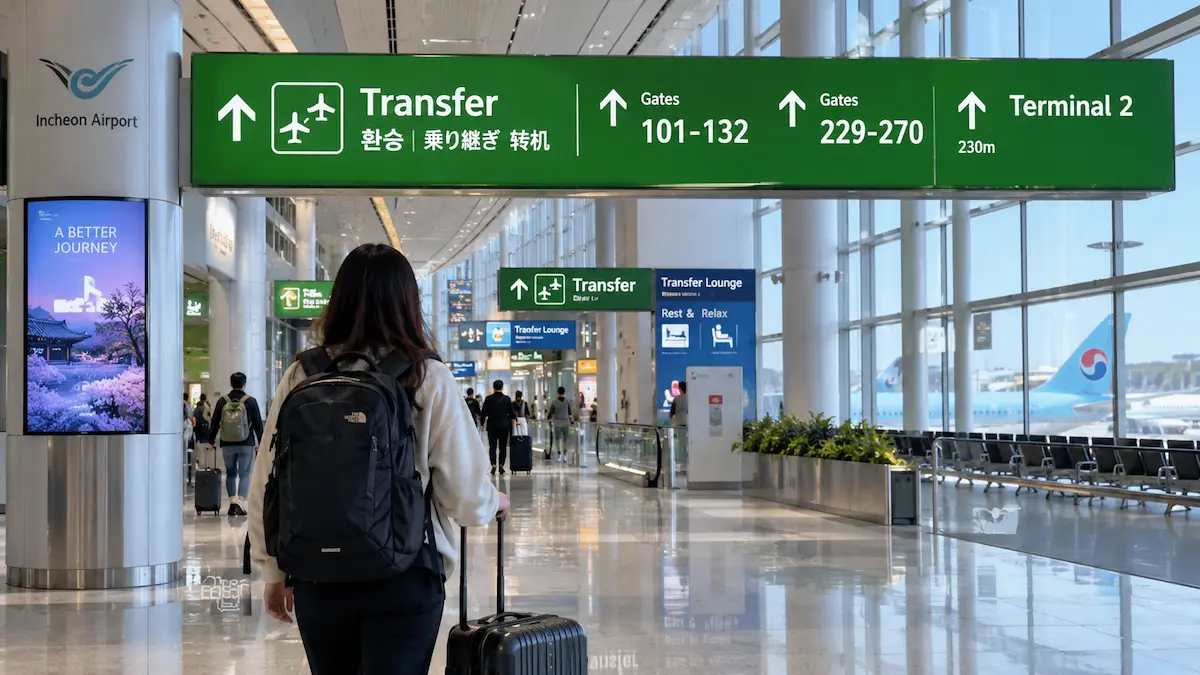
If Incheon Airport is not your final destination, the first thing to decide after landing is simple:
Do I stay inside the airport and follow Transfer signs, or do I need to enter Korea?
For many international-to-international connections, the normal route is:
Arrival gate → follow the green Transfer signs → transfer security → move to the correct terminal or concourse if necessary → check your gate → board your next flight.
If your checked baggage is tagged through to your final destination and your connection allows you to remain airside, you normally do not collect your suitcase or pass Korean immigration.
But this is not true for every itinerary.
If your baggage is not checked through, you are traveling on separate tickets, or your airline tells you to collect and re-check your baggage, you may need to:
enter Korea → collect baggage → pass customs → check in again → pass departure security and immigration → board your next flight.
That difference determines almost everything about your transfer.
Last fact-checked: October 2026.
Incheon Airport Transfer at a Glance
| Your Situation | What You Usually Do |
|---|---|
| International → international, bags checked through | Follow Transfer signs and stay airside |
| Next flight leaves from another terminal | Follow the official transfer route and shuttle-train signs |
| No onward boarding pass | Visit the transfer desk |
| Bags are not checked through | You may need to enter Korea and collect them |
| Separate tickets | Confirm baggage and check-in arrangements with both airlines |
| Long layover, staying airside | Use lounges, rest zones or a transit hotel |
| Want to leave the airport | Check Korean entry eligibility first |
| Want an official Transit Tour | Check the current tour schedule and eligibility |
The simplest rule is:
Do not follow Arrivals automatically just because you landed at Incheon.
If you are connecting internationally and do not need to enter Korea, look for the green Transfer signs.
Before Your First Flight: Check These Three Things
A smooth Incheon transfer starts before you reach Korea.
Ask your airline:
- Is my checked baggage tagged to my final destination?
- Will I receive my boarding pass for the next flight?
- Where does my onward flight depart from?
The baggage question is the most important.
At your original airport, ask clearly:
“Is my baggage checked through to my final destination?”
Then look at the baggage receipt.
The destination airport code on the tag tells you where the airline expects the suitcase to go.
Do not assume your baggage transfers automatically simply because both flights appear in one travel app or confirmation email.
Separate tickets, airline agreements and route-specific procedures can change what happens at Incheon.
Step 1: After Landing, Follow the Green Transfer Signs
If you are staying airside for another international flight, look for:
Transfer / 환승
Incheon Airport uses green signs for transfer passengers.
Do not automatically join the general immigration or arrivals flow.
Your exact path depends on:
- your arrival terminal
- your next departure terminal
- whether you need to use the Concourse
- whether you already have your onward boarding pass
Incheon Airport also provides an official online Transfer Guide where travelers can enter their arriving and departing flight information to see a tailored route.
Step 2: Complete Transfer Security
International transfer passengers normally go through transfer security screening before reaching the departure area for the next flight.
This is separate from the security screening completed at your original airport.
Keep ready:
- passport
- onward boarding pass or booking information
Follow security staff instructions for your carry-on baggage.
After screening, continue following the Transfer signs toward your next terminal or gate.
Step 3: Check Whether You Need Terminal 1, Terminal 2 or the Concourse
Incheon Airport’s international transfer system includes:
- Terminal 1
- Concourse
- Terminal 2
Your next flight may not leave from the same building where you arrived.
This matters because some transfers require an airside shuttle train.
The airport’s current terminal guidance also warns that actual terminals can differ because of codeshare arrangements and airline operations, so check the actual flight rather than relying only on the airline name.
If Your Next Flight Leaves From the Same Terminal
This is usually the simplest connection.
A typical route is:
Arrival gate → Transfer signs → transfer security → departure level → gate
If you do not yet have a boarding pass, use the transfer desk as directed.
If You Need Another Terminal or the Concourse
Follow the airport’s official Transfer signs.
Some routes use the airside shuttle train.
Current Incheon Airport transfer pages show that these shuttle trains generally operate at about five-minute intervals on the relevant routes.
Do not leave the secure area and use the public terminal shuttle simply because your next flight is in another terminal.
If you are a normal airside international transfer passenger, follow the airside transfer route.
Important: Do Not Take a Shuttle Train Just to Explore
This is one of the most important Incheon Airport details.
On several airside transfer routes, the airport specifically warns:
Once you board the shuttle train, you cannot simply return the way you came.
That applies on current transfer routes between the terminals and Concourse.
So before taking a shuttle train:
- Check your next terminal.
- Check your gate.
- Finish anything you specifically want to do in your current area.
Do not board the shuttle train simply to look around another terminal.
What If You Do Not Have Your Next Boarding Pass?
This is common and usually manageable.
Incheon Airport has transfer desks.
The airport states that boarding-pass issuance depends on the airline, but passengers without an onward boarding pass may be able to obtain one at a transfer desk near the gate or transfer route. Transfer-desk locations differ by terminal and whether you are before or after transfer security.
Bring:
- passport
- onward flight details
- booking confirmation
- any documents required by your final destination
If your airline needs to check a visa or other entry requirement for the next country, allow extra time.
What Happens to Your Checked Baggage?
There are two very different situations.
Situation 1: Your Baggage Is Checked Through
If your suitcase is tagged to your final destination, you normally do not collect it at Incheon.
Stay inside the transfer process.
Your route is usually:
Arrival gate → Transfer → transfer security → next gate
Still check the baggage tag at your first airport.
Do not rely only on assumptions.
Situation 2: Your Baggage Is Not Checked Through
If your airline tells you to collect the suitcase at Incheon, your connection may become a landside self-transfer.
The route can be:
Arrival → Korean immigration → baggage claim → customs → departures → airline check-in → baggage drop → security → departure immigration → gate
That means you must also be legally eligible to enter Korea.
This is especially important with separate tickets.
A short connection that looks acceptable for a normal airside transfer may be completely unrealistic if you must collect baggage and check in again.
Do You Need Korean Immigration for a Normal International Transfer?
Usually not if you remain airside.
For a normal international-to-international connection with checked-through baggage, follow Transfer signs instead of Korean immigration.
You may need to enter Korea if:
- your baggage must be collected
- you need to check in landside
- you have a separate-ticket self-transfer requiring entry
- you want to leave the airport
- you book a landside hotel
- you join an activity that requires entering Korea
Whether you are allowed to enter depends on your passport, nationality and current Korean entry rules.
Transit permission and permission to enter Korea are not the same thing.
If you may need to enter Korea, check CoreaDesk’s Korea Entry Requirements and Arrival Checklist before departure.
Separate Tickets: The Most Important Warning
Separate-ticket connections deserve extra caution.
Example:
London → Incheon on Airline A
Incheon → Osaka on Airline B
If Airline A checks your baggage only to Incheon, you may need to enter Korea and repeat the full departure process.
The second airline may also have no obligation to rebook you if the first flight is delayed and you miss the connection.
Before buying a short separate-ticket connection, confirm:
- baggage through-check
- check-in deadline for the second flight
- whether online check-in is enough
- whether you must enter Korea
- whether you meet Korean entry requirements
- how long you realistically need
Do not treat a self-transfer like a normal protected connecting flight.
How Much Connection Time Do You Need?
There is no single number that is safe for every Incheon connection.
A same-terminal airside transfer can be much simpler than:
- T1 → T2
- T2 → T1
- terminal → Concourse
- separate-ticket self-transfer
- baggage collection and re-check
- immigration and customs
If your airline sold both flights as one connection, the itinerary should comply with its connection rules.
But you should still move directly through the transfer process before eating or shopping.
For separate tickets, build in a much larger margin.
If the connection feels tight before you even travel, do not assume Incheon Airport’s efficiency will solve the problem.
Can You Leave Incheon Airport During a Layover?
Potentially, yes.
But once you leave the secure transfer area, you are entering Korea.
That means you may need to:
- Meet Korean entry requirements.
- Pass arrival immigration.
- Pass customs.
- Travel away from the airport.
- Return to the correct terminal.
- Check in if required.
- Pass departure security.
- Complete departure immigration.
- Reach your boarding gate.
So do not judge a layover by its headline length alone.
An eight-hour layover does not mean eight hours in Seoul.
Should You Go Into Seoul During a Layover?
For a short connection, generally stay at the airport.
A longer layover may make a Seoul visit possible, but only after subtracting:
- immigration time
- travel time into Seoul
- travel time back to Incheon
- airport re-entry time
- security
- departure immigration
- walking time to the gate
- a safety margin
If you leave the airport, keep the plan simple.
Choose one area or one activity, not a full Seoul sightseeing itinerary.
The goal should be to enjoy the layover, not spend the whole time watching the clock.
A Practical Way to Decide
Instead of asking:
“Can I go to Seoul with an eight-hour layover?”
Ask:
“How many usable hours will I actually have after entering Korea and allowing enough time to return?”
That answer depends on:
- your passport
- arrival time
- next departure time
- terminal
- baggage
- day of the week
- transport conditions
- immigration and security queues
For first-time visitors, staying inside Incheon Airport is often the safer choice unless the layover is comfortably long.
Incheon Airport Transit Tours
Incheon Airport currently operates official Transit Tours.
The airport states that participants must have a layover of 24 hours or less.
You need:
- passport
- boarding pass for the arriving flight
- boarding pass for the departing flight
Passengers with reservations should arrive at the registration desk at least 30 minutes before the tour starts.
Tour programs can change, and spaces are limited.
The current booking system offers several types of tours, including city, heritage and Incheon-area options depending on date and terminal.
If a tour requires entry into Korea, you must meet Korean immigration requirements.
Do not assume that booking a tour automatically gives you permission to enter the country.
Staying Airside During a Long Layover
Incheon Airport has useful facilities for passengers who stay inside the secure transfer area.
Depending on terminal and location, these include:
- transit hotels
- lounges
- Nap Zones
- Relax Zones
- Cozy Zones
- restaurants
- cafés
- charging areas
- duty-free shopping
Current airport listings show 24-hour airside transit facilities, including the Terminal 1 Transit Hotel near Gate 11, as well as 24-hour Nap and Relax Zones in transfer areas.
Facilities and operating hours can change.
Check your actual terminal before planning around a specific lounge or rest area.
Transit Hotel vs Landside Hotel
This distinction matters.
Transit Hotel
A transit hotel is inside the secure international area.
It is intended for passengers staying airside between international flights.
You do not enter Korea just to use an airside transit hotel.
Landside Hotel
A landside hotel is outside the secure area.
To use it, you generally need to enter Korea.
That means immigration on arrival and normal departure procedures again when you return.
Before booking an airport hotel, always check:
Is it airside or landside?
Do not assume every hotel described as “at Incheon Airport” is available to an airside transfer passenger.
Overnight Layover
An overnight connection does not automatically mean you need to leave the airport.
If your baggage is checked through and you can stay airside, consider:
- a transit hotel
- a lounge
- a Nap Zone
- a Relax Zone
These options avoid immigration and another full airport departure process.
For a transit hotel, book ahead if possible because rooms can sell out.
If you prefer a landside hotel, first confirm that you can legally enter Korea.
Can You Meet Someone During a Layover?
Not in the public arrivals hall while remaining airside.
To meet a friend or family member outside the secure transit zone, you would need to enter Korea.
For a short layover, that is usually not worth the added immigration and departure procedures.
For a long connection, it can be possible if you meet Korean entry requirements and allow enough time.
What If Your Incoming Flight Is Delayed?
If your flights are on one protected itinerary, contact your airline or transfer staff if the connection becomes tight or is missed.
Incheon Airport also provides transfer-guide service desks, and individual passengers can ask for help without advance reservation.
Do not leave the transfer area unnecessarily.
For separate tickets, missed-flight protection may be very different.
The second airline may simply treat you as a no-show.
This is another reason to leave a larger buffer for self-transfers.
Example 1: Normal International Transfer
You fly:
New York → Incheon → Bangkok
Both flights are on one booking, and your suitcase is tagged to Bangkok.
At New York:
- Confirm the baggage tag says Bangkok.
- Get the onward boarding pass if available.
At Incheon:
- Leave the aircraft.
- Follow the green Transfer signs.
- Do not join the general arrivals immigration line.
- Pass transfer security.
- Confirm whether the Bangkok flight is in T1, T2 or the Concourse.
- Take the shuttle train if your route requires it.
- Visit a transfer desk if you still need a boarding pass.
- Find the gate.
- Then eat, shop or rest.
- Return to the gate before boarding.
That is the standard type of Incheon international transfer.
Example 2: Separate-Ticket Self-Transfer
You fly:
London → Incheon
Then separately:
Incheon → Osaka
Your first airline checks the suitcase only to Incheon.
Your route may be:
- Arrive at Incheon.
- Pass Korean immigration.
- Collect your suitcase.
- Pass customs.
- Go to the correct departure terminal.
- Check in with the second airline.
- Check the suitcase again.
- Pass security.
- Pass departure immigration.
- Find the gate.
- Board the next flight.
This is not a normal airside transfer.
You need:
- enough time
- valid Korean entry permission
- enough time to meet the second airline’s check-in deadline
Seven Transfer Mistakes to Avoid
1. Following Arrivals Instead of Transfer
If you are staying airside, follow the green Transfer signs.
2. Assuming Your Baggage Transfers Automatically
Check the baggage tag at your first airport.
3. Assuming Separate Tickets Work Like One Booking
They may not.
4. Taking the Shuttle Train Before Confirming Your Route
Some airside shuttle trips cannot simply be reversed.
5. Shopping Before Finding Your Gate
Gate first.
Shopping second.
6. Leaving the Airport Because the Layover “Sounds Long”
Subtract immigration, transport and return time first.
7. Booking the Wrong Airport Hotel
Check whether it is airside or landside.
Incheon Airport Transfer Checklist
Before your first flight
- Confirm whether baggage is checked through
- Check the baggage tag
- Check whether you have the onward boarding pass
- Check the next flight’s terminal
- Check whether the flights are on one ticket or separate tickets
- Check Korean entry requirements if you may need to leave the airport
After landing at Incheon
- Follow the green Transfer signs
- Complete transfer security
- Get your onward boarding pass if needed
- Confirm T1, T2 or Concourse
- Use the airside shuttle only when required
- Find your gate
- Then use the remaining layover time
For a long layover
- Decide whether to stay airside or enter Korea
- Check immigration eligibility before leaving the secure area
- Consider an airside transit hotel or rest area
- Keep your plan simple if leaving the airport
- Leave a generous return margin
Final Advice
For most international transfer passengers, Incheon Airport is straightforward once you understand the route:
Arrival Gate → Green Transfer Signs → Transfer Security → Correct Terminal → Gate
The two questions that matter most are:
Is my baggage checked through?
Do I need to enter Korea?
If your baggage is checked through and you can stay airside, the process is usually simple.
If you need to collect your baggage or are making a separate-ticket self-transfer, treat the connection as a much more complex trip.
Before your first flight, ask the airline:
“Is my baggage checked through to my final destination?”
Then after landing at Incheon:
look for the green Transfer signs before doing anything else.
Official Information
For current transfer routes and facilities, use the official Incheon International Airport website:
Transfer Guide
https://www.airport.kr/ap_en/1454/subview.do
International Transfer Information
https://www.airport.kr/ap_en/1453/subview.do
Transit Tour Guide
https://www.airport.kr/ap_en/1469/subview.do
Airport Facilities and Rest Areas
https://www.airport.kr/ap_en/1536/subview.do