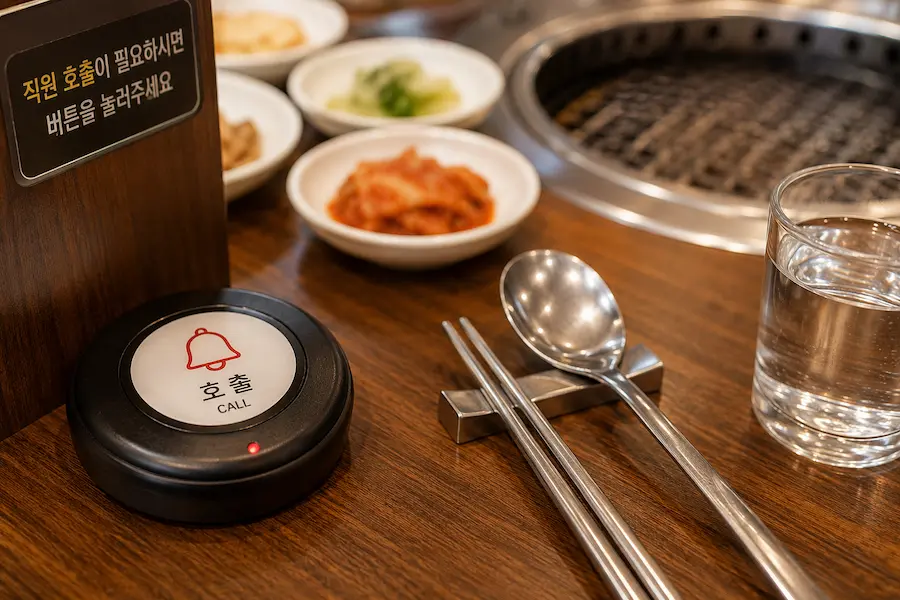
A small button on a restaurant table can be confusing when you do not know what it is for.
A Korean restaurant call button is usually used to let staff know that someone at the table needs assistance. You may find it near the edge of the table, attached to a wall, or included in a table-ordering screen. It might show a bell icon or a Korean label such as 호출, which means “call.”
For many Koreans, the button is such an ordinary part of eating out that it barely attracts attention. When you need help, you press it once and wait for a staff member to come.
I did not think of restaurant call buttons as especially convenient until I ate at restaurants abroad. Waiting to catch a server’s attention was rarely a serious problem, but there were small moments when I thought, “In Korea, I would just press the button.”
That simple convenience becomes even more noticeable in a large restaurant or a private dining room, where staff may not be able to see every table.
Korean Restaurant Call Buttons: Quick Answers
| Question | Quick answer |
|---|---|
| What is the button for? | It usually calls a staff member to your table. |
| Is it rude to press it? | No. Using it once is normal in restaurants that provide one. |
| How many times should I press it? | Press it once and wait briefly. |
| What can I ask for? | Extra orders, utensils, water, side dishes, or help with the meal. |
| What if there is no button? | Make eye contact, raise your hand slightly, or say “Jeogiyo.” |
For a broader guide to ordering, payment, kiosks and table customs, see our Korean Restaurant Guide.
Quick FAQs
What does the button on a Korean restaurant table do?
It usually calls a staff member to the table.
Is it rude to press a restaurant call button in Korea?
No. In restaurants that provide one, pressing it once is a normal way to ask for help.
How many times should I press the call button?
Press it once and wait briefly. If no one comes after a reasonable time, you can try again.
What should I do if there is no call button?
Make eye contact, raise your hand slightly, or say “Jeogiyo” to get a staff member’s attention.
What Is a Korean Restaurant Call Button Used For?
The button lets the staff know that someone at the table needs assistance.
You might use it to:
- order more food or drinks
- ask for a spoon, chopsticks, cup, or small plate
- check on an item that has not arrived
- request more side dishes
- ask for help with a barbecue grill
- ask about packing leftovers
- check where or how to pay
Its exact function depends on the restaurant.
Some places have one button that simply calls a staff member. Others may have separate options for water, payment, additional orders, or grill replacement. A table-ordering screen may also include a staff-call function.
When several buttons appear together, check the label or icon before choosing one.
Is It Rude to Press the Button?
No. When a restaurant provides a call button, using it is a normal way to ask for service.
It is not a signal that the customer is angry or impatient. It only tells the staff which table needs attention.
Press it once, then wait.
A staff member may be taking another order, carrying food, or working in a different part of the restaurant. Pressing the button several times within a few seconds will not necessarily bring someone faster.
Some buttons make a sound or light up when pressed. Others send the signal quietly to a staff screen or receiver. Even if you do not hear anything, the call may still have been received.
When no one comes after a reasonable wait, you can press it once more or get the attention of a nearby staff member.
When Should You Use It?
When You Want to Order More Food
Additional orders are common during a Korean meal.
At a barbecue restaurant, you may want another portion of meat, rice, noodles, stew, or drinks. If there is no table-ordering screen, the call button is often the easiest way to place another order.
Some restaurants take the first order through a kiosk but accept additional orders at the table. Check the instructions before assuming that every order must be made in the same way.
When Something Is Missing
You can call the staff if you need a spoon, chopsticks, cup, plate, or another basic item.
Before pressing the button, look around the table. Many Korean restaurants keep spoons and chopsticks in a shallow drawer under the tabletop. Napkins, bottle openers, or small plates may also be stored nearby.
Water and extra side dishes may be available at a self-service station. Look for the Korean word 셀프, meaning “self-service,” or check whether other diners are collecting the items themselves.
When You Need Help With the Meal
The button is also useful when something requires staff assistance.
At a Korean barbecue restaurant, staff may help light the grill, adjust the heat, or replace a used grill plate. Because the plate can be extremely hot, it is safer to call a staff member than to move it yourself.
You can also use the button if an order appears to be missing or you need to ask a question about the food.
For allergies or dietary restrictions, explain the concern clearly and confirm the ingredients with the staff. Do not assume that a dish is suitable based only on its appearance.
Why Call Buttons Are Useful in Large Restaurants
The value of the button becomes clearer in a large dining space.
Some Korean restaurants have wide halls with many tables. Others are divided by walls, partitions, or long corridors. In these settings, staff cannot continuously see every customer.
Without a call button, diners may have to wait for someone to walk past, leave the table to find a staff member, or call across the room.
The button gives customers a quieter and more direct way to ask for help. When it is pressed, the restaurant usually receives the table number, allowing a staff member to identify where the request came from.
This can be especially practical in large barbecue restaurants, family dining spaces, and restaurants that frequently serve groups.
Why Private Dining Rooms Make the Button Even More Helpful
Some Korean restaurants have private or semi-private rooms for family meals, group gatherings, and business dinners.
Once the door is closed, staff may not know whether the table needs another dish, a drink, or help with the meal. Guests may also be unable to see anyone in the hallway.
In that setting, the call button removes the need to open the door, leave the room, or wait for a staff member to check in.
As a Korean diner, I used these buttons for years without thinking about them. They were simply part of the restaurant.
But when I imagine a large restaurant or private room without one, the inconvenience becomes obvious. Sometimes the usefulness of an everyday object is easiest to understand when it is no longer there.
What If There Is No Call Button?
Not every Korean restaurant has one.
Small restaurants, counter-service businesses, cafés, food courts, and takeout-focused places may use different systems. Staff may already be close to the tables, or customers may be expected to order and collect what they need at a counter.
When there is no button, make eye contact with a staff member and raise your hand slightly.
You can also say:
Jeogiyo — 저기요
This is a general way to say “Excuse me” when you need someone’s attention.
Yeogiyo — 여기요
This means “Over here” and is also commonly heard in restaurants.
You may hear Koreans use other forms of address in familiar local restaurants, but visitors do not need to copy every expression. “Jeogiyo” is a simple and neutral choice in most situations.
There is usually no need to shout. Say it clearly when a staff member is nearby.
Call Buttons, Kiosks, and Table Screens May Be Used Together
Korean restaurants do not all follow one service system.
A restaurant might use:
- a kiosk for the first order
- a table screen for extra dishes
- a call button for questions
- a self-service station for water and side dishes
- a front counter for payment
This combination may feel confusing at first.
A call button does not always mean that staff take every order at the table. A table screen does not mean that customers can never ask a staff member for help.
Look for instructions on the menu, wall, table, or ordering screen. When the system is unclear, calling a staff member and asking is completely reasonable.
For more help with self-ordering machines, see our Korean Restaurant Kiosk guide.
What Happens After You Press the Button?
The process varies, but it is usually simple.
- Press the button once.
- A sound, light, or message may confirm the call.
- The table number is sent to the staff.
- A staff member comes when available.
- Make your request.
You do not need to explain everything before the staff member arrives. The button only signals that the table needs assistance.
Useful Korean Requests
A few short phrases can make the interaction easier.
- Mul juseyo — 물 주세요
Water, please. - Apjeopsi juseyo — 앞접시 주세요
A small plate, please. - Sutgarak juseyo — 숟가락 주세요
A spoon, please. - Igeo hana deo juseyo — 이거 하나 더 주세요
One more of this, please. - Bulpan bakkwo juseyo — 불판 바꿔 주세요
Please change the grill plate.
Pointing to an item on the menu can also help when placing an additional order.
For more short phrases you can use during a trip, see our Simple Korean Phrases guide.
A Small Convenience That Is Easy to Miss
Restaurant call buttons do not replace every conversation with the staff. They are not found in every restaurant, and pressing one does not mean that service will be immediate.
Their purpose is much simpler. They give customers a clear way to let the restaurant know that a table needs help.
For a visitor, the button may seem unfamiliar at first. For many Koreans, it is simply part of the dining environment.
Press it once, wait for a staff member, and check whether water, utensils, or side dishes are self-service before asking.
Once you know what the button does, there is no reason to hesitate. It is there to be used.
For more practical guides to Korean restaurants, ordering and dining, return to our Food & Drink guide.