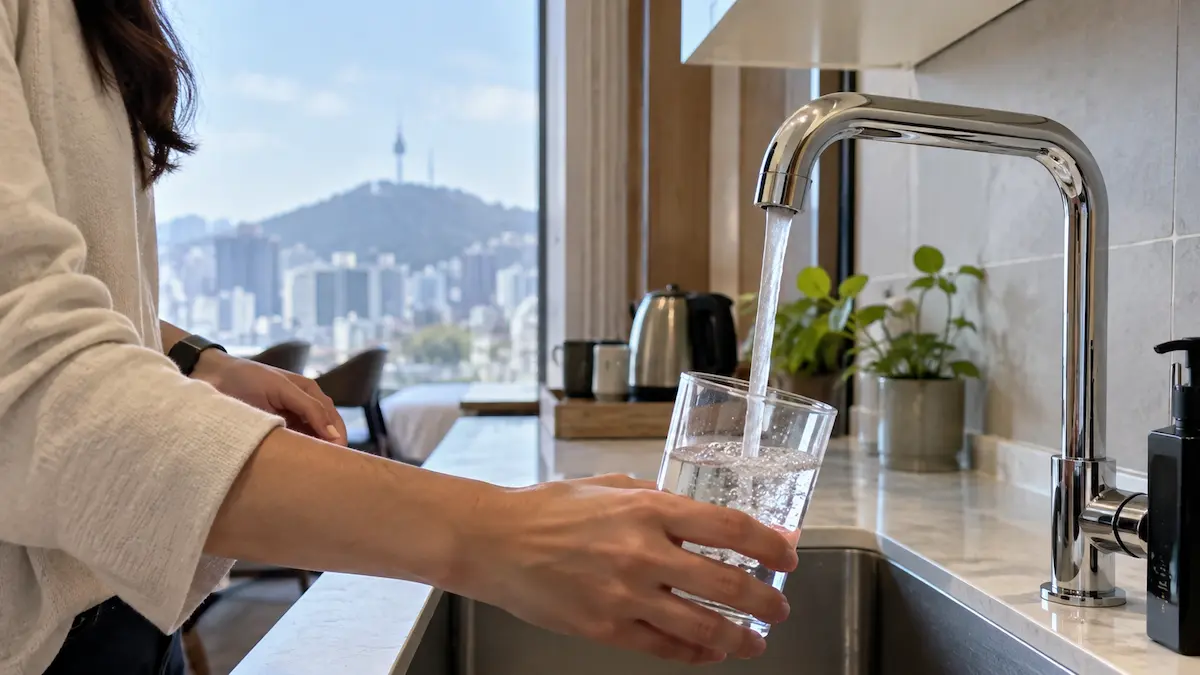
Can you drink tap water in Korea?
For most travelers, the practical answer is:
Korea’s public water supply is produced under national drinking-water quality standards, and Seoul officially states that its tap water, called Arisu, is safe to drink.
However, the condition of water at the final tap can also depend on the building’s internal pipes, water tank and maintenance.
So if you are staying in an older building or the water has an unusual color, smell or taste, do not simply ignore it.
For ordinary travel situations, you can generally use tap water for:
- brushing your teeth
- washing your face
- showering
- washing fruit or utensils
- boiling water
Drinking directly from the tap is a personal choice, but you do not need to treat Korean tap water as inherently unsafe.
Last fact-checked: October 2026.
Tap Water in Korea: Quick Answer
| Question | Practical Answer |
|---|---|
| Is tap water in Korea treated as drinking water? | Yes. Public water supplied for drinking must meet national water-quality standards. |
| Is Seoul tap water safe to drink? | Seoul Water officially states that Arisu is safe drinking water. |
| Can I brush my teeth with tap water? | Yes, under normal conditions. |
| Can I boil tap water for tea or coffee? | Yes. |
| Is hotel tap water always identical in quality? | Not necessarily. Building pipes and tanks can affect water at the final tap. |
| Should I drink water that looks or smells unusual? | No. Ask the hotel or use another water source. |
| Do I need bottled water for the entire trip? | No, not purely because you are in Korea. |
The most useful distinction is:
The municipal water supply and the condition of a particular building’s plumbing are not exactly the same question.
Is Tap Water in Korea Legally Regulated?
Yes.
Korea’s Water Supply and Waterworks Installation Act requires water supplied through public water systems for drinking purposes to meet drinking-water quality standards.
The law prohibits drinking water supplied through waterworks from containing:
- pathogenic microorganisms
- harmful inorganic or organic substances
- substances that can adversely affect water quality
- other materials harmful to health
Detailed drinking-water standards are established separately under Korea’s drinking-water regulations.
Official legal reference:
This means public tap water in Korea is not simply untreated utility water.
It is produced and monitored as drinking water.
What About Tap Water in Seoul?
Seoul’s tap water is called Arisu.
The Seoul Metropolitan Government states directly that Arisu is safe drinking water and that it undergoes extensive water-quality monitoring.
Official Seoul Water information:
Seoul also publishes local and tap-level water-quality test results.
The city currently conducts regular testing at purification facilities and taps throughout Seoul and provides neighborhood water-quality information to residents.
For travelers, the simple takeaway is:
Seoul’s municipal tap water itself is officially considered drinkable.
Then Why Do Many Koreans Use Filters or Bottled Water?
This is where visitors can become confused.
Seeing bottled water or water purifiers everywhere does not automatically mean Korean tap water is unsafe.
People may prefer:
- filtered water
- refrigerator water
- bottled water
- boiled water
for many reasons, including:
- taste
- habit
- concern about older building pipes
- concern about water tanks
- convenience
- preference for chilled water
Even Seoul’s official water service recognizes that some people trust water leaving the treatment plant but worry about indoor water pipes and water tanks.
For that reason, Seoul operates a household water-quality verification service that checks factors including:
- residual chlorine
- turbidity
- pH
- iron
- copper
Official information:
So the practical question is often not:
“Is Korean tap water safe?”
It is:
“What is the condition of the plumbing in this particular building?”
Can You Drink Tap Water in a Korean Hotel?
Usually, the municipal water entering a hotel comes from the same regulated public supply used elsewhere in the area.
But hotels differ in:
- building age
- internal plumbing
- water tanks
- maintenance systems
A modern hotel may have no obvious issue at all.
An older guesthouse or building may have pipes that affect:
- taste
- smell
- color
If you are unsure, ask reception.
A useful question is:
Is the tap water safe to drink?
You can also ask:
Can I drink the water from the bathroom tap?
Do not feel awkward asking.
What If the Hotel Provides Bottled Water?
Many Korean hotels provide bottled water or a water dispenser.
That does not necessarily mean the tap water is unsafe.
The bottled water may simply be:
- a guest amenity
- more convenient
- preferred for drinking
- easier to chill
Some hotels provide bottles in the refrigerator.
Others use hallway water dispensers.
Smaller guesthouses may have a shared purifier.
Use whichever option you prefer.
For broader accommodation guidance, see CoreaDesk’s Start Here guide.
Can You Brush Your Teeth With Tap Water in Korea?
Yes, under normal conditions.
There is generally no reason for an ordinary traveler to use bottled water for brushing teeth simply because they are in South Korea.
You can also normally use tap water for:
- washing your face
- showering
- rinsing your mouth
- washing dishes
- washing fruit
If water from a particular tap appears cloudy, rusty or unusually colored, treat that as a building-specific problem, not as normal Korean tap water.
Ask the accommodation before using it.
Can You Boil Tap Water for Tea or Coffee?
Yes.
Using tap water in a kettle for:
- tea
- coffee
- instant noodles
- cooking
is generally reasonable under normal conditions.
Boiling may change taste, but remember:
Boiling does not solve every possible plumbing or contamination problem.
If the water looks or smells clearly abnormal, do not assume boiling will make it acceptable.
Use another water source and notify the accommodation.
Is the Chlorine Smell Normal?
Korean municipal water is disinfected.
A light chlorine smell can sometimes be noticeable, particularly depending on:
- location
- season
- building
- water temperature
This does not automatically mean the water is unsafe.
If taste is the main issue, Seoul Water recommends simple methods such as chilling tap water before drinking.
Official Seoul Water information:
However, a strong or unusual chemical smell should not simply be dismissed.
If something seems wrong, ask the hotel or building manager.
What About Rust-Colored or Cloudy Water?
Do not drink obviously discolored water.
Possible building-related causes can include:
- old internal pipes
- maintenance work
- temporary building plumbing issues
- water-tank problems
If the water is:
- brown
- rusty
- strongly cloudy
- carrying visible particles
- unusually smelly
stop using that tap for drinking and contact the accommodation.
Do not assume this is normal because you are overseas.
What About Restaurant Water?
Water served at Korean restaurants is commonly provided through:
- a water bottle on the table
- a water purifier
- a dispenser
- a self-service station
It is usually provided free with the meal.
If nobody brings water to your table, the restaurant may use a self-service system.
Look for:
물은 셀프입니다
which means:
Water is self-service.
CoreaDesk’s Self-Service in Korean Restaurants guide explains how water dispensers, side-dish refills and self-service areas commonly work.
Can You Drink Water From Public Fountains?
Seoul operates Arisu drinking fountains in locations including:
- schools
- public facilities
- major parks
The Seoul Water service states that Arisu drinking fountains provide safe drinking water.
Official information:
Use designated drinking fountains rather than assuming every public tap is intended for drinking.
What About Ice in Korean Restaurants and Cafés?
Commercial restaurants and cafés routinely serve ice in drinks.
For an ordinary traveler, there is no general reason to avoid ice simply because you are in Korea.
As anywhere, basic hygiene depends on the individual establishment.
If a restaurant or café looks poorly maintained, that is a business-specific judgment rather than a Korea-wide water issue.
Should You Buy Bottled Water in Korea?
You can, but you do not need to carry bottled water everywhere because the national tap-water system is unsafe.
Bottled water is easy to buy at:
- convenience stores
- supermarkets
- vending machines
- stations
It may be useful when:
- sightseeing all day
- hiking
- taking long train or bus journeys
- you dislike the taste of tap water
- your accommodation has questionable plumbing
- you simply prefer bottled water
This is a convenience decision, not automatically a safety requirement.
Can You Refill Your Own Bottle?
Yes, when you have access to a suitable drinking-water source.
Possible refill options include:
- hotel water dispensers
- designated drinking fountains
- restaurant dispensers where appropriate
- your accommodation’s kitchen tap if you are comfortable with the building
Do not refill from taps clearly marked as non-drinking water.
Seoul Water Quality Is Publicly Checkable
One unusual advantage in Seoul is that water-quality information is publicly available.
Seoul Water provides:
- neighborhood water-quality information
- purification-center testing
- tap-water testing
- household water-quality inspections
The city’s current 2026 records include regular monthly tap-water testing.
Official water-quality information:
This does not mean a traveler needs to check laboratory results before brushing their teeth.
It simply provides useful reassurance that the public supply is actively monitored.
What If You Have a Sensitive Stomach?
Travelers sometimes blame water for any stomach problem during a trip.
But gastrointestinal symptoms can also come from:
- unfamiliar food
- overeating
- alcohol
- travel stress
- viral illness
- food contamination
- other causes
If you personally feel more comfortable using bottled or filtered water, that is perfectly reasonable.
But do not assume that drinking tap water in Korea automatically causes illness.
If you develop significant symptoms, use appropriate medical care rather than trying to diagnose the cause from the water alone.
What If You Are Traveling Outside Seoul?
The name Arisu applies specifically to Seoul’s municipal tap water.
Other Korean cities operate their own water systems.
Korea’s national Water Supply and Waterworks Installation Act applies drinking-water quality standards to water supplied for drinking through public waterworks.
However, the condition at the final tap can still vary by:
- building
- pipes
- water tanks
- maintenance
So the same practical rule applies outside Seoul:
The municipal supply may meet drinking-water standards, but pay attention to the condition of the actual tap you are using.
If something seems abnormal, ask the accommodation or use another water source.
A Practical Hotel Decision
You arrive at a Seoul hotel.
The bathroom tap runs clear.
There is no unusual smell.
The hotel looks well maintained.
In this situation, there is no general Korea-specific reason why you would need bottled water simply to:
- brush your teeth
- wash your face
- boil water
If you prefer bottled or filtered water for drinking, use it.
Now imagine the tap runs brown for several seconds.
That is different.
Do not drink it.
Contact reception and ask whether there has been:
- plumbing maintenance
- water-tank cleaning
- another temporary problem
The decision should be based on the actual water and building—not fear of Korean tap water in general.
First-Time Traveler Mistakes to Avoid
1. Assuming Tap Water in Korea Is Unsafe
Korea regulates public drinking-water quality, and Seoul explicitly identifies Arisu as safe drinking water.
2. Assuming Every Building Tap Is Automatically Perfect
Internal pipes and tanks can affect water after it enters a building.
3. Using Bottled Water Just to Brush Your Teeth
This is normally unnecessary.
4. Drinking Obviously Discolored Water
A visibly abnormal tap should be checked.
5. Assuming Restaurant Water Must Be Bottled
Many restaurants use water purifiers or dispensers.
6. Thinking Self-Service Water Means Poor Service
It is simply a common restaurant system.
7. Treating Bottled Water Use as Proof That Tap Water Is Unsafe
Preference and safety are not the same thing.
Tap Water in Korea Checklist
Normally Fine
- brushing teeth
- washing face
- showering
- washing dishes
- boiling water
- cooking
- drinking from a clean, normal tap if you are comfortable doing so
Check First
- older accommodation
- unusual smell
- rusty color
- visible particles
- recent building maintenance
- questionable water-tank condition
Use Another Water Source
- clearly discolored water
- strong unusual smell
- accommodation staff advises against drinking
- tap is marked as non-potable
Final Advice
So, can you drink tap water in Korea?
The public water supply is regulated as drinking water, and Seoul officially states that its Arisu tap water is safe to drink.
For travelers, the practical distinction is this:
Water-system quality and building plumbing are two different things.
You do not need bottled water simply to brush your teeth or boil a kettle.
If a normal hotel tap runs clear and has no unusual smell or appearance, ordinary use should not be a concern.
If a particular building’s water looks or smells wrong, do not guess.
Ask the accommodation and use another drinking source until the issue is clear.
For more everyday Korea travel basics, return to CoreaDesk’s Start Here guide.
Official Information
Seoul Water — Arisu
https://arisu.seoul.go.kr/eng/
Seoul Water — Merits of Arisu
https://arisu.seoul.go.kr/eng/sub?menukey=8008
Seoul Water — Drinking Fountains
https://arisu.seoul.go.kr/eng/sub?menukey=8010
Seoul Water — Water Quality Verification System
https://arisu.seoul.go.kr/eng/sub?menukey=8023
Korea Water Supply and Waterworks Installation Act — Water Quality Standards
https://www.law.go.kr/LSW/lsLinkCommonInfo.do?chrClsCd=010202&lsJoLnkSeq=1029747449