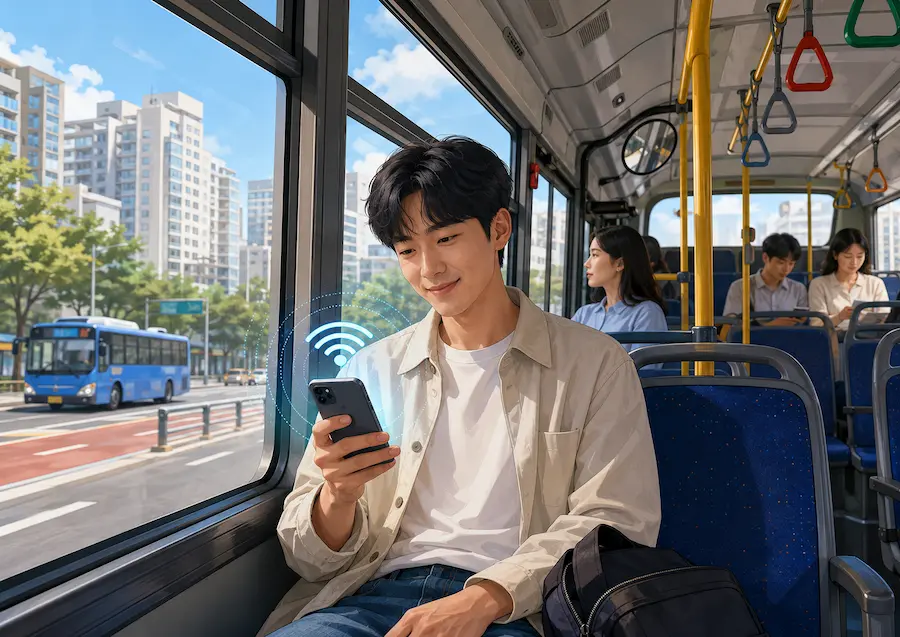
Public Wi-Fi on Korean city buses is easy to overlook.
For many adults, a bus ride is still just a bus ride. You check the route, tap your transport card, find a seat if you are lucky, and look out the window or use your own mobile data.
But younger passengers may notice something else first.
I personally do not usually search for bus Wi-Fi when I get on a bus in Korea. I normally just use my phone as usual. But my middle-school-aged nephew tends to look for Wi-Fi when he rides a bus. For him, checking the connection is part of the ride.
That small difference says a lot about how public transport is changing.
If you are new to Koreanpublic transport, it also helps to understand how Korean transport cards work before using buses or subways.
In Korea, buses are not only moving people from one stop to another. They are also becoming part of the country’s everyday digital infrastructure.
What Is Changing?
Recent Korean news coverage has reported that public Wi-Fi on city buses is expected to be upgraded with 5G-based equipment.
The reported plan would cover about 33,000 city buses nationwide, with rollout expected from September.
This matters because public Wi-Fi use on buses has grown as more passengers use their phones during commutes, school rides, transfers, and short everyday trips.
But it is important to understand the upgrade carefully.
It does not mean every passenger will immediately experience perfect high-speed internet on every bus at all times. Public Wi-Fi quality can still depend on the bus, region, network conditions, number of passengers, and the user’s device.
A better way to understand the change is this:
Korea is modernizing the public Wi-Fi system on buses so it can better support how people already use public transport today.
Why Bus Wi-Fi Matters in Korea
Korea is often described as a highly connected country. That is usually true, but the everyday experience is more specific than that.
Connectivity in Korea is not only about having fast internet at home or strong mobile networks. It also appears in small public spaces:
subway stations, libraries, public buildings, parks, and buses.
For travelers and international residents, this can be helpful. Public Wi-Fi can make it easier to check a map, confirm a bus stop, message someone, translate a sign, or look up a destination during a ride.
For local students, commuters, and older passengers, it can also reduce dependence on mobile data.
This is why bus Wi-Fi matters. It is not just a luxury feature. It is part of how public services and digital convenience overlap in daily Korean life.
What Travelers Should Know
If you are visiting Korea, you may see public Wi-Fi networks on buses.
The exact network name, connection method, speed, and stability may differ depending on the region, bus operator, vehicle, and passenger volume.
On some buses, the Wi-Fi may feel useful. On others, your own mobile data may still be more stable.
So it is best to treat bus Wi-Fi as a helpful option, not something to fully depend on.
If you need to navigate to an unfamiliar place, save the destination, map route, or address before you board. Bus stops in Korea can also be confusing at first, especially in Seoul, where roadside stops, median bus stops, village bus stops, and transfer points may look different. Bus Wi-Fi can help, but it should not be your only plan.
Is Public Wi-Fi Safe to Use?
Public Wi-Fi is convenient, but it should be used carefully.
This is not only true in Korea. It applies anywhere.
When using public Wi-Fi on a bus, it is better to avoid sensitive activity such as online banking, entering important passwords, or handling private documents.
For simple tasks like checking maps, reading general information, or sending casual messages, public Wi-Fi can be useful.
For anything sensitive, mobile data or a trusted secure connection is safer.
Why This Upgrade Says Something About Korea
The interesting part is not only the technology itself.
The more interesting part is what the upgrade shows about everyday expectations.
In Korea, convenience often becomes normal very quickly.
At first, public Wi-Fi on a bus may feel like an extra service. After a while, some passengers begin to expect it. Younger users especially may treat it as a normal part of public transport.
This is similar to many other parts of Korean daily life.
A service starts as a convenience.
Then people get used to it.
Then it becomes part of the background.
Bus Wi-Fi is one small example of that pattern.
A Small Detail With a Bigger Meaning
A visitor may not notice bus Wi-Fi at first.
They may be more focused on finding the right bus stop, checking the route number, or making sure they get off at the right place.
But for many people living in Korea, especially younger riders, the digital layer of public transport is part of the experience.
The bus is not only a vehicle.
It is a moving public space where people watch videos, message friends, study, search, and navigate.
Upgrading public Wi-Fi is not just about speed. It is about keeping public transport aligned with how people actually use their time while moving through the city.
Final Thoughts
Korea’s city bus public Wi-Fi upgrade may sound like a small technical change.
But it reflects a larger part of Korean daily life: public transport, digital access, and convenience are closely connected.
Not every passenger will use bus Wi-Fi. Not every ride will depend on it. But for students, commuters, travelers, and people trying to save mobile data, a better public Wi-Fi system can make everyday movement a little easier.
In Korea, convenience is often built into small details.
Sometimes, it is a bus arriving on time.
Sometimes, it is a transport card that works across systems.
And sometimes, it is a Wi-Fi signal quietly following you through the city.