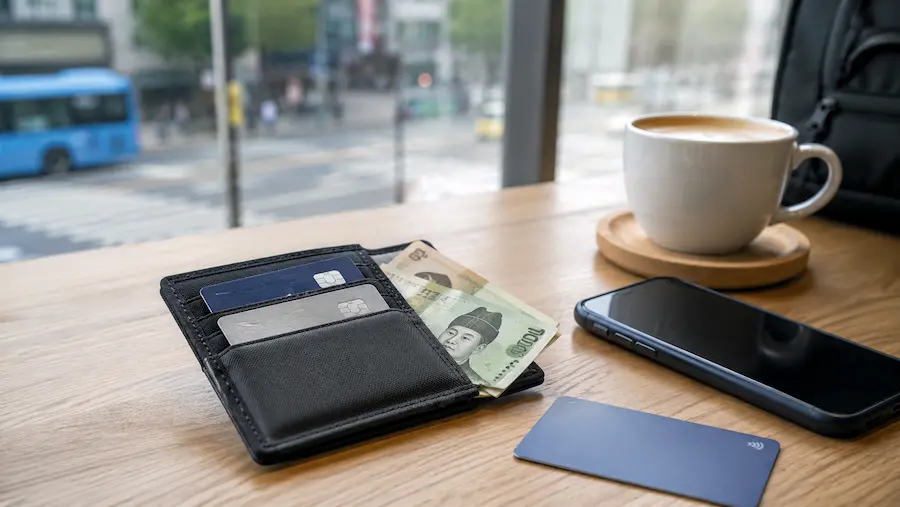
For nearly ten years, I have carried a small cardholder rather than a traditional wallet.
Most days, I leave home with one or two cards and very little cash. Many of my friends do the same. I still keep a few 1,000-won notes and perhaps one or two 10,000-won notes folded inside the cardholder, just in case I come across a place that needs cash.
Those notes are used so rarely that their corners sometimes begin to look worn simply from staying in the wallet for too long.
This does not mean that cash has disappeared from Korea. It means that, in my own daily life, cash has become a backup rather than the first way I expect to pay.
For a visitor, however, the situation needs a little more explanation. Korean residents can use locally issued cards, bank transfers and domestic mobile payment services. A short-term visitor may be relying on one overseas card without access to those alternatives.
Most travelers can pay by card for much of their trip. Still, it is sensible to carry a small amount of Korean won for places or machines where an overseas card may not work.
Is Korea a Cashless Country?
Korea is highly card-oriented, but calling it completely cashless would be misleading.
Cards are commonly used at convenience stores, cafés, restaurants, hotels, department stores, supermarkets and many tourist attractions. Paying for a small purchase by card is normal. Staff members are unlikely to find it unusual if a customer uses a card for a bottle of water or a single cup of coffee.
This everyday impression is also reflected in national payment data. According to the Bank of Korea’s report on payment and settlement trends in 2025, the daily average value of card payments reached 3.6 trillion won, an increase of 4.7 percent from the previous year. Payments made through mobile devices without presenting a physical card also continued to increase.
These figures show how established card and digital payments have become. They do not, however, guarantee that every foreign-issued card will work at every Korean payment terminal.
That distinction matters.
A Korean customer using a locally issued card and a visitor using an overseas card may stand at the same counter but have different payment options.
Where Can Visitors Usually Pay by Card?
The Korea Tourism Organization states that major international cards, including Visa, Mastercard, JCB, American Express and UnionPay, can be used at most Korean stores.
In practical terms, visitors can generally expect card payment to be available in the following places.
| Place | What visitors can generally expect | What to check |
|---|---|---|
| Convenience stores | Card payment is standard | An overseas card can still fail because of the card or terminal |
| Cafés and chain restaurants | Cards are widely accepted | A self-order kiosk may not accept every overseas card |
| Hotels | Major international cards are commonly accepted | Check deposits, pre-authorisation and overseas payment settings |
| Department stores and supermarkets | Card payment is standard | Your own card issuer may charge foreign transaction fees |
| Taxis | Card terminals are widely used | Keep another payment option available |
| Tourist attractions | Many staffed ticket counters accept cards | Older or specialised machines may have different options |
| Traditional markets | Many permanent shops accept cards | Acceptance varies by individual stall |
| Small or temporary street stalls | Payment methods vary | Some may prefer or require cash |
This table describes the general environment, not a promise that a particular card will be accepted.
A Visa or Mastercard logo on a card does not remove every possible problem. The card may have overseas payments disabled, the transaction may be blocked by the issuing bank, or the individual terminal may not process that card successfully.
When Is Cash Still Useful in Korea?
Most visitors do not need to pay for their entire trip in cash. A small backup amount, however, can solve several ordinary problems.
At Some Market Stalls and Small Vendors
Traditional markets are not universally cash-only.
Many established market shops accept cards, particularly in large and well-known markets. Payment conditions can still vary from one seller to another. A permanent shop selling clothing or household goods may accept cards, while a small food stall or temporary vendor nearby may have fewer options.
I do not visit traditional markets regularly. There is no market close to my home, and visiting one usually requires a separate trip. On weekdays, it is not a realistic part of my routine.
I am more likely to stop by a market while traveling in another region or when spending time with older family members. On those occasions, I may bring cash intentionally, especially if I plan to buy snacks from small stalls. That is a personal habit rather than a rule that applies to every Korean market.
Visitors interested in this side of Korean food culture can also read Seoul After Dark: Pojangmacha, Gwangjang Market, and Korea’s Late-Night Street Food Culture.
When an Overseas Card Does Not Work
A business does not have to be cash-only for cash to become useful.
A card payment may fail because of the settings on the card, a temporary approval problem or the type of payment terminal. At a staffed counter, an employee may be able to try the card again or use another terminal. At an unattended kiosk, there may be fewer ways to solve the problem.
This is one reason a second card and a small amount of cash are more useful than relying on a single payment method.
For Some Small On-Site Services
I still keep cash for unexpected situations such as a valet service that asks for a separate fee. This is not a nationwide rule, and many valet services use other payment methods. It is simply one of the few situations that reminds me why I still carry a few notes.
Payment methods for small on-site services can depend on the operator, location and equipment available.
At Older Machines or Small Self-Service Facilities
Some older vending machines, lockers, laundries or other self-service equipment may require cash or coins. Many newer machines accept cards or mobile payments, so visitors should check the instructions on the individual machine rather than assuming one system applies everywhere.
How Much Cash Should You Bring?
There is no official amount that every traveler should carry.
Your needs will depend on where you are going, how long you are staying and whether you plan to visit markets, smaller towns or businesses with limited payment equipment.
For a short stay in a major city, some travelers may find that 20,000 to 50,000 won in backup cash is enough. This is only a practical example, not a required amount.
A few smaller notes are usually more useful than carrying only a 50,000-won note. A simple mix could include:
- several 1,000-won notes;
- one or two 5,000-won notes;
- one or two 10,000-won notes.
There is usually no need to exchange the entire travel budget into cash before arriving. Most routine spending can be handled by card, while cash remains available for exceptions.
Will a Foreign Credit or Debit Card Work?
Major international credit and debit cards are widely accepted in Korea, particularly in hotels, shopping centres, convenience stores, chain restaurants and tourist areas.
Before traveling, check that:
- overseas in-person payments are enabled;
- your card can be used at overseas ATMs;
- you know the foreign transaction and withdrawal fees;
- your daily payment and withdrawal limits are suitable;
- you can access the card issuer’s app while abroad;
- you know how to report a lost or blocked card.
Bringing two cards is safer than depending on one. Ideally, they should not both depend on the same account or issuing bank.
Debit cards can work for everyday purchases, but hotels and other businesses that place temporary holds may be easier to manage with a credit card. The exact conditions depend on the business and the card issuer, so travelers should check before relying on a debit card for deposits.
What Should You Do If Your Card Is Declined?
A declined payment does not necessarily mean that the store refuses all foreign cards.
Try the following steps.
- Ask the employee to try the card again.
- Insert the card rather than using contactless payment, or follow the terminal instructions.
- Move from the kiosk to a staffed counter if one is available.
- Try a second card.
- Check your card issuer’s app for a security block or overseas payment restriction.
- Ask whether cash is accepted.
- Use a global ATM if you need Korean won.
At a restaurant or shop, these short Korean phrases may help.
| Korean | Pronunciation | Meaning |
|---|---|---|
| 이 카드 돼요? | I kadeu dwaeyo? | Does this card work? |
| 다른 카드로 할게요. | Dareun kadeuro halgeyo. | I’ll use another card. |
| 현금만 돼요? | Hyeongeumman dwaeyo? | Is it cash only? |
| 현금으로 낼게요. | Hyeongeumeuro naelgeyo. | I’ll pay in cash. |
For more everyday expressions, see Simple Korean Phrases for Travel in Korea.
Can Travelers Use Korean Mobile Payment Apps?
Mobile payment is part of daily life for many Korean residents, but not every Korean payment service is practical for a short-term visitor.
Services built around a Korean bank account, Korean phone number or locally issued card may require domestic registration. A resident may solve a payment problem by making an instant bank transfer, but most short-term visitors cannot assume that option will be available.
I have seen this difference at markets and small food stalls. When a Korean customer has no cash, a seller may provide a bank account number and the customer can transfer the money immediately through a banking app. Services such as mobile banking are so familiar that this may feel almost as easy as paying by card.
For a visitor without a Korean bank account, it is not a reliable backup plan.
Some Korean businesses accept international QR or mobile payment services, but availability depends on the store and service. Do not assume that a mobile wallet accepted at home will automatically work at every Korean contactless terminal.
For most visitors, an overseas-enabled physical card, a second backup card and a small amount of Korean cash remain the simplest combination.
Why Do Some Places Accept Cards Only?
Although card use is already normal in Korea, I am still slightly surprised when I see a card-only sign.
It does not usually cause a problem for me because I was probably planning to use a card anyway. I still find myself wondering why a business needs to exclude cash completely.
There is no single national reason for card-only operation. It is usually a decision made by the individual business.
A shop may choose card-only payment to reduce the need to store cash, prepare change or manually match cash sales with its records. It may also fit a kiosk-based or minimally staffed operation. These are possible operational reasons, not an explanation that applies to every card-only business.
Visitors should also remember that “card only” does not always mean “every foreign card accepted.” A shop may operate without cash but still use a payment system that does not work with a particular overseas card.
What About Subway Tickets and Transportation Cards?
General payment cards and Korean transportation cards are not always interchangeable.
A transportation card is normally used for buses and subways and follows its own purchase, recharge and transfer rules. Read How Korean Transportation Cards and Transfer Rules Work before choosing a card or pass.
Payment options at Seoul subway stations have also changed.
From March 17, 2026, the Seoul Metropolitan Government introduced overseas credit and debit card payments at 440 new ticket machines across 273 stations on Seoul Subway Lines 1 through 8. These machines allow visitors to buy single-journey tickets and purchase or recharge short-term Climate Card passes using supported overseas cards.
The change does not mean that every transport machine throughout Korea now follows the same system. The machines covered are specific new machines in the announced Seoul subway network. A service fee averaging 3.7 percent is also charged when an overseas-issued card is used for these purchases.
The current details are available in the Seoul Metropolitan Government’s official transportation notice.
Visitors should still check:
- whether the station has a supported machine;
- whether the ticket or pass is covered;
- whether an overseas-card service fee applies;
- whether cash or another payment option is needed outside Seoul.
A Practical Payment Setup for a Korea Trip
A visitor does not need every Korean payment app or a large amount of cash.
A simple setup is usually enough:
- one overseas-enabled credit or debit card for regular purchases;
- a second card stored separately;
- a small amount of Korean won in smaller notes;
- access to the card issuer’s mobile app;
- a card that can withdraw cash from an overseas ATM;
- a separate transportation card or suitable transport pass.
Do not store all cards and cash in the same wallet. Losing one item should not remove every way you have to pay.
Visitors preparing for arrival may also find First Day in Korea: Transport, Maps, Payments and Arrival Tips useful. For small purchases and everyday services, see How Korean Convenience Stores Work as Everyday Service Hubs.
For SIMs, eSIMs, useful apps and other digital essentials, return to our Money, Phones & Apps guide.
Frequently Asked Questions
Do I need cash in Korea?
You can pay by card for most routine purchases in major Korean cities. Small amounts of cash can still be useful at some market stalls, small vendors, older machines or when an overseas card does not work.
Can I use Visa or Mastercard in Korea?
Visa and Mastercard are widely accepted, particularly at hotels, shops, restaurants and larger tourist facilities. Acceptance of an individual card is not guaranteed, so check that overseas payments are enabled and bring a backup.
Are Korean traditional markets cash-only?
No. Many permanent shops in traditional markets accept cards. Payment options differ by individual seller, and some small stalls may still prefer or require cash.
Can tourists use Korean mobile payment apps?
Some international payment services may work at participating businesses. Many domestic Korean services require a Korean phone number, bank account or locally issued card, making them less practical for short-term visitors.
Can I use a foreign card to buy a Seoul subway ticket?
Supported overseas cards can be used at designated new ticket machines across Seoul Subway Lines 1 through 8 to buy single-journey tickets and eligible short-term Climate Card products. The service began on March 17, 2026, and an overseas-card service fee applies.
Should I exchange a large amount of money before traveling?
Usually not. Many travelers use cards for regular spending and keep a smaller amount of Korean won as a backup. The right amount depends on the trip and the places you plan to visit.
Final Thoughts
Korea can feel almost cashless during an ordinary day.
I may pay for coffee, groceries, lunch and transport without touching a banknote. The cash folded inside my cardholder often stays there for months.
A visitor should not take that local experience to mean that cash is useless. Korean residents have domestic cards, bank transfers and mobile services that may not be available to someone visiting for a week.
The most practical approach is not to choose between cards and cash.
Use a card for most everyday purchases. Bring a second card in case the first one fails. Keep a small amount of Korean won for the exceptions.
That is usually enough to enjoy Korea’s convenient payment environment without assuming that every card will work everywhere.
For restaurant-specific payment systems, split bills and tipping, see our Korean Restaurant Guide.
Information checked: July 2026
Payment acceptance, transport ticket machines, mobile payment services and card fees can change. Check your card issuer and the relevant official service before traveling.
Official references