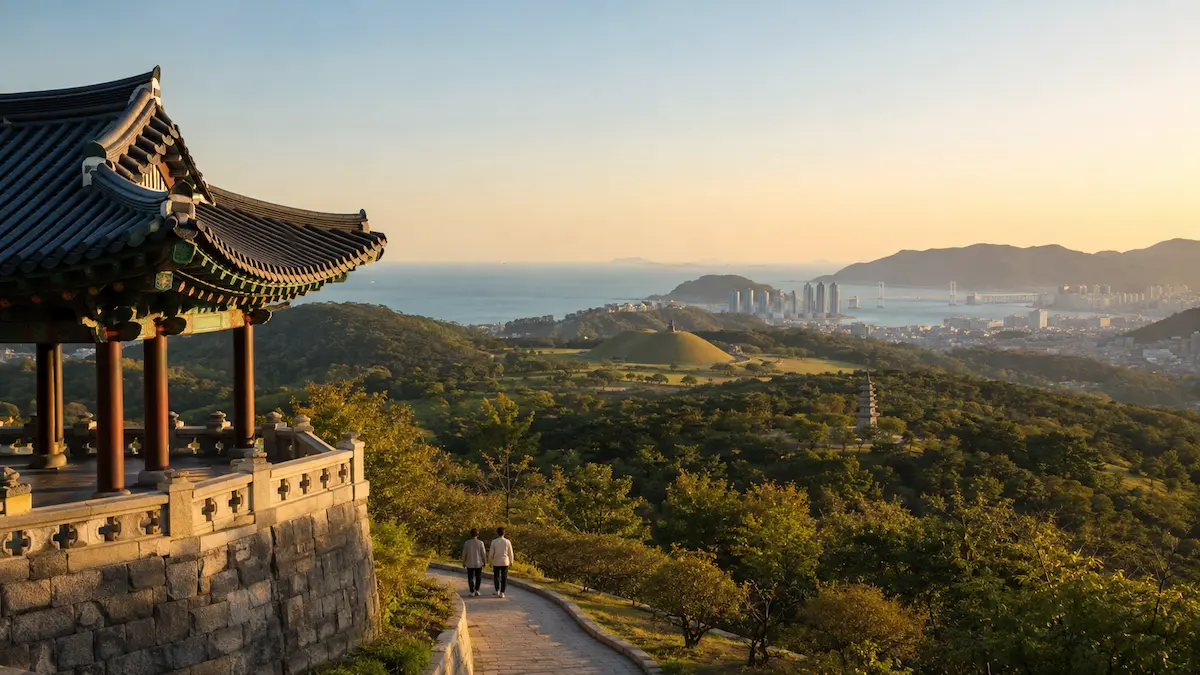
Planning 10 days in Korea gives first-time visitors enough time to experience the country without turning every day into a race. This itinerary connects Seoul, Gyeongju and Busan in a logical north-to-south route, combining major historic sites, modern neighbourhoods, traditional markets, coastal scenery and practical travel time.
The route assumes that you have ten usable days in Korea. If your arrival or departure takes most of a day, remove an optional neighbourhood rather than compressing the intercity journey.
If you have less time, use the shorter 5-day Korea itinerary or 7-day Korea itinerary instead.
10-Day Korea Itinerary at a Glance
- Day 1: Arrive in Seoul and keep the first evening simple
- Day 2: Gyeongbokgung Palace, Bukchon, Insadong and Gwangjang Market
- Day 3: Bongeunsa Temple, COEX and Jamsil
- Day 4: Choose one Seoul neighbourhood and prepare for Gyeongju
- Day 5: Travel from Seoul to Gyeongju and explore the historic centre
- Day 6: Bulguksa, Seokguram and an evening in Gyeongju
- Day 7: Travel from Gyeongju to Busan and explore the old city
- Day 8: Haedong Yonggungsa, Haeundae and the eastern coast
- Day 9: Enjoy a flexible Busan day or return to Seoul
- Day 10: Depart from Busan or Seoul
Before booking hotels, confirm your international departure airport. Travellers departing from Incheon International Airport should normally return to Seoul on Day 9. Travellers departing from Gimhae International Airport can spend their final night in Busan.
Before You Follow This 10-Day Korea Itinerary
Book Accommodation Around the Route
Use one hotel in Seoul, one in central Gyeongju and one in Busan. Changing hotels within the same city usually adds more inconvenience than value.
In Seoul, areas near Seoul Station, Myeongdong, Euljiro or another well-connected subway station make intercity travel easier. In Gyeongju, staying near the central historic area gives you easier evening access to Daereungwon, Hwangnidan-gil and Woljeonggyo Bridge. In Busan, choose Nampo for traditional markets and the old city, or Haeundae for beaches and the eastern coast.
Reserve Important Transport Early
High-speed train tickets can sell out during weekends, festivals and Korean public holidays. Check schedules and purchase tickets through the official KORAIL website.
When searching for Gyeongju, remember that high-speed trains use Singyeongju Station, which is outside the historic centre. Allow time for a local bus or taxi between the station and your accommodation.
Install Korean Navigation Apps
Naver Map and KakaoMap generally provide more useful local transit and address information than overseas map services. Save the Korean names of your hotels, stations and major attractions before travelling.
Day 1: Arrive in Seoul and Keep the First Evening Simple
Your first day should be deliberately light. Immigration, baggage collection, mobile data setup, airport transport and hotel check-in can take longer than expected, particularly after a long flight.
Getting from Incheon Airport to Seoul
Choose airport transport according to your arrival time, luggage and hotel location.
- AREX: Practical for travellers staying near Seoul Station or Hongdae
- Airport limousine bus: Useful when a bus stops near your hotel
- Taxi: The simplest door-to-door choice for groups, late arrivals or heavy luggage
Confirm current airport transportation information through the official Incheon International Airport website.
What to Do After Check-in
Stay close to your accommodation. Have a relaxed meal, locate the nearest convenience store and station, and check the route you will use the following morning.
If you arrive early enough, choose only one nearby area:
- Myeongdong or Euljiro for dinner and basic shopping
- Hongdae or Yeonnam for cafés and a lively evening
- Insadong or Ikseondong for traditional streets and tea houses
If you arrive late, skip sightseeing. Rest is more useful than beginning the itinerary exhausted.
Day 2: Historic Seoul, Bukchon and Gwangjang Market
This day groups several central historic areas that can be visited without repeatedly crossing Seoul.
Check current tourism notices, seasonal events and visitor information through the official Visit Seoul website.
Morning: Gyeongbokgung Palace
Start near opening time if possible. Allow approximately two hours for the main palace grounds without trying to visit every building.
Palace closing days, admission arrangements and special programmes can change. Read the official Gyeongbokgung Palace overview before your visit.
Do not build the entire day around a guard ceremony without checking whether it is operating on your chosen date.
Late Morning: Bukchon Hanok Village
Continue towards Bukchon for traditional architecture and elevated views across the historic centre.
Bukchon is a residential neighbourhood, not an open-air theme park. Keep conversations quiet, stay on public streets, avoid photographing residents and follow posted access restrictions. If visitor access is limited, continue directly to Insadong instead.
Afternoon: Insadong and Ikseondong
Use Insadong for crafts, tea, galleries and an easy lunch. Ikseondong can be added if your group still has energy, but it is not necessary to explore every lane.
Avoid travelling to another distant district during the afternoon. Keeping the route compact makes the day much more manageable.
Evening: Gwangjang Market
Finish at Gwangjang Market for an early dinner. Walk through the food area before ordering and choose stalls with clearly displayed menus and prices.
Individual vendor hours vary, so do not depend on one particular stall. Order a small number of dishes first and add more only if necessary.
Day 3: Modern Seoul, COEX and an Evening View
Spend Day 3 in southeastern Seoul. Bongeunsa, COEX and Jamsil form a more practical route than combining Gangnam with distant attractions north of the river.
Morning: Bongeunsa Temple
Begin at Bongeunsa before the surrounding business district becomes busy. The temple’s location opposite COEX creates one of Seoul’s clearest contrasts between traditional and modern architecture.
Bongeunsa remains an active religious site. Dress respectfully, keep your voice low and avoid photographing people during worship.
Late Morning and Lunch: COEX
Cross to the COEX complex for lunch, shopping or an indoor weather-proof break.
Choose one main activity:
- Visit Starfield Library
- Explore the shops and restaurants
- Visit the aquarium if it is a priority and you have reserved sufficient time
COEX is large. Save exact entrances and restaurant locations in a Korean navigation app rather than relying only on interior signs.
Afternoon: Choose One Gangnam Stop
Do not try to visit every famous neighbourhood south of the river. Select one option:
- Remain around Samseong and COEX
- Visit Gangnam Station for busy streets and shopping
- Visit Seonjeongneung for a quieter outdoor stop, subject to current access conditions
Evening: Jamsil or Seokchon Lake
Continue to Jamsil for dinner, a walk around Seokchon Lake or an evening viewpoint.
If you plan to visit an observatory, check current weather, admission rules and last-entry time before purchasing a ticket. Cloud, rain and fine dust can significantly reduce visibility.
Day 4: Choose One Seoul Neighbourhood
Day 4 provides breathing room before the intercity section of the trip. Choose one area based on your interests rather than combining several distant neighbourhoods.
Option 1: Seongsu and Seoul Forest
Choose Seongsu for design shops, cafés and converted industrial spaces. Combine it with Seoul Forest for an outdoor walk.
This option works best for travellers interested in contemporary Seoul and requires relatively little advance planning.
Option 2: Hongdae and Yeonnam
Choose Hongdae and Yeonnam for independent shops, cafés, casual dining and a younger atmosphere.
Explore on foot and keep the route within the same general area rather than adding central Seoul attractions.
Option 3: National Museum and the Han River
Choose the National Museum of Korea for a quieter cultural day. Check current opening and exhibition information through the museum’s official website before visiting.
If the weather is suitable, add a nearby Han River walk. If the weather is poor, spend more time indoors instead of crossing the city for another attraction.
Prepare for Gyeongju
Before sleeping, confirm your train departure station, departure time and seat reservation. Pack so that you can check out efficiently the following morning.
Day 5: Travel from Seoul to Gyeongju
Take a morning train from Seoul Station to Singyeongju Station. Check the exact service and platform through KORAIL.
From Singyeongju Station to Central Gyeongju
Singyeongju Station is not in the historic centre. Continue by local bus or taxi to your hotel or the Daereungwon area.
Do not schedule a timed attraction immediately after the train. Allow for station navigation, local transport, luggage storage and check-in.
Afternoon: Daereungwon Tomb Complex
Begin with Daereungwon after leaving your luggage. The tomb complex provides a useful introduction to the Silla period and is close to several central attractions.
Check current city tourism notices and attraction information through the official Gyeongju tourism website.
Late Afternoon: Hwangnidan-gil
Continue to Hwangnidan-gil for cafés, shops and dinner. The area can become crowded, so treat it as a relaxed walking district rather than a checklist of specific businesses.
Restaurants and cafés change frequently. Choose places with visible menus, recent opening information and a queue you are willing to wait in.
Evening: Woljeonggyo Bridge
If you still have energy, walk or take a short taxi ride to Woljeonggyo Bridge after dark. Confirm the return route to your hotel before staying late.
Keep this evening flexible. The purpose of Day 5 is to arrive comfortably and begin exploring Gyeongju without rushing.
Day 6: Bulguksa, Seokguram and Historic Gyeongju
Day 6 combines Gyeongju’s major UNESCO-associated sites with a flexible return to the historic centre.
Morning: Bulguksa Temple
Start at Bulguksa Temple. The journey from central Gyeongju takes time, so check your route the previous evening and leave enough time for the return journey.
Bulguksa is an active Buddhist temple and part of the UNESCO World Heritage property shared with Seokguram Grotto. Follow posted rules, dress respectfully and allow enough time to explore without rushing.
Before your visit, check current opening hours, admission details and transport information locally. For an authoritative English overview of Bulguksa and Seokguram, see the UNESCO World Heritage Centre page.
Optional Addition: Seokguram Grotto
Add Seokguram only if weather, transport and mobility conditions are suitable. The grotto is located on Tohamsan above Bulguksa and should not be treated as a quick walk from the temple.
Check the same-day bus or taxi route and current access conditions before travelling uphill. If conditions are poor or time is limited, spend more time at Bulguksa and return to central Gyeongju instead.
Afternoon: Return to the Historic Centre
After returning, choose one or two central attractions rather than trying to complete everything:
- Cheomseongdae Observatory
- Gyochon Traditional Village
- The Wolseong area
- A second walk through Daereungwon
- A café break around Hwangnidan-gil
Evening: Donggung Palace and Wolji Pond
Visit Donggung Palace and Wolji Pond near sunset or after dark if current opening conditions allow.
Evening crowds and seasonal closing times vary. Check the official Gyeongju tourism information before committing to a specific arrival time.
Day 7: Travel from Gyeongju to Busan
The best transport depends on your Busan hotel.
Travellers staying near Busan Station or Nampo may use a train from Singyeongju to Busan Station. Depending on schedules and hotel location, an intercity bus may also be practical. Compare the complete door-to-door journey rather than looking only at the fastest vehicle time.
Check in Before Sightseeing
Leave your luggage at the hotel before beginning the Busan route. Do not carry suitcases through hillside neighbourhoods or traditional markets.
For current destination information and local travel notices, use the official Visit Busan website.
Afternoon: Gamcheon Culture Village
Visit Gamcheon after checking in if the weather and your energy are suitable.
The neighbourhood contains steep slopes, stairs and residential streets. Wear suitable shoes, remain on public routes and avoid photographing residents or private homes.
If anyone in your group has limited mobility, shorten the route or replace Gamcheon with a flatter attraction.
Evening: Jagalchi and Nampo
Continue to Jagalchi and Nampo for markets, shops and dinner.
Seafood prices and restaurant systems vary. Confirm the price and preparation method before ordering. If seafood markets are not a priority, choose a regular restaurant around Nampo instead.
Keep the evening in the same general district. There is no need to travel to Haeundae after an intercity travel day.
Day 8: Haedong Yonggungsa and the Eastern Busan Coast
Day 8 focuses on eastern Busan. Travel distances can be longer than they appear, so do not add attractions in western Busan.
Morning: Haedong Yonggungsa Temple
Leave early for Haedong Yonggungsa. The temple is popular and includes stairs and uneven surfaces.
Dress respectfully and remember that it remains a religious site. Coastal wind, rain and heat can affect the visit, so adjust the schedule to the weather.
Midday: Songjeong or Cheongsapo
After the temple, continue towards Songjeong or Cheongsapo for lunch. Choose the area that best matches your onward reservation and transport route.
Avoid returning to central Busan for lunch and then travelling east again.
Afternoon: Haeundae Blue Line Park
Use the Haeundae coastal route for sea views, subject to weather and ticket availability.
If you want the Sky Capsule or another timed service, check schedules and booking conditions on the official Haeundae Blue Line Park website before travelling. Do not assume that a preferred departure time will be available on arrival.
The Beach Train and walking sections can be easier alternatives if capsule tickets are unavailable.
Evening: Haeundae
Finish around Haeundae Beach for dinner and an evening walk. Confirm the last convenient transport to your hotel, particularly if you are staying near Nampo or Busan Station.
Day 9: Choose a Flexible Busan Day or Return to Seoul
Your Day 9 plan depends on your international departure airport.
If You Depart from Gimhae Airport
Stay in Busan and choose one route.
Option 1: Gwangalli and Millak
Choose Gwangalli for a relaxed beach day, cafés and evening bridge views. This is the easiest option after several active sightseeing days.
Option 2: Taejongdae
Choose Taejongdae for coastal scenery if weather and mobility conditions are suitable. Allow additional transport time and avoid combining it with distant eastern Busan attractions.
Option 3: A Museum or Spa Day
Use an indoor museum, department store or spa if the weather is poor. A flexible day is valuable in a ten-day itinerary and does not need to be filled with famous landmarks.
If You Depart from Incheon Airport
Return to Seoul on Day 9 and stay overnight.
Travelling from Busan to Incheon Airport on the morning of an international flight creates unnecessary risk from train delays, transfers and airport queues. Take a daytime train to Seoul, check in near Seoul Station or another convenient airport connection and keep the evening free.
Reconfirm your Seoul-bound train through KORAIL.
Day 10: Departure Day
Keep the final day simple. Confirm your airport, terminal, airline check-in requirements and transport route before leaving your hotel.
Departing from Gimhae International Airport
Check current terminal and transportation information on the official Gimhae International Airport website.
Allow extra time for local transport, baggage handling and security procedures. Do not add a distant Busan attraction immediately before departure.
Departing from Incheon International Airport
Use the official Incheon International Airport website to verify your terminal and current passenger information.
If you returned to Seoul on Day 9, travel from your Seoul hotel using the airport railway, limousine bus or another suitable connection. Choose the option based on luggage and departure time, not only on the advertised journey duration.
Final Departure Checklist
- Confirm the correct airport and terminal
- Check passports and travel documents
- Keep tax-refund receipts and eligible purchases accessible
- Check your airline’s baggage allowance
- Return or dispose of rental items correctly
- Leave enough time for traffic, queues and unexpected transfers
How to Adjust This 10-Day Korea Itinerary
If You Want More Time in Seoul
Remove one Gyeongju night only if you are comfortable making the remaining Gyeongju schedule more compact. Do not attempt Bulguksa, Seokguram and every central attraction in a few hours.
A better alternative is to keep two nights in Gyeongju and use Day 4 for an additional Seoul neighbourhood.
If You Prefer a Slower Trip
Remove optional attractions from each day. Visit one main area in the morning and one in the afternoon, with longer meal and café breaks.
Do not compensate for a slower pace by crossing Seoul or Busan several times in one day.
If You Have Limited Mobility
Check stairs, slopes and walking surfaces before visiting Bukchon, Gamcheon, Haedong Yonggungsa, Seokguram or extended sections of the Suwon and Gyeongju heritage areas.
Use taxis selectively for the final connection between stations, hotels and attractions. Short taxi journeys can save substantial energy without changing the overall route.
If the Weather Is Poor
Use indoor alternatives around COEX, museums, shopping centres and spas. Keep coastal viewpoints, observatories and long outdoor walks flexible.
Avoid reserving every outdoor activity at a fixed time unless the ticket conditions allow changes.
Final Thoughts on Spending 10 Days in Korea
Ten days in Korea is enough for a balanced first journey through Seoul, Gyeongju and Busan. The route introduces the modern capital, the heritage of the Silla period and Korea’s largest coastal city without requiring constant hotel changes.
The key is not completing every attraction. Keep each day geographically focused, check official information shortly before travelling and remove optional stops whenever the itinerary begins to feel rushed.
Use this plan as a flexible framework. A comfortable trip with time for meals, navigation and unexpected discoveries will be more memorable than a schedule built only around the number of places visited.