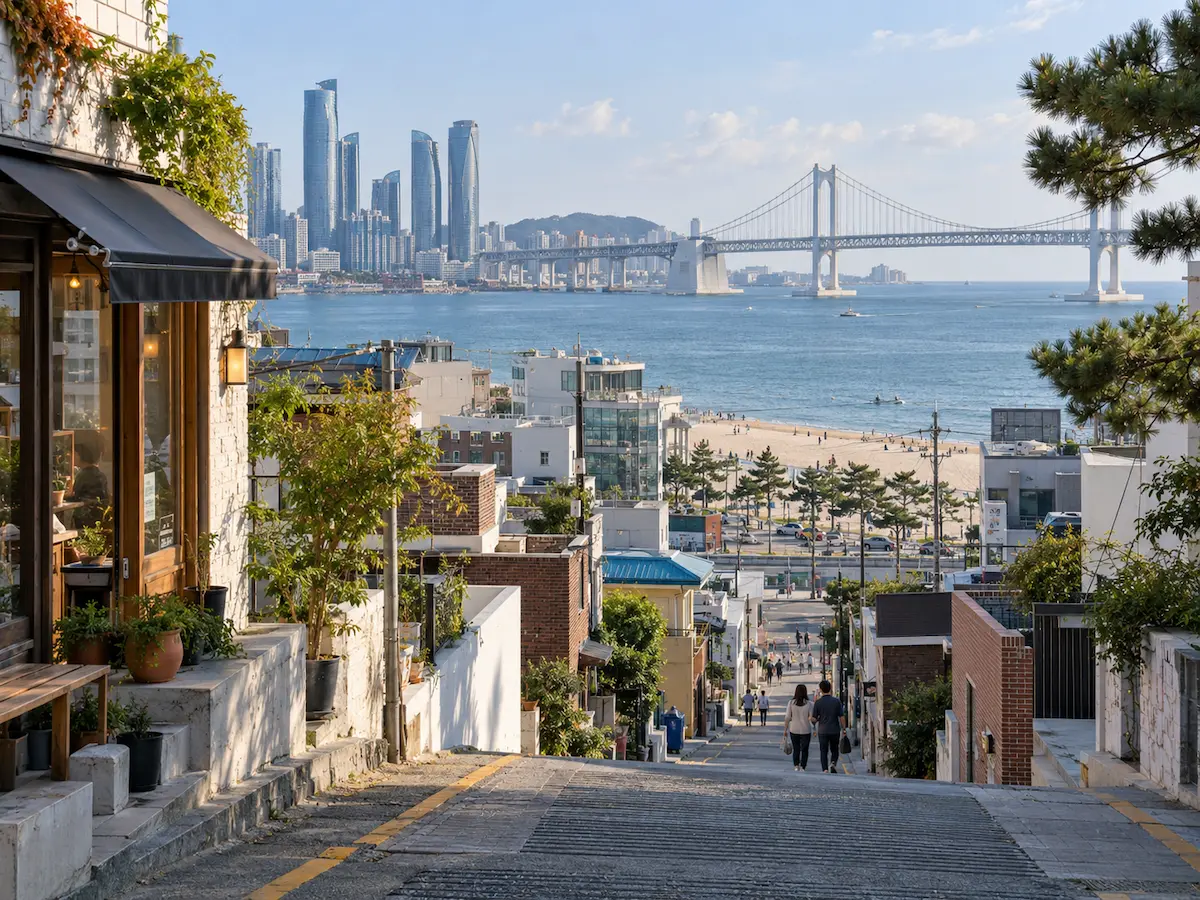
Two days in Busan can give you a strong introduction to the city if you plan by area rather than trying to visit every famous attraction.
Busan stretches between the sea, mountains and several distinct urban centres. Haeundae, Gwangalli, Nampo and Gamcheon may all appear on the same tourist map, but travelling between them takes real time.
For a first two-day visit, keep the plan simple:
Day 1: Gamcheon, Nampo and Jagalchi for hillside views, markets and older central Busan.
Day 2: Haeundae and Gwangalli for beaches, coastal walks and evening views.
This itinerary works without a rental car. Use the subway and buses for most journeys, with a taxi when hills, luggage or an awkward connection make it worthwhile.
2 Days in Busan at a Glance
| Day | Main areas | Best for |
|---|---|---|
| Day 1 | Gamcheon, Nampo, Jagalchi | Hillside scenery, markets, food and older Busan |
| Day 2 | Haeundae, Dongbaek area, Gwangalli | Beaches, coastal views, cafés and evening atmosphere |
The most important rule is simple:
Do not cross Busan repeatedly just to add another famous place to the itinerary.
If Busan is part of a longer Korea trip, compare your overall route with our Korea Itineraries before booking accommodation.
Day 1: Gamcheon, Nampo and Jagalchi
The first day stays mainly in western and central Busan.
This gives you time to experience the city’s hills, older commercial streets and market culture without spending the day travelling back and forth to the eastern beaches.
Morning: Gamcheon Culture Village
Start at Gamcheon Culture Village.
The neighbourhood is known for colourful houses arranged along a steep hillside, narrow lanes, public artwork and viewpoints across western Busan.
The scenery is distinctive, but Gamcheon is also a real residential neighbourhood.
Keep your voice down around homes, respect signs restricting access and do not treat private doorways, stairs or rooftops as photography sets.
Comfortable shoes are important.
Short distances in Busan can involve steep slopes and stairs, and Gamcheon is one of the clearest examples.
How Much Time Do You Need?
You do not need to explore every alley.
For most first-time visitors, walking the main public routes, stopping at several viewpoints and allowing some time for a café or small shop is enough.
If hills or stairs are difficult for you, consider taking a taxi closer to the upper part of the village rather than turning the journey itself into an exhausting climb.
Late Morning: Head Towards Nampo and Jagalchi
After Gamcheon, continue towards Nampo and Jagalchi.
This part of Busan feels very different from Haeundae.
The area combines:
- seafood markets;
- traditional markets;
- shopping streets;
- restaurants;
- street food;
- older commercial areas;
- a strong port-city atmosphere.
Do not think of Jagalchi as a single attraction that needs to be checked off quickly.
The surrounding streets are part of the experience.
Lunch: Eat Around Jagalchi or Nampo
Jagalchi is strongly associated with seafood, but you do not have to eat seafood to enjoy the area.
Depending on what you feel like eating, you can look for:
- fish and seafood;
- Korean soups;
- noodles;
- market snacks;
- casual restaurants;
- cafés around Nampo.
Do not build the entire itinerary around one famous restaurant.
Popular restaurants can have queues, minimum-order requirements or waiting systems that are inconvenient for visitors without a Korean phone number.
For ordering, paying, allergies and restaurant customs, use our Food & Drink guide.
Afternoon: Explore Nampo at a Slower Pace
Spend the afternoon around Nampo rather than immediately travelling to another side of Busan.
Depending on your interests, spend time on:
- market streets;
- BIFF-area streets;
- local snacks;
- shopping;
- cafés;
- people-watching;
- nearby public spaces.
This is one part of the itinerary that benefits from being slightly unstructured.
A two-day trip does not need every hour assigned to a specific attraction.
Optional: Yongdusan Park
If you still have time and energy, consider Yongdusan Park.
It sits naturally within the Nampo side of the itinerary and provides a higher viewpoint over parts of central Busan.
Treat it as optional.
If Gamcheon, the markets and lunch have already filled the day, there is no reason to rush simply to include another stop.
Evening: Stay Around Central Busan or Return to Your Base
Do not cross the city to Haeundae simply because you feel that a Busan day must end at the beach.
If you are staying around Nampo or Seomyeon, have dinner nearby and keep the evening relaxed.
If your accommodation is in Haeundae or Gwangalli, return after dinner or when it fits your route.
Save the main coastal sightseeing for Day 2.
That separation is what keeps this two-day itinerary practical.
Day 2: Haeundae and Gwangalli
Day 2 focuses on Busan’s modern coastline.
Haeundae and Gwangalli are both urban beaches, but they provide different experiences.
Haeundae works particularly well during the day.
Gwangalli becomes especially attractive towards evening, when the beach looks across towards Gwangan Bridge.
Morning: Haeundae Beach
Start at Haeundae Beach.
You do not need to visit during swimming season to enjoy it.
Haeundae works well for:
- a morning walk;
- sea views;
- cafés;
- photography;
- a slower start after Day 1.
Leave enough time to explore the surrounding area rather than arriving only to photograph the beach and immediately leaving.
Busan’s coastal character is part of the experience.
Late Morning: Walk Towards the Dongbaek Area
If the weather is suitable, continue towards the Dongbaek coastal area.
This keeps the morning geographically compact and adds another view of the coastline without requiring another long transport journey.
Do not feel that every famous coastal attraction has to be included.
A scenic walk close to where you already are often makes better use of a short trip than another cross-city transfer.
Lunch: Stay Around Haeundae
Have lunch around Haeundae before moving west.
There are enough restaurants and cafés in the area that travelling across Busan purely for lunch is unnecessary during a two-day itinerary.
If you have one particular restaurant in mind, check:
- current opening hours;
- break times;
- waiting arrangements;
- minimum-order requirements;
- whether a reservation or phone number is needed.
Otherwise, save two or three alternatives nearby.
Should You Add Haedong Yonggungsa?
Not automatically.
Haedong Yonggungsa is one of Busan’s best-known coastal temples, but it lies farther east than the rest of this two-day route.
Include it only if the temple is a personal priority.
Adding it means:
- additional transport;
- less time at Haeundae;
- a later arrival at Gwangalli;
- a noticeably busier Day 2.
For a two-day first trip, a simpler coastal day is often more enjoyable.
If you do choose the temple, keep it on the eastern side of the itinerary rather than combining it with Gamcheon or Nampo.
Afternoon: Travel to Gwangalli
Move towards Gwangalli during the afternoon.
Do not assume that the subway is automatically the fastest option for every journey.
Depending on your exact starting point, a bus or taxi may sometimes create a simpler route.
For subway, buses, taxis and transport cards, use our Getting Around guide.
For live route planning, station exits and Korean-address searching, use our NAVER Map and KakaoMap guide.
Late Afternoon and Evening: Gwangalli Beach
Gwangalli is a good place to finish the trip at a slower pace.
The beach faces Gwangan Bridge, creating one of Busan’s most recognisable combinations of city and sea.
Spend the final part of the day around:
- the beach;
- cafés;
- restaurants;
- nearby streets;
- the waterfront.
You do not need another complicated programme.
Walk, eat and allow the view to change as daylight fades.
That is enough.
Where Should You Stay for This Two-Day Trip?
With only two days, accommodation location matters.
Seomyeon
Seomyeon is practical if you want a relatively central base between the two sides of this itinerary.
It works well for:
- subway connections;
- restaurants;
- nightlife;
- travellers who do not need to sleep beside the beach.
Nampo
Choose Nampo if markets, older Busan and Day 1 are especially important to you.
The trade-off is a longer journey towards Haeundae and Gwangalli on Day 2.
Haeundae
Choose Haeundae if the coast is the main reason for your Busan visit.
Day 2 becomes particularly convenient, while Day 1 requires more travel across the city.
Gwangalli
Gwangalli works well if you want to return to a beach area at the end of the day and enjoy the evening atmosphere around Gwangan Bridge.
Whichever area you choose, check the exact property location and nearest useful station, not only the neighbourhood name.
How to Get Around During These Two Days
You do not need a rental car for this itinerary.
Busan’s subway, buses and taxis can cover the main journeys.
For a short visit:
- use the subway for predictable longer journeys;
- use buses when they provide a direct connection;
- use a taxi when hills, luggage or awkward transfers make it worthwhile;
- check your return route before a late evening.
Busan is mountainous, so buses are particularly useful for some areas that do not sit neatly beside subway stations.
For detailed transport guidance, see Getting Around.
Arriving at Busan Station
If you arrive by intercity train, remember that Busan Station is not beside Haeundae or Gwangalli.
You still need to travel onwards after leaving the train.
Busan Station is comparatively convenient for the central and Nampo side of the city, which can make Day 1 straightforward if you arrive early enough.
If your hotel is near Haeundae or Gwangalli, allow additional time to cross the city.
With large luggage, compare the public-transport route with a taxi before deciding.
Arriving Through Gimhae International Airport
Gimhae International Airport connects with Busan through public transport and taxis.
The practical route depends on where you are staying.
Before arrival:
- save the hotel’s Korean address;
- check the exact route;
- check the number of transfers;
- consider how much luggage you have;
- check transport availability if you arrive late.
Do not wait until you leave the airport terminal to work out which part of Busan your hotel is in.
What to Pack
A standard two-day Busan city trip does not require specialist equipment.
Useful items include:
- comfortable walking shoes;
- a light rain layer when rain is possible;
- mobile data;
- a portable battery;
- water during hot weather;
- a small amount of Korean won;
- a second payment card.
Comfortable shoes matter because Busan’s hills and stairs can turn a short-looking route into a much harder walk.
The coast can also feel windy outside the warmer months.
Check the current forecast shortly before travelling.
Payments and Mobile Data
Card payment is common in Busan, but no foreign-issued card is guaranteed to work everywhere.
A practical setup is:
- one overseas-enabled card;
- a second card stored separately;
- a small amount of Korean won;
- access to your card issuer’s app.
Mobile data is equally useful.
You may need to check buses, station exits and walking routes while moving between neighbourhoods.
For cards, cash, ATMs, SIMs, eSIMs, Korean phone numbers and public Wi-Fi, use our Money, Phones & Apps guide.
What If It Rains?
Rain does not automatically ruin a Busan trip.
Adjust the itinerary instead.
You can:
- spend longer in markets;
- use cafés;
- shorten coastal walks;
- move meals earlier;
- change the order of nearby stops;
- use taxis for inconvenient wet-weather transfers.
Heavy rain, strong winds or severe weather can affect coastal plans.
Do not continue an outdoor itinerary simply because it was scheduled.
For emergency information and practical traveller support, keep our Help & Safety guide available.
Common Mistakes on a Two-Day Busan Trip
Trying to See Everything
Two days is enough for an introduction, not for the entire city.
A coherent itinerary is better than a longer checklist.
Crossing Between Haeundae and Nampo Repeatedly
Give central Busan and eastern Busan their own time.
Adding Haedong Yonggungsa Automatically
It is worthwhile for some travellers, but it makes Day 2 substantially busier.
Include it because you particularly want to see it, not because every Busan itinerary lists it.
Ignoring Hills
Gamcheon and many other parts of Busan involve steep walking.
Check the actual route.
Choosing a Hotel Only by Price
A cheaper room can become poor value if it creates unnecessary cross-city journeys every day.
Relying Only on Public Wi-Fi
Mobile data makes Busan much easier to navigate while moving between destinations.
Two-Day Busan Checklist
Before travelling:
- Choose your accommodation area.
- Save your hotel’s Korean address.
- Prepare mobile data.
- Install NAVER Map or KakaoMap.
- Prepare two payment options.
- Check your route from Busan Station or Gimhae Airport.
- Keep Day 1 around Gamcheon, Nampo and Jagalchi.
- Keep Day 2 around Haeundae and Gwangalli.
- Check the weather shortly before travelling.
- Wear comfortable walking shoes.
- Leave some flexibility for meals and transport delays.
Frequently Asked Questions
Is two days enough for Busan?
Yes, for a first introduction.
Two full days allows you to experience older central Busan and a coastal day if you keep the itinerary geographically organised.
Three or four days is more comfortable if Busan is a major part of your Korea trip.
Can I travel around Busan without a car?
Yes.
The subway, buses and occasional taxis are sufficient for this itinerary.
Is Haeundae the best place to stay?
Not necessarily.
Haeundae is excellent if the coast is your priority.
Seomyeon may be more balanced if you plan to spend substantial time in both central and eastern Busan, while Nampo suits travellers who prioritise markets and older Busan.
Should I visit both Haeundae and Gwangalli?
You can comfortably include both on Day 2.
Haeundae works well during the day, while Gwangalli makes a natural final stop towards evening.
Is Gamcheon Culture Village worth visiting?
It can be worthwhile for its hillside landscape and views.
Remember that it is also a residential neighbourhood and involves slopes and stairs.
Should I add Haedong Yonggungsa?
Only if it is a priority.
For a two-day itinerary, adding it makes the coastal day considerably busier.
Can Busan be a day trip from Seoul?
A same-day return is technically possible by high-speed train, but it leaves limited time for Busan itself.
If Busan is an important part of your trip, staying at least one night is much more practical.
Final Recommendation
Two days in Busan works best when you stop trying to see the entire city.
Use Day 1 for Gamcheon, Nampo and Jagalchi.
Use Day 2 for Haeundae and Gwangalli.
Allow the markets to feel different from the beaches.
Allow older central Busan to feel different from the modern coastline.
And leave enough time between attractions to experience the city rather than spending the entire trip watching the next route on your phone.
To compare Busan with Seoul, Jeju, Gyeongju and other parts of Korea, return to our Destinations guide.
If Busan is one stop in a longer journey, compare the full route with our Korea Itineraries before booking accommodation.
Information reviewed: September 2026.