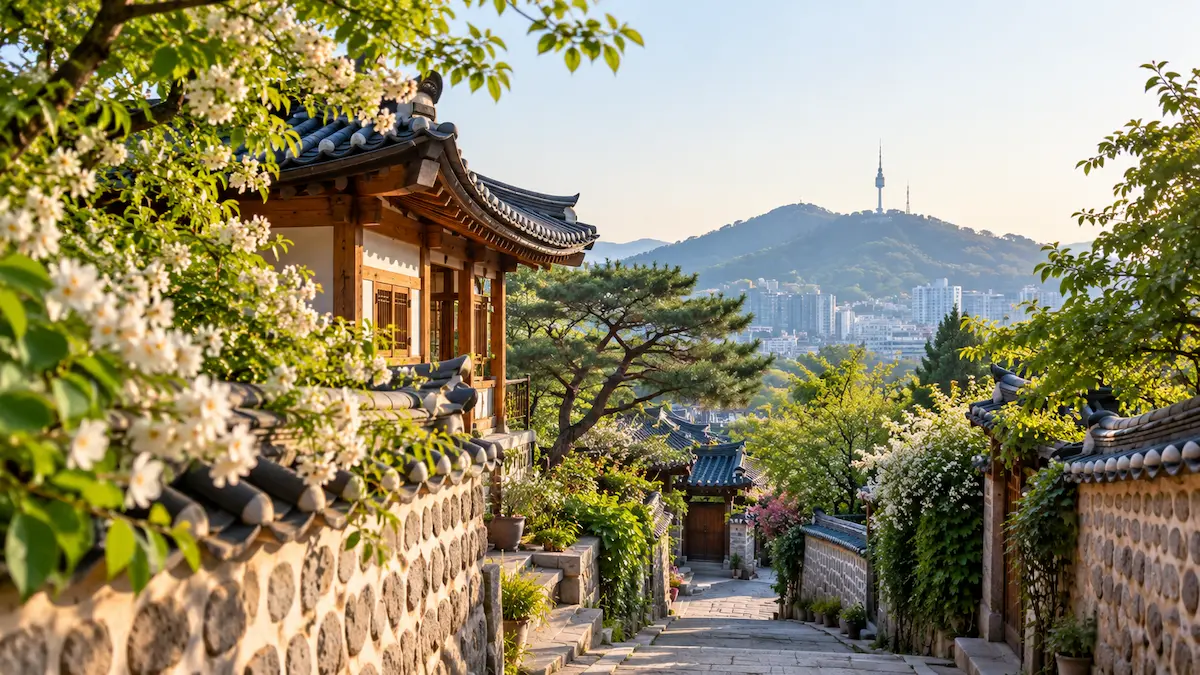
Seoul is not always fast.
Between the busy shopping streets, subway transfers and crowded attractions, there are quieter parts of the city where the pace changes completely.
You can spend a morning in a hanok library near Inwangsan, walk slowly through Seochon, stop for Korean tea in Insadong and finish the day without feeling that every hour needs another famous landmark.
This guide is for travellers who want a softer Seoul day built around libraries, tea houses, old neighbourhoods and slow walking rather than shopping or a long attraction checklist.
For a first visit, the easiest approach is:
Morning: Seochon and Cheongun Literature Library
Afternoon: Insadong and a traditional tea stop
Optional alternative: Achasan Forest Library and an eastern Seoul nature walk
This is not a fixed itinerary.
It is a way to experience Seoul at a slower pace.
Quiet Seoul at a Glance
| Area | Best for | What to expect |
|---|---|---|
| Seochon | Old alleys and local atmosphere | Traditional streets, small shops, cafés and a slower walk |
| Cheongun Literature Library | Architecture and quiet public space | Hanok library, greenery and a calm stop near Inwangsan |
| Insadong | Traditional tea and craft culture | Tea houses, galleries, shops and traditional streets |
| Achasan Forest Library | Nature and neighbourhood Seoul | Forest setting, local park atmosphere and a quieter eastern route |
The main principle is simple:
Do less, walk more slowly and leave enough time to sit somewhere without needing to move on immediately.
For a wider introduction to the city, return to our Destinations guide.
Morning: Start in Seochon
Begin the day around Seochon, west of Gyeongbokgung Palace.
Seochon works well for a quiet Seoul itinerary because it is easy to reach but feels different from the city’s largest shopping and entertainment districts.
The neighbourhood sits between Gyeongbokgung and Inwangsan and is known for old alleys, small cultural sites, cafés and traces of artists and writers who lived in the area.
Visit Seoul’s official walking-tour information describes Seochon as a neighbourhood where visitors can follow old alleys and historic cultural traces between Gyeongbokgung and Inwangsan.
Do not treat it as a route that needs to be completed quickly.
The value of Seochon is in the streets between the named stops.
Walk slowly.
Notice the small buildings.
Stop when something looks interesting.
If you are hungry, use a café or local restaurant as part of the route rather than leaving the area simply to visit a famous place elsewhere.
Continue to Cheongun Literature Library
From the Seochon side of Jongno, continue towards Cheongun Literature Library.
This is one of the Seoul libraries that can work as a travel destination even if borrowing a book is not part of your plan.
The library is a hanok-style public library near Inwangsan.
Its tiled roofs, wooden structure and surrounding greenery give it a very different atmosphere from a large urban reading room.
The official Jongno District Library information describes it as a culture-focused hanok library connected with nearby literary and cultural sites.
Current official information lists:
Address: 40 Jahamun-ro 36-gil, Jongno-gu, Seoul
Opening hours and temporary access restrictions can change, so check the official library page before travelling.
Jongno District Libraries — Cheongun Literature Library
A library visit should remain quiet.
Avoid loud conversation inside reading areas and check whether photography is appropriate before taking pictures.
The library works best as a place to pause.
You may read.
You may look around.
Or you may simply sit for a while before continuing the day.
For more libraries across Seoul and other parts of Korea, read our Libraries in Korea Worth Visiting for Quiet Travel and Architecture guide.
Do Not Turn the Morning Into a Race
A slow itinerary stops working when every quiet place becomes another item to complete.
After the library, do not immediately add three distant attractions simply because the morning still has time left.
Instead, choose one of these:
- continue walking around the surrounding Jongno area;
- return through Seochon;
- stop for lunch;
- sit in a café;
- take a short break before moving towards Insadong.
A quieter Seoul day should feel different from a palace-and-shopping checklist.
That difference is the point.
Afternoon: Move to Insadong
Later in the day, continue towards Insadong.
Insadong is more commercial than Seochon, and it can become crowded.
It still works well in a slow Seoul itinerary because traditional tea houses, craft shops, galleries and older-style spaces remain an important part of the neighbourhood.
Visit Seoul currently describes Insadong as a central neighbourhood known for traditional craft shops, galleries and wooden tea houses.
Do not expect the whole district to be silent.
Insadong is popular.
The goal is not to find an empty historic street.
The goal is to move through a busy part of Seoul without treating it only as a shopping destination.
Stop for Korean Tea
A traditional tea stop fits naturally into this itinerary.
Korean tea houses offer a different pace from the takeaway-coffee culture that many visitors first notice in Seoul.
Menus can include drinks such as:
- yuja tea;
- omija tea;
- daechu, or jujube tea;
- ginger tea;
- green tea;
- roasted grain teas.
The exact style varies by tea house.
Some spaces feel traditional.
Others are modern cafés using Korean ingredients and ceramics.
Some are genuinely quiet, while others can be popular and busy.
For a deeper explanation of Korean tea culture and common drinks, read our Korean tea culture guide.
A Currently Listed Traditional Tea House
If you prefer a specific example rather than choosing spontaneously, Visit Seoul currently lists Jidaebang as a traditional tea shop in Insadong.
The official Seoul tourism page describes it as a long-running traditional tea space with a large tea selection.
Operating hours can change, so check the official listing shortly before visiting.
You do not need to visit this particular tea house.
The better choice is whichever current tea space fits your route, available time and preferred atmosphere.
How to Choose a Tea House
Before entering, check what kind of place it actually is.
A sign mentioning traditional tea does not always mean the experience will be the same.
Some places focus on:
- Korean traditional teas;
- green tea;
- tea and Korean desserts;
- hanok interiors;
- contemporary tea service;
- café-style drinks.
If you want a quieter experience, avoid choosing only by social-media popularity.
A heavily photographed tea house may have waiting lines and a faster customer turnover than a less famous place nearby.
When possible, check:
- current opening hours;
- last order;
- closing day;
- whether reservations are needed;
- whether the menu suits you;
- recent operating information.
Tea houses and cafés change more frequently than major historic attractions.
What Korean Tea Should a First-Time Visitor Try?
There is no single correct first tea.
Choose according to taste.
Yuja Tea
Yuja tea has a sweet citrus flavour and is one of the easiest Korean teas for many first-time visitors to approach.
Omija Tea
Omija is known for a more complex sweet-and-sour flavour and a distinctive red colour.
Daechu Tea
Daechu, or jujube tea, is usually deeper and sweeter and can feel more substantial than a light tea.
Ginger Tea
Ginger tea has a stronger, sharper flavour and is especially appealing in colder weather.
Green Tea
Korean green tea can be found in traditional tea houses as well as modern cafés and desserts.
These drinks are part of food culture.
They should not be presented as medical treatments or cures.
Try them for flavour, season and experience.
Optional Evening: Walk Without Adding Another Major Attraction
After tea, you can simply continue walking.
Insadong connects naturally with several central Seoul areas, but you do not need to turn the evening into another major sightseeing programme.
Depending on your energy, consider:
- staying around Insadong;
- walking towards Jogyesa;
- continuing towards Ikseon-dong;
- having an early dinner;
- returning to your accommodation.
Ikseon-dong can be attractive, but it is often much busier than the quieter parts of this itinerary.
If the streets are crowded, there is no need to force it into the day.
A quiet Seoul itinerary should allow you to stop when you have had enough.
Alternative Quiet Seoul Route: Achasan Forest Library
If you want a quieter route away from central Seoul, consider Achasan Forest Library instead.
Achasan Forest Library belongs to the Gwangjin District public library system and sits in eastern Seoul.
The library works best as part of a nature-focused half-day rather than something added to a central Jongno itinerary.
The surrounding Achasan area gives the visit a different atmosphere from Seochon and Insadong.
This route suits travellers who want:
- more greenery;
- a local neighbourhood atmosphere;
- a park walk;
- fewer central tourist stops;
- a quieter half-day.
The official Gwangjin District Library website currently lists Achasan Forest Library at:
139 Yeonghwasa-ro, Gwangjin-gu, Seoul
Check current closing days and programmes before travelling.
Achasan Forest Library — Official Website
For more detail about this library and other architectural libraries in Korea, use our Libraries in Korea Worth Visiting for Quiet Travel and Architecture guide.
Which Quiet Seoul Route Should You Choose?
Choose the Seochon → Cheongun → Insadong route if:
- this is your first Seoul trip;
- you are staying centrally;
- you want hanok architecture;
- tea culture interests you;
- you prefer a route that can fit easily between other Seoul plans.
Choose Achasan Forest Library if:
- you have already seen central Seoul;
- nature matters more than traditional shopping streets;
- you want a more local atmosphere;
- you do not mind travelling farther east.
Do not try to combine both routes into one slow day.
That would defeat the purpose.
How to Get Around
The central route can be completed through a mixture of walking and short public-transport journeys.
Seoul’s terrain matters.
Cheongun Literature Library sits closer to the Inwangsan side of Jongno, so some walking can involve slopes.
Achasan is a separate eastern Seoul destination and should be treated as its own route.
For subway, bus, taxi and transport-card information, use our Getting Around guide.
For walking routes, Korean place names and station exits, use our NAVER Map and KakaoMap guide.
What If It Rains?
Quiet Seoul can work particularly well on a rainy day, but the itinerary should change.
You can:
- spend more time inside the library;
- shorten outdoor walking;
- choose a tea house earlier;
- use buses or taxis for uphill sections;
- avoid forest or mountain-adjacent walking in poor conditions.
Heavy rain, snow, heat or strong wind can change whether a slow outdoor walk is actually comfortable.
Check the current weather before leaving.
For emergency information and practical traveller support, keep our Help & Safety guide available.
Quiet Seoul Etiquette
These places work because people treat them differently from major tourist attractions.
In Libraries
Keep conversations quiet.
Do not photograph readers without permission.
Follow any photography restrictions.
Do not occupy study spaces only for staged photographs.
In Residential Streets
Seochon and similar neighbourhoods include real homes.
Keep noise down and respect private entrances.
In Tea Houses
Do not assume every traditional-looking space is designed for quick turnover.
Some tea service takes time.
That is part of the experience.
Common Mistakes on a Quiet Seoul Day
Adding Too Many Famous Attractions
The whole point is to reduce the schedule.
Do not turn a slow route into another top-ten Seoul itinerary.
Choosing a Tea House Only Because It Is Famous Online
Popularity can mean queues and noise.
Choose according to atmosphere and route.
Expecting Every Library to Be a Tourist Attraction
Libraries are public spaces first.
Respect people who are using them normally.
Combining Central Seoul and Achasan in One Day
They serve different routes.
Choose one.
Forgetting Seoul’s Hills
A short distance around Inwangsan or Achasan can involve more climbing than expected.
Check the actual walking route.
Quiet Seoul Checklist
Before leaving:
- [ ] Choose the central route or Achasan route.
- [ ] Check the library’s current opening information.
- [ ] Save Korean place names in your map app.
- [ ] Check the weather.
- [ ] Wear comfortable walking shoes.
- [ ] Check your tea-house choice shortly before visiting.
- [ ] Leave part of the day unscheduled.
- [ ] Keep your phone on silent inside libraries.
- [ ] Treat residential streets respectfully.
Frequently Asked Questions
Is Seoul actually quiet anywhere?
Yes.
Seoul is a dense and busy city, but neighbourhood libraries, parks, older residential streets and tea houses can offer a very different pace from the main shopping and entertainment districts.
Is Cheongun Literature Library worth visiting?
It can be, especially if you already plan to spend time around Seochon, Inwangsan or Jongno.
It works best as a quiet architectural and cultural stop rather than a major tourist attraction.
Can tourists use Korean public libraries?
Public-library access rules differ by facility and service.
Visitors can generally enter public areas where permitted, but borrowing books, using specific facilities or attending programmes may require registration.
Check the individual library’s current rules.
Is Insadong quiet?
Not always.
Insadong can become busy, especially during popular visiting times.
It is included here because its traditional tea houses and cultural spaces can provide slower stops within a busy central district.
Is Achasan Forest Library central?
No.
It is in eastern Seoul and works better as a separate nature-and-neighbourhood half-day.
Do I need to book a traditional tea house?
Usually not for ordinary visits, but individual businesses can have different reservation or waiting policies.
Check before travelling if one specific tea house is important to you.
Is this itinerary suitable for a first Seoul trip?
Yes, particularly as a slower half-day or full day between more intensive sightseeing days.
It should complement, not replace, the major sights you personally want to see.
Final Recommendation
Quiet Seoul is not about finding a completely silent version of the city.
It is about changing the way you move through it.
Walk through Seochon’s older streets without rushing.
Sit inside a hanok library without needing to buy anything.
Choose a tea house because you want to pause, not because it is another attraction to complete.
If you want more nature, save Achasan Forest Library for a separate slow half-day.
The goal is not to see more Seoul.
It is to experience one day with less pressure to keep moving.
For other libraries across Korea, continue with our Libraries in Korea Worth Visiting for Quiet Travel and Architecture guide.
For Korean tea, traditional drinks and tea-house culture, read A Quiet Table in a Coffee City.
To compare Seoul with other parts of Korea, return to our Destinations guide.
Official Information
Information reviewed: September 2026.