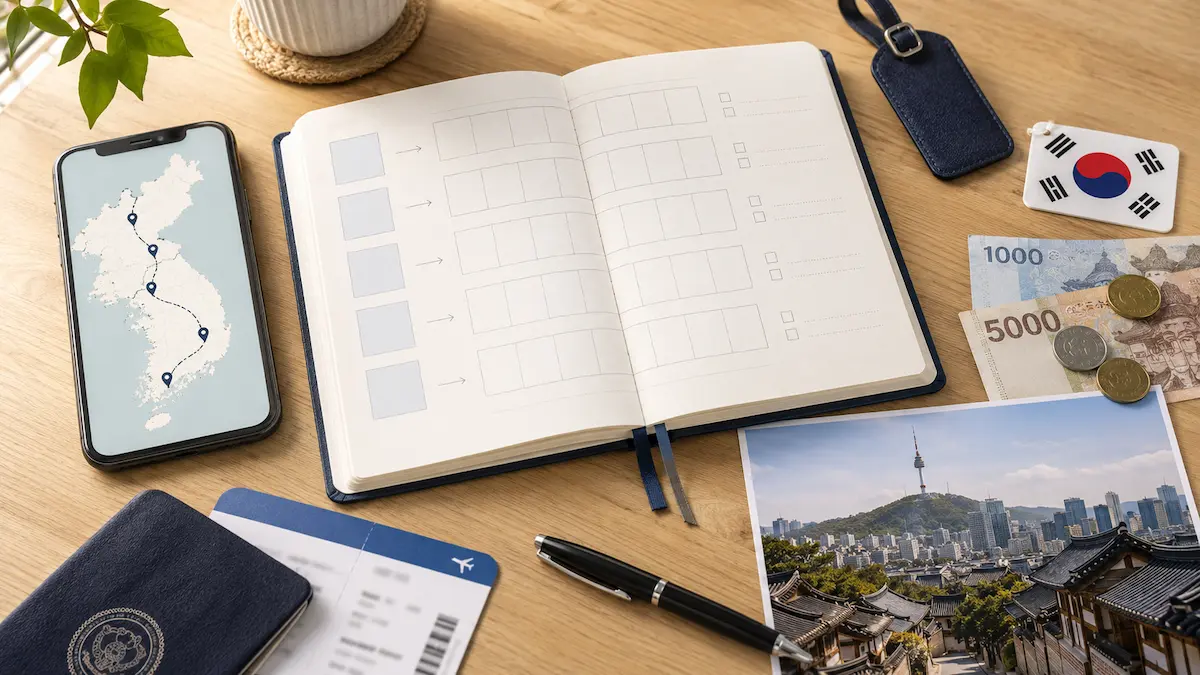
Planning a trip to Korea becomes much easier when each decision is made at the right time. You do not need to reserve everything six months ahead, but flights, accommodation, entry requirements and popular activities should not all be left until the final week.
This Korea trip planning timeline gives first-time visitors a practical sequence to follow from six months before departure until the day of travel. Use it as a flexible framework rather than a fixed booking rule, as prices, availability and entry requirements vary by nationality, season and destination.
Korea Trip Planning Timeline at a Glance
| Time before departure | Main priorities |
|---|---|
| 4–6 months | Choose dates, estimate your budget, decide trip length and compare flights |
| 3–4 months | Book major flights and accommodation with suitable cancellation terms |
| 2–3 months | Finalise your route and research intercity transport and popular attractions |
| 1 month | Confirm entry requirements, insurance, payments, mobile data and essential apps |
| 2 weeks | Review reservations, weather, documents and packing |
| 3 days | Complete the e-Arrival Card if required and conduct final checks |
| Departure day | Carry essential documents, payment methods and arrival information |
4–6 Months Before Your Korea Trip
Choose the Best Travel Dates for You
Start by deciding what kind of experience you want. Spring and autumn generally provide comfortable sightseeing conditions, while summer and winter may suit travellers interested in beaches, festivals, skiing or quieter city travel.
Weather should not be your only consideration. Compare flight prices, accommodation demand, Korean public holidays and any major events taking place during your proposed dates.
Compare seasonal weather, crowds and major holiday periods in When Is the Best Time to Visit Korea? before choosing your travel dates.
Decide How Many Days You Need
Three days can work for a focused Seoul visit, while five to seven days allow time for Seoul and another destination. Ten to fourteen days provide more room for cities such as Gyeongju, Busan and Jeju without changing accommodation every day.
Choose your trip length before booking flights. Your arrival and departure airports can affect the most efficient route, particularly if you plan to travel beyond Seoul.
Compare practical routes for different trip lengths in the Korea Itineraries guide.
Estimate Your Total Budget
Create an early budget covering:
- International and domestic transport
- Accommodation
- Meals and drinks
- Attractions and activities
- Mobile data
- Travel insurance
- Shopping
- Emergency funds
Avoid calculating the trip from airfare alone. A cheaper flight may involve inconvenient arrival times, additional baggage charges or an airport transfer that increases the real cost.
Use How Much Does a Trip to Korea Cost? A First-Time Visitor Budget Guide to estimate daily spending and set a realistic total budget before booking.
Check Your Passport and Entry Baseline
Check your passport’s validity and condition well before purchasing non-refundable travel arrangements. Entry rules depend on the passport you hold, the purpose of your visit and the length of stay.
Use only official sources to check whether you need a visa, K-ETA or another form of travel authorisation:
Do not rely on social media posts or an outdated travel article when making an immigration decision. Requirements and temporary exemptions can change.
For a practical overview of the documents and arrival procedures to review before departure, read the Korea Entry Requirements and Arrival Checklist.
3–4 Months Before: Book the Major Parts of Your Trip
Compare and Book Flights
When comparing flights, consider:
- Total journey time
- Baggage allowance
- Change and cancellation conditions
- Arrival airport
- Arrival time
- Transport options after landing
- Whether separate tickets require collecting and rechecking baggage
Booking early does not guarantee the lowest price, but it gives you more route and seat options. If your dates are flexible, compare several departure days before committing.
Reserve Accommodation
Once your flights are reasonably certain, reserve your main accommodation. First-time visitors to Seoul should choose an area based on transport convenience and planned activities rather than selecting a hotel by price alone.
Check:
- Distance from a useful subway station
- Airport transport options
- Check-in and luggage-storage policies
- Room size
- Lift access
- Recent guest reviews
- Cancellation conditions
Read Where to Stay in Seoul for First-Time Visitors before deciding between areas such as Myeongdong, Hongdae, Insadong and Gangnam.
If your itinerary includes several cities, reserve accommodation in route order. Avoid changing hotels unnecessarily, as repeated check-outs and luggage transfers consume useful travel time.
2–3 Months Before: Finalise Your Route
Turn Your Destination List into a Realistic Itinerary
A list of attractions is not yet an itinerary. Group places by area, allow for travel time and avoid scheduling every day from morning until night.
For each destination, identify:
- The experiences you consider essential
- Activities that require advance booking
- Indoor alternatives for poor weather
- Time needed to travel to the next city
- At least one flexible period
A realistic itinerary should leave room for meals, queues, navigation mistakes and unexpected discoveries.
Choose Where to Stay in Seoul
Choose your accommodation area after outlining your route. The best neighbourhood depends on your arrival airport, preferred atmosphere, planned activities and the transport connections you will use most often.
Before booking, compare:
- Walking distance to the nearest subway station
- Airport transfer options
- Late-night transport and dining
- Travel time to your priority attractions
- Room size, luggage storage and check-in hours
- Cancellation and payment conditions
First-time visitors often consider areas such as Myeongdong, Hongdae, Insadong, Jongno and Gangnam, but no single neighbourhood is best for every itinerary.
Compare the main neighbourhoods and their practical differences in Where to Stay in Seoul for First-Time Visitors.
Research Intercity Transport
Korea has convenient rail and intercity bus networks, but the best option depends on the route. Compare actual station locations and door-to-door journey times rather than choosing transport by speed alone.
At this stage, research:
- KTX and other train routes
- Express and intercity buses
- Domestic flights
- Ferry requirements where relevant
- Luggage restrictions
- Holiday demand
Tickets may not always be available several months in advance. Record the date when reservations are expected to open instead of repeatedly searching too early.
Identify Reservations That Matter
Popular experiences, limited-capacity tours and special events may require advance booking. However, there is no benefit in reserving every ordinary attraction months ahead.
Prioritise activities that:
- Have limited daily capacity
- Operate only on selected dates
- Require identity information
- Are essential to your trip
- Become busy during your travel period
Before paying, confirm the cancellation policy, meeting point and accepted identification.
1 Month Before: Prepare the Practical Details
Recheck Entry Requirements
Review official entry information again approximately one month before travel. Confirm that your passport, visa or K-ETA status matches your planned visit.
The article Korea Entry Requirements and Arrival Checklist explains how to organise the documents and information commonly needed before arrival.
Arrange Travel Insurance
Choose insurance based on your circumstances and planned activities. Check coverage for medical treatment, trip cancellation, delays, lost belongings and any activities that may require additional protection.
Save the policy number and emergency contact details somewhere accessible without internet service.
Prepare Payments
Do not rely on a single payment method. Carry:
- At least one internationally enabled payment card
- A backup card stored separately
- A modest amount of Korean won
- A plan for notifying your bank if required
Check foreign transaction and cash-withdrawal fees before departure. Mobile wallets are useful in some situations but should not be your only payment option.
For cards, cash, ATMs and payment backups, see our Money, Phones & Apps guide.
Decide on Mobile Data
Compare an eSIM, physical SIM and portable Wi-Fi according to:
- Phone compatibility
- Number of travellers
- Data needs
- Voice-call requirements
- Collection or activation process
- Battery use
Confirm that your phone is unlocked before purchasing a travel SIM or eSIM.
Install Essential Apps
Install and test the apps you expect to use before departure. These may include:
- A Korean map and navigation app
- A translation app
- Airline and accommodation apps
- Rail or bus booking services
- Your mobile-data provider’s app
- Your travel insurance app
Save important addresses in both English and Korean where possible.
For practical setup after arrival, see our First Day in Korea guide.
2 Weeks Before: Confirm Every Reservation
Build a Master Itinerary
Create one master itinerary containing:
- Flight numbers
- Accommodation names and addresses
- Check-in dates
- Intercity transport
- Activity reservations
- Airport transfer plan
- Insurance information
- Emergency contacts
Check that names on reservations match the relevant passports. Confirm whether any booking requires a printed voucher or the original payment card.
Check the Weather and Pack by Activity
Begin checking the forecast, but remember that a two-week forecast can change. Use it to shape your packing strategy rather than to predict each day precisely.
Pack according to your planned activities. Comfortable walking shoes, suitable layers, rain protection and any essential medication are usually more important than bringing an outfit for every possible condition.
3 Days Before Arrival: Complete Final Entry Tasks
Complete the e-Arrival Card If Required
Travellers who are required to submit Korea’s electronic arrival card can complete it through the official e-Arrival Card website.
The official service is free. Submission opens three days before arrival in Korea, based on Korea Standard Time, and may be completed at any time before immigration clearance, including after arrival. You will need a valid passport, an email address, your expected arrival date and flight number, your expected departure date, and accommodation information.
Travellers holding a valid K-ETA are generally excluded from e-Arrival Card submission. However, travellers entering Korea with a visa must complete the e-Arrival Card even if they also hold a valid K-ETA. Confirm your own current requirement through the official website before departure.
Avoid unofficial websites that charge an application or processing fee for the e-Arrival Card.
Complete Your Final Travel Checks
Also complete the following checks:
- Confirm your flight status
- Check online check-in availability
- Charge phones and power banks
- Download offline copies of documents
- Confirm your first-night accommodation
- Save the Korean address of your accommodation
- Review your airport-to-hotel route
- Check baggage allowances again
Departure Day Checklist
Keep Essential Items in Your Hand Luggage
Keep the following items in your hand luggage:
- Passport
- Required visa or travel authorisation
- Boarding pass
- Accommodation address
- Return or onward travel details
- Payment cards and emergency cash
- Insurance information
- Essential medication
- Phone charger
- Mobile-data activation instructions
Do not place essential documents, medication or your only payment method in checked baggage.
Before leaving home, check that you understand how to reach your accommodation from the arrival airport. Knowing your first transport step will make arrival much less stressful.
Planning a Last-Minute Korea Trip
A well-organised Korea trip is still possible with less preparation time. If you are travelling within the next few weeks, complete tasks in this order:
- Confirm passport and entry requirements
- Book transport to and from Korea
- Reserve accommodation
- Choose a simple, realistic route
- Arrange insurance and mobile data
- Book only essential limited-capacity activities
- Prepare arrival information and payment methods
Do not try to compensate for limited planning time by creating an overcrowded itinerary. A shorter route with fewer hotel changes is usually easier to manage.
Final Korea Trip Planning Checklist
Before departure, confirm that you have:
- Checked official entry requirements
- Booked flights and suitable accommodation
- Chosen a realistic itinerary
- Reviewed intercity transport
- Purchased appropriate travel insurance
- Prepared more than one payment method
- Arranged mobile data
- Installed and tested essential apps
- Saved reservations offline
- Checked current weather and transport notices
- Completed the e-Arrival Card if required
- Prepared your airport arrival route
The best Korea trip planning timeline is one that reduces uncertainty without removing all flexibility. Make the important decisions early, verify time-sensitive information close to departure and leave enough space in your itinerary to enjoy Korea at a comfortable pace.
For the rest of your planning, return to our Plan Your Trip guide.