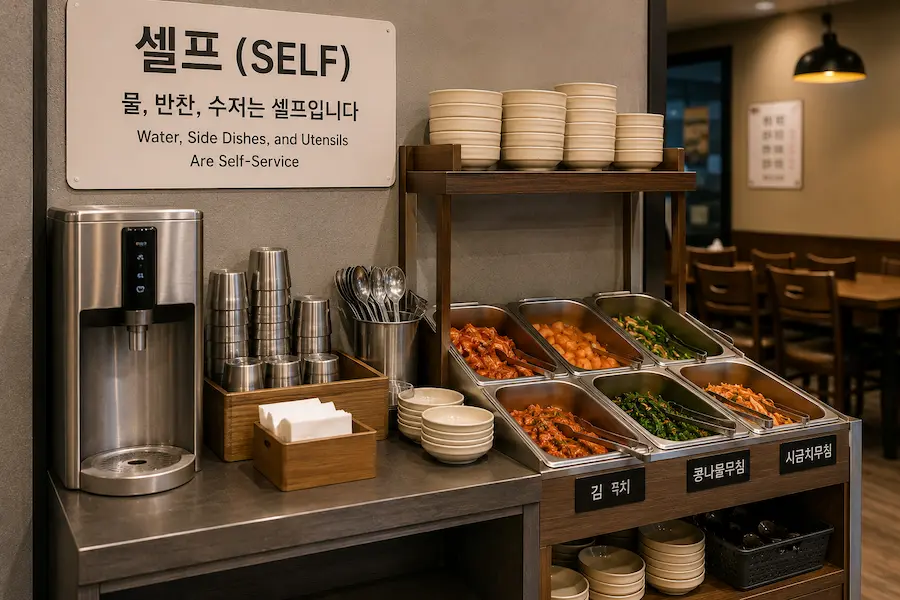
You sit down at a Korean restaurant, place your order, and wait for water.
A few minutes pass, but no one brings it. Then you notice another customer walking to a water dispenser near the wall and filling a cup.
The restaurant may not have forgotten your table. Water could simply be self-service.
Self-service in Korean restaurants may mean getting your own water, collecting utensils, refilling side dishes, or returning a tray after eating. It does not necessarily mean that the entire restaurant is self-service.
Each place has its own system. Even Koreans often look around when visiting an unfamiliar restaurant for the first time.
Self-Service in Korean Restaurants: Quick Answers
| Question | Quick answer |
|---|---|
| What does 셀프 mean? | Customers should collect or handle certain items themselves. |
| Is water always self-service? | No. It depends on the restaurant. |
| Can I get more side dishes? | Sometimes. Check whether refills are available and included. |
| Where are the utensils? | Check the table drawer or self-service station. |
| Should I return my tray? | Only when there is a return area or clear instruction. |
For a broader guide to ordering, payment, kiosks and table customs, see our Korean Restaurant Guide.
What Does “Self” Mean in a Korean Restaurant?
The Korean word 셀프 comes from the English word “self” and is commonly used to mean self-service.
You may see signs such as:
- 셀프
- 물은 셀프입니다
- 추가 반찬 셀프
- 식기 반납
- 퇴식구
- SELF
The meaning depends on where the sign is placed.
A 셀프 sign above a water dispenser usually means that customers should get their own water. The same word beside a side dish station may mean that extra side dishes can be collected there.
Do not assume that everything in the restaurant is self-service just because you see the word once. Ordering, water, utensils, payment, and tray return may each follow a different system.
Water May Be Self-Service
Water service varies from one restaurant to another.
You may find:
- a water bottle already on the table
- a shared water dispenser
- bottled water in a refrigerator
- cups beside the counter
- a small self-service station
Sometimes a filled bottle is waiting on the table. In other places, customers take a bottle from a refrigerator or fill their own cups.
If you cannot find water, look near the wall, counter, or entrance. A water dispenser is often placed with cups, napkins, and other basic items.
When the system is still unclear, ask a staff member. You are not expected to understand every restaurant immediately.
If the table has a call button, you can also use it to ask for help. Our guide to using a Korean restaurant call button explains when to press it and what happens afterward.
How Side Dish Service Works
Korean meals are often served with small side dishes called banchan. However, the way they are provided is not the same everywhere.
The Staff Brings the Side Dishes
In some restaurants, the staff brings the first serving and any additional portions you request.
There may be no self-service station. If you would like more, ask whether a refill is available.
The First Serving Arrives at the Table, but Refills Are Self-Service
Another arrangement is for the staff to bring the first set of side dishes with the meal.
When you want more, you can visit a self-service station and take another small portion. The station may have separate containers with serving tongs, spoons, or ladles.
Customers Collect the Side Dishes From the Start
Some casual restaurants, food courts, and cafeterias ask customers to collect side dishes before or after receiving the main meal.
If you are unsure, watch what other diners do for a moment or ask the staff before taking anything.
Are Korean Side Dishes Free?
Basic side dishes served with a meal are often included in the menu price. However, this does not mean that every item near the counter is free.
Some foods may be separate menu items, especially when they are served in larger portions or have their own price labels.
These might include:
- rolled omelette
- grilled fish
- meat dishes
- dumplings
- special seasonal dishes
- packaged side dishes for takeout
A self-service station for basic banchan often contains the same small side dishes already served at the table.
When an item has a menu name or price beside it, check before taking it.
It is also better not to assume that every refill is unlimited. Availability and charges can depend on the restaurant and the dish.
Take Only What You Plan to Eat
When side dish refills are available, start with a small amount.
You can return for more if needed. Taking a large portion and leaving most of it creates unnecessary food waste.
Use the serving utensil provided for each dish. Do not place your personal spoon or chopsticks inside a shared container.
A simple approach works well:
- take a small portion first
- return for more when refills are available
- use the shared serving utensil
- avoid taking food you do not plan to eat
Self-service means choosing what you need without waiting for a staff member. It does not mean taking as much as possible.
Where Are the Spoons and Chopsticks?
If there are no utensils on the table, check underneath the tabletop.
Many Korean restaurants have a shallow drawer built into the side of the table. It may contain:
- metal spoons
- metal chopsticks
- napkins
- bottle openers
- small plates
The drawer can be easy to miss if you have never seen one before.
Other restaurants keep utensils at a self-service station or beside the counter. Cafeterias and food courts may provide them near the tray collection area.
For more information about utensils and everyday dining customs, see our guide to Korean chopsticks and table manners.
If you still cannot find what you need, ask:
Sujeo eodie isseoyo? — 수저 어디에 있어요?
Where are the utensils?
Do You Need to Return Your Tray?
Some self-service restaurants ask customers to return their trays or dishes after eating.
Look for signs such as:
- 식기 반납
- 퇴식구
- Return
- Tray Return
Tray return areas are commonly found in food courts, cafeterias, highway rest areas, and some casual restaurants. There may be separate places for leftover food, dishes, cups, and trays.
In a regular table-service restaurant, customers usually leave the dishes on the table unless instructions say otherwise.
Do not carry plates around simply because water or side dishes were self-service. One self-service feature does not necessarily mean that customers must clear the table.
When other diners are taking their trays to a clearly marked return area, you should usually do the same.
Kiosks, Call Buttons, and Self-Service May Be Used Together
A Korean restaurant may use several systems at once.
For example, you might:
- order and pay at a kiosk
- collect food when a number appears
- get water and side dishes from a self-service station
- use a call button for questions
- return the tray after eating
Another restaurant may take orders at the table but still ask customers to get their own water.
This mix can feel confusing because each part of the meal may work differently. The best approach is to check one step at a time rather than assuming that the whole restaurant follows one system.
Look at the table, wall signs, ordering screen, and counter area. When something is unclear, asking the staff is completely reasonable.
For more help with self-ordering machines, see our Korean Restaurant Kiosk guide.
Useful Korean Questions
A few short questions can help when the instructions are not obvious.
Mul-eun self-yeyo? — 물은 셀프예요?
Is water self-service?
Banchan deo gajyeoga-do dwaeyo? — 반찬 더 가져가도 돼요?
May I get more side dishes?
Sujeo eodie isseoyo? — 수저 어디에 있어요?
Where are the utensils?
You do not need to say a perfect sentence. Pointing toward the water dispenser, side dish station, or table can make your question easier to understand.
For more short phrases you can use during a trip, see our Simple Korean Phrases guide.
What to Check Before Asking the Staff
When you sit down in an unfamiliar restaurant, a quick look around may answer most questions.
Check:
- whether a water bottle is already on the table
- whether there is a drawer under the tabletop
- whether a self-service station is near the wall or counter
- whether the side dishes have serving utensils
- whether there is a tray return area
- whether ordering and payment instructions appear on a screen
Watching other customers for a moment can also help. Koreans do this too when visiting a restaurant with an unfamiliar system.
Frequently Asked Questions
Is water always self-service in Korean restaurants?
No. Some restaurants bring water to the table, while others provide a water dispenser, refrigerator, or self-service station. Look around the table and counter area before asking.
Are side dish refills always free?
No. Basic refills may be included at some restaurants, but availability and charges depend on the restaurant and the dish. Items with a separate name or price may need to be ordered.
Can I take any food displayed near the self-service area?
No. Take only items clearly provided as part of the self-service station. Ask before taking anything that looks like a separate menu item or packaged product.
Where are spoons and chopsticks kept?
They may be inside a shallow drawer under the tabletop, at a self-service station, beside the counter, or near the tray collection area.
Do I need to return my dishes after eating?
Only when the restaurant provides a tray return area or clear instructions. In a regular table-service restaurant, dishes are usually left on the table.
What should I do when I cannot understand the system?
Check the signs, watch what other customers do, and ask a staff member. Different restaurants may use different systems, so asking is normal.
Check First, Then Help Yourself
Self-service in a Korean restaurant does not always mean doing everything yourself.
It may apply only to water, utensils, extra side dishes, or returning a tray. The first serving of banchan may come from the staff, while refills are available at a separate station.
Check the signs, look around the table, and take only what you plan to eat.
Once you know what each self-service area is for, the system is usually straightforward. When it is not, asking the staff is the safest choice.
For more practical guides to Korean restaurants, ordering and dining, return to our Food & Drink guide.