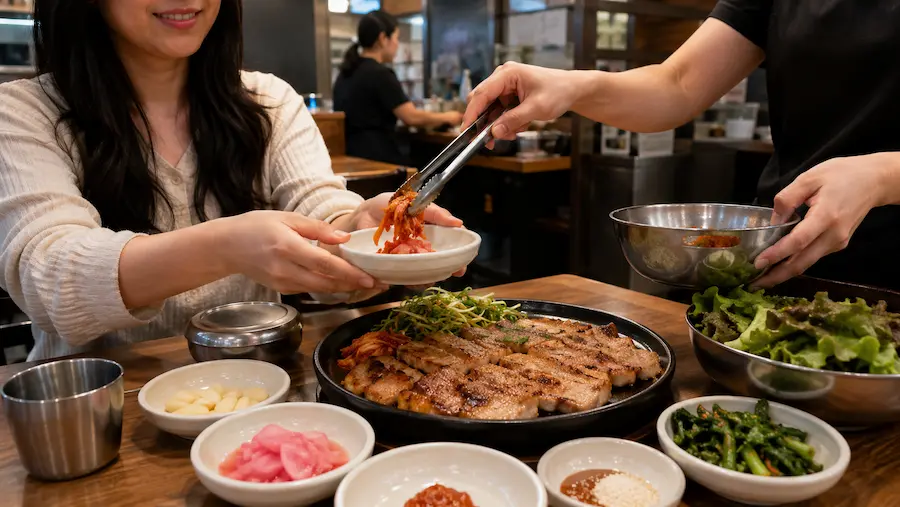
A Korean meal may arrive with several small dishes placed around the main food.
Kimchi, seasoned vegetables, pickles, sauces and other small dishes are commonly called banchan, or side dishes. They are an ordinary part of many Korean meals rather than separate appetisers that must always be ordered individually.
Basic side dishes can often be refilled without an additional charge. Depending on the restaurant, you may ask a staff member or take more from a self-service bar.
That does not mean that every food on the table is unlimited or free.
Rice, noodles, meat, soup and larger dishes may be separate menu items. Some side dishes may also be limited because of the restaurant’s policy, ingredient availability or temporary supply problems.
The easiest rule is to check how the food was served, look at the menu and ask when you are unsure.
Side-Dish Refills at a Glance
| Situation | What commonly happens | What to check |
|---|---|---|
| Small side dish served automatically | Often refillable without an extra charge | Ask staff or check the self-service bar |
| Side dish placed at a self-service bar | Customers take more themselves | Follow the signs and use the serving utensils |
| Item with a price on the menu | Treated as an additional order | Confirm the price before ordering |
| Extra bowl of rice | Usually a separate order | Look for 공깃밥 |
| Extra noodles, meat or other main ingredients | Paid additional order | Look for 추가 or 사리 추가 |
| Soup or steamed egg | Depends on how it is served and listed | Do not assume; check the menu or ask |
| Ingredient shortage or sold-out item | Refill may be limited or replaced | Read any notice or listen to staff guidance |
For a broader guide to ordering, payment, kiosks and table customs, see our Korean Restaurant Guide.
These are practical patterns, not fixed rules for every restaurant.
The restaurant’s menu, signs and staff instructions take priority.
What Is Banchan?
Banchan refers to small dishes served alongside rice, soup or a main dish.
Depending on the restaurant, these may include:
- kimchi;
- cubed radish kimchi;
- seasoned bean sprouts;
- pickled radish;
- seasoned vegetables;
- fish cake;
- seaweed;
- small salads;
- garlic;
- chilli peppers;
- dipping sauces.
The selection depends on the meal.
A barbecue restaurant may provide lettuce, garlic, sliced chilli and sauces. A soup restaurant may serve kimchi and cubed radish kimchi. A noodle restaurant may provide only pickled radish or kimchi.
Not every Korean meal includes a large collection of side dishes, and restaurants do not all serve the same number or type.
Are Side-Dish Refills Free?
Basic side dishes served automatically with a meal are commonly refilled without an additional charge.
The Korea Tourism Organization explains that requests for more water or side dishes at Korean restaurants generally do not incur additional costs. It also notes that some restaurants let customers collect water and side dishes from a self-service area.
Read the Korea Tourism Organization’s introduction to Korean restaurant customs.
In my own experience, I cannot remember being charged for an ordinary refill of a basic side dish.
However, this should not be understood as a guarantee that every restaurant offers unlimited quantities of every item.
A refill may be unavailable or limited when:
- the item is listed separately on the menu;
- it is part of a limited set;
- the ingredient has become difficult to obtain;
- the restaurant has introduced a temporary refill limit;
- the prepared food has sold out;
- the restaurant is close to closing.
When the distinction is unclear, ask before ordering more.
Basic Refill or Paid Extra Order?
The way an item is served can provide a useful clue.
More likely to be a basic side-dish refill
- It arrived automatically with the meal.
- You did not order it separately.
- It was served in a small side-dish bowl.
- The same item is available at the self-service bar.
- The staff refills it without adding another menu item.
More likely to be a paid addition
- It has its own price on the menu.
- It was ordered separately.
- It is served as a full dish.
- It contains additional meat, noodles or another main ingredient.
- It appears under
추가 메뉴on the ordering screen. - The staff asks whether you want to place another order.
추가 메뉴 means additional menu items.
A small serving bowl is only a clue, not a guarantee. The menu and staff guidance are more reliable.
Rice, Soup and Steamed Egg
These items can be confusing because they may be included with one menu but sold separately with another.
Rice
An extra bowl of rice is normally treated as a separate order.
Look for:
공깃밥;밥 추가;- a price beside the rice item.
공깃밥 means a bowl of rice.
Soup
A small soup included with a set meal and a separate bowl of soup ordered from the menu are not necessarily treated the same way.
Do not assume that soup is refillable. Check the menu or ask the staff.
Steamed egg
Steamed egg may appear as:
- a small side dish included with the meal;
- a complimentary dish offered by the restaurant;
- a larger dish cooked in a hot stone or metal pot;
- a separate paid menu item.
A small included serving may be treated differently from a full steamed egg dish. Because this varies widely, ask before requesting another one.
계란찜 리필돼요?
Gyeranjjim ripildwaeyo?
Can the steamed egg be refilled?
How a Self-Service Side-Dish Bar Works
Some Korean restaurants have a self-service area marked:
셀프바;반찬 셀프;추가 반찬;물은 셀프.
셀프바 means self-service bar.
At the self-service area, customers may be able to collect:
- additional side dishes;
- water;
- sauces;
- cups;
- small plates;
- cutlery or napkins.
The exact selection depends on the restaurant.
The usual process is:
- Try the first serving.
- Decide which side dish you want more of.
- Check whether the restaurant provides clean bowls or expects you to reuse the side-dish bowl.
- Use the spoon, tongs or ladle provided for that food.
- Take only as much as you expect to eat.
- Return again later if you need more.
I usually finish or nearly finish the first serving before taking more. If there is one side dish I particularly enjoy, I take a little extra.
I try not to waste food, although a particularly good side dish can sometimes make me take more than I first planned.
For a fuller explanation of water, utensils, side dishes and tray-return systems, see our Self-Service in Korean Restaurants guide.
Should You Take Your Existing Bowl?
Restaurants handle this differently.
At some self-service bars, customers carry the existing small side-dish bowl back and add more. Other restaurants place clean bowls beside the food and expect customers to use those.
Check:
- signs near the self-service bar;
- where clean bowls are placed;
- what other customers are doing;
- whether staff have given any instructions.
Do not assume that one method applies everywhere.
Whichever dish you use, take food with the serving utensil provided at the self-service bar. Do not place personal chopsticks or spoons into shared food containers.
What If There Is No Self-Service Bar?
Ask a staff member.
Requesting another serving of a basic side dish is a normal part of dining. There is no need to feel embarrassed or to behave as though you are asking for an unreasonable favour.
I usually make eye contact, smile lightly and ask in a polite but confident way.
Sometimes I add that the food is especially good:
너무 맛있어서 많이 먹게 돼요.
Neomu masisseoseo mani meokge dwaeyo.
It is so good that I keep eating more.
When I would like a larger refill, I might say:
많이 주세요. 너무 맛있어요.
Mani juseyo. Neomu masisseoyo.
Please give me plenty. It is very good.
A compliment is not required. A clear request using polite language is enough.
Useful Refill Phrases
반찬 좀 더 주세요.
Banchan jom deo juseyo.
Please give me some more side dishes.
김치 좀 더 주세요.
Gimchi jom deo juseyo.
Please give me some more kimchi.
이 반찬 조금 더 주세요.
I banchan jogeum deo juseyo.
Please give me a little more of this side dish.
리필할 수 있어요?
Ripilhal su isseoyo?
Can this be refilled?
무료로 리필돼요?
Muryoro ripildwaeyo?
Can this be refilled for free?
이거 추가 비용 있어요?
Igeo chuga biyong isseoyo?
Is there an extra charge for this?
셀프바가 어디예요?
Selpeubaga eodiyeyo?
Where is the self-service bar?
이 그릇을 가져가면 돼요?
I geureuseul gajyeogamyeon dwaeyo?
Should I take this bowl with me?
For more everyday expressions, read Simple Korean Phrases for Travel in Korea.
How to Get a Staff Member’s Attention
When there is a call button on the table, press it once and wait.
When there is no button, say:
저기요.
Jeogiyo.
Excuse me.
You can then make the request:
저기요. 김치 좀 더 주세요.
Jeogiyo. Gimchi jom deo juseyo.
Excuse me. Please give me some more kimchi.
There is no need for visitors to memorise informal relationship-style terms for restaurant staff. 저기요 followed by a polite request is clear and widely useful.
If the table has a call button, see our Korean Restaurant Call Button guide for when and how to use it.
Polite Does Not Mean Submissive
Customers pay for their meals and may make reasonable requests.
There is no need to apologise repeatedly or take an excessively humble position when asking for more basic side dishes.
At the same time, speaking as though the staff member is being ordered around can feel rude.
A practical approach is to:
- get the person’s attention;
- make eye contact when possible;
- speak in a calm voice;
- use
주세요; - smile lightly;
- say thank you when the food arrives.
Politeness is not about treating the customer and employee as superior and inferior. It is about making an ordinary request with respect.
When Refills May Be Limited
A restaurant may temporarily limit or replace a side dish because of:
- poor harvests;
- extreme weather;
- crop damage;
- a supply interruption;
- a sharp rise in ingredient prices;
- the item selling out;
- the restaurant approaching closing time.
When a shortage becomes a wider public issue, a restaurant may display a notice explaining that:
- the item can be refilled only a certain number of times;
- the portion has been reduced;
- another ingredient is being used;
- a different side dish will be provided.
In my experience, restaurants usually explain the reason and ask for customers’ understanding.
When the shortage is already affecting supermarkets and household food prices, diners often know why the restaurant has made the change.
Replacements at Barbecue Restaurants
At barbecue and wrap restaurants, lettuce, garlic, chillies or other vegetables may normally be available as basic accompaniments.
During a temporary supply problem, the restaurant may:
- serve another type of leaf vegetable;
- provide a smaller portion;
- limit the number of refills;
- explain that the usual ingredient is unavailable.
Staff may mention the substitution when the food is first served.
A temporary replacement does not necessarily mean that the restaurant has permanently stopped providing the original item.
What Happens Near Closing Time?
A popular side dish may run out late in the day.
The restaurant may then:
- provide another side dish;
- explain that no more is available;
- offer a smaller final serving;
- stop refilling that particular item.
I have experienced staff explaining that I was receiving the last serving of one side dish and offering a different dish afterwards.
This is not the same as charging for a refill. It means the food prepared for that day has been used up.
How to Check Whether an Item Costs Extra
Look for these Korean words:
| Korean | Meaning |
|---|---|
| 추가 | Extra or additional |
| 추가 메뉴 | Additional menu |
| 추가 주문 | Additional order |
| 리필 | Refill |
| 무료 | Free |
| 유료 | Paid |
| 셀프 | Self-service |
| 공깃밥 | Bowl of rice |
| 사리 추가 | Add noodles or another extra |
| 고기 추가 | Add meat |
| 반찬 추가 | Additional side dish |
When an item has a price beside it, treat it as a paid order unless the staff explains otherwise.
When the menu or screen remains unclear, ask:
이거 무료로 리필돼요?
Igeo muryoro ripildwaeyo?
Can this be refilled for free?
Or:
추가하면 얼마예요?
Chugahamyeon eolmayeyo?
How much is it to add this?
Side-Dish Etiquette
The most important habit is to take what you can finish.
At a self-service bar:
- start with a small amount;
- return again when necessary;
- use the provided serving utensils;
- follow the restaurant’s bowl policy;
- keep the area tidy;
- do not take the food outside;
- follow any refill-limit notice.
When asking staff:
- say which item you need;
- point to the dish when you do not know its name;
- combine several requests when the restaurant is busy;
- thank the staff when the refill arrives.
It is not rude to request a side dish more than once.
The less considerate behaviour is taking a large amount and leaving it uneaten.
A Practical Example
Imagine that a barbecue meal arrives with:
- kimchi;
- seasoned spring onion;
- lettuce;
- garlic;
- chilli peppers;
- dipping sauce;
- a large steamed egg.
The kimchi, spring onion, lettuce, garlic, chilli and sauce may be basic accompaniments available for refills.
The large steamed egg may be a separate menu item.
Before requesting another steamed egg, check whether it appears on the menu with a price.
For the basic accompaniments, look for a self-service bar. When there is none, ask the staff politely.
This works better than trying to memorise one permanent rule for every Korean food.
Quick Checklist for Foreign Visitors
Before requesting more
- Check whether the item arrived automatically.
- Look for a price on the menu.
- Check for a self-service bar.
- Read any refill-limit notice.
- Ask when the difference is unclear.
At a self-service bar
- Check whether to reuse the dish or take a clean one.
- Use the provided serving utensils.
- Take only what you expect to finish.
- Return later if you need more.
- Keep the shared area tidy.
When asking staff
- Say the name of the item when possible.
- Point to the dish when necessary.
- Use
좀 더 주세요. - Ask about the price when unsure.
- Say thank you when the refill arrives.
Frequently Asked Questions
Are side-dish refills free in Korea?
Basic side dishes served automatically with a meal can commonly be refilled without an additional charge.
Restaurant policies and individual menu items still differ.
Is every side dish unlimited?
No.
A restaurant may limit an item because of its policy, supply conditions, ingredient prices or availability.
How do I know whether an item costs extra?
Check whether the item has a separate price on the menu or ordering screen.
Rice, noodles, meat and larger dishes are commonly treated as additional orders.
Can I refill side dishes myself?
Yes, when the restaurant provides a self-service bar.
Follow the signs, use the serving utensils and check whether the restaurant provides clean bowls or expects customers to reuse the existing dish.
What should I do when there is no self-service bar?
Ask a staff member politely.
You can say 반찬 좀 더 주세요.
Is rice refilled for free?
An extra bowl of rice is normally a separate order. Check the menu for 공깃밥 or 밥 추가.
Is steamed egg free to refill?
Not necessarily.
A small included serving and a full steamed egg dish may be treated differently. Check the menu or ask the staff.
Can lettuce and garlic be refilled at barbecue restaurants?
They are commonly served as basic accompaniments at many barbecue restaurants, but availability and refill policies depend on the restaurant and current supply conditions.
Is it rude to ask for several refills?
No, provided you ask politely and finish what you receive.
Taking excessive amounts and leaving them uneaten is less considerate.
What happens if a side dish runs out?
The restaurant may provide a substitute, offer a smaller serving or explain that no more is available.
Final Thoughts
Asking for more side dishes at a Korean restaurant is usually a normal part of the meal.
Basic banchan can commonly be refilled by visiting a self-service bar or asking the staff. Items with a separate menu price are generally treated as additional orders.
The exact distinction depends on the restaurant, the menu and how the item is served.
You do not need to memorise a separate rule for every dish.
Check the menu, look for a self-service area and ask when something is unclear.
A polite request, a light smile and a simple 조금 더 주세요 are usually enough.
Most importantly, take only what you can finish. Enjoying a side dish and asking for more is natural. Wasting a large amount is not.
For more practical guides to Korean food, ordering and dining, return to our Food & Drink guide.