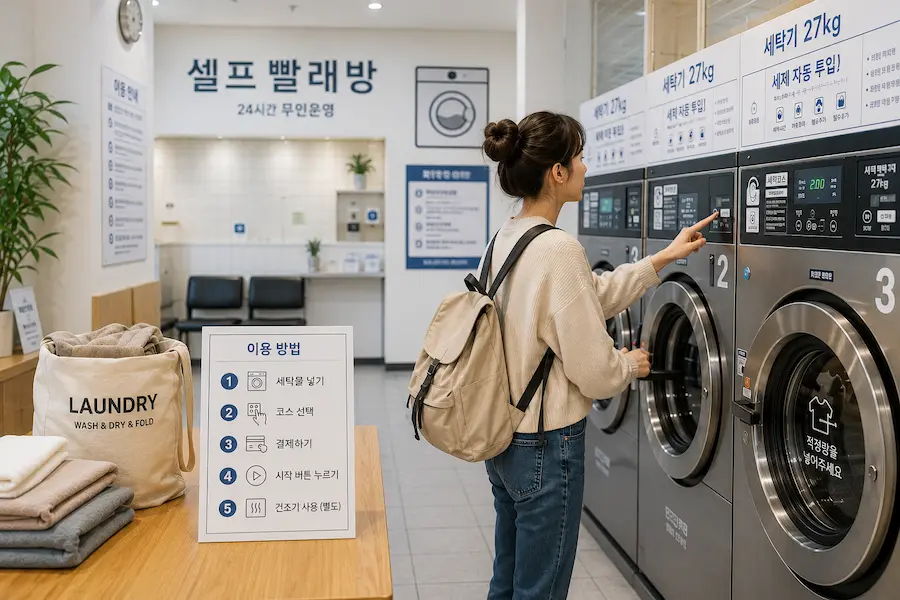
I have not personally needed to use a coin laundry in Korea, but several people around me do.
Some have washing machines at home and still visit a coin laundry for blankets, curtains and other bulky items that do not fit comfortably in a household machine. Friends living alone or in small officetels also use them when they want to wash and dry several loads without spending most of the day on laundry.
Coin laundries can be useful during travel for the same reason.
Korean families may use them on longer domestic trips, especially when traveling with children and carrying enough clothes for every day is not practical. International visitors may need one when their accommodation does not have a guest laundry room, their clothes get wet during Korea’s rainy season or they simply want to pack lighter.
The machines are usually not difficult to operate. The confusing part is that payment methods, detergent systems and controls vary by store.
This guide explains what to check before starting, how to wash and dry your clothes and what to do when the laundromat is unattended.
What Is a Coin Laundry Called in Korea?
A self-service laundry may be described in Korean using several different terms.
| Korean term | Meaning |
|---|---|
| 코인세탁 | Coin laundry |
| 코인빨래방 | Coin laundromat |
| 셀프빨래방 | Self-service laundromat |
| 무인빨래방 | Unattended laundromat |
| 24시 빨래방 | 24-hour laundromat |
The English phrase “coin laundry” is commonly understood, but it does not always mean that the machines accept only coins.
Depending on the store, payment may be made with:
- coins;
- banknotes through a kiosk or change machine;
- Korean credit or debit cards;
- a store membership card;
- a mobile payment app;
- prepaid credit loaded at a kiosk.
An overseas card may work at one store and fail at another. Keep another payment method available rather than relying on a single foreign card.
For a broader explanation of transport cards, cash and payments, read First Day in Korea: Transport, Maps, Payments and Arrival Tips for Visitors.
How to Find a Coin Laundry in Korea
Korean map apps often produce better local results when you search in Korean.
Try entering one of these terms:
- 코인세탁
- 코인빨래방
- 셀프빨래방
- 무인빨래방
- 24시 빨래방
Before going, check:
- recent customer reviews;
- photos of the machines;
- listed operating hours;
- whether washers and dryers are both available;
- whether the store has a kiosk or coin machine;
- whether recent customers mention card payment;
- whether large blankets are accepted.
Do not assume that every store marked as open 24 hours is always accessible. Building access, maintenance, cleaning or temporary operating changes may affect entry.
For navigation help, see our guide to Korean map apps.
What to Check Before Using a Machine
Take a minute to inspect the store and your laundry before paying.
Check the clothing care labels
Do not use a laundromat machine for clothing that should be:
- hand-washed;
- dry-cleaned;
- washed only at a low temperature;
- kept away from tumble dryers.
Commercial dryers can use strong heat. This may shrink or damage certain fabrics.
Pay particular attention to:
- wool;
- silk;
- leather;
- coated fabrics;
- padded jackets;
- delicate sportswear;
- clothing with glued decorations;
- items marked “do not tumble dry.”
When the care label is unclear, choose a gentler option or use a professional laundry service instead.
Empty every pocket
Remove:
- coins;
- receipts;
- tissues;
- keys;
- earphones;
- batteries;
- cosmetics;
- pens;
- lighters.
A forgotten tissue can cover the entire load in small pieces of paper. Pens, batteries and lighters can damage clothing or the machine.
Separate restricted items
Do not mix ordinary clothing with heavily contaminated items.
Stores may restrict:
- items covered in oil or chemicals;
- pet bedding;
- shoes;
- floor mats;
- diapers;
- items with excessive sand or mud;
- waterproof materials;
- commercial or industrial laundry.
Some laundromats have separate machines for shoes, pet items or large bedding. Use those only when they are clearly marked for that purpose.
The rules posted inside the store take priority over general online advice.
How to Choose the Right Machine
Coin laundries often have machines in several sizes.
A larger machine may be useful for:
- blankets;
- washable comforters;
- curtains;
- several days of family laundry;
- thick towels;
- bulky winter clothing.
Do not force a large item into a small drum.
Laundry needs room to move during washing and drying. An overloaded machine may clean poorly, rinse unevenly or stop during the cycle.
Look for the machine capacity shown in kilograms. When the store provides a load guide, follow that guide rather than estimating from the size of the door.
For blankets and curtains, also check whether the material itself is machine-washable. A large machine does not make every large item safe to wash.
Is Detergent Included?
Sometimes, but not always.
Korean coin laundries generally use one of three systems:
- Detergent is added automatically by the machine.
- Detergent must be purchased from a vending machine.
- Customers must bring and add their own detergent.
Look for the following Korean expressions.
| Korean | Meaning |
|---|---|
| 세제 자동 투입 | Detergent added automatically |
| 세제 포함 | Detergent included |
| 세제 별도 | Detergent not included |
| 세제 투입구 | Detergent compartment |
| 섬유유연제 | Fabric softener |
Do not add extra detergent when the machine already dispenses it automatically.
Using more detergent does not necessarily produce cleaner clothes. Too much can leave residue, create excessive foam or interfere with rinsing.
When the system is unclear, check the instructions on the machine, kiosk screen or wall before paying.
How to Use a Washing Machine
The exact order varies by store and machine, but the basic process is usually similar.
1. Confirm that the washer is available
Look for a screen or light showing that the machine is not already in use.
| Korean | Meaning |
|---|---|
| 사용 가능 | Available |
| 사용 중 | In use |
| 세탁 중 | Washing |
| 고장 | Out of order |
Do not use a machine marked 고장.
2. Check the drum
Open the door and make sure another customer has not left behind a sock, tissue or small item.
3. Put in the laundry
Load the clothes without packing the drum too tightly.
Close the door firmly. Some machines will not accept payment or start unless the door is completely locked.
4. Confirm the detergent system
Check whether detergent is added automatically, sold separately or supplied by the customer.
When you need to add it yourself, use only the recommended amount.
5. Select a washing course
Common washing-machine labels include:
| Korean | Meaning |
|---|---|
| 표준 | Standard |
| 일반 | Normal |
| 급속 | Quick |
| 온수 | Warm or hot water |
| 찬물 | Cold water |
| 헹굼 | Rinse |
| 탈수 | Spin |
| 이불 | Bedding |
| 시작 | Start |
| 취소 | Cancel |
A standard course may suit ordinary washable clothing, but the care label should guide your decision.
Do not choose hot water simply because the clothes are dirty. Heat may cause shrinking, fading or other damage.
6. Pay
Follow the instructions on the machine or central kiosk.
Depending on the store, you may need to:
- insert coins directly into the washer;
- select the machine number on a kiosk;
- pay by card;
- load prepaid credit;
- scan a QR code through an app.
Check the machine number carefully before paying at a central kiosk. A payment made for the wrong washer may be difficult to cancel in an unattended store.
7. Start the machine
Some machines begin automatically after full payment. Others require you to press 시작, meaning “start.”
Make sure the cycle has actually begun before walking away.
8. Note the finishing time
Take a photo of the remaining time or set an alarm on your phone.
Return before the cycle finishes because another customer may be waiting to use the machine.
How to Use a Dryer
Washing and drying are normally separate services and may require separate payment.
After the wash cycle:
- Remove all laundry from the washer.
- Check that no small items remain in the drum or around the door seal.
- Move the clothes to an available dryer.
- Check the care labels again.
- Select a suitable temperature or drying course.
- Pay for the drying time.
- Press start if required.
- Return before the cycle ends.
Common dryer labels include:
| Korean | Meaning |
|---|---|
| 건조 | Drying |
| 고온 | High heat |
| 중온 | Medium heat |
| 저온 | Low heat |
| 송풍 | Air only |
| 추가 건조 | Additional drying |
| 남은 시간 | Remaining time |
| 완료 | Complete |
Do not use high heat for every item.
Lower heat may be safer for:
- synthetic fabrics;
- elastic clothing;
- printed garments;
- delicate sportswear;
- clothes that may shrink.
Thick blankets, towels and hooded clothing may still feel damp after one cycle. Some dryers allow you to purchase additional time.
Before leaving, unfold thick items and check the center, not only the surface.
How Long Does Laundry Take?
The exact time depends on:
- machine size;
- washing course;
- fabric type;
- amount of laundry;
- dryer temperature;
- thickness of the clothes.
The machine screen usually shows the remaining time.
Rather than relying on a general estimate, check the timer after the cycle starts and set an alarm.
Large bedding and thick towels may need additional drying time.
Can You Leave While the Machine Is Running?
Many customers step out briefly, but you remain responsible for your belongings.
A safer approach is to:
- keep valuables with you;
- photograph the machine number;
- set an alarm;
- return before the cycle finishes;
- use app notifications when the store provides them.
Do not leave your passport, wallet, phone or shopping bags inside the laundromat.
Some stores have security cameras, but this does not guarantee that lost or stolen property will be recovered.
What Happens If You Return Late?
Laundry should be removed promptly after the cycle ends.
A customer waiting for the machine may become frustrated when finished laundry remains inside for a long time. Store policies differ on whether another customer or the operator may remove an unattended load.
To avoid an uncomfortable situation:
- return a few minutes early;
- set a phone alarm;
- check app notifications if available;
- move the laundry as soon as the cycle ends.
Do not remove another customer’s clothes unless the posted store instructions clearly explain what to do.
When possible, contact the store operator instead.
Washing Blankets, Curtains and Other Bulky Items
Large machines are one reason Koreans use coin laundries even when they have washing machines at home.
They can be useful for:
- washable blankets;
- lightweight comforters;
- bed covers;
- large towels;
- washable curtains.
However, size is not the only consideration.
Before washing a bulky item, check:
- whether it is machine-washable;
- whether tumble drying is permitted;
- whether the filling can move or clump;
- whether metal hooks or curtain accessories have been removed;
- whether the store permits that type of item;
- whether a bedding-specific machine is available.
Heavy bedding can become much heavier when wet. Do not place it in a machine below the recommended capacity.
Electric blankets, heated pads and items with wiring should not be placed in an ordinary washer or dryer unless the manufacturer’s instructions clearly permit it.
Using a Coin Laundry While Traveling With Children
Coin laundries can be practical for families on longer trips.
Children may need more changes of clothing because of:
- food spills;
- rain;
- sweat;
- outdoor activities;
- unexpected accidents.
Using a laundromat during the trip may reduce the number of clothes that need to be packed.
Before visiting with children:
- bring a separate bag for dirty laundry;
- check pockets carefully;
- keep children away from moving doors and hot dryers;
- do not let them climb on machines or carts;
- check whether the store has enough waiting space;
- return before the cycle ends.
Laundry carts and folding tables are shared equipment, not play areas.
Dryer doors and freshly dried metal parts may also be hot.
Coin Laundry Etiquette in Korea
The basic manners are simple.
- Use only an available machine.
- Check pockets before washing.
- Do not overload the drum.
- Keep the folding area tidy.
- Clean up spilled detergent.
- Do not occupy several machines longer than necessary.
- Remove laundry promptly.
- Do not handle another person’s clothes without a clear reason.
- Follow restrictions for shoes, pet items and floor mats.
- Dispose of packaging and rubbish correctly.
A coin laundry is a shared space. Returning on time is as important as operating the machine correctly.
For broader advice about shared spaces and everyday manners, read Korean Etiquette for First-Time Visitors.
What to Do If the Machine Does Not Work
Many Korean coin laundries operate without staff on site.
Look for a telephone number or customer-service notice:
- on the wall;
- beside the kiosk;
- on the machine;
- near the entrance;
- on the payment receipt.
When reporting a problem, record:
- the store location;
- the machine number;
- the amount paid;
- the payment time;
- the error message;
- whether the laundry is locked inside.
Take clear photos of the machine screen and payment record.
Do not pull the door open by force or repeatedly insert more money without checking the instructions.
Useful Korean phrases include:
| Korean | Meaning |
|---|---|
| 기계가 작동하지 않아요. | The machine is not working. |
| 결제했는데 시작하지 않아요. | I paid, but it did not start. |
| 문이 열리지 않아요. | The door will not open. |
| 세탁물이 안에 있어요. | My laundry is inside. |
| 환불받을 수 있나요? | Can I receive a refund? |
A translation app can help when the contact number does not provide English assistance.
For more short phrases that can help during everyday travel problems, see our Simple Korean Phrases guide.
What to Bring
A simple laundry kit may include:
- dirty clothes in a reusable bag;
- a separate bag for clean laundry;
- coins or cash;
- a payment card;
- detergent only when the store requires it;
- a stain remover;
- your phone;
- a portable charger;
- the address of your accommodation.
A large reusable bag is often more practical than carrying freshly washed clothes loosely or placing them back into a dirty laundry bag.
Quick Checklist
Before starting:
- Check the clothing care labels.
- Empty all pockets.
- Separate restricted items.
- Choose the correct machine size.
- Confirm whether detergent is included.
- Check the payment method.
- Confirm the machine number.
- Set a phone alarm.
- Return before the cycle ends.
- Check that nothing is left behind.
Frequently Asked Questions
Do Korean coin laundries accept foreign credit cards?
Some machines or kiosks may accept an overseas card, while others may not. Payment systems differ by store. Carry another card, cash or coins as a backup.
Is detergent included in the washing price?
It depends on the machine. Some add detergent automatically, while others require customers to purchase or bring it. Look for 세제 자동 투입, 세제 포함 or 세제 별도.
Are washing and drying included in one price?
Usually, washing and drying use separate machines and require separate payment. Check the store instructions before starting.
Can I wash a blanket at a Korean coin laundry?
Many stores have large machines or bedding courses, but the blanket must still be machine-washable. Check its care label, the machine capacity and the store’s restrictions.
Can I wash shoes in a normal washing machine?
Do not put shoes in an ordinary washer unless the store clearly allows it. Some laundromats provide separate shoe-washing and shoe-drying machines.
Can I leave the laundromat while my clothes are washing?
You can step out briefly, but keep valuables with you and return before the cycle ends. You remain responsible for the laundry.
Are coin laundries in Korea open 24 hours?
Many unattended laundromats advertise 24-hour service, but this is not universal. Check the specific location’s current hours and building access before visiting.
What should I do if my clothes are still wet?
Check whether the dryer allows additional time. Thick clothes and bedding may need another cycle. Use a temperature suitable for the fabric.
What should I do if the machine takes my payment but does not start?
Take photos of the machine number, error screen and payment record. Use the customer-service number posted inside the store and avoid paying repeatedly without checking.
Final Thoughts
Coin laundries in Korea are not used only by people without washing machines.
Koreans also use them for large blankets, curtains, heavy laundry and fast drying. They are equally useful for long trips, family travel and accommodation without laundry facilities.
The main challenge is not the washing itself. It is identifying how that particular store handles detergent, payment and machine selection.
Before starting, check the care labels, read the machine instructions and confirm the detergent system. Choose a machine with enough capacity, note the finishing time and return promptly.
You do not need to understand every type of Korean laundromat in advance.
You only need to check the instructions at the store before pressing start.
For more practical preparation before and during your trip, return to our Plan Your Trip guide.