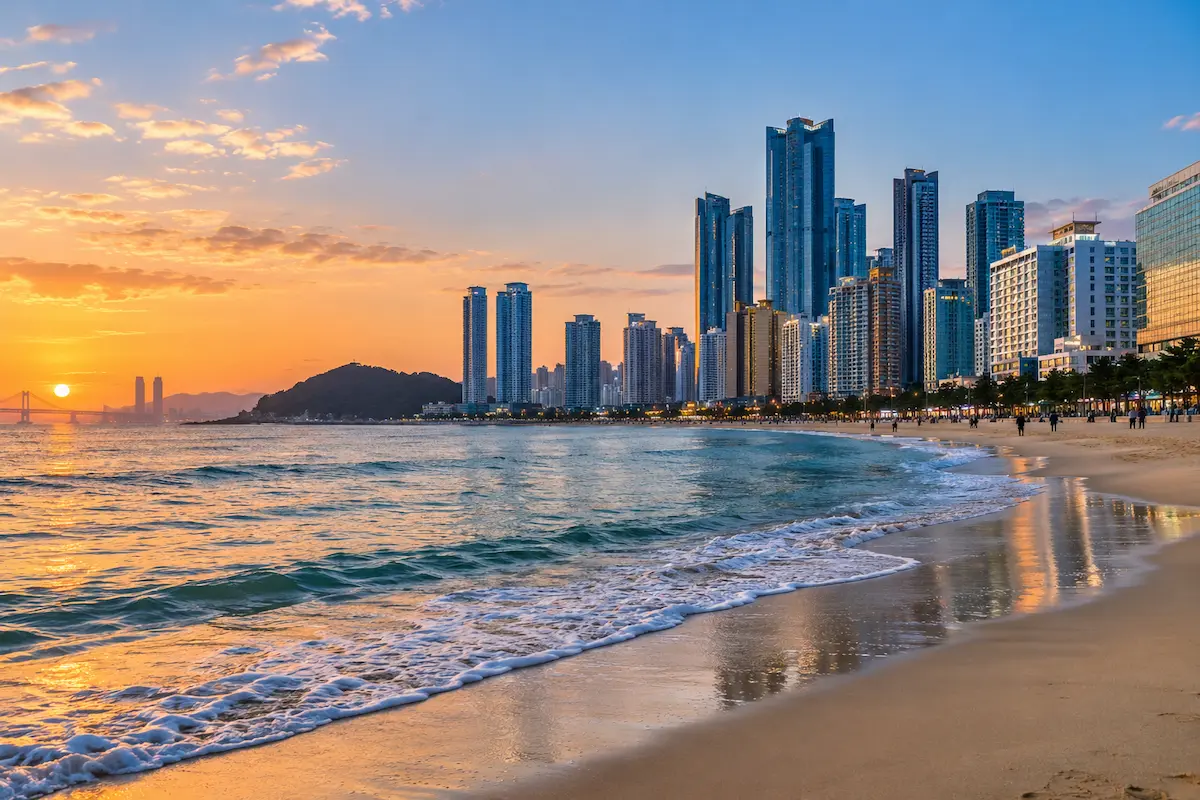
Busan is South Korea’s second-largest city, but it feels very different from Seoul.
The city stretches along the coast and between mountains, so beaches, markets, temples, shopping areas and residential neighbourhoods are spread across a wide area. A destination that looks nearby on a simple map may still require a substantial subway or bus journey.
For many first-time travellers, three to four full days provides a comfortable introduction to Busan, although a shorter stay can still work if you focus on fewer areas.
This guide explains where to stay, what to see, how to get around and how to organise a first Busan trip without trying to fit the entire city into one day.
Busan at a Glance
| Question | Practical answer |
|---|---|
| How many days for a first visit? | 3–4 full days works well for many travellers |
| Best for beaches and modern coastal scenery | Haeundae |
| Best for Gwangalli Beach and evening views | Gwangan |
| Best for markets and older central Busan | Nampo |
| Best for transport and nightlife | Seomyeon |
| Main ways to travel | Subway, bus and taxi |
| Do you need a car? | Usually not for a standard first visit |
| Best known market area | Jagalchi and Nampo |
| Main planning mistake | Putting distant coastal and central areas into the same day |
Busan is easier when you plan by area, not by individual attraction.
How Many Days Do You Need in Busan?
1 Day
One day is possible, but it will feel rushed.
If you only have one day, choose one side of the city rather than trying to cross Busan repeatedly.
A coastal day could focus on:
- Haeundae;
- Gwangalli;
- one nearby eastern Busan attraction.
A central and western Busan day could focus on:
- Gamcheon Culture Village;
- Jagalchi Market;
- Nampo;
- BIFF Square;
- Gukje Market.
Trying to cover both sides of Busan in detail in one day usually creates too much transit time.
2 Days
Two full days can give first-time visitors a useful introduction.
A practical split is:
Day 1 — Eastern Busan
- Haedong Yonggungsa;
- Haeundae;
- nearby coastal areas;
- Gwangalli in the evening.
Day 2 — Central and Western Busan
- Gamcheon Culture Village;
- Jagalchi Market;
- Nampo;
- BIFF Square;
- Gukje Market.
3 to 4 Days
Three to four full days is the most comfortable range for many first-time visitors.
It gives you time for:
- Haeundae and eastern Busan;
- Gwangalli;
- Nampo and Jagalchi;
- Gamcheon or another hillside area;
- a temple or scenic coastal destination;
- cafés, markets and slower neighbourhood exploration;
- weather changes without losing your entire plan.
Two to three full days is enough for a first introduction, but three to four days is better if you want to enjoy beaches, markets, temples and neighbourhoods without rushing.
5 Days or More
A longer stay allows you to explore Busan beyond its best-known sights.
You can add:
- Taejongdae;
- Songdo;
- Dadaepo;
- museums;
- coastal walks;
- local neighbourhoods;
- slower café and market days.
If Busan is part of a multi-city Korea trip, compare your available time with our Korea Itineraries before deciding how many nights to book.
Understand Busan Before Planning Your Days
Busan does not have one compact sightseeing centre.
For practical planning, it helps to think of the city as several travel zones.
Haeundae and Eastern Busan
Haeundae is one of the most familiar names associated with Busan.
This side of the city is useful for:
- Haeundae Beach;
- coastal scenery;
- modern hotels;
- cafés;
- shopping;
- destinations farther east along the coast.
It suits travellers who want the sea to feel like a major part of the trip.
The trade-off is distance from Nampo, Jagalchi and some older parts of central Busan.
Gwangalli
Gwangalli is another popular coastal base.
The beach faces Gwangan Bridge, making the area particularly attractive in the evening.
Visitors often choose Gwangalli for:
- beach walks;
- cafés;
- restaurants;
- evening atmosphere;
- bridge views.
It has a different feeling from Haeundae and can be a good option for travellers who want coastal nightlife without staying in Busan’s easternmost tourist area.
Nampo and Jagalchi
Nampo is one of the strongest areas for travellers interested in Busan’s older commercial centre.
This area works well for:
- Jagalchi Market;
- traditional markets;
- shopping streets;
- local food;
- nearby historic and hillside neighbourhoods.
It is particularly useful if markets and older urban Busan matter more to you than resort-style beaches.
Seomyeon
Seomyeon is inland rather than coastal, but its central transport position makes it practical.
It suits travellers who prioritise:
- subway connections;
- restaurants;
- shopping;
- nightlife;
- easier access to several different parts of Busan.
You will not step outside the hotel and immediately see the sea, but you may save time moving between different areas of the city.
Where Should First-Time Visitors Stay?
The best area depends on the kind of Busan trip you want.
Choose:
- Haeundae if beaches, coastal scenery and modern hotels are priorities;
- Gwangalli for evening beach atmosphere and Gwangan Bridge views;
- Nampo for markets, older central Busan and food;
- Seomyeon for transport convenience, restaurants and nightlife.
Do not choose accommodation by district name alone.
Check:
- the exact subway station;
- the walking route;
- hills and stairs;
- luggage access;
- late-evening transport;
- how long it takes to reach the places on your itinerary.
Busan is spread out enough that accommodation location can noticeably change the pace of the trip.
What Should You See on a First Busan Trip?
You do not need to visit every famous attraction.
A strong first visit usually combines the coast, markets and at least one area that shows Busan beyond the beach.
1. Spend Time by the Sea
For many visitors, the coastline is the main reason Busan feels different from Seoul.
Haeundae and Gwangalli are the two most obvious starting points.
Haeundae
Haeundae is known for its wide urban beach and large concentration of hotels, restaurants and visitor facilities.
The area works well for:
- morning or evening walks;
- cafés;
- coastal views;
- modern Busan;
- easy access to other eastern destinations.
Gwangalli
Gwangalli is particularly attractive later in the day.
The view towards Gwangan Bridge creates one of Busan’s most recognisable evening scenes.
Restaurants and cafés around the beach make it easy to spend several hours in the area without building a complicated itinerary.
2. Visit Nampo and Jagalchi
The Nampo and Jagalchi area provides a very different Busan experience from the eastern beaches.
Here, the city feels more closely connected to markets, port culture and older commercial streets.
Jagalchi is strongly associated with seafood, but visitors who do not plan to eat seafood can still experience the surrounding market district and nearby streets.
This is a good area to combine with other central Busan destinations rather than travelling back and forth from Haeundae several times in one day.
3. Explore a Hillside Neighbourhood
Busan’s geography is one of the things that makes the city visually distinctive.
Homes and streets often rise along steep hills behind the coast.
Gamcheon Culture Village is the best-known example for many international visitors.
Its colourful hillside setting attracts large numbers of tourists, but remember that it is also a neighbourhood rather than an outdoor theme park.
Be considerate around homes, narrow lanes and residents.
Wear comfortable shoes because slopes and stairs are part of the experience.
4. See a Coastal Temple
Haedong Yonggungsa is well known for its location beside the sea.
Its setting makes it visually different from many mountain temples elsewhere in Korea.
Because it is east of central Busan and can require more travel than attractions around Nampo or Seomyeon, it is better grouped with an eastern Busan day rather than inserted randomly into a central-city itinerary.
Allow enough time for transport as well as the visit itself.
5. Leave Time for Ordinary Busan
Busan is more enjoyable when every hour is not assigned to a landmark.
Leave room for:
- a walk beside the sea;
- a neighbourhood restaurant;
- a market snack;
- a café overlooking the coast;
- a convenience-store stop;
- an unexpected detour;
- simply sitting near the water.
The city often works best when you allow its location and atmosphere to become part of the itinerary.
How to Get to Busan
From Seoul by Train
For many visitors, rail is the easiest way to travel from Seoul to Busan.
When comparing trains, do not look only at the advertised rail journey time.
Also consider:
- travel from your Seoul accommodation to the departure station;
- your train arrival time;
- the location of your Busan accommodation;
- luggage;
- metro or taxi transfers after arrival.
Busan Station connects directly with Metro Line 1, but travellers staying in Haeundae or farther east still need additional travel across the city.
For current schedules and reservations, use the official KORAIL booking system.
From Seoul by Bus
Express and intercity buses are another option.
They may suit travellers whose accommodation is closer to a bus terminal or whose route works better by road.
Compare the full door-to-door journey rather than only the time between terminals.
By Air
Domestic flights can make sense when Busan is part of a route involving Jeju.
For Seoul-to-Busan alone, train travel is often simpler after airport transport, check-in and baggage time are considered.
How to Get Around Busan
Busan has an extensive public transport network, and most first-time visitors do not need a rental car.
The subway is useful for many major areas, while buses are important for destinations that are not directly beside a subway station.
Taxis can be particularly useful when:
- travelling with luggage;
- moving between awkwardly connected areas;
- visiting destinations on hills;
- returning late;
- reducing a complicated bus journey.
Busan’s size means that you should check actual journey times before planning the day.
A trip from one famous attraction to another may require significantly more time than expected.
For broader information on transport cards, trains, buses and taxis, use our Getting Around guide.
Arriving in Busan by Train
Many international visitors reach Busan from Seoul or another Korean city by intercity train.
Busan Station is close to the older central part of the city and provides convenient onward connections by subway, bus and taxi.
If your accommodation is in Haeundae or farther east, remember that arriving at Busan Station does not mean your journey is finished.
Allow time for the additional trip across the city.
When travelling with large luggage, compare the subway journey with a taxi rather than choosing automatically.
Arriving Through Gimhae Airport
Gimhae International Airport serves Busan and the surrounding region.
Your best onward route depends on the location of your accommodation.
Before arrival, check:
- the route to your hotel;
- the number of transfers;
- expected arrival time;
- whether you will have large luggage;
- whether public transport is still operating when your flight lands.
Do not wait until you leave the terminal to work out your hotel location.
Save the Korean address and nearest useful station in advance.
Check your route before departure, as the most practical combination of light rail, subway, bus or taxi depends on your accommodation area and arrival time.
Use Map Apps to Check Real Journey Times
Busan’s coastline, rivers, mountains and hills can make simple map distances misleading.
NAVER Map and KakaoMap are useful for:
- subway routes;
- buses;
- walking routes;
- station exits;
- Korean addresses;
- journey times.
For setup, Korean-address searching and route planning, use our guide to NAVER Map and KakaoMap for travellers.
Check the route again on the day you travel, particularly when buses are involved.
Busan’s hills and coastline make route time more important than straight-line distance.
Busan Is Hillier Than It Looks
One of the easiest mistakes is assuming that every short walking route is flat.
Busan has many steep neighbourhoods and hillside streets.
A route of only several hundred metres may involve:
- stairs;
- steep slopes;
- pedestrian bridges;
- narrow roads;
- uneven surfaces.
This matters particularly when visiting places such as hillside neighbourhoods or when choosing accommodation away from a major station.
If mobility is a concern, examine the walking route rather than only the distance.
Plan Busan by Area, Not by Checklist
This is the most important planning principle for a first trip.
Do not select famous attractions from a list and then attempt to connect them afterwards.
Group nearby destinations together.
For example:
Eastern Coastal Day
Haeundae → nearby eastern coastal destinations → evening around Haeundae
Gwangalli Day or Evening
Nearby neighbourhood exploration → Gwangalli Beach → dinner and bridge views
Central Busan Day
Nampo → Jagalchi → surrounding markets and streets → nearby central attractions
Hillside and Market Day
Gamcheon area → central Busan → market or Nampo evening
These are examples, not fixed itineraries.
The goal is to avoid spending large parts of the day travelling from one side of Busan to another.
Food Planning in Busan
Busan has a strong food identity, but you do not need to cross the entire city for one famous restaurant.
A good meal near the area you are already visiting is often a better travel decision than spending an hour each way for a single social-media-famous restaurant.
Foods visitors often look for include:
- seafood;
- dwaeji gukbap;
- milmyeon;
- eomuk;
- grilled fish;
- market food;
- coastal restaurant meals.
Dwaeji Gukbap
Dwaeji gukbap is a pork-and-rice soup closely associated with Busan.
Restaurants prepare it differently, so the seasoning, meat cuts and side dishes can vary.
Milmyeon
Milmyeon is another dish strongly associated with Busan.
It is commonly served as a cold noodle dish and can be especially appealing in warmer weather.
Eomuk
Busan is also well known for eomuk, or fish cake.
You will see it in markets, shops and transport areas.
Seafood
Seafood is an important part of Busan’s food identity.
Jagalchi is the best-known market area, but seafood restaurants are found throughout the city, especially near coastal districts.
When prices are not clearly displayed, ask before ordering.
Popular restaurants may also use waiting systems, minimum-order rules or Korean phone-number verification.
Keep one or two alternative restaurants saved nearby.
For broader restaurant and ordering guidance, see our Food & Drink section.
Payments, Phones and Internet
Card payment is common across Busan, particularly at hotels, convenience stores, cafés, restaurants and larger shops.
Still, visitors should carry a backup.
A practical setup includes:
- an overseas-enabled card;
- a second card;
- a small amount of Korean won;
- mobile data;
- access to the card issuer’s app.
Mobile data is particularly useful in Busan because buses and walking routes can be important for places outside the main subway network.
For cards, cash, SIMs, eSIMs, public Wi-Fi and Korean phone numbers, use our Money, Phones & Apps guide.
Should You Buy the VISIT BUSAN PASS?
Busan offers the VISIT BUSAN PASS for foreign visitors.
Depending on the pass type, it may include participating attractions and other visitor benefits.
Do not buy one automatically.
Before purchasing, compare:
- the attractions you genuinely plan to visit;
- normal admission prices;
- your available time;
- the pass validity period;
- included benefits;
- your actual route.
A sightseeing pass only saves money when the included attractions match your itinerary.
Check the current participating attractions and conditions before purchase because pass benefits can change.
What to Do on Your First Day in Busan
Do not design an exhausting first afternoon simply because you have arrived.
If you have travelled from Seoul, another Korean city or an international flight, allow time to settle in.
A practical first day could be:
- Reach your accommodation.
- Confirm that mobile data and maps work.
- Find the nearest useful subway station or bus stop.
- Check the route for the following morning.
- Eat close to your hotel.
- Take a beach or neighbourhood walk if convenient.
- Leave longer journeys for the next day.
If you are staying near Haeundae or Gwangalli, an evening beside the coast can make an easy introduction without requiring a full sightseeing programme.
When Is the Best Time to Visit Busan?
Busan can be visited throughout the year, but its coastal location changes the experience.
Spring
Spring is generally comfortable for walking and outdoor sightseeing.
Popular seasonal periods can increase visitor numbers and accommodation demand.
Summer
Summer brings heat, humidity and the main beach season.
Haeundae and other coastal areas can become particularly busy.
Rain and storms can affect outdoor plans, so keep indoor alternatives available.
Autumn
Autumn can be comfortable for city exploration and coastal walking.
Major events and popular travel periods may increase accommodation demand.
Winter
Winter is quieter and cooler.
Busan winters are generally milder than Seoul’s, but coastal wind can still make outdoor conditions feel noticeably colder.
For broader seasonal planning, see our guide to the best time to visit Korea.
Common First-Time Busan Mistakes
Treating Busan Like a Compact City Centre
It is geographically spread out.
Check journey times before putting destinations together.
Booking Accommodation Without Checking the Itinerary
Haeundae can be ideal for one traveller and inconvenient for another.
Choose according to where you expect to spend most of your time.
Putting Haeundae, Nampo and Distant Eastern Attractions Into One Day
Technically possible does not mean enjoyable.
Group destinations geographically.
Underestimating Hills
Short walking distances can include significant slopes or stairs.
Assuming Every Attraction Is Beside a Subway Station
Buses or taxis can be more useful for certain places.
Planning Only Beaches
The coast is important, but markets, neighbourhoods and older central Busan provide another side of the city.
Relying Only on Public Wi-Fi
Keep mobile data available while moving between destinations.
A Practical Busan Planning Checklist
Tourist Information and Help
Busan has tourist information services in major visitor areas.
For non-emergency travel information and multilingual visitor assistance, travellers can use the 1330 Korea Travel Helpline.
For emergencies:
- 112 — Police
- 119 — Fire, rescue and ambulance
Save your accommodation name and Korean address on your phone before going out.
This can help with:
- taxis;
- directions;
- lost items;
- emergencies;
- communication when English is limited.
For more practical help, keep our Help & Safety section available.
Before travelling:
- Decide how many full days you have.
- Choose accommodation according to your itinerary.
- Check the nearest useful subway station.
- Save the hotel’s Korean address.
- Prepare mobile data.
- Prepare at least two payment methods.
- Install the map apps you plan to use.
- Group attractions geographically.
- Check bus routes for destinations outside the subway network.
- Look at slopes and walking routes.
- Save important reservations offline.
- Check the weather shortly before travelling.
- Know how you will reach the hotel from Busan Station or Gimhae Airport.
For emergencies, medical help and practical traveller support, keep our Help & Safety section available.
Frequently Asked Questions
Is Busan worth visiting on a first Korea trip?
Yes, particularly if you want to experience a major Korean city with beaches, coastal scenery, markets and a different pace from Seoul.
How many days should I spend in Busan?
Two days can provide a short introduction, but three or four full days allows a more comfortable first visit.
Is Busan easy to travel without a car?
Yes.
The subway, buses and taxis are sufficient for most standard first-time itineraries.
Where should I stay in Busan?
Choose Haeundae for beaches and eastern Busan, Gwangalli for coastal evening atmosphere, Nampo for markets and older central Busan, or Seomyeon for transport convenience and nightlife.
Is Haeundae the best place to stay?
Not necessarily.
It is an excellent choice for coastal travel, but visitors focusing on markets and central Busan may find Nampo more convenient. Travellers moving around several parts of the city may prefer Seomyeon.
Is Busan walkable?
Individual neighbourhoods are walkable, but Busan as a whole is too large and geographically varied to explore mainly on foot.
Use public transport between areas.
Can I visit Busan as a day trip from Seoul?
It is physically possible to travel between the cities quickly by high-speed train, but a same-day return allows very little time to experience Busan properly.
An overnight stay is more practical if Busan is an important part of your trip.
Do I need to visit both Haeundae and Gwangalli?
No.
Both offer beach settings but have different atmospheres. Visit both if you have enough time, or choose the one that fits your accommodation and itinerary better.
Final Recommendation
For a first Busan trip, do not try to cover the whole city in one day.
Give yourself three or four days if possible, choose accommodation that matches the areas you most want to see and group each day’s sightseeing geographically.
Spend time beside the sea.
Explore a market or older central neighbourhood.
See at least one place that shows Busan’s hills or coastal geography.
Use the subway for major corridors and buses or taxis when they make the route simpler.
Most importantly, allow the city enough time to feel different from Seoul rather than treating Busan as a checklist of beaches and famous attractions.
If you are combining Busan with Seoul or Gyeongju, check the travel order before booking accommodation so you do not create unnecessary backtracking.
To compare Busan with Seoul, Gyeongju, Jeju and other parts of Korea, return to our Destinations guide.