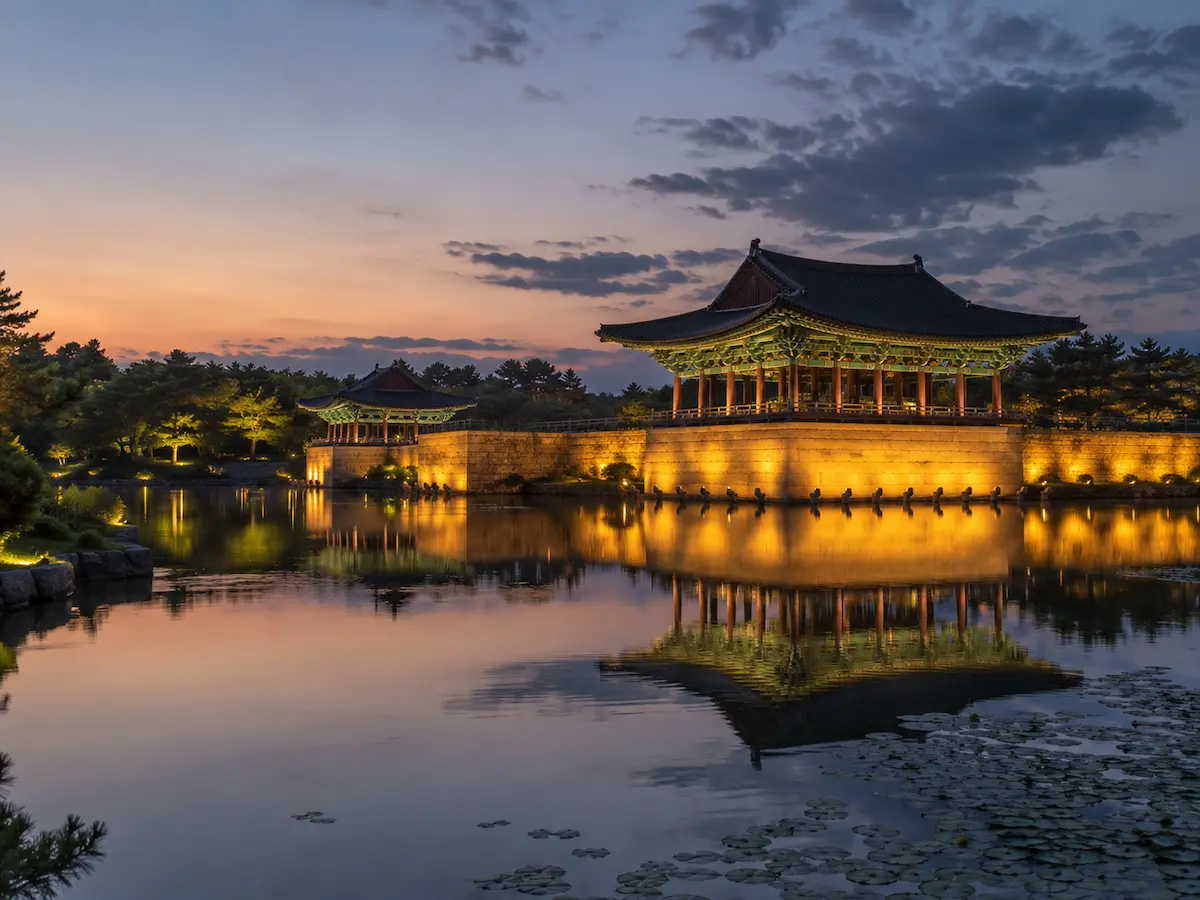
Gyeongju is one of the easiest Korean cities to enjoy without trying to see everything.
Many of its most important Silla-era sites are concentrated around the historic centre, which means a one-day visit can already include royal tombs, Cheomseongdae, traditional streets and an evening at Donggung and Wolji.
With two days, you can slow the pace down and add Bulguksa Temple, Seokguram Grotto and more time for museums, cafés or neighbourhood walking.
For a first visit, the simplest plan is:
1 day: focus on central historic Gyeongju.
2 days: keep Day 1 in the historic centre and use Day 2 for Bulguksa, Seokguram and a slower cultural stop.
This itinerary is designed for travellers arriving by train or bus and using walking, local buses and occasional taxis rather than renting a car.
Gyeongju in 1 or 2 Days at a Glance
| Trip length | Main areas | Best for |
|---|---|---|
| 1 day | Daereungwon, Hwangridan-gil, Cheomseongdae, Woljeonggyo, Donggung and Wolji | First-time highlights and historic central Gyeongju |
| 2 days | Day 1 central Gyeongju + Day 2 Bulguksa, Seokguram and museum or slower exploration | A more complete introduction to Silla history and culture |
The key planning principle is simple:
Do not scatter your day across distant attractions when central Gyeongju already offers several major sites within walking distance.
If Gyeongju is one stop in a longer Korea journey, compare your route with our Korea Itineraries before booking accommodation.
If You Have Only 1 Day in Gyeongju
One day works best when you stay around the historic centre.
Do not begin with Bulguksa or another outer attraction unless it is your personal priority.
A central route gives you more time to walk between sites and less time waiting for transport.
Morning: Start at Daereungwon
Begin at Daereungwon, Gyeongju’s large royal tomb complex.
The rounded grass-covered burial mounds immediately make the city feel different from Seoul or Busan.
This is a useful first stop because it places you directly inside the historic centre and close to several other major sights.
Walk slowly rather than treating the site as a quick photo stop.
The scale and shape of the tombs are part of the experience.
Late Morning: Walk to Hwangridan-gil
From Daereungwon, continue towards Hwangridan-gil.
This area combines traditional-style buildings with cafés, restaurants, small shops and modern businesses.
It is not an ancient street preserved exactly as it looked during the Silla period.
It is a contemporary commercial neighbourhood that sits beside some of Gyeongju’s most important historic sites.
That contrast is part of what makes central Gyeongju interesting.
Use Hwangridan-gil for:
- coffee;
- lunch;
- snacks;
- small shops;
- a slower break between historic sites.
Do not feel that you need to visit a famous café simply because it appears on social media.
Choose somewhere that fits naturally into your walking route.
Lunch: Stay Around Hwangridan-gil or the Historic Centre
Have lunch before continuing the afternoon sightseeing.
Popular restaurants can have queues, waiting systems or minimum-order rules.
Keep one or two alternatives saved nearby rather than allowing one restaurant to control the whole itinerary.
For ordering, payment and restaurant customs, use our Food & Drink guide.
Afternoon: Cheomseongdae and the Wolseong Area
Continue towards Cheomseongdae.
Cheomseongdae is one of Gyeongju’s most recognisable landmarks and sits within the wider Wolseong historic area.
The advantage of this part of Gyeongju is proximity.
You can move between several historic sites without constantly using buses or taxis.
Take your time walking through the surrounding landscape rather than focusing only on the stone observatory itself.
This is also where planning Gyeongju by area rather than by attraction begins to pay off.
Continue Towards Woljeonggyo Bridge
From the central historic area, continue towards Woljeonggyo Bridge if your pace and weather allow.
The reconstructed bridge crosses the Namcheon stream and fits naturally into a walking route through central Gyeongju.
It is especially attractive later in the day when the light begins to soften.
You do not need to arrive at a precise photography time.
The main benefit is that the bridge can be included without creating a major detour from the historic district.
Evening: Donggung and Wolji
Finish the day at Donggung Palace and Wolji Pond.
This is one of the best places in Gyeongju to save for the evening.
The illuminated buildings reflected in the water create a very different atmosphere from the daytime tombs and open historic landscapes.
Do not rush here too early simply to complete the itinerary.
If possible, allow the transition from daylight into evening to become part of the visit.
After Donggung and Wolji, return to your accommodation or have dinner nearby.
For a one-day Gyeongju trip, this is already a substantial itinerary.
If You Have 2 Days in Gyeongju
With two days, keep the first day largely the same.
The extra day should make the trip slower and broader, not simply add another long checklist.
Use Day 2 for the major Buddhist heritage sites outside central Gyeongju.
Day 2 Morning: Bulguksa Temple
Start Day 2 at Bulguksa Temple.
Bulguksa is one of Korea’s most important Buddhist heritage sites and, together with Seokguram Grotto, forms a UNESCO World Heritage property.
Unlike the compact historic centre, Bulguksa sits outside the main downtown walking cluster.
That is why it works better as part of a separate second day.
Allow enough time to walk through the temple grounds rather than treating it as a brief stop before the next attraction.
The details of the stone terraces, pagodas, gates and temple layout are part of the experience.
Should You Add Seokguram Grotto?
If you have two full days, Seokguram Grotto is a logical addition to Bulguksa.
The two sites share a strong historical and cultural connection, but they are not beside each other in a way that makes them one continuous walking attraction.
Check the current bus or taxi route before leaving Bulguksa.
Do not underestimate the additional travel time simply because both places are often mentioned together.
If mobility, weather or time makes Seokguram inconvenient, visiting Bulguksa properly is better than rushing through both.
Afternoon Option 1: Gyeongju National Museum
After Bulguksa and Seokguram, consider returning towards central Gyeongju for the Gyeongju National Museum.
The museum is particularly useful after you have already seen the tombs, palace sites and temples.
Objects that can feel abstract at the beginning of a trip often make more sense after you have walked through the places where Silla history happened.
Choose the museum if you want:
- more historical context;
- Silla artefacts;
- royal and Buddhist objects;
- an indoor activity;
- a slower second afternoon.
This is also a useful option in poor weather.
Afternoon Option 2: Slow Down Instead
You do not have to visit another major institution.
If you prefer a slower trip, return to central Gyeongju and spend the afternoon around:
- Hwangridan-gil;
- cafés;
- quieter historic streets;
- another walk near Daereungwon;
- areas you passed too quickly on Day 1.
Two days should give you breathing room.
If the second afternoon feels like another race, the extra day is not doing its job.
Where Should You Stay in Gyeongju?
For a one- or two-day first trip, staying close to central historic Gyeongju is usually the most practical choice.
Areas around Hwangridan-gil and the central sightseeing district provide easier access to:
- Daereungwon;
- Cheomseongdae;
- restaurants and cafés;
- central evening walks;
- bus and taxi connections.
Accommodation ranges from hotels to guesthouses and hanok-style stays.
Do not choose a property simply because the booking page says “Gyeongju”.
Check:
- the exact location;
- walking distance to the historic centre;
- luggage access;
- stairs;
- reception hours;
- distance from the bus terminal or route from Gyeongju Station.
A beautiful rural stay can work well for a longer trip but may make a short first visit unnecessarily complicated.
Arriving in Gyeongju by KTX
High-speed trains serve Gyeongju Station.
The station is outside the central historic district, so arriving by KTX does not mean you can walk directly from the platform to Daereungwon or Hwangridan-gil.
You will need onward transport.
Depending on your arrival time and accommodation, use:
- local bus;
- taxi;
- another appropriate connection.
Gyeongju City’s official transport information currently lists approximate KTX journey times of around:
- 2 hours 10 minutes from Seoul;
- 30 minutes from Busan.
Treat these as general planning times rather than guarantees for every train.
Check your actual service before departure.
For trains, intercity transport and practical connections, use our Getting Around guide.
Arriving by Intercity or Express Bus
The bus terminals are closer to central Gyeongju than the high-speed rail station.
This can make bus travel particularly convenient if your accommodation is around Hwangridan-gil or the historic centre.
The best option depends on where you are coming from.
For example, travellers arriving from Busan may find a direct intercity bus competitive with taking a train once transfers and local transport are included.
Do not compare only the fastest scheduled vehicle time.
Compare the entire journey from your previous accommodation to your next one.
Can You Visit Gyeongju as a Day Trip?
Yes.
Gyeongju works better as a day trip than many larger Korean destinations because several major historic sites are concentrated in the central district.
A day trip can work particularly well from:
- Busan;
- Daegu;
- another nearby city.
A same-day trip from Seoul is also possible by high-speed train, but it creates a longer and more structured travel day.
If you are especially interested in history, temples or evening Gyeongju, staying overnight is more rewarding.
The overnight stay allows you to experience Donggung and Wolji after dark without worrying as much about the final train or bus.
How to Get Around Gyeongju
Central Gyeongju is one of the more walkable parts of a Korea itinerary.
Many important downtown sights are relatively close together.
Walking works particularly well for:
- Daereungwon;
- Hwangridan-gil;
- Cheomseongdae;
- Wolseong-area sites;
- Woljeonggyo.
For outer attractions such as Bulguksa and Seokguram, use buses or taxis.
Do not assume that every Gyeongju attraction belongs in one walking circuit.
The historic centre is compact.
The wider city is not.
For Korean public transport, taxis and transport cards, see Getting Around.
Use Korean Map Apps
NAVER Map and KakaoMap are useful in Gyeongju for:
- bus routes;
- walking directions;
- Korean attraction names;
- station and terminal connections;
- checking the route to Bulguksa;
- estimating travel time between central and outer attractions.
For setup and Korean-address searching, use our NAVER Map and KakaoMap guide.
Save the Korean name of your accommodation before arrival.
This is especially useful when taking a taxi from Gyeongju Station.
Food and Cafés
Gyeongju is a historic destination, but food does not need to become another sightseeing checklist.
For a one- or two-day trip, keep meals convenient.
Hwangridan-gil and the surrounding centre provide plenty of restaurants, cafés and snacks between major attractions.
You may also encounter foods and products associated with Gyeongju, including local baked snacks and traditional-style dishes.
Try them if they interest you.
Do not spend an hour crossing town simply because one shop is famous online.
For general ordering, payment and food-allergy guidance, use our Food & Drink section.
Payments, Phones and Mobile Data
Card payment is common at hotels, cafés, restaurants and many attractions, but visitors should still carry a backup.
A practical setup includes:
- one overseas-enabled card;
- a second card;
- a small amount of Korean won;
- mobile data;
- access to your card issuer’s app.
Mobile data is particularly useful when checking buses between the station, central Gyeongju and attractions such as Bulguksa.
For cards, cash, SIMs, eSIMs, Korean phone numbers and public Wi-Fi, use our Money, Phones & Apps guide.
What If It Rains?
Gyeongju can still work in poor weather, but adjust the pace.
You can:
- spend longer at the Gyeongju National Museum;
- use cafés around Hwangridan-gil;
- shorten long outdoor walks;
- use taxis for awkward connections;
- move open historic areas to a drier part of the day.
Historic landscapes are a major part of Gyeongju, so heavy rain can affect the experience more than it would on a shopping-focused Seoul day.
Do not force an outdoor schedule during severe weather.
For emergency information and practical traveller support, keep our Help & Safety guide available.
When Is the Best Time to Visit Gyeongju?
Gyeongju can be visited throughout the year.
Spring
Spring is popular for outdoor walking and seasonal blossoms.
Popular weekends can also bring larger crowds.
Summer
Summer can be hot and humid.
Central Gyeongju involves considerable outdoor walking, so plan breaks, water and indoor alternatives.
Autumn
Autumn is popular for comfortable walking weather and seasonal scenery.
Accommodation demand can increase during busy periods.
Winter
Winter is quieter and colder.
Outdoor sites remain visitable, but shorter daylight and low temperatures can affect how long you want to remain outside.
For broader seasonal planning, see our guide to the best time to visit Korea.
Common Mistakes on a Gyeongju Trip
Trying to Add Bulguksa to a Packed One-Day Downtown Route
It can be done, but it often makes the day much more rushed.
For most first-time visitors, central Gyeongju alone can fill one day well.
Treating Every Historic Site as a Separate Transport Journey
Several important central sites are close enough to combine on foot.
Check the map before calling another taxi.
Leaving Donggung and Wolji Too Early
If you want the evening atmosphere, allow enough time for the light to change.
Assuming Gyeongju Station Is in the Historic Centre
The KTX station requires onward transport.
Build this into arrival and departure planning.
Spending Too Much Time in Cafés
Hwangridan-gil is enjoyable, but do not let café queues consume the time you intended for the historic sites.
Trying to See Every UNESCO or Silla Site in Two Days
Gyeongju contains far more heritage than a short first visit can cover.
Choose a coherent introduction rather than a complete inventory.
Gyeongju 1-Day Checklist
- [ ] Arrive early enough for a full central sightseeing day.
- [ ] Start around Daereungwon.
- [ ] Keep Hwangridan-gil convenient for lunch or a café break.
- [ ] Walk towards Cheomseongdae and the Wolseong area.
- [ ] Include Woljeonggyo if time and weather suit.
- [ ] Save Donggung and Wolji for the evening if possible.
- [ ] Check your final train or bus if you are not staying overnight.
Gyeongju 2-Day Checklist
Day 1
- [ ] Daereungwon
- [ ] Hwangridan-gil
- [ ] Cheomseongdae
- [ ] Wolseong-area walking
- [ ] Woljeonggyo
- [ ] Donggung and Wolji
Day 2
- [ ] Bulguksa
- [ ] Seokguram if time, weather and mobility suit
- [ ] Gyeongju National Museum or a slower central afternoon
- [ ] Leave enough time for your onward train or bus
Frequently Asked Questions
Is one day enough for Gyeongju?
Yes, for a strong first introduction.
The historic centre contains enough major sites to fill a full day without travelling constantly across the city.
Is two days better?
Yes, if Silla history and Korean heritage are important to you.
A second day gives you time for Bulguksa, Seokguram and a slower pace.
Should I stay overnight?
An overnight stay is worthwhile if you want to see Donggung and Wolji in the evening or avoid organising the whole trip around a return train or bus.
Can I visit Gyeongju without a car?
Yes.
Central Gyeongju is highly suitable for walking, while buses and taxis can cover outer attractions.
Should I visit Bulguksa on a one-day trip?
Only if it is a major personal priority.
For most first-time visitors, keeping a one-day itinerary around central Gyeongju creates a more relaxed and coherent trip.
Is Seokguram next to Bulguksa?
No.
The two sites are closely connected historically, but additional transport is required.
Check the current route before travelling.
Is Gyeongju a good day trip from Busan?
Yes.
Its proximity to Busan makes a day trip practical, although an overnight stay provides more time and allows you to enjoy the historic centre after dark.
Is Gyeongju Station close to Hwangridan-gil?
Not within normal sightseeing walking distance.
Plan a bus or taxi connection between Gyeongju Station and the historic centre.
Final Recommendation
If you have one day in Gyeongju, keep it simple.
Stay around Daereungwon, Hwangridan-gil, Cheomseongdae, the Wolseong area and Donggung and Wolji.
If you have two days, use the second day for Bulguksa, Seokguram and either the Gyeongju National Museum or a slower return to central Gyeongju.
Do not turn one of Korea’s most walkable historic cities into a race between distant attractions.
The best first Gyeongju trip is not the one with the longest heritage checklist.
It is the one that gives you enough time to understand why this relatively quiet city was once the centre of the Silla kingdom.
To compare Gyeongju with Seoul, Busan, Jeju and other parts of Korea, return to our Destinations guide.
If Gyeongju is one stop on a longer journey, compare the route with our Korea Itineraries before booking accommodation.
Official Information
For current Gyeongju tourism information and official suggested routes:
Gyeongju City Tourism — Downtown Gyeongju
For Bulguksa, Seokguram and other UNESCO heritage information:
Gyeongju City Tourism — UNESCO Heritage
For current transport information to Gyeongju:
Gyeongju City Tourism — Getting to Gyeongju
Information reviewed: September 2026.