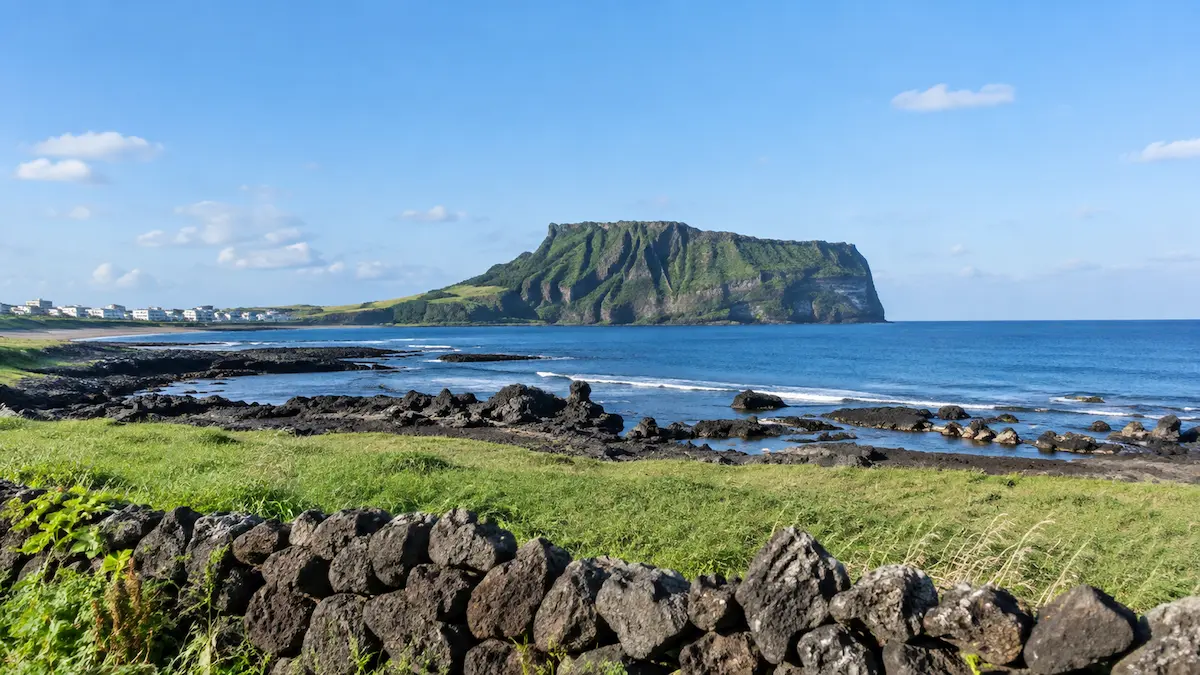
Jeju is one of the easiest places in Korea to underestimate on a map.
The island looks compact, but beaches, waterfalls, volcanic landscapes, cafés, towns and hiking areas are spread across a much larger area than many first-time visitors expect.
The most important decision is therefore not which attraction to visit first.
It is how you will move around the island.
You can travel around Jeju without renting a car. Buses, taxis and carefully chosen accommodation can make a car-free trip work well. A rental car, however, gives you considerably more freedom when visiting rural areas, coastal roads and attractions that would otherwise require long waits or multiple transfers.
For many first-time travellers, three to five full days gives enough time to experience more than one part of the island without turning every day into a race.
This guide explains how to plan Jeju both without a car and with a car, where to stay, which parts of the island work well together and what to prepare before arrival.
Jeju at a Glance
| Question | Practical answer |
|---|---|
| How many days for a first visit? | Around 3–5 full days works well for many travellers |
| Can you visit without a car? | Yes, with careful planning |
| Is a rental car useful? | Very useful for flexibility and rural destinations |
| Best base for airport access | Jeju City |
| Best base for southern Jeju | Seogwipo |
| Best for resort areas | Jungmun |
| Main car-free transport | Public buses and taxis |
| Main driving requirement for many overseas visitors | Valid International Driving Permit plus required identification |
| Main planning mistake | Crossing the island repeatedly in one day |
The most useful principle is simple:
Plan Jeju by region, not by a list of attractions.
How Many Days Do You Need in Jeju?
2 Days
Two full days is possible, but you need to be selective.
Do not try to circle the entire island.
A practical short trip might focus on:
- one eastern Jeju day;
- one southern or western Jeju day.
If you are travelling without a car, reduce the number of stops further and plan around the bus network.
3 Days
Three days works well for a first introduction.
A practical structure is:
Day 1 — Eastern Jeju
- Seongsan Ilchulbong;
- nearby coastal scenery;
- Seopjikoji or another nearby stop;
- café or local meal.
Day 2 — Southern Jeju
- Seogwipo;
- waterfall or coastal area;
- local market;
- slower evening.
Day 3 — Choose One
- western Jeju;
- Hallasan;
- an Olle walking route;
- or a flexible weather day.
Do not try to combine all four options.
4 to 5 Days
Four or five days is the most comfortable range for many first-time visitors.
It gives you time for:
- eastern Jeju;
- southern Jeju;
- western Jeju;
- Hallasan or another volcanic landscape;
- markets and local food;
- cafés and coastal roads;
- one flexible day if the weather changes.
This is especially useful if you want to see both northern and southern Jeju without spending every day moving long distances.
A Week or More
A longer stay allows you to travel more slowly and explore areas outside the best-known tourist circuit.
You can add:
- smaller coastal villages;
- longer walks;
- multiple oreum;
- less crowded cafés;
- museums;
- local markets;
- hiking;
- weather-flexible days.
If Jeju is part of a longer Korea trip, compare your available time with our Korea Itineraries before booking flights and accommodation.
The First Decision: Jeju Without a Car or With a Car?
Both are possible.
The right choice depends on your confidence, itinerary and travel style.
Jeju Without a Car
A car-free trip works best when you:
- stay close to a useful transport hub;
- group attractions geographically;
- allow more time between destinations;
- use taxis when a bus connection is inconvenient;
- avoid trying to visit several remote places in one day.
This style suits travellers who:
- do not drive;
- prefer not to drive abroad;
- are staying mainly in Jeju City or Seogwipo;
- plan a slower itinerary;
- are comfortable using buses and taxis.
Public transport can take you around the island, but the experience is different from travelling around Seoul or Busan.
Jeju attractions are often farther apart, and some rural journeys may involve longer waiting times or transfers.
The island is therefore possible without a car, but easier when your itinerary is designed around that fact.
Jeju With a Rental Car
A rental car gives you considerably more control over the day.
It is useful when you want to:
- stop at several coastal locations;
- visit rural cafés;
- reach smaller attractions;
- explore oreum or countryside areas;
- change plans because of weather;
- avoid waiting for connecting buses;
- carry luggage between different accommodation areas.
Driving also makes it easier to stay outside the main urban centres.
However, renting a car is not automatically the best choice for everyone.
You still need to consider:
- driving in an unfamiliar country;
- parking;
- insurance;
- weather;
- narrow rural roads;
- speed limits and traffic rules;
- alcohol and driving;
- navigation.
If you are uncomfortable driving abroad, a slower car-free itinerary is better than renting a car simply because other travellers say you need one.
What Do Foreign Visitors Need to Rent a Car?
Do not arrive in Jeju assuming your ordinary home driving licence alone will always be sufficient.
For many short-term overseas visitors, you should prepare:
- your passport;
- a valid International Driving Permit (IDP) recognised in Korea;
- your original home-country driving licence;
- a credit card accepted by the rental company;
- the rental confirmation.
VISITKOREA advises short-term visitors to carry an appropriate international driving licence and passport, and notes that some rental companies may also request the original licence from the traveller’s home country. Individual rental companies can impose additional age, driving-experience and payment conditions.
Do not confuse a genuine International Driving Permit with unofficial documents sold online as an “international driving licence”.
Before paying for a rental car, confirm the requirements directly with the rental company.
Jeju Without a Car: Who Is It Best For?
A car-free Jeju trip can work well if you:
- do not drive;
- prefer not to drive abroad;
- are staying mainly in Jeju City or Seogwipo;
- have three or more days;
- prefer a slower itinerary;
- are comfortable using buses and occasional taxis.
The key is to accept that a bus itinerary should contain fewer stops than a driving itinerary.
Jeju With a Car: Who Is It Best For?
A rental car is especially useful if you:
- want to visit several rural or coastal places;
- plan to stay outside Jeju City or central Seogwipo;
- want flexibility around weather;
- are travelling with luggage;
- are travelling as a couple, family or small group;
- are comfortable driving in Korea.
A car provides flexibility, but it does not make every route short or every parking situation easy.
Where Should First-Time Visitors Stay?
Jeju does not have one universally best accommodation area.
Your transport choice matters almost as much as the location itself.
Jeju City
Jeju City is practical for:
- short stays;
- airport access;
- early flights;
- late arrivals;
- markets;
- restaurants;
- northern Jeju;
- travellers without a car.
It is often the easiest first or final base because Jeju International Airport is nearby.
The trade-off is that southern and far eastern or western destinations can require longer journeys.
Seogwipo
Seogwipo is useful for travellers focusing on southern Jeju.
It works well for:
- waterfalls;
- southern coastal scenery;
- markets;
- restaurants;
- access to several southern attractions.
For a longer trip, some visitors divide their stay between Jeju City and Seogwipo rather than travelling across the island every day.
Jungmun
Jungmun is a major resort and tourism area west of central Seogwipo.
It can suit:
- resort stays;
- families;
- travellers prioritising hotel facilities;
- nearby coastal attractions;
- visitors who prefer a quieter resort-style base.
It is less convenient if most of your plans are around Jeju City or the far east.
Eastern Jeju
Eastern Jeju is attractive for travellers interested in:
- Seongsan area;
- coastal scenery;
- volcanic landscapes;
- quieter countryside;
- nearby island or coastal excursions.
It can work well as part of a driving itinerary or a slower regional stay.
Without a car, check bus connections carefully before booking accommodation far from a transport hub.
Western Jeju
Western Jeju offers another mixture of:
- coast;
- cafés;
- rural landscapes;
- beaches;
- museums and attractions.
As in eastern Jeju, having a car makes spontaneous stops much easier.
Car-free travellers should plan around specific bus corridors rather than assuming every attraction connects directly to the next one.
What Should You See on a First Jeju Trip?
You do not need to see every famous attraction.
A stronger first trip usually combines several different sides of the island.
1. See the Volcanic Landscape
Jeju’s identity is inseparable from its volcanic geography.
Hallasan rises in the centre of the island, while oreum — smaller volcanic cones — are scattered across the landscape.
You do not need to climb Hallasan to appreciate this side of Jeju.
Shorter walks, viewpoints and oreum can provide a volcanic landscape experience without committing to a full mountain hike.
2. Spend Time on the Coast
Jeju’s coastline changes constantly.
You will find:
- rocky volcanic shores;
- beaches;
- cliffs;
- fishing villages;
- coastal roads;
- walking paths.
One of the advantages of having a rental car is the freedom to stop when the coast looks interesting.
Without a car, choose one or two accessible coastal areas rather than trying to follow the entire shoreline.
3. Visit a Waterfall or Southern Scenic Area
The Seogwipo region is particularly well known for waterfalls and coastal scenery.
These destinations fit naturally into a southern Jeju day.
Do not combine several southern attractions with far eastern and northern destinations simply because they all appear on a “top things to do” list.
Check actual travel times first.
4. Visit a Market
Markets provide a useful contrast to scenic attractions.
They can be good places for:
- local food;
- fruit;
- snacks;
- souvenirs;
- seeing ordinary daily activity.
If you are staying in Jeju City or Seogwipo, a market can also make an easy evening activity without requiring another long journey.
5. Leave Time for Cafés and Unplanned Stops
Jeju has a large café culture, particularly around coastal and scenic areas.
You do not need a list of twenty famous cafés.
Choose one that fits naturally into your route.
This matters especially when driving.
A good Jeju day may include fewer major attractions than a Seoul sightseeing day but more stops along the way.
Can You Really Travel Jeju by Bus?
Yes.
Jeju has a public bus network connecting urban areas, transport hubs and many attractions.
Tourist shuttle routes also serve selected sightseeing areas.
However, public transport works best when the itinerary is designed around the routes rather than when the traveller selects attractions first and tries to connect them later.
Official VISITJEJU information describes regular buses, airport connections and tourist shuttle services operating across different parts of the island.
For a car-free trip:
- check the route before leaving;
- check the return route as well;
- allow buffer time;
- save the stop name in Korean;
- know when the last practical bus leaves;
- use taxis when a connection would otherwise consume too much time.
Do not rely on an old blog post for bus numbers or exact timetables.
Routes and schedules can change.
Use Taxis Strategically
A car-free trip does not mean every journey needs to be made by bus.
A taxi can be worthwhile when:
- two attractions are close geographically but poorly connected by bus;
- you are travelling with luggage;
- rain changes your plans;
- the next bus requires a long wait;
- you need to reach an accommodation property away from the main road.
The most efficient car-free Jeju trip often uses buses for longer planned journeys and taxis selectively for awkward connections.
For broader information about Korean taxis and transport cards, see our Getting Around guide.
Use Korean Map Apps
Map apps are especially important in Jeju.
Straight-line distance can be misleading when:
- Hallasan lies between two destinations;
- roads follow the coast;
- a bus route requires a transfer;
- an attraction entrance is far from the main road.
NAVER Map and KakaoMap are useful for:
- bus routes;
- stops;
- driving routes;
- estimated travel times;
- Korean addresses;
- attraction entrances.
For setup, Korean-address searching and route planning, use our guide to NAVER Map and KakaoMap for travellers.
Arriving at Jeju International Airport
Most visitors arrive through Jeju International Airport.
Before landing, know:
- where your accommodation is;
- whether you are collecting a rental car;
- whether the rental company uses a shuttle;
- which bus route serves your area;
- whether a taxi is more practical with luggage.
If you are renting a car, do not assume the vehicle itself will be waiting directly outside the terminal.
Rental companies commonly operate shuttle services between the airport and off-site rental facilities.
If you are travelling without a car, save your accommodation’s Korean name, address and nearest useful bus stop before leaving the airport.
Should You Split Your Accommodation?
For a short stay, changing hotels can waste time.
For a longer Jeju trip, however, two bases can sometimes reduce travel.
For example:
Jeju City + Seogwipo
can work well when your plans are divided between northern and southern Jeju.
A split stay is more useful when it eliminates repeated long journeys than when it simply gives you two different hotels.
Before booking, compare the inconvenience of moving luggage with the travel time you would save.
Plan Jeju by Region
This is the most important planning habit.
Do not arrange attractions according to popularity.
Arrange them according to geography.
For example:
Northern Jeju Day
Jeju City → nearby northern coast → market or city evening
Southern Jeju Day
Seogwipo → waterfall or coastal destination → southern cafés or market
Eastern Jeju Day
One major eastern attraction → nearby coast or volcanic landscape → regional café or village
Western Jeju Day
Western coastline → one or two nearby attractions → relaxed return
These are planning patterns rather than fixed itineraries.
The point is to avoid crossing Jeju unnecessarily.
A Practical 3-Day Jeju Itinerary
Day 1 — Eastern Jeju
Focus on one eastern route.
Possible stops include:
- Seongsan Ilchulbong;
- Seopjikoji;
- nearby coast;
- local café or meal.
Day 2 — Southern Jeju
Base the day around Seogwipo and nearby southern attractions.
Possible stops include:
- one waterfall;
- a coastal area;
- Seogwipo market;
- a relaxed evening meal.
Day 3 — Choose One Region
Choose only one main direction:
- western Jeju;
- Hallasan;
- an Olle trail;
- or a flexible day based on weather.
Trying to combine all of them usually creates too much travel.
A Practical 4-Day Jeju Itinerary
Day 1 — Eastern Jeju
Seongsan area and nearby coastal attractions.
Day 2 — Southern Jeju
Seogwipo, waterfall or coast, market and dinner.
Day 3 — Western Jeju
Western coast, cafés, beaches or smaller regional attractions.
Day 4 — Hallasan or Flexible Day
Use the final day for Hallasan, an Olle route or whichever outdoor plan was affected by weather earlier in the trip.
If you are travelling without a car, reduce the number of stops and check the complete return route before leaving for remote areas.
What About Hallasan?
Hallasan requires separate planning from an ordinary sightseeing day.
Weather, trail conditions, seasonal restrictions and reservation rules can affect access.
At present, summit access through designated sections of the Seongpanak and Gwaneumsa routes is subject to the Hallasan Trail Reservation System. Other official trails have different access rules.
Do not choose a trail solely from an old itinerary.
Check the official Hallasan National Park information shortly before hiking.
Also remember that a mountain day can consume most of the day.
Do not plan a long summit hike and then fill the evening with distant sightseeing simply because the attractions appear close on an island map.
What to Eat in Jeju
Jeju has its own food identity, and meals can be part of the travel experience without requiring a long detour to one famous restaurant.
Jeju Black Pork
Black pork is one of Jeju’s best-known local foods.
You will find black-pork restaurants across the island, particularly in Jeju City and Seogwipo.
When comparing restaurants, check:
- menu prices;
- minimum-order rules;
- whether portions are designed for two or more people;
- waiting systems;
- location relative to your day’s route.
Solo travellers should check serving requirements before making a special trip.
Seafood and Haenyeo Culture
Seafood is closely connected with Jeju’s island identity.
Jeju’s haenyeo, or female divers, are an important part of the island’s cultural heritage.
Some coastal areas have restaurants and food stalls associated with seafood gathered locally.
Do not assume every seafood restaurant or “haenyeo” experience is the same.
Check current opening hours, menus and prices before travelling a long distance specifically for one restaurant.
Tangerines and Local Products
Jeju is strongly associated with citrus fruit.
Depending on the season, visitors may see:
- fresh mandarins;
- citrus drinks;
- desserts;
- jams;
- snacks;
- locally branded products.
These can be easy additions to a trip because they are available in markets, cafés and shops across the island.
Markets and Everyday Meals
Traditional markets can be useful for trying several foods in one place.
Jeju City and Seogwipo both have major market areas, while smaller neighbourhood restaurants often provide a less crowded alternative to famous social-media destinations.
Save one or two backup restaurants near each day’s route.
For broader restaurant and ordering guidance, see our Food & Drink section.
Payments, Phones and Internet
Card payment is widely used in Jeju, but do not rely on one card only.
A practical setup includes:
- one overseas-enabled card;
- a second card;
- a small amount of Korean won;
- mobile data;
- access to your card issuer’s app.
Mobile data is particularly valuable on Jeju because directions, bus routes, attraction entrances and driving routes may need to be checked while moving between rural areas.
For cards, cash, SIMs, eSIMs, public Wi-Fi and Korean phone numbers, use our Money, Phones & Apps guide.
Weather Can Change the Day
Jeju’s island weather deserves more flexibility than many travellers expect.
Wind, rain, heat, fog or poor mountain conditions can change:
- hiking;
- coastal walks;
- ferry services;
- scenic viewpoints;
- driving conditions.
Keep at least one indoor or lower-risk alternative available.
If Hallasan is important to your trip, avoid designing the entire itinerary so tightly that you have no alternative day if conditions are unsuitable.
For broader seasonal planning, read our guide to the best time to visit Korea.
What to Do on a Rainy Day in Jeju
Jeju weather can change quickly, especially when wind and rain affect the coast or mountain areas.
Keep at least one indoor or flexible alternative available.
Depending on where you are staying, a rainy day can include:
- a museum;
- a market;
- a café area;
- a local food stop;
- shopping;
- a shorter urban walk;
- moving a major outdoor attraction to another day.
Do not force Hallasan, exposed coastal walks or long scenic drives into the schedule when conditions are poor.
Check official weather information and attraction notices again on the morning of your visit.
Common Mistakes When Travelling Jeju Without a Car
Choosing Accommodation Far From Useful Transport
A beautiful rural hotel may be inconvenient if every outing starts with a taxi.
Check transport before booking.
Selecting Attractions Before Checking Bus Routes
Plan the route first.
Then decide how many attractions realistically fit.
Assuming Every Bus Runs Frequently
Frequency varies.
Always check the actual journey and return option.
Refusing to Use Taxis
One short taxi ride can sometimes save a large amount of waiting or transferring.
Changing Accommodation Too Often
Moving luggage every night can erase the time saved by changing regions.
Common Mistakes When Driving in Jeju
Booking a Car Before Checking Licence Requirements
Confirm your documents before paying.
Underestimating Driving Time
A coastal route may take longer than expected, especially when you stop frequently.
Planning Too Many Stops
The flexibility of a rental car can tempt travellers into adding more and more destinations.
Leave room for spontaneous stops.
Ignoring Parking
Popular areas can become busy.
Check parking information before arriving.
Driving After Drinking
Do not combine alcohol with driving.
Use a taxi or remain within walking distance of your accommodation instead.
Following Navigation Without Looking at the Road
Rural roads can be narrow and unfamiliar.
Use navigation as guidance, not as a substitute for safe driving.
A Practical Jeju Planning Checklist
Before travelling:
- Decide whether you will drive or use public transport.
- If driving, confirm that your licence and IDP meet current Korean and rental-company requirements.
- Choose accommodation according to the regions you will visit.
- Save your accommodation’s Korean address.
- Prepare mobile data.
- Install NAVER Map or KakaoMap.
- Prepare at least two payment methods.
- Group attractions geographically.
- Check actual travel times.
- Check the return route when using buses.
- Save important bookings offline.
- Check the weather shortly before travel.
- Check current Hallasan rules if hiking.
- Keep some flexibility for wind and rain.
For emergency numbers, medical help and practical traveller support, keep our Help & Safety guide available.
Frequently Asked Questions
Can I visit Jeju without renting a car?
Yes.
A car-free trip is possible with buses, taxis and careful accommodation planning.
It works best when you focus on fewer regions rather than trying to cover the entire island quickly.
Is renting a car better in Jeju?
For many travellers, a rental car provides more flexibility, particularly for rural attractions, coastal routes and multiple stops.
It is not essential if you do not want to drive.
How many days do I need in Jeju?
Three to five full days works well for many first-time visitors.
A shorter trip is possible if you concentrate on one or two parts of the island.
Should I stay in Jeju City or Seogwipo?
Choose Jeju City for airport access, northern Jeju and a convenient arrival or departure base.
Choose Seogwipo if much of your itinerary focuses on southern Jeju.
For longer trips, using both can sometimes reduce repeated travel.
Do I need an International Driving Permit?
Many short-term overseas visitors renting a car in Korea need a valid International Driving Permit together with required identification and, depending on the company, their original home-country licence.
Check both Korea’s current requirements and your rental company’s conditions before departure.
Is Jeju easy to drive around?
Many visitors rent cars successfully, but unfamiliar roads, parking, weather and local driving rules still require attention.
Do not rent a vehicle unless you are comfortable driving abroad.
Can I rely only on buses?
You can, but your itinerary should be built around the bus network.
Adding occasional taxis can make a car-free trip considerably easier.
Do I need to climb Hallasan?
No.
Hallasan is important to Jeju’s landscape, but a summit hike is not required for a rewarding first visit.
There are many other coastal, volcanic and walking experiences across the island.
Should I book one hotel or change areas?
For a short trip, one convenient base may be simplest.
For a longer trip, two carefully chosen bases can reduce repeated cross-island travel.
Final Recommendation
The best Jeju trip is not automatically the one with a rental car.
It is the one whose transport plan matches the places you actually want to see.
If you do not want to drive, choose accommodation carefully, group destinations by region and combine buses with occasional taxis.
If you do rent a car, use the flexibility to travel more slowly rather than to add as many attractions as possible.
Spend time on the coast.
See Jeju’s volcanic landscape.
Leave room for weather changes.
Do not cross the island repeatedly simply because the distances look small on a map.
Jeju becomes much easier when you decide how you will travel before deciding how much you will see.
To compare Jeju with Seoul, Busan, Gyeongju and other parts of Korea, return to our Destinations guide.
Official Information
For current island-wide tourism information, transport changes and visitor assistance, use the official VISITJEJU website maintained by the Jeju Tourism Organization. VISITJEJU official website
For current rental-car requirements for overseas visitors, use the official VISITKOREA Driving in Korea guidance. VISITKOREA — Driving in Korea
For Hallasan trail access and reservation requirements, check the official Hallasan information before hiking.