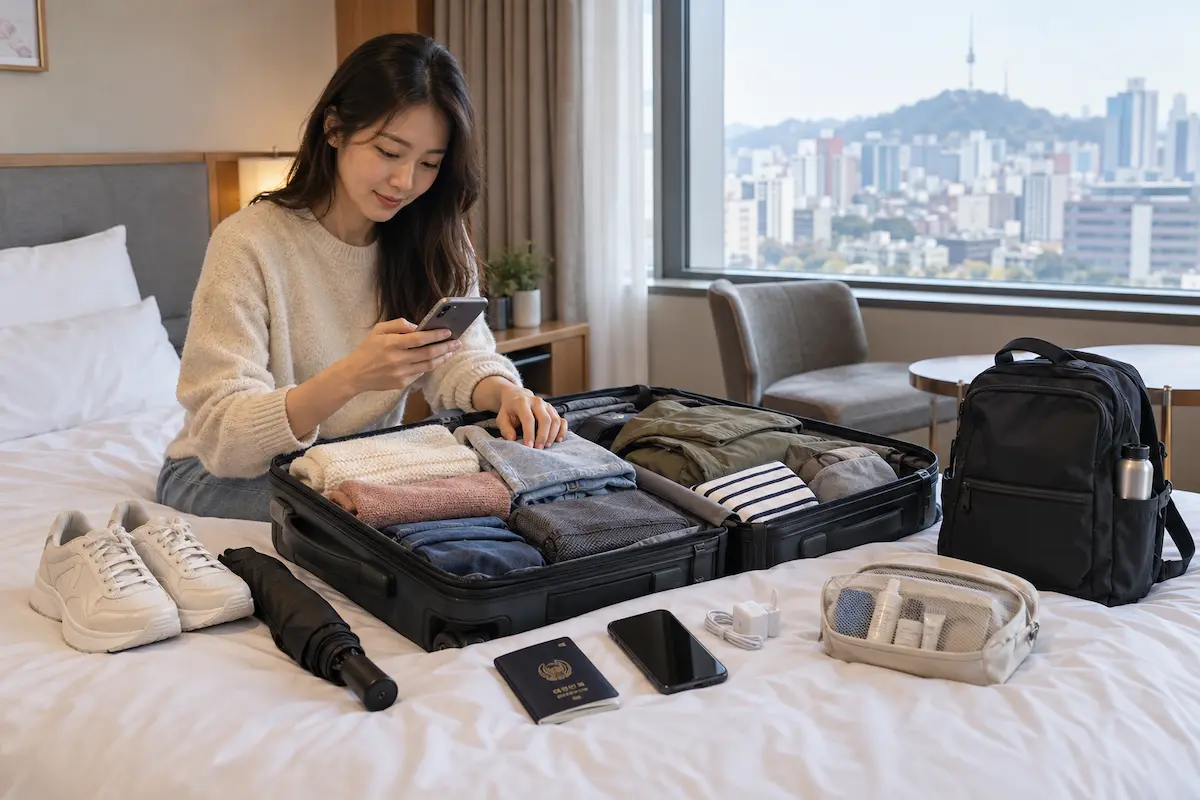
Packing for South Korea is less about bringing more and more about preparing for the season, long walking days and a few practical differences that can surprise first-time visitors.
The simplest rule is this: pack for the weather you will actually meet, bring comfortable walking shoes, keep essential documents and medication in your carry-on, and do not fill your suitcase with things that are easy to buy after arrival.
Korea has four distinct seasons. Spring and autumn are generally the easiest for sightseeing, summer can be hot, humid and rainy, and winter can be cold enough to require proper insulated clothing. Conditions also vary by region and from year to year.
Before deciding what clothes to bring, compare your travel dates with CoreaDesk’s When Is the Best Time to Visit Korea? guide.
Last fact-checked: September 23, 2026. Seasonal information, electricity standards, controlled-medication requirements and current airport baggage restrictions were checked against official Korean sources. Airline, weather and entry rules can change, so recheck time-sensitive information shortly before departure.
Korea Packing List: Quick Answer
| Pack This | Why It Matters |
|---|---|
| Passport and entry documents | Keep them accessible during the journey, not inside checked baggage |
| Season-appropriate layers | Korea’s weather changes significantly between seasons |
| Comfortable walking shoes | Many sightseeing days involve long periods on foot |
| Phone, charger and plug adapter | Korea uses 220V, 60Hz and two round-pin outlets |
| Mobile-data plan | Maps, translation, transport and reservations are much easier with data |
| Two payment methods | A foreign-issued card can occasionally fail |
| Small amount of Korean won | Useful as a backup for some machines, markets and small businesses |
| Necessary medication | Do not assume you can easily replace your exact medicine in Korea |
| Compact day bag | Useful for water, umbrella, power bank and an extra layer |
You do not need to pack every item on a generic travel checklist. The right packing list depends on when you visit, how long you stay and what you plan to do.
Check Korea’s Weather Before You Pack
Korea has a temperate climate with four distinct seasons. According to the Korea Tourism Organization, summer is generally hot and humid while winter is cold and comparatively dry. Spring and autumn are usually milder.
Use seasonal patterns to choose your basic wardrobe, but do not pack from an annual average alone. Check the actual forecast for the cities you will visit shortly before departure.
You can review Korea’s general seasonal conditions on the official VISITKOREA climate guide.
What to Pack for Korea in Spring
Spring runs from March to May, but March can feel very different from May.
Early spring can still be chilly, especially in the morning and evening. April and May usually become much easier for long sightseeing days.
Useful Spring Clothing
- Light or medium-weight jacket
- Long-sleeved tops
- T-shirts for layering
- Comfortable trousers or jeans
- Walking shoes
- Light scarf if you feel the cold easily
- Compact umbrella
Layers are more useful than one very heavy coat because midday temperatures can feel much warmer than early morning or evening.
If you travel in March, check the forecast carefully before deciding that a thin spring jacket will be enough.
What to Pack for Korea in Summer
Summer runs from June to August. July and August can be particularly hot and humid, and periods of heavy rain can affect outdoor plans.
Useful Summer Clothing
- Lightweight, breathable tops
- Quick-drying trousers, skirts or shorts
- Comfortable walking shoes that can cope with wet streets
- Light extra layer for strongly air-conditioned indoor spaces
- Hat or other sun protection
- Compact umbrella
- Sunscreen
- Reusable water bottle if you normally carry one
You do not automatically need heavy rain boots. They take a lot of suitcase space and may be uncomfortable in heat. Choose footwear according to the actual forecast and your itinerary.
A small umbrella is more useful than trying to predict exactly which summer day will rain.
If you are visiting during the hottest months, read CoreaDesk’s Summer in Korea: Heat, Rain and Indoor Planning guide before finalising your day bag.
What to Pack for Korea in Autumn
Autumn runs from September to November. Early September can still feel like late summer, while November can become distinctly cold.
Useful Autumn Clothing
- T-shirts and long-sleeved tops for layering
- Light jacket in early autumn
- Warmer jacket later in the season
- Comfortable trousers
- Walking shoes
- Light scarf for cooler evenings if needed
- Compact umbrella
October is often comfortable for long walking days, but do not assume that the temperature at 2 p.m. tells you how it will feel after sunset.
If your trip extends into November, warmer outerwear becomes increasingly important.
What to Pack for Korea in Winter
Winter runs from December to February. Seoul and inland areas can become very cold, especially during cold waves and windy conditions.
Useful Winter Clothing
- Insulated winter coat
- Thermal or warm base layers
- Sweaters or mid-layers
- Warm trousers
- Warm socks
- Gloves
- Scarf
- Hat or ear protection if you are sensitive to cold
- Comfortable winter footwear with reasonable grip
The important word is layers.
Korean shops, cafés, restaurants, hotels and public transport can be well heated in winter. Dressing in removable layers is often more comfortable than wearing one extremely thick outfit that cannot be adjusted indoors.
Snow is possible, but do not assume every winter trip to Seoul will involve deep snow. Check the actual forecast shortly before travel.
Shoes Matter More Than Many First-Time Visitors Expect
If you prioritise only one clothing item, prioritise comfortable shoes.
A normal Korea sightseeing day can include subway stations, stairs, palace grounds, traditional neighbourhoods, markets, shopping areas and long transfers between attractions.
Bring shoes you have already worn enough to know they are comfortable.
For most city trips, one reliable walking pair plus an optional second pair is more useful than packing several fashion-only shoes.
Choose specialist footwear only when your itinerary genuinely needs it, such as hiking, skiing or extended winter outdoor activities.
Korea Uses 220V and Two Round-Pin Outlets
Korea’s standard electricity supply is 220 volts at 60 Hz, and common wall outlets have two round holes.
If your plug does not match, bring a suitable travel plug adapter.
But remember: a plug adapter and a voltage converter are not the same thing.
- A plug adapter changes the physical plug shape.
- A voltage converter changes electrical voltage when a device cannot safely accept Korea’s supply.
Many modern phone and laptop chargers are designed for a wide input range such as 100-240V, but check the label on your own device instead of assuming.
Official electricity information is available from VISITKOREA’s Electricity & Communications guide.
Phone, Charger and Mobile Data
Your phone is likely to be one of the most useful things you carry in Korea.
You may use it for:
- Maps
- Translation
- Subway and bus information
- Hotel addresses
- Train and attraction bookings
- Communication
- Emergency information
Before departure, decide whether you will use international roaming, an eSIM, a physical SIM or portable Wi-Fi.
Check phone compatibility and whether you need a Korean phone number in CoreaDesk’s SIM Cards and eSIMs in Korea guide.
What About a Power Bank?
A power bank is useful on long sightseeing days, but battery rules matter when flying.
Incheon International Airport’s current restricted-items guidance lists power banks as carry-on items rather than checked baggage. It currently allows up to two power banks under 160Wh per person, with airline approval required for batteries over 100Wh and up to 160Wh. Batteries over 160Wh are not permitted.
Airline and destination rules can differ, so check your own carrier before flying. See the Incheon International Airport restricted-items guide.
Medication: Check Before You Pack
Bring enough necessary medication for your trip and do not assume that the exact same brand, dosage or formulation will be easy to replace in Korea.
Keep useful medication information accessible, such as the generic ingredient name, dosage and prescription details where applicable.
Controlled medicines require extra attention.
Korea’s Ministry of Food and Drug Safety states that people entering Korea with medicines containing controlled narcotic or psychotropic substances for personal treatment must receive MFDS approval, regardless of nationality. The ministry has provided an online application route since December 27, 2024.
If your medicine may fall into this category, check it well before departure rather than waiting until the airport. See the official MFDS guidance on bringing controlled medicines into Korea.
For ordinary prescription medicines, individual circumstances differ. If you are unsure whether a medicine is restricted, confirm with the appropriate Korean authority or your Korean embassy or consulate before travel.
Do Not Put Essential Travel Documents in Checked Baggage
Keep your passport and essential entry information with you until you have completed arrival procedures.
Your carry-on should normally contain the travel documents and information that you would have difficulty replacing immediately:
- Passport
- Visa or K-ETA information if applicable
- e-Arrival Card information if required
- Accommodation name, Korean address and telephone number
- Return or onward travel information
- Travel insurance information if you use it
- Necessary medication
- Phone and charging cable
- Wallet and payment cards
Entry requirements depend on your nationality, passport and purpose of travel. Complete your personal checks with CoreaDesk’s Korea Entry Requirements and Arrival Checklist.
Bring More Than One Way to Pay
Do not make one foreign-issued card your only payment option.
A practical setup is:
- Primary credit or debit card
- Backup card stored separately
- Small amount of Korean won
Cards are commonly used in Korea, but a foreign card can occasionally fail at a kiosk, machine, ATM or individual business.
For a detailed payment setup, read How Payment Works in Korea: Cards, Cash, and What Travelers Should Prepare.
Toiletries: Bring What You Need, Not Your Entire Bathroom
Basic toiletries are easy to buy in Korean cities, but that does not mean you will immediately find your preferred brand or product.
Bring your own if you have:
- Sensitive skin
- Specific hair-care needs
- Contact-lens products you depend on
- Prescription skin treatments
- Products that are difficult to substitute
For ordinary shampoo, body wash, toothpaste and other basic items, check what your accommodation already provides before using suitcase space.
Do not assume every hotel automatically provides a free disposable toothbrush, toothpaste or razor. Amenities differ by property, so check your booking details.
Carry-On Liquids: Check the Rules Before Flying
Your outbound flight to Korea is governed by the security rules at your departure airport and by your airline, so check those first.
When departing on an international flight from Incheon Airport, current airport guidance allows carry-on liquids, sprays and gels in individual containers of 100 ml or less, placed in one transparent 1-liter zip-top bag per person.
This includes products such as shampoo, toothpaste, lotion, sunscreen and perfume.
The same official Incheon Airport restricted-items page provides current baggage restrictions.
Pack Less if You Are Willing to Do Laundry
You do not need fourteen complete outfits for a fourteen-day trip.
For a longer stay, doing laundry once can reduce luggage significantly.
Korean self-service laundries vary in payment methods and detergent systems, but they can be practical for travelers staying more than a few days.
If you plan to pack light, save CoreaDesk’s How to Use a Coin Laundry in Korea guide before departure.
A Practical 7-Day Korea Packing List
This is a starting point for an ordinary city-focused trip. Adjust the quantities for your season, personal habits and access to laundry.
Clothing
- 4-5 everyday tops
- 2-3 bottoms
- Underwear and socks for your preferred laundry schedule
- Sleepwear
- 1 season-appropriate outer layer
- 1 reliable pair of walking shoes
- Optional second pair of shoes
- Season-specific items such as gloves, hat or sun protection
Electronics
- Phone
- Charging cable
- 220V-compatible charger
- Plug adapter if needed
- Power bank that complies with airline rules
- Earphones or headphones
Travel Essentials
- Passport
- Required entry documents
- Accommodation information
- Primary card
- Backup card
- Small amount of Korean won
- Necessary medication
- Mobile-data plan
- Compact day bag
- Reusable shopping or laundry bag
Weather Items
- Compact umbrella
- Sunscreen when appropriate
- Hat for strong sun
- Warm accessories for winter
- Light extra layer for changing temperatures
What You Probably Do Not Need to Overpack
| Easy to Overpack | A More Practical Approach |
|---|---|
| Too many pairs of shoes | Bring one reliable walking pair and only add another if you will use it |
| Full-size toiletries | Check hotel amenities and bring only products you specifically need |
| An outfit for every single day | Use laundry on longer trips |
| Large amounts of cash | Use cards plus a reasonable cash backup |
| Multiple heavy coats | Use one suitable outer layer with removable layers underneath |
| Every possible “just in case” item | Prioritise items that would be difficult to replace quickly |
What Is Easy to Buy After You Arrive?
In major Korean cities, it is usually easy to find ordinary travel items such as:
- Umbrellas
- Basic toiletries
- Tissues and wet wipes
- Simple clothing basics
- Charging cables
- Snacks and bottled drinks
- Basic pharmacy items
Availability does not mean your preferred international brand will be nearby or inexpensive, so bring anything specific that you rely on.
Carry-On vs Checked Luggage
| Keep in Your Carry-On | Usually Fine in Checked Luggage |
|---|---|
| Passport and entry documents | Most clothing |
| Wallet and cards | Extra shoes |
| Phone | Full-size ordinary toiletries if permitted |
| Necessary medication | Non-essential clothing accessories |
| Valuable electronics | Laundry bag |
| Power bank, subject to airline rules | Other non-valuable items allowed by your airline |
Never use a generic internet packing list as a substitute for your airline’s baggage policy. Weight limits, battery rules, sports equipment and restricted items can differ between carriers and routes.
A Better Way to Pack the Night Before Your Flight
- Check the latest weather for every major city on your route.
- Remove clothing that does not match the forecast.
- Confirm passport and entry requirements.
- Save your accommodation address offline.
- Check your phone’s mobile-data plan.
- Confirm your charger works with 220V.
- Put your power bank in your carry-on according to airline rules.
- Check any prescription or controlled medication requirements.
- Pack your primary and backup cards separately.
- Weigh your luggage before leaving home if your airline has a strict allowance.
Frequently Asked Questions
Do I need a plug adapter for Korea?
You need one if your plug does not fit Korea’s two round-pin outlets. Korea uses 220V at 60Hz. Check the input rating on your charger or appliance because a plug adapter does not convert voltage.
Do I need to bring an umbrella to Korea?
A compact umbrella is useful in most seasons, particularly during summer. You can also buy one easily after arrival, so forgetting an umbrella is not a major problem.
Should I bring cash to Korea?
Bring or obtain a modest amount rather than carrying your entire travel budget in cash. Cards are widely used, but cash remains useful as a backup when a foreign-issued card or payment terminal does not work.
Can I pack lightly for a two-week Korea trip?
Yes. If you are willing to do laundry once or twice, you can often pack far less than fourteen days of complete outfits. Winter clothing takes more space, so carry-on-only travel is generally easier in milder seasons.
Can I bring my prescription medicine to Korea?
Many travelers bring necessary prescription medicines, but the rules depend on the substance. Medicines containing controlled narcotic or psychotropic ingredients require MFDS approval for personal import. Check your exact medicine before departure if there is any uncertainty.
What is the most important thing to pack for Korea?
After your passport and necessary documents, comfortable walking shoes and season-appropriate clothing will probably affect your daily experience more than most travel gadgets.
Final Packing Checklist
- Passport and required entry information
- Accommodation address and contact details
- Season-appropriate clothing
- Comfortable walking shoes
- Phone and mobile data
- 220V-compatible charger and adapter if needed
- Power bank packed according to airline rules
- Primary and backup payment methods
- Small cash backup
- Necessary medication and any required approval
- Compact umbrella or weather protection suited to your season
- Small day bag
Final Takeaway
You do not need a huge suitcase to be prepared for Korea.
Pack around four priorities:
- The actual season and forecast
- Comfortable walking
- Documents, medication and payment backups
- A working phone and charging setup
Everything else should earn its space in your bag.
If an item is inexpensive, easy to find in Korea and unlikely to be needed on your first day, you probably do not need to carry a large supply from home.
If an item would be difficult to replace quickly—your passport, necessary medication, a specific medical product, glasses or contact-lens supplies, or a device you depend on—pack it carefully and keep important essentials accessible during the journey.
Information reviewed September 23, 2026. Weather, airline baggage restrictions, entry requirements and medication rules can change. Check the latest forecast, your airline’s baggage policy and relevant Korean government guidance before departure.