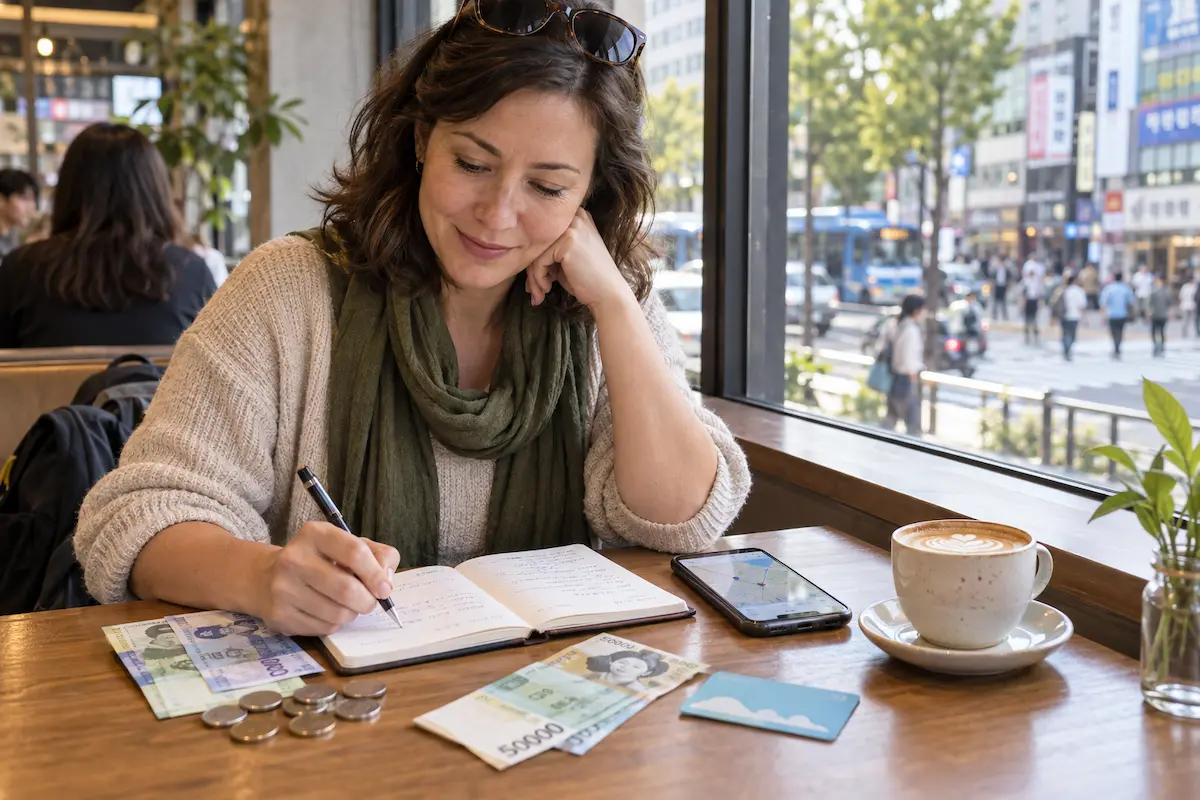
How much money do you actually need for a trip to South Korea?
For a solo traveler, a useful 2026 planning target is about ₩100,000–₩130,000 a day for a budget trip, ₩200,000–₩280,000 for a mid-range trip, and ₩350,000 or more for a more comfortable trip.
These are CoreaDesk planning models, not official national averages. Your actual cost can change significantly depending on hotel dates, room type, shopping, taxis, intercity travel and paid activities.
The safest way to build a Korea budget is to start with your actual accommodation price, then add food, local transport, attractions, intercity travel, mobile data and a buffer. If you are still at the early planning stage, start with our Plan Your Trip guide.
At the exchange rate checked on September 23, 2026, US$1 was about ₩1,351, so ₩100,000 was roughly US$74. Exchange rates change every day, so it is safer to plan your budget in Korean won first and use USD only as a reference.
Last fact-checked: September 23, 2026. Fixed public fares and admission prices below were checked against current official sources. Accommodation and overall daily budgets are planning assumptions, not official averages.
Korea Travel Budget at a Glance
| Travel Style | Planning Target per Day | What This Model Assumes |
|---|---|---|
| Budget | ₩100,000–₩130,000 | Low-cost accommodation, simple local meals, public transport, inexpensive or free attractions |
| Mid-range | ₩200,000–₩280,000 | Private hotel room, regular restaurant meals, cafés, paid attractions and occasional taxis |
| Comfortable | ₩350,000+ | Better-positioned hotel, more taxis, higher dining spend and more paid activities |
International airfare and shopping are not included in these daily targets.
What Should Be Included in a Korea Travel Budget?
For a realistic trip total, include:
- Accommodation
- Food and drinks
- Local subway and bus fares
- Airport transportation
- Attractions and activities
- Intercity trains or buses
- Mobile data
- Small everyday expenses
- An emergency or flexibility buffer
Keep these separate because they can vary too much from traveler to traveler:
- International airfare
- Shopping and K-beauty purchases
- Concerts and special events
- Luxury dining
- Private tours
- Domestic flights
Accommodation: Start With Your Actual Dates
Accommodation is usually the biggest variable in a Korea trip budget.
Instead of relying on one “average Seoul hotel price,” check the final price for your actual dates and room type. Weekends, holidays, festivals, concerts, neighborhood, cancellation terms, taxes and fees can all change the total.
For the sample calculations in this guide, we use these budgeting assumptions only:
| Travel Style | Sample Accommodation Allowance |
|---|---|
| Budget | ₩50,000 per night |
| Mid-range | ₩130,000 per night |
| Comfortable | ₩230,000+ per night |
These are not market averages. Replace them with the actual final booking price you would realistically pay.
If Seoul is your base, compare neighborhoods before choosing a hotel in Where to Stay in Seoul for First-Time Visitors.
How Much Does Food Cost in Korea?
Old travel guides can underestimate current restaurant prices.
The Korea Consumer Agency price page checked on September 23, 2026 lists the following Seoul reference prices:
| Food | Seoul Reference Price |
|---|---|
| Gimbap, 1 roll | ₩3,923 |
| Kimchi jjigae set meal | ₩8,769 |
| Kalguksu | ₩10,038 |
| Bibimbap | ₩11,923 |
| Samgyeopsal, converted to 200 g | ₩21,321 |
These are reference figures, not fixed menu prices. Individual restaurants can charge more or less. You can check the current figures on the Korea Consumer Agency dining-price page.
A Practical Daily Food Allowance
Budget: around ₩30,000 a day if you combine inexpensive Korean meals, gimbap, simple breakfasts and occasional convenience-store food.
Mid-range: around ₩50,000 a day for normal restaurant meals plus a café or snack.
Comfortable: around ₩80,000 or more a day if you include barbecue, specialty restaurants, desserts, drinks or higher-priced dining areas.
These are planning allowances, not official averages.
Local Transportation Is One of the Easier Costs to Plan
For most first-time visitors, subways and buses will cover the majority of everyday travel. See the full Korea Transportation Guide for transportation cards, buses, taxis, KTX and route planning.
As of the current Seoul Metropolitan Government fare table, the adult Seoul subway base fare using a transportation card is ₩1,550. See the official Seoul subway fare table.
For an ordinary sightseeing day using several subway or bus rides, a planning allowance of roughly ₩6,000–₩10,000 per person is a practical starting point. Longer distance-based trips can cost more.
Incheon Airport to Seoul
The current Seoul Metropolitan Government airport guide lists the AREX All-Stop Train at approximately ₩4,150–₩4,750 one way, depending on the airport terminal and route. The AREX Express Train is ₩13,000 one way.
Check the official Seoul airport transportation information for current fares, and compare the complete route to your hotel in our Incheon Airport to Seoul: AREX, Bus and Taxi Compared guide.
KTX and Intercity Travel
Do not hide long-distance train costs inside your normal subway budget.
South Korea integrated its high-speed rail operations on September 1, 2026. KORAIL states that KTX fares were reduced by about 10% on average. The standard Seoul–Busan fare was reduced from ₩59,800 to ₩54,400 one way.
A Seoul–Busan round trip at that standard fare is therefore ₩108,800, before local station transfers or optional upgrades. See the KORAIL announcement on the September 2026 high-speed rail integration.
For booking steps, station choices and intercity buses, use How to Book KTX and Intercity Travel in Korea.
How Much Should You Budget for Attractions?
Korea does not require a large attraction budget every day.
For example, adult admission to Gyeongbokgung Palace is currently ₩3,000.
Neighborhood walks, traditional markets, parks, riverside areas and many public spaces can also be enjoyed without an admission fee.
A useful planning allowance is:
- Budget: around ₩0–₩10,000 a day
- Mid-range: around ₩10,000–₩30,000 a day
- Activity-heavy days: ₩30,000 or more
Theme parks, performances, guided tours and premium experiences should be added separately.
Do Not Forget Mobile Data
Mobile data is a trip-level expense rather than a daily sightseeing cost.
You will likely use your phone for Korean map apps, translation, transport information, reservations and communication with your accommodation. Plan a separate amount for a SIM, eSIM, roaming or portable Wi-Fi, then replace that allowance with the exact product price before departure.
Before buying, compare data limits, Korean phone-number availability, activation conditions and phone compatibility in SIM Cards and eSIMs in Korea.
A Realistic 7-Day Korea Budget Example
The table below shows a 7-day, 6-night planning model for one solo traveler. It is not an official average.
| Expense | Budget | Mid-range | Comfortable |
|---|---|---|---|
| Accommodation, 6 nights | ₩300,000 | ₩780,000 | ₩1,380,000 |
| Food, 7 days | ₩210,000 | ₩350,000 | ₩560,000 |
| Local transport | ₩56,000 | ₩70,000 | ₩175,000 |
| Attractions | ₩35,000 | ₩140,000 | ₩280,000 |
| Small expenses / flexibility buffer | ₩70,000 | ₩105,000 | ₩105,000 |
| Mobile data planning allowance | ₩30,000 | ₩40,000 | ₩50,000 |
| Airport rail planning amount | ₩9,500 | ₩26,000 | ₩26,000 |
| Estimated total | ₩710,500 | ₩1,511,000 | ₩2,576,000 |
International airfare, shopping and intercity travel are not included.
If the trip includes a Seoul–Busan KTX round trip at the current standard fare, add ₩108,800. If your route is one-way through Seoul, Gyeongju and Busan, calculate each actual rail segment instead of automatically adding a round trip.
The value of this table is not the final number. It is the method: replace each planning allowance with your real hotel, transport and activity choices.
Costs First-Time Visitors Often Forget
- Airport transport on arrival and departure
- Intercity trains or buses
- Luggage storage
- Laundry
- Coffee, drinks and snacks
- ATM or foreign-card fees charged by your bank or card issuer
- Hotel taxes or booking fees shown at checkout
- Extra taxis when carrying luggage or returning late
- Weather-related plan changes
- Shopping
Common Korea Trip Budget Mistakes
Treating a Room Price as a Per-Person Price
Accommodation is usually priced per room, while meals, transport and attractions are normally calculated per person.
This matters especially for solo travellers.
A ₩130,000 hotel room costs ₩130,000 per person when travelling alone, but about ₩65,000 per person when two people share the same room.
Always separate:
- room-based costs;
- per-person costs.
Looking Only at the Advertised Price
The cheapest flight or hotel shown in search results may not be the amount you finally pay.
Check for:
- checked baggage;
- seat selection;
- taxes and fees;
- breakfast;
- cancellation terms;
- airport transfers;
- transport from the hotel location.
A slightly more expensive booking can sometimes cost less overall when these extras are included.
Forgetting Airport and Intercity Transport
Your normal daily subway and bus allowance does not include:
- airport transfers;
- KTX;
- intercity buses;
- domestic flights.
Calculate these separately before setting your daily average.
Building the Budget Around the Cheapest Possible Day
A plan based entirely on the cheapest hostel, cheapest meals and free attractions leaves very little room for changes.
A realistic budget should include:
- at least a few higher-cost meals;
- occasional taxis;
- paid attractions;
- weather-related changes;
- unexpected purchases.
Leaving No Contingency Buffer
After calculating your likely in-country expenses, add a separate flexibility reserve.
A practical starting point is around 10–15% of your expected in-country spending.
This can help cover:
- exchange-rate changes;
- missed transport;
- an unexpected taxi;
- additional baggage;
- medicine;
- replacement bookings;
- weather-related itinerary changes.
Keep this buffer separate from your normal daily spending target.
Keep Shopping Separate From the Trip Budget
K-beauty, fashion, souvenirs and food products can change the total more than public transport or palace tickets.
Use two separate numbers:
- Trip essentials budget
- Shopping budget
This makes it much easier to understand what the trip itself actually costs.
How to Save Money Without Making the Trip Worse
The cheapest option is not always the best-value option.
The goal is to reduce expenses that add little value while keeping the parts of the trip that matter to you.
Choose Accommodation Around Your Actual Itinerary
A cheaper hotel can become more expensive if it requires long journeys, repeated transfers or frequent taxis.
Before booking, compare:
- nightly room price;
- distance from a useful subway station;
- airport transport;
- breakfast;
- laundry;
- luggage storage;
- likely taxi use.
Pay attention to the total cost of staying there, not only the room rate.
Use Public Transport for Routine Journeys
Subways and buses are usually the most economical choice for ordinary sightseeing.
Use taxis when they provide clear practical value, such as:
- late-night travel;
- heavy luggage;
- awkward transfers;
- shared trips with several people.
Mix Everyday Meals With Planned Special Meals
You do not need to choose the cheapest food every day.
A more realistic approach is to keep some meals simple and decide in advance which dining experiences are worth spending more on.
Markets, bakeries, food courts, casual restaurants and convenience stores can help balance the total.
Finalise Your Route Before Booking Intercity Transport
Changing cities too frequently increases:
- train or bus costs;
- local transport;
- luggage movement;
- hotel check-ins.
Build the route first, then book intercity transport.
Do Not Buy Sightseeing Passes Automatically
A pass only saves money if the attractions you actually want to visit are included and you can realistically use enough of them during the validity period.
Compare the pass price with normal admission fees before buying.
Track Small Daily Expenses
Coffee, snacks, convenience-store purchases, delivery fees and short taxi rides can quietly increase the total.
Give yourself a small flexible allowance rather than pretending these expenses will not happen.
How Much Cash Should You Carry in Korea?
You do not need to carry your entire trip budget in cash.
Cards are widely used, but a foreign-issued card is not guaranteed to work at every terminal, kiosk, ATM, market stall or online payment page. Keep a small cash backup and at least one alternative payment method.
For a practical setup, read How Payment Works in Korea: Cards, Cash, and What Travelers Should Prepare.
Frequently Asked Questions
Is South Korea expensive for tourists?
It depends mostly on accommodation, dining style, shopping and intercity travel. Local public transport and many cultural attractions are relatively easy to budget, while hotel prices and discretionary spending can change the total quickly.
Is US$100 a day enough in Korea?
For a budget traveler, it can be.
At the exchange rate checked on September 23, 2026, US$100 was roughly ₩135,000. That can work if accommodation is inexpensive, most meals are casual, public transport is the default and the same daily amount does not also need to cover major shopping or long-distance rail.
How much money do I need for 7 days in Korea?
Using the sample assumptions in this guide, a 7-day, 6-night trip for one traveler comes to roughly ₩710,500 for the budget model, ₩1,511,000 for the mid-range model and ₩2,576,000 for the comfortable model.
These figures exclude international airfare, shopping and intercity transport. Replace the accommodation allowance first because it is usually the biggest variable.
Should I budget in US dollars or Korean won?
Use Korean won as your main planning currency. Convert to your home currency only as a reference because exchange rates can change before and during the trip.
A Simple Korea Budget Formula
Accommodation × nights + food × days + local transport + airport transport + intercity travel + attractions + mobile data + buffer = realistic trip budget
If you are still deciding how long to stay, compare CoreaDesk’s 3-, 5-, 7-, 10- and 14-day Korea itineraries before calculating the final total.
Final Takeaway
Do not start with a viral claim that Korea is simply “cheap” or “expensive.”
Start with the choices you will actually make.
- Check the real accommodation price for your dates.
- Choose a realistic daily food allowance.
- Add local and airport transportation.
- Add KTX or other intercity travel separately.
- Add the activities you genuinely plan to do.
- Add mobile data.
- Keep shopping separate.
- Leave a buffer for changes and small expenses.
That gives you a Korea travel budget you can actually use.
Information reviewed September 23, 2026. Fixed transport fares and public admission prices can change after publication. Accommodation, restaurant menus, exchange rates, mobile plans and private-service prices vary by date and provider, so confirm the final price before booking or paying.