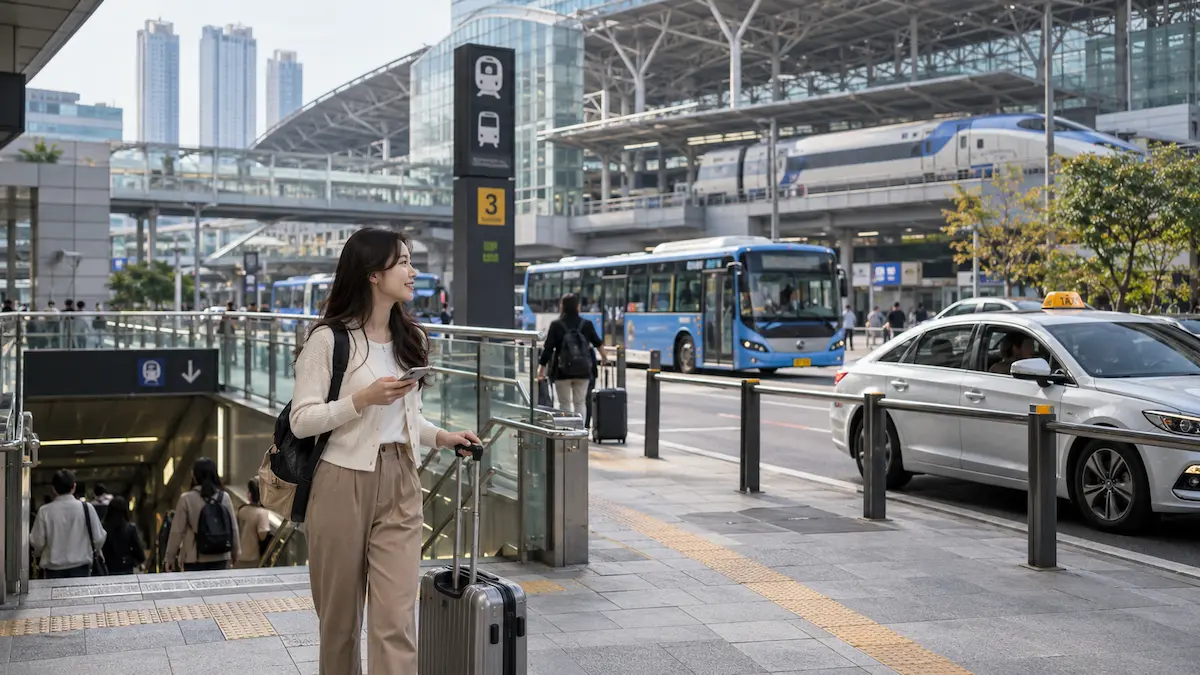
Getting around South Korea is easier than it first appears.
For most first-time visitors, the basic system is:
use a transportation card for everyday buses and subways, use Korean map apps for local routes, take taxis when they genuinely save time, and book KTX or other intercity transport separately for longer journeys.
You do not need to understand every transport system before arriving.
You do need to know which tool fits which journey.
Korea Transportation at a Glance
| Situation | Practical Option |
|---|---|
| Seoul and Busan city travel | Subway + bus |
| Everyday fares | T-money or another compatible transportation card |
| Short journey with luggage | Taxi |
| Seoul to Busan | KTX |
| Seoul to Gyeongju | KTX + local bus or taxi |
| Airport to Seoul | AREX, airport bus or taxi |
| Local directions | NAVER Map or KakaoMap |
| Remote regional area | Bus, taxi or rental car depending on destination |
| Late-night travel | Check final public transport first; taxi may be necessary |
The most important habit is simple:
check the complete route, not only the distance on a map.
A journey may include a subway ride, station transfer, bus connection and final walk.
Do You Need a Transportation Card in Korea?
For most independent travellers, yes.
A rechargeable transportation card makes everyday travel easier because it can be used across many subway and bus systems and on some taxis.
T-money is one of the best-known options.
Other compatible transportation cards may also be accepted depending on the system and region.
For the detailed rules on purchasing, recharging, transfers and tapping in and out, read How Korean Transportation Cards and Transfer Rules Work.
Where Can You Buy a Transportation Card?
Transportation cards are commonly available at places such as:
- convenience stores
- subway stations
- transport-card sales points
- some airport locations
Availability varies by card and location.
Do not assume that buying the card and adding balance use the same payment method.
A shop may accept a foreign credit card for ordinary purchases while a transportation-card recharge may still require cash or another supported method.
Carrying a small amount of Korean won remains useful.
Do You Tap When You Get Off?
Usually, yes.
When using a transportation card on Korean public transport, tapping correctly matters.
Subway
Tap when entering the station and again when exiting.
Bus
Tap when boarding.
Tap again before or while getting off.
The second tap can affect transfer calculations, so visitors should build the habit from the beginning.
For the detailed bus routine, including stop buttons and announcements, see How to Get Off a Korean City Bus Without Missing Your Stop.
Understanding Transfers
Korean public transport systems often allow discounted transfers when the same eligible transportation card is used correctly within the relevant time and system rules.
The exact rules can vary by city and transport network.
Do not assume that:
- every transfer is free
- every route qualifies
- every region uses identical rules
- two people can share one card and receive normal individual transfer benefits
For current card and transfer guidance, use the dedicated Korean Transportation Cards and Transfer Rules guide.
Using the Subway in Korea
Subways are usually the easiest transport option in Seoul and Busan.
Major systems provide:
- numbered or named lines
- station numbers
- Korean and English station names
- route maps
- transfer signs
- electronic information displays
First-time visitors often find the network complicated on a map but much easier once they start following signs inside stations.
How to Navigate a Subway Station
Do not look only for the station name.
Check:
- the line
- the direction
- the destination station
- the transfer station
- the exit number at the end
Exit numbers are particularly important in large Korean stations.
Two exits from the same station may lead to very different streets.
For a more detailed walkthrough, see Seoul Subway Stations Guide.
Single-Journey Tickets
Visitors who do not have a transportation card can usually buy single-journey subway tickets.
The process and payment options depend on the network and machine.
In Seoul, single-journey tickets are for subway travel rather than general bus use.
As of 2026, Seoul has also introduced new ticket machines at many stations on Lines 1–8 that accept internationally issued credit and debit cards for certain products, including single-journey tickets and short-term Climate Card passes.
Do not assume this means every Korean transport machine accepts overseas cards.
The change is specific to supported machines and products in Seoul.
What About Seoul’s Climate Card?
Seoul offers short-term Climate Card options that may suit visitors making many eligible journeys within the covered network.
However, a pass is not automatically cheaper for every traveller.
Before buying one, compare:
- where you are staying
- how many journeys you expect to make
- whether your routes are included
- whether you will travel outside the eligible network
Transport products and eligibility can change, so check the current Seoul Metropolitan Government transportation information before buying.
Using Buses in Korea
Buses are useful when the subway does not reach your destination directly.
They are particularly valuable for:
- neighbourhood travel
- shorter cross-city journeys
- attractions away from subway stations
- regional destinations
- Jeju travel
The difficulty for foreign visitors is usually knowing:
- whether the bus is travelling in the correct direction
- which stop to use
- when to press the stop button
- where to get off
Before Boarding a Bus
Check:
- bus number
- direction
- boarding stop
- destination stop
- previous stop
- approximate number of stops
- final walking route
NAVER Map and KakaoMap are useful for this.
For setup and navigation guidance, read How to Use Korean Map Apps: NAVER Map and KakaoMap for Travelers.
Getting Off a Korean Bus
A practical routine is:
- Follow the route on your phone.
- Watch for the stop before your destination.
- Press the stop button before arriving.
- Move towards the exit when it is safe.
- Tap your transportation card.
- Exit after the bus stops.
Do not wait until the doors are already open before deciding whether this is your stop.
City Bus or Intercity Bus?
They serve different purposes.
City Bus
Used for local travel within a city or metropolitan area.
Intercity or Express Bus
Used for travel between cities and regions.
Long-distance buses generally require a separate ticket rather than simply tapping your everyday city transportation card.
Terminals can also be located far from one another, so confirm the exact terminal before travelling.
Taking a Taxi in Korea
Taxis can be extremely useful when:
- you have heavy luggage
- public transport requires several transfers
- you arrive late
- the weather is poor
- the final destination is far from a station
- several travellers can share the fare
But a taxi should not automatically replace public transport for every journey.
Traffic can make taxis slower than the subway, particularly in large cities.
Show the Destination in Korean
The simplest method is to show the driver:
- Korean place name
- Korean address
- map pin
- nearby landmark
- entrance or gate when relevant
An English-only place name may not be enough.
For the full taxi guide, including payment, receipts and pickup problems, read What to Check Before Taking a Taxi in Korea.
Taxi Payment
Payment options vary by city, vehicle and card.
Many taxis accept cards, and some accept transportation cards.
However, foreign-card compatibility should never be treated as guaranteed.
Carry a backup payment method.
A receipt is also worth taking because it can help identify the taxi if something is left behind.
Taxi Apps
App-based taxis are widely used in Korea.
However, registration, overseas card support, Korean phone-number requirements and language options can change.
Visitors should not rely on one app as their only transport plan.
Keep:
- a Korean address
- map access
- a backup payment method
- another way to reach your accommodation
Travelling Between Korean Cities
For longer journeys, Korea has:
- high-speed trains
- conventional trains
- express buses
- intercity buses
- domestic flights
The right option depends on the cities involved.
When Is KTX Useful?
KTX is particularly useful on major rail corridors.
Common visitor routes include journeys connecting cities such as:
- Seoul
- Daejeon
- Daegu
- Gyeongju area
- Busan
High-speed rail can save significant time on long mainland journeys.
How to Book KTX
Use official KORAIL channels when possible.
For current booking procedures and the 2026 KORAIL booking changes, see How to Book KTX and Intercity Travel in Korea.
The official English booking page is:
KORAIL — Official English Ticket Reservation
Do Not Confuse the Station With the City Centre
Some high-speed rail stations are outside the historic or central part of the city.
Always check the full journey.
For example, your actual route may be:
hotel → subway → Seoul Station → KTX → regional station → local bus or taxi → accommodation
The KTX journey itself may be fast while the door-to-door journey is much longer.
Reserve Long-Distance Travel Early During Busy Periods
Trains and buses can become heavily booked around:
- weekends
- public holidays
- Lunar New Year
- Chuseok
- major events
- peak holiday periods
If a particular train is essential to your itinerary, do not wait until the last minute.
Incheon Airport to Seoul
For most first-time visitors, the main options are:
- AREX train
- airport limousine bus
- taxi
The best choice depends on your final accommodation rather than which option sounds fastest.
AREX
Useful when your accommodation connects conveniently with the airport railway or Seoul Station.
Airport Bus
Useful when the bus stops near your hotel and you want to reduce stairs or transfers with luggage.
Taxi
Useful for groups, heavy luggage, late arrivals or destinations that are inconvenient by public transport.
Always check your actual arrival time and the final service of the day.
Official current information is available from Incheon International Airport — Public Transportation.
Airport Transport After a Late Arrival
Do not compare the last train or bus only with your scheduled landing time.
You still need time for:
- immigration
- baggage collection
- customs
- walking through the terminal
- finding the ticket or boarding area
Prepare a backup before flying.
That may mean:
- late-night bus
- official taxi
- airport-area hotel
- late check-in arrangement with your accommodation
Using NAVER Map and KakaoMap
Korean map apps are particularly helpful for public transport.
They can help you check:
- subway routes
- bus numbers
- transfer points
- station exits
- walking distances
- Korean addresses
- building locations
Google Maps can still be useful for saved places, reviews and general orientation.
For local movement, however, preparing NAVER Map or KakaoMap before arrival makes travel much easier.
Read the full NAVER Map and KakaoMap Guide.
Travelling With Luggage
The theoretically fastest route may not be the easiest route with a suitcase.
Consider:
- stairs
- station size
- transfer distance
- elevators
- crowded trains
- final walk
- weather
A direct airport bus or short taxi ride may be more practical than a route involving several rail transfers.
If you need temporary storage, see Subway Lockers in Korea: When They Help and When They Do Not.
Accessibility and Mobility
Do not assume every journey will be equally easy for travellers with reduced mobility.
Large stations can involve long walking distances.
Elevators may be located away from the most obvious route.
Bus boarding can also be more difficult with large luggage or mobility limitations.
Check the actual station and route before travelling when step-free access is important.
Common First-Time Transport Mistakes
Following Only the Fastest Route
A route with several transfers may be faster on paper but more stressful in practice.
Ignoring the Subway Exit Number
The correct station with the wrong exit can add a long walk.
Forgetting to Tap Off the Bus
Make tapping when leaving a routine.
Assuming Every Machine Accepts a Foreign Card
Payment support varies.
Keep another payment method.
Getting on the Correct Bus in the Wrong Direction
Check the boarding stop and direction, not just the bus number.
Booking KTX Without Checking the Final Station
The railway station may not be in the centre of the destination.
Depending on One Map App
Compare another Korean map app when a route looks wrong.
Leaving Airport Transport Planning Until Arrival
After a long flight is not the best time to discover that the final train has already departed.
A Simple Transportation Plan for a First Korea Trip
Before departure:
- Install NAVER Map or KakaoMap.
- Save your accommodation address in Korean.
- Decide how you will travel from the airport.
- Plan to obtain a transportation card.
- Carry some Korean won as backup.
- Save official long-distance booking sites.
- Book important KTX or bus journeys in advance.
- Keep offline copies of your key routes.
After arrival:
- Connect your phone.
- Confirm the airport route using the actual time.
- Obtain or recharge your transport card if needed.
- Follow official station and terminal signs.
- Check each journey before leaving.
Which Transport Should You Choose?
Subway
Choose it for predictable urban journeys and avoiding road traffic.
Bus
Choose it for neighbourhoods or destinations not directly served by subway.
Taxi
Choose it when convenience, luggage or the final connection justifies the cost.
KTX
Choose it for fast travel between major mainland cities.
Intercity or Express Bus
Choose it when the destination is better connected by road than rail.
Domestic Flight
Consider it for Jeju and selected long-distance routes where flying makes practical sense.
Final Recommendation
Most first-time visitors do not need a complicated transportation strategy.
Use a transportation card for everyday local travel.
Use subway and buses as the default in major cities.
Use taxis selectively when they genuinely simplify the journey.
Use KTX or other long-distance services for intercity travel.
Prepare NAVER Map or KakaoMap before arrival.
And always check the complete route from door to door.
Korea’s transport network becomes much easier once you stop thinking of it as one system and start choosing the right tool for each journey.
Official Sources and Further Reading
Seoul Metropolitan Government — Public Transportation
Seoul Metropolitan Government — Transportation
Incheon International Airport — Public Transportation
KORAIL — Official English Ticket Reservation
VISITKOREA — Korea Tourism Organization
Last fact-checked: September 2026