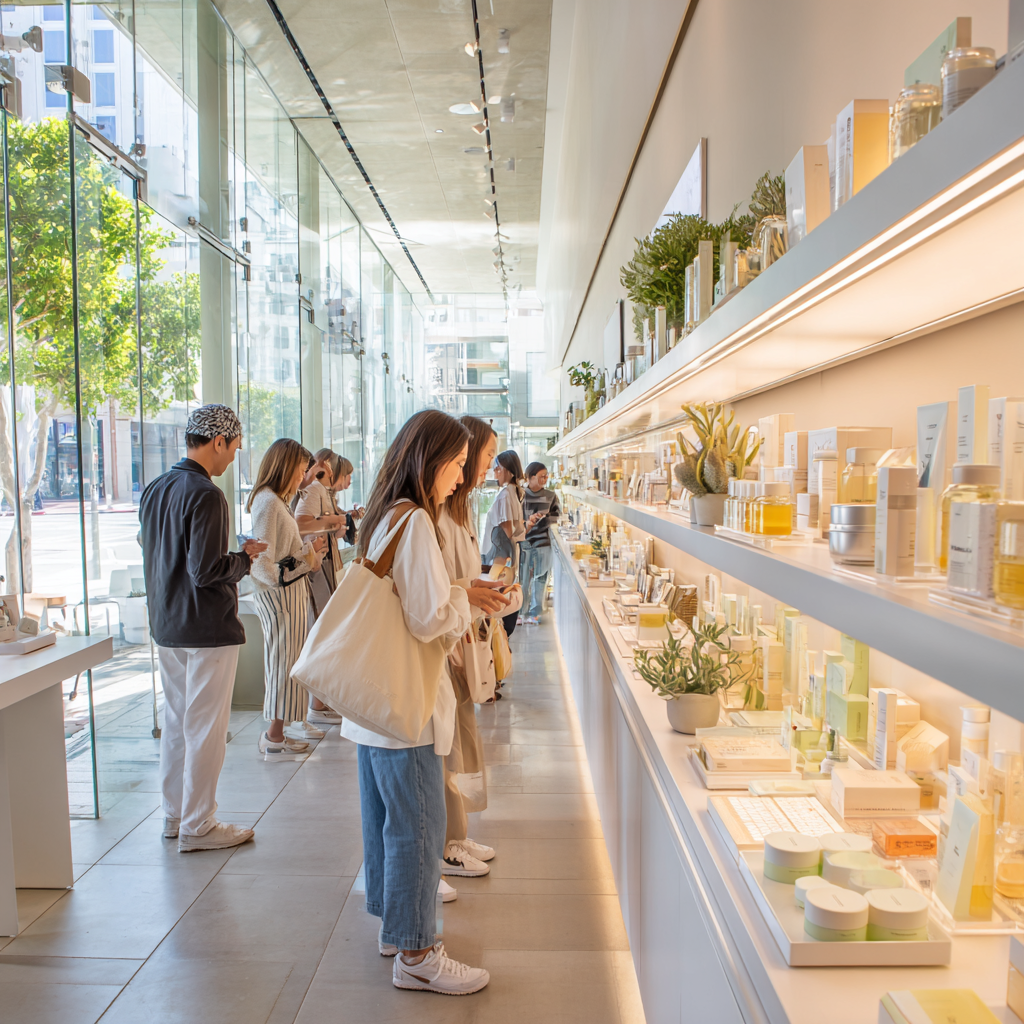
The Pasadena Moment
In May 2026, something remarkable happened in California. Olive Young, South Korea’s dominant beauty retailer, opened its first physical store in Pasadena. This wasn’t just another beauty shop opening. It represented a fundamental shift in how K-beauty operates in the Americas. For the first time, a Korean beauty company didn’t need to rely on e-commerce platforms or department store partnerships. It could establish its own retail infrastructure on American soil.
The Pasadena opening is the first of at least four California locations planned for 2026. Olive Young has confirmed a second store will open in Santa Monica. The company is simultaneously launching a dedicated US e-commerce platform, creating a dual-channel strategy that mirrors its Korean success. This isn’t expansion. This is colonisation of American retail space.
K-beauty has fundamentally changed how Americans think about skincare. The transformation happened quietly, without the fanfare of K-pop or Korean drama. But the numbers tell the story. Korean cosmetics exports reached $10.2 billion globally in 2025, with the United States representing the single largest market. The global K-beauty market hit $15.4 billion in 2026, growing at 11-13% annually. In the United States specifically, K-beauty has moved from niche enthusiasm to mainstream dominance.
Olive Young’s American launch represents the final phase of K-beauty’s conquest of the American market. The question isn’t whether K-beauty will succeed in America. The question is whether American beauty retailers can compete with Korean innovation and efficiency.
The Numbers: K-Beauty’s American Dominance
The scale of K-beauty’s market penetration in the United States is staggering.
Global K-Beauty Market:
•2025 Total: $15.4 billion
•2026 Growth: 11-13% annually
•5-year CAGR: 11-13%
Korean Cosmetics Exports:
•Q1 2026: $3.1 billion (record quarterly total)
•2025 Annual: $10.2 billion
•US Market Share: ~35-40% of Korean exports
American Market Penetration:
•K-beauty influences 60%+ of US skincare trends
•Ingredients like ginseng and fermented extracts now mainstream
•Korean brands dominate luxury skincare category
Competitive Landscape:
•Sephora: Traditional model, limited K-beauty curation
•Olive Young: Skincare-first, Korean-optimised model
•Independent K-beauty brands: Fastest-growing segment
The data reveals a simple truth: K-beauty isn’t competing with American beauty retailers. It’s replacing them.
Olive Young’s Strategic Advantage
What distinguishes Olive Young from other K-beauty retailers is its operational philosophy.
Skincare-First Curation: Olive Young organises products by skin concern, not brand hierarchy. American consumers encounter this system and immediately understand its logic. The store doesn’t prioritise luxury brands. It prioritises solutions. This approach has proven devastatingly effective against Sephora’s brand-hierarchical model.
Price Democratisation: Olive Young stocks products at multiple price points. A consumer can purchase a $5 essence or a $50 serum, both curated for identical skin concerns. This democratisation of beauty access resonates with American consumers accustomed to Sephora’s luxury positioning.
Efficiency Infrastructure: Olive Young’s supply chain is optimised for Korean skincare. The company sources directly from Korean manufacturers, maintaining quality control and pricing advantages that American retailers cannot match. The company’s logistics network is built for rapid inventory turnover, minimising waste and maximising freshness.
Customer Respect Philosophy: Olive Young staff don’t employ aggressive sales tactics. Customers browse independently, make informed decisions, and complete transactions without pressure. This approach respects consumer autonomy in ways that traditional American beauty retail does not.
The Broader K-Beauty Ecosystem in America
Olive Young’s launch occurs within a broader K-beauty expansion across American retail.
Costco Expansion: Korean beauty brands have secured unprecedented shelf space in Costco warehouses. KSECRET SEOUL 1988 launched nationwide in April 2026. MISSHA secured placements across North American Costco locations. These aren’t niche placements. These are mainstream retail integration.
Independent Brand Growth: JiYu Skin, founded by American female entrepreneurs, has become one of the fastest-growing K-beauty brands in the United States, tracking toward $100 million in revenue. The brand demonstrates that K-beauty methodology can be adapted to American entrepreneurship.
Market Consolidation: Larger Korean companies are systematically acquiring or partnering with American beauty retailers. CJ Group’s investment in Olive Young’s American expansion represents corporate-level commitment to American market dominance.
Ingredient Innovation: K-beauty’s success rests partly on ingredient innovation. Fermented extracts, ginseng, snail mucin, and other Korean-origin ingredients have become mainstream in American skincare. American consumers now expect these ingredients as standard features.
Why American Beauty Retailers Cannot Compete
The competitive disadvantage facing American beauty retailers is structural, not tactical.
Supply Chain Disadvantage: American retailers source from global suppliers. Korean retailers source from Korean manufacturers with decades of optimisation. The cost differential is significant. Korean companies can offer superior products at lower prices.
Philosophical Disadvantage: American beauty retail is built on luxury positioning and brand hierarchy. K-beauty is built on efficacy and consumer respect. These philosophies are fundamentally incompatible. Sephora cannot transform into Olive Young without destroying its brand identity.
Innovation Disadvantage: Korean beauty companies invest heavily in ingredient research and formulation innovation. American companies invest in marketing and brand positioning. The innovation gap widens annually. American consumers increasingly recognise that Korean skincare simply works better.
Cultural Disadvantage: K-beauty benefits from the broader Korean Wave. Consumers interested in K-pop, Korean drama, and Korean culture are naturally drawn to Korean skincare. The cultural infrastructure supporting K-beauty is unmatched in American retail.
The Challenges of Rapid Expansion
Not everything about Olive Young’s American expansion is seamless. Rapid retail expansion creates real challenges.
Localisation Challenge: Olive Young’s Korean operational model doesn’t automatically translate to American retail. American consumers have different expectations around customer service, store layout, and product availability. The company must balance Korean efficiency with American consumer preferences.
Supply Chain Vulnerability: Rapid expansion strains supply chains. Olive Young must maintain product freshness and availability across multiple American locations whilst managing Korean sourcing logistics. Any disruption in Korean manufacturing or shipping creates immediate American retail consequences.
Competitive Response: American retailers won’t passively accept K-beauty dominance. Sephora is investing in K-beauty curation. Ulta Beauty is expanding Korean brand partnerships. The competitive response is accelerating, not diminishing.
Cultural Integration: Rapid Korean retail expansion can create backlash from consumers who view it as cultural imperialism. Olive Young must present itself as a respectful participant in American retail, not a Korean coloniser of American market space.
What’s Actually Happening
What’s genuinely significant about Olive Young’s American launch is the systematisation of K-beauty retail infrastructure in the United States.
For decades, K-beauty operated through e-commerce platforms and department store partnerships. These channels were effective but limited. Olive Young’s physical retail presence changes the game. The company can now control the entire customer experience—from product curation to customer service to store atmosphere.
This infrastructure shift has implications for American retail’s future. If Olive Young succeeds in establishing 50+ American locations, the company will have fundamentally restructured American beauty retail. Consumers will have experienced a superior retail model. Competing with that model becomes increasingly difficult.
The Pasadena store isn’t just a retail location. It’s a proof of concept. If the concept succeeds, expect rapid expansion. If it fails, expect strategic retreat. Either way, the American beauty retail landscape has been fundamentally disrupted.
The Strategic Imperative
For American beauty retailers, the challenge is existential. K-beauty isn’t a trend or a niche market segment. It’s a systematic replacement of American beauty retail infrastructure.
Sephora can respond by improving K-beauty curation. But curation isn’t Olive Young’s advantage. Olive Young’s advantage is operational philosophy—a fundamental commitment to consumer respect and efficacy over luxury positioning.
American retailers can invest in supply chain optimisation. But Korean companies have decades of supply chain experience. Catching up requires more than investment. It requires cultural transformation.
The most likely scenario is consolidation. American beauty retailers will either partner with Korean companies or gradually lose market share to Korean competitors. The era of American beauty retail dominance is ending. The era of Korean beauty retail dominance is beginning.
For consumers, this transformation is positive. K-beauty’s emphasis on efficacy, innovation, and consumer respect represents genuine improvement over traditional American beauty retail. The American market is becoming more sophisticated, more efficient, and more respectful of consumer autonomy.
Olive Young’s Pasadena store represents this transformation. It’s not just a retail location. It’s the future of American beauty retail.
The Bigger Picture: Soft Power Becomes Retail Infrastructure
What’s remarkable about K-beauty’s American expansion is how it demonstrates the evolution of soft power in the 21st century.
Traditional soft power operates through culture—music, film, fashion. K-pop and Korean drama created the cultural infrastructure for K-beauty’s success. But K-beauty’s expansion represents something more fundamental: the transformation of cultural influence into retail infrastructure.
Olive Young isn’t just selling Korean skincare. It’s establishing Korean retail philosophy as the American standard. Consumers who experience Olive Young’s skincare-first curation will expect this model from other retailers. The company is reshaping American consumer expectations.
This represents a profound shift in how nations exercise global influence. Korea isn’t just exporting products. Korea is exporting retail infrastructure, operational philosophy, and consumer expectations. The transformation is structural, not superficial.
The Strategic Imperative for Korea
For Korea, K-beauty’s American expansion represents a strategic opportunity to solidify economic dominance in the beauty sector.
The Korean government has invested in K-beauty infrastructure through research institutions, export support, and cultural marketing. These investments are paying dividends. K-beauty companies are capturing American market share at unprecedented rates.
The next phase requires consolidation. Korean companies must establish retail infrastructure, supply chain dominance, and consumer loyalty. Olive Young’s American expansion is the first major step. Expect additional Korean retailers to follow.
The strategic goal is clear: establish Korea as the global standard for beauty retail. Once that standard is established, Korean companies can operate from a position of structural advantage. Competitors will be playing catch-up indefinitely.
Looking Forward: The American Beauty Retail Transformation
By 2030, expect significant transformation in American beauty retail.
Olive Young will likely operate 50-100 American locations. Other Korean retailers will establish American presence. Korean beauty brands will dominate premium skincare and cosmetics categories. American consumers will increasingly view Korean beauty retail as the standard.
The transformation won’t be complete. American retailers will adapt, improve, and compete. But the era of American beauty retail dominance is ending. The era of Korean beauty retail dominance is beginning.
For consumers, this transformation is positive. For American retailers, it’s existential. For Korea, it’s strategic victory in the global beauty market.
Olive Young’s Pasadena store is just the beginning.